
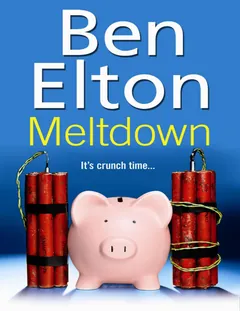
Meltdown
12. Lucky Jimmy
Lucky Jimmy
Jimmy always thought it was very unfair of his father to be so disparaging about his profession and so suspicious of his wealth. It was pretty hypocritical too when Jimmy remembered how at rst, after he had scraped a 2/2 in Politics and Modern History, Derek Corby had been delighted that his only son had ended up in the nancial sector.
After al , Jimmy had been toying with the most horribly romantic notions.
Like becoming a National Trust ranger or, worse, ‘something at the BBC’.
Faced with such airy-fairy ideas Mr and Mrs Corby were relieved indeed and much surprised when, out of the blue, Jimmy became what at the time they stil cal ed a stockbroker but the world would soon identify as a trader and would nal y denounce as a stupid, reckless, greedy, irresponsible bastard.
Of course Mr and Mrs Corby weren’t half as surprised as Jimmy was. He just didn’t see it coming. Only a week before the day he stepped on to his rst trading oor he had been trying his hand at independent documentary lm-making. Videotaping homeless people on the South Bank in the hope of knocking together a ground-breaking social exposé edited on the TV in the at where he was staying above a kebab shop in Pimlico.
‘Rather amusing, don’t you think?’ his friend Rupert had drawled through the smoke of his unashamedly pretentious Gitanes cigarette. ‘You making a documentary about homelessness when you are in fact homeless yourself. Why don’t you give me the camera and you can be in your own lm.’
Rupert had been the stock reactionary in the famous house in Sussex. e counterpoint to Henry’s political and David’s artistic pretentions. He cared neither for art nor for social justice. He cared about money.
He was very brainy and very arrogant, the former somewhat making up for the latter but not quite. He had got a First in Mathematics and it was no surprise to the other members of the Radish Club when he became the rst of their little graduation group to move to London and get a at of his own. A circumstance Jimmy had been delighted to exploit. Rupert didn’t mind the situation either as they were both stil in that happy, unattached,
unencumbered stage of their young lives when it was possible to continue to live like students even though they weren’t students any more.
‘I’l pay the rent, you can do the booze runs and attract the totty,’ Rupert said. ‘Babes always love you and I can have your sloppy seconds. We’l get drunk and shagged three nights a week.’
ey managed the drunk bit at least and for a month or two had been happy together. But the situation couldn’t go on for ever and one day when Rupert returned from the bank to nd Jimmy stil under the Batman duvet on the couch where he had left him that morning, the conversation turned to what Jimmy actual y intended to do with his life.
‘Perhaps you should rob your father’s bank,’ Rupert suggested. ‘Perfect crime if you ask me. After al , you have al the inside information that you need and yet would never be suspected. Victimless too, in any real sense. I mean the money’s only notional anyway and the insurance companies are thieves who deserve to be eeced.’
Rupert was so right-wing it was actual y quite funny. at was his shtick, his conversational thing. He cal ed himself a libertarian and liked to shock people by saying things like ‘A crack whore and her pimp are the perfect business model. No, I’m serious, capitalism in its purest form. e free market operating as it should. Supply and demand. Goods and services. Management and labour. I fail to see a moral dilemma. For fuck’s sake, let them get on with it.’Rupert had got his job at the Royal Lancashire Bank before he’d even graduated and everybody knew he was on the fast track to making mil ions both for himself and for his bank. ere was just something about him, a sort of cheerful y ruthless amoral charm, that and a terri c command of gures, which meant you knew he would be rich. When Derek Corby had been introduced to Rupert at Jimmy’s graduation, old Mr Corby had said, ‘I hear you’re going to be a banker like me,’ to which Rupert had drawled, ‘Not quite like you, Mr Corby.’
As the son of a commercial haulier he wasn’t actual y posh at al , but on the day he arrived at Sussex he started pretending to be posh, cal ing people ‘old boy’ and girls ‘totty’ and experimenting with a pipe. By the time he left he had clearly come to believe that he was posh, wearing brogues, tweedy jackets and sometimes even a cravat. Years later, after he had married the genuinely posh Amanda and was on his way to running a major bank, Amanda explained to
him that brogues and tweed hadn’t been posh since the fties. Under her tutelage he would become rather trendy, favouring designer suits and hundred-pound haircuts. At twenty Rupert was trying to look like he was forty, and at forty he would be trying to look like he was twenty.
It was Rupert who suggested that Jimmy forget his pathetic notions of a media career and try nancial trading.
‘Five years from now the BBC wil employ only women, ethnics and poofs.
What’s more, the commercial media wil be owned by proper professional Americans, as indeed it should be since they’re the only people on Earth who have the rst idea about entertainment. You wouldn’t stand a chance in either, Jim lad. No, the only place left where a man can stil be a man is in money.
You’re too thick and too badly educated to bank, so I suggest you trade.’
‘Trade in what?’ Jimmy enquired.
‘Trade in wealth.’
‘What do I know about money?’
‘You know you like it, don’t you?’
‘Of course. Who doesn’t?’
‘en that’s al you need to know.’
It had been as simple as that. Rupert made a cal to his friend Piers that very evening. Piers had attended the same minor private school as Rupert (who had been a scholarship boy) and hence could be prevailed upon to do a favour. He was at a rm cal ed Mason Jervis who traded in a thing cal ed ‘futures’ and who, like most of the city, were on a rol . ey were looking for new traders, young, energetic guys to work the phones. No previous experience required, al you needed was a strong nerve, a free, creative spirit and bal s of titanium.
Rupert assured Piers that Jimmy had al these things.
‘Piers mate,’ he drawled into his fancy new mobile, ‘Jimmy Corby’s bal s could handle a direct hit from a laser-guided smart bomb.’
Jimmy had never thought of himself as a kind of testicular Rambo. But his friend Rupert had gone to the same school as a bloke who had jobs on offer, so Jimmy was in.
After that he just went with the ow.
He told himself that he was doing it for a laugh. Secretly observing some weird post-yuppie world. He would do six months, earn enough to spend a winter snowboarding and then leave. Perhaps he would write a movie about it, working title atcher’s Children. He’d read an article in Time Out about how
the Brit movie industry was back in the game. Surely they’d lap it up. Lots of guys from his uni were now independent lm producers and they couldn’t al do movies about gay launderette owners or Empire nostalgia.
But inside his rst month Jimmy knew that he wouldn’t be writing any movies about traders. And he wouldn’t be taking any time off to go snowboarding either. Who the hel would want to slide down some French Alp when you could be s ur ng the future?
‘I’m a time travel er!’ he shouted at his new mates as he ordered champagne and beer at the end of his rst month on the oor, a month in which he had earned Mason Jervis thousands of pounds and gained an appreciative nod from Piers. ‘I’m Michael J. Fox! I get in my time-machine DeLorean car, I go to the future and I bring back money!’
He told the same story to his old mates on the rst curry night after he became a trader.
‘It’s just so fucking exciting, ’ Jimmy burbled. ‘You take notional money, make a fantasy trade, hold on to your bol ocks and out comes real money!’
‘What? Out of your bol ocks?’ Henry asked.
‘Might as wel be. I am the man with golden bol ocks.’
His new enthusiasm came as quite a surprise for some members of the old gang. Jimmy had never been a bread-head. He liked money but he had never been obsessed with it. He got it, he spent it. at was it with Jim, and when he didn’t have it he lived off sliced bread and chocolate stolen from the Student Union shop.
But the truth was that it wasn’t the money that obsessed Jimmy. It was the process of making it, the trading. e new, wonderful, high-octane guy-world in which he and a group of equal y young, devil-may-care, fun-loving blokes created money. It felt so utterly exhilarating and also sort of hilarious. Here was the one thing everybody on earth wanted, dreamed about and worried about al the time and he and the guys were actual y making the stuff out of thin air.
If it wasn’t so utterly beautiful it would be a crime.
He and his father immediately clashed. Jimmy would turn up waving a bottle of champagne and a sack of washing, suggesting that he take his parents to lunch in some country-house gastro hotel. His dad would point out that the sandwiches were already made for the shing. Jimmy and his mum would hug and then he and his dad would argue. Derek Corby thought Jim’s view of trading was baffling; worse, it was offensive.
‘I’l tel you what stocks and shares are, my lad,’ he told his grinning son.
‘Stocks and shares represent part ownership in a company. If the company is successful then the stock price goes up. If the company is failing then the price goes down.’
Jimmy and his mother would exchange glances as if to say that Dad was off on one again, and Derek would continue to go off on it. ‘e job of a responsible stockbroker is to study the performance of a company and determine whether the performance of that company is likely to go up or down. Having made his calculations, he then makes a prudent investment on behalf of his client. at’s how it’s done. End of story. And if you don’t do it that way, Jimmy, it wil end in tears. at I can promise you.’
‘Dad, you’re insane,’ the newly con dent and bul ish Jimmy insisted. ‘e value of a company doesn’t have to have anything to do with what that company’s actual y worth!’
‘I beg your pardon?’ Derek Corby enquired. ‘Something’s value has nothing to do with its value?’
‘Of course not. Not its actual practical value. Who cares about that? A trader doesn’t hang around waiting for companies to post their yearly gures in order to nd out what they’re actual y worth. How dul would that be?’
is was too much for a man who had begun his career at the National City Bank in 1968.
‘Dul ! DULL!’ Derek Corby spluttered into his Scotch and lemonade.
‘What has “dul ” to do with the price of eggs! We’re discussing stockbroking.’
Father and son were existing on different planets. Living in different ages.
Never once in his entire life had Derek Corby imagined that the nancial sector should be interesting. Quite the opposite. He believed that by its very nature it should be dul , very, very dul . at was why it was the nancial sector. If you wanted your work to be interesting, nd another profession.
Become a soldier or an engineer or an entertainer in the hal s. Derek Corby had sacri ced eight hours a day, ve and a half days a week al his adult life to dul . It was what he was paid for. at was why he worked, not to be stimulated but to earn a decent living so that he could support his family and enjoy his leisure. What he did at home was interesting. Bridge nights, shing trips and home brewing. Holidays were interesting, not work, two weeks rambling in the Lake District. at was why he worked, so that he might appreciate the rewards of his labour.
Jimmy always ended up drinking the whole bottle of champagne. His father declined to share it and his mother had only a thimbleful.
‘e difference between you and me, Dad, is you earn money. I make it.’
‘And as far as I’m aware,’ Derek replied, ‘ making money is in ationary. ey made money in Germany in 1923 and the result was people needed a wheelbarrow ful of Reichsmarks to buy a box of matches. e rules of economics don’t change.’
‘Oh yes they do, Dad. Cos you see we don’t just make the money, we make the rules too.’
‘Yes,’ Derek replied, ‘you used to make up your own rules at Monopoly, I seem to remember. I tried to explain to you at the time that it was cal ed cheating.’
‘Dad, come on,’ Jimmy said, using his twinkling smile on the one person on whom it had no effect at al . ‘It isn’t cheating if you win.’
OceanofPDF.com