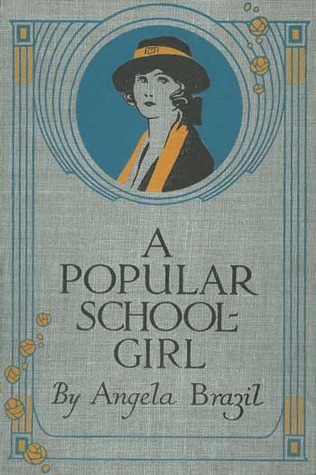
A Popular Schoolgirl
A Popular Schoolgirl is a novel for girls by Angela Brazil, first published in 1920. Brazil, who lived from 1868 to 1947, was the most successful and most prolific English writer of girls’ school stories during the first half of the twentieth century, producing more than fifty novels in the genre across a long career that effectively created the modern English boarding school story for girls as a substantial literary form.
The novel follows the central character Ingred Saxon, a popular and capable schoolgirl at a girls’ boarding school in the years just after the First World War. The plot involves the various rivalries, friendships, sporting competitions, academic activities, and small dramatic incidents that the girls’ school story characteristically featured. Ingred’s family has recently fallen on harder financial times due to the postwar economic situation, and the novel weaves the family difficulties together with the school activities to create a more substantial story than the conventional school stories of the period typically attempted.
Brazil was working within a genre she had largely created. The English boys’ school story had a long established tradition going back to Tom Brown’s Schooldays of 1857, but the equivalent for girls had not really developed until Brazil began her series of school novels in the early 1900s. She drew on her own experience of late Victorian and Edwardian girls’ education and on her observation of the boarding schools that were proliferating in England during the period, and she produced fiction that captured both the small daily details of school life and the broader cultural meaning of the girls’ boarding school as a new educational institution.
A Popular Schoolgirl includes the typical Brazil ingredients. There are intense friendships among the girls, complications arising from misunderstandings and resolved through moments of mutual recognition, sporting events including hockey matches and the various athletic competitions that the girls’ schools were beginning to take seriously, academic activities, and the underlying ethical framework of the school that emphasized responsibility, fair play, and personal growth.
The novel runs about three hundred pages and is best read straight through. For readers interested in early twentieth century English girls’ school fiction, Brazil is the essential writer and this is one of her better novels of the postwar period. It pairs naturally with her other school stories from the same decade.
About the Author
Read and download 2 free books by Angela Brazil on BDeBooks. Browse the complete collection of Angela Brazil’s works available as free PDF and EPUB downloads. Discover novels, fiction, and other writings by Angela Brazil in our online eBook library.
See all books by Angela Brazil →