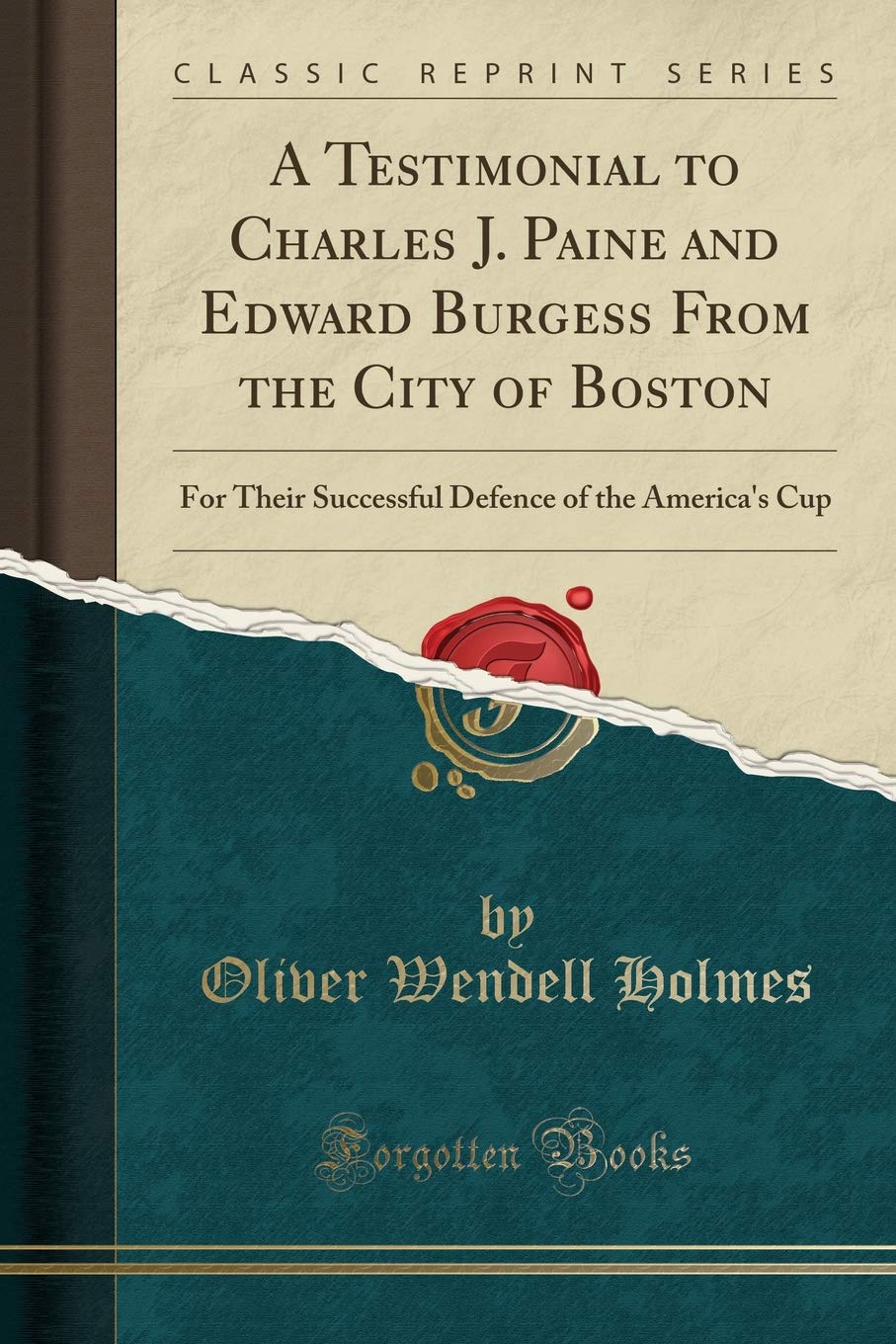
A Testimonial to Charles J. Paine and Edward Burgess From the City of Boston
A Testimonial to Charles J. Paine and Edward Burgess is one of Oliver Wendell Holmes Sr.’s many occasional pieces, a published version of a public address or formal tribute that he delivered on the occasion of honoring the two Boston yachting figures named in the title. Charles J. Paine and Edward Burgess were both prominent figures in the Boston yachting community of the late nineteenth century. Paine was a Civil War general turned wealthy yachting enthusiast who served as the syndicate manager for several America’s Cup defenders. Burgess was the brilliant naval architect who designed the cup defenders Puritan, Mayflower, and Volunteer that successfully defended the America’s Cup against British challengers in 1885, 1886, and 1887.
Holmes was one of the most popular American public speakers of the mid to late nineteenth century, with a reputation as a graceful and witty lecturer whose appearances at civic, sporting, and literary occasions were widely attended and widely reported. The testimonial format was a particular kind of nineteenth century public address, in which a community of supporters would gather to honor a figure or figures whose contributions deserved formal recognition. The America’s Cup defenses of the mid 1880s had been major Boston civic accomplishments, with the city’s wealthy yachting community taking particular pride in their successful defense of the international yacht racing trophy.
Holmes’s testimonial address would have combined the kind of substantive recognition of Paine and Burgess’s contributions that the occasion required with the wit and grace that Holmes’s public addresses were known for. The published version of the address, in pamphlet form, would have circulated through the Boston civic and yachting communities and would have been collected in the various editions of Holmes’s complete works that appeared during his lifetime and after his death.
For historians of nineteenth century American yachting, of the early America’s Cup competitions, of Boston civic culture in the post Civil War decades, or of the wider catalogue of Oliver Wendell Holmes Sr. beyond his most famous Breakfast Table books and his medical writings, this published address is worth knowing. The piece is short and well suited to a single sitting. Anyone reading their way through Holmes’s collected works will encounter it as one of many similar occasional pieces that fill out the shorter writings section of his published volumes.
The America’s Cup competitions of the 1880s remain one of the high points of nineteenth century American sporting history, and Holmes’s published tribute to two of the central figures in those defenses provides a primary source view of how the Boston civic community celebrated the accomplishments at the time.
About the Author
Oliver Wendell Holmes Sr. was a 19th-century American physician, poet, and essayist, and a leading figure among the New England writers. He is known for witty essays such as The Autocrat of the Breakfast-Table.
See all books by Oliver Wendell Holmes Sr. →