
Bacon's Essays, and Wisdom of the Ancients
Appendix to Essays.
| 1. | Fragment of an Essay of Fame | 301 |
| 2. | Of a King | 303 |
| 3. | An Essay on Death | 307 |
THE WISDOM OF THE ANCIENTS; A SERIES OF
MYTHOLOGICAL FABLES.
| Preface | 317 | |
| 1. | Cassandra, or Divination. Explained of too free and unseasonable Advice | 323 |
| 2. | Typhon, or a Rebel. Explained of Rebellion | 324 |
| 3. | The Cyclops, or the Ministers of Terror. Explained of base Court Officers | 327 |
| 4. | Narcissus, or Self-Love | 329 |
| 5. | The River Styx, or Leagues. Explained of Necessity, in the Oaths or Solemn Leagues of Princes | 331 |
| 6. | Pan, or Nature. Explained of Natural Philosophy | 333 |
| 7. | Perseus, or War. Explained of the Preparation and Conduct necessary to War | 343 |
| 8. | Endymion, or a Favorite. Explained of Court Favorites | 348 |
| 9. | The Sister of the Giants, or Fame. Explained of Public Detraction | 350 |
| 10. | Acteon and Pentheus, or a Curious Man. Explained of Curiosity, or Prying into the Secrets of Princes and Divine Mysteries | 351 |
| 11. | Orpheus, or Philosophy. Explained of Natural and Moral Philosophy | 353 |
| 12. | Cœlum, or Beginnings. Explained of the Creation, or Origin of all Things | 357 |
| 13. | Proteus, or Matter. Explained of Matter and its Changes | 360 |
| 14. | Memnon, or a Youth too forward. Explained of the fatal Precipitancy of Youth | 363 |
| 15. | Tythonus, or Satiety. Explained of Predominant Passions | 364 |
| 16. | Juno’s Suitor, or Baseness. Explained of Submission and Abjection | 365 |
| 17. | Cupid, or an Atom. Explained of the Corpuscular Philosophy | 366 |
| 18. | Diomed, or Zeal. Explained of Persecution, or Zeal for Religion | 371 |
| 19. | Dædalus, or Mechanical Skill. Explained of Arts and Artists in Kingdoms and States | 374 |
| 20. | Ericthonius, or Imposture. Explained of the improper Use of Force in Natural Philosophy | 378 |
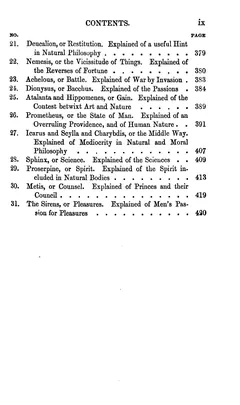
| 21. | Deucalion, or Restitution. Explained of a useful Hint in Natural Philosophy | 379 |
| 22. | Nemesis, or the Vicissitude of Things. Explained of the Reverses of Fortune | 380 |
| 23. | Achelous, or Battle. Explained of War by Invasion | 383 |
| 24. | Dionysus, or Bacchus. Explained of the Passions | 384 |
| 25. | Atalanta and Hippomenes, or Gain. Explained of the Contest betwixt Art and Nature | 389 |
| 26. | Prometheus, or the State of Man. Explained of an Overruling Providence, and of Human Nature | 391 |
| 27. | Icarus and Scylla and Charybdis, or the Middle Way. Explained of Mediocrity in Natural and Moral Philosophy | 407 |
| 28. | Sphinx, or Science. Explained of the Sciences | 409 |
| 29. | Proserpine, or Spirit. Explained of the Spirit included in Natural Bodies | 413 |
| 30. | Metis, or Counsel. Explained of Princes and their Council | 419 |
| 31. | The Sirens, or Pleasures. Explained of Men’s Passion for Pleasures | 420 |