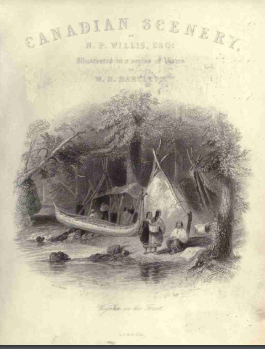
Canadian Scenery, Volume 1
Canadian Scenery, Volume 1 is the first volume of the companion illustrated book to American Scenery, published in 1842. The book combined steel engravings by William Henry Bartlett with descriptive prose, though for the Canadian project the text was written by N. P. Willis only in part, with substantial portions also written by the English topographical writer Henry Brown.
The project followed the same model that had made American Scenery a commercial success two years earlier. Bartlett had toured the British North American provinces of Upper Canada (now Ontario), Lower Canada (now Quebec), Nova Scotia, and New Brunswick in 1838, producing the topographical drawings that were then engraved on steel for the published book. The geographical coverage extends from the Maritime provinces in the east through the St. Lawrence valley and around the Great Lakes.
The major scenic locations receive substantial visual treatment. Quebec City, with its dramatic clifftop fortifications and the surrounding St. Lawrence landscape, appears in multiple engravings. Niagara Falls is treated again, this time from the Canadian side. The Thousand Islands, the Ottawa River valley, Montreal, and various smaller locations across the colonies are presented in the picturesque mode that Bartlett had perfected.
The historical context matters. The book was published in 1842, only a few years after the Rebellions of 1837 in both Upper and Lower Canada that had nearly broken the British North American colonies away from the imperial connection. The 1840 Act of Union had merged the two Canadian provinces into a single Province of Canada in response to the rebellions, and the political situation across British North America was still settling when the Canadian Scenery volumes appeared. The book aimed partly at the British audience that wanted reassurance that the Canadian colonies were a worthwhile imperial possession.
For readers interested in early Victorian topographical illustration, in the visual history of pre-Confederation Canada, or in the broader British illustrated book tradition of the period, the work is essential. It pairs with American Scenery and with the various other Bartlett illustrated travel books that he produced across his prolific career before his death in 1854.
About the Author
Read and download 3 free books by Nathaniel Parker Willis on BDeBooks. Browse the complete collection of Nathaniel Parker Willis’s works available as free PDF and EPUB downloads. Discover novels, fiction, and other writings by Nathaniel Parker Willis in our online eBook library.
See all books by Nathaniel Parker Willis →




Listen to Canadian Scenery, Volume 1 Audiobook Free
Listen to Canadian Scenery, Volume 1 by Nathaniel Parker Willis free online. The full audiobook (6 hr 59 min, 20 chapters, read by volunteer narrators) streams free on this page.
Canadian Scenery, Volume 1 (1840) is a public domain work.
| # | Chapter | Length | |
|---|---|---|---|
| 1 | Canadian Scenery introduction | 21:46 | |
| 2 | The native Indian part 1 | 17:03 | |
| 3 | The native Indian part 2 | 24:13 | |
| 4 | The native Indian part 3 | 27:35 | |
| 5 | The native Indian Part 4 | 20:42 | |
| 6 | The native Indian part 5 | 16:45 | |
| 7 | The discovery and settlement of Canada part 1 | 28:36 | |
| 8 | The discovery and settlement of Canada part 2 | 23:37 | |
| 9 | The discovery and settlement of Canada part 3 | 21:33 | |
| 10 | Later events in Canada part 1 | 20:14 | |
| 11 | Later events in Canada part 2 | 25:57 | |
| 12 | Later events in Canada part 3 | 24:15 | |
| 13 | Later events in Canada part 4 | 14:39 | |
| 14 | Later events in Canada part 5 | 15:57 | |
| 15 | Later events in Canada part 6 | 19:14 | |
| 16 | Condition of the inhabitants of Canada part 1 | 23:39 | |
| 17 | Condition of the inhabitants of Canada part 2 | 21:04 | |
| 18 | Impressions of Canada on travellers part 1 | 15:42 | |
| 19 | Impressions of Canada on travellers part 2 | 19:22 | |
| 20 | Impressions of Canada on travellers part 3 | 16:52 |
Prefer reading? Read Canadian Scenery, Volume 1 online free or download the PDF and EPUB above.