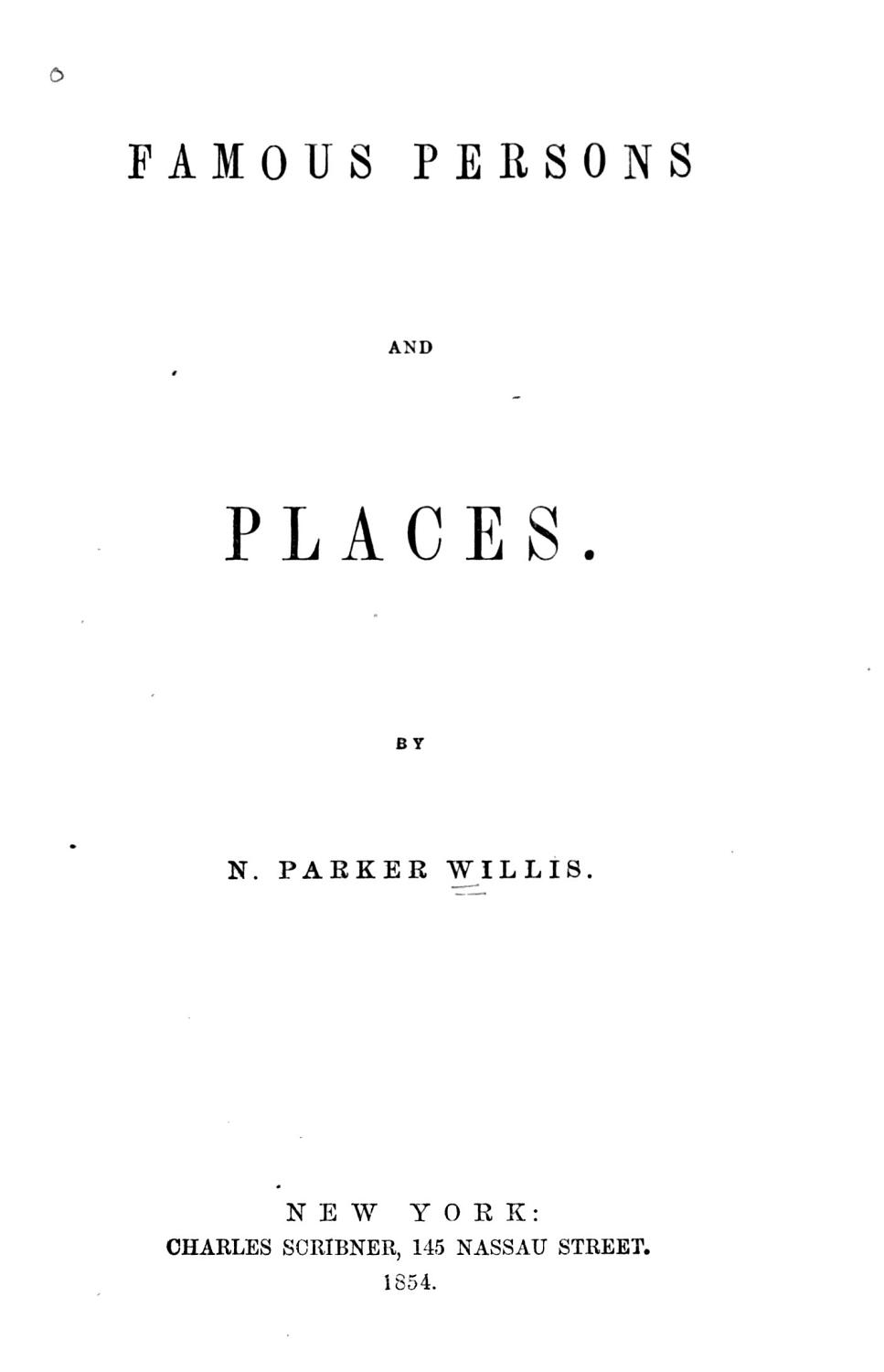
Famous Persons and Places
Famous Persons and Places is a collection of magazine pieces by Nathaniel Parker Willis, gathered and published in book form in 1854. The collection draws on Willis’s long career as one of the most successful American magazine writers of the mid-nineteenth century and includes his observations of various major figures and locations from his many years of travel in Europe and America.
Willis had a particular gift for the kind of social and observational writing that the new mass-circulation magazines of the 1830s and 1840s wanted. He had spent substantial time in Europe in the early 1830s, serving as foreign correspondent for the New York Mirror and producing the series of travel letters that established his reputation. His access to European literary and aristocratic society was unusually good for a young American writer, and his published descriptions of figures including Lady Blessington, Disraeli, Walter Savage Landor, and various others gave American readers a closer view of European cultural life than they had previously had.
Famous Persons and Places gathers many of these earlier pieces into a single volume. The famous persons section includes profiles of writers, politicians, aristocrats, and various other public figures Willis had met or observed. The famous places section provides his descriptions of European cities, country houses, classical sites in Italy and Greece, and various American locations of historical or scenic interest.
Willis’s prose was light, observant, and pitched at the educated middle-class American audience that the new magazine market was developing. He was sometimes accused of being too gossipy and of trading too much on the social access he had gained, but his actual writing is more careful than the harsher critics admitted. The portraits of public figures are based on direct observation and quote actual conversation where Willis could recall it accurately.
The collection is a useful introduction to Willis for readers who do not want to work through his magazine output piece by piece. It pairs with his Pencillings by the Way and with the American Scenery volumes for a fuller picture of his career. For readers interested in mid-nineteenth-century American magazine writing, the book is essential.
About the Author
Read and download 3 free books by Nathaniel Parker Willis on BDeBooks. Browse the complete collection of Nathaniel Parker Willis’s works available as free PDF and EPUB downloads. Discover novels, fiction, and other writings by Nathaniel Parker Willis in our online eBook library.
See all books by Nathaniel Parker Willis →