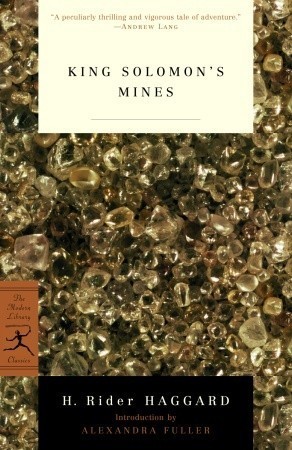
King Solomon’s Mines
H. Rider Haggard published King Solomon’s Mines in 1885, and the book essentially invented the lost-civilization adventure genre as English-speaking readers came to know it. Haggard supposedly wrote it on a five-shilling bet with his brother, who claimed he could not produce anything as good as Treasure Island. He won the bet. The novel sold out edition after edition for years, made him famous, and laid the blueprint for everything from Tarzan to Indiana Jones.
The narrator is Allan Quatermain, a fifty-something professional hunter living in Durban, South Africa, who has been hired by Sir Henry Curtis to find his missing brother in the African interior. Captain Good of the Royal Navy joins them. They march north into uncharted territory, guided by a mysterious Zulu named Umbopa, and end up in the kingdom of Kukuanaland, ruled by the tyrant Twala. There is a witch named Gagool, a long-dead Portuguese explorer’s map, an underground treasure chamber, a battle for the throne, and a near-death escape from the sealed mine that gives the book its title. The colonial-era assumptions in the text have not aged well in many places. Read it as both a landmark adventure novel and a document of its imperial moment.
About the Author
Henry Rider Haggard was born in 1856 in Norfolk, England, and came from a large landed family that had largely exhausted its money by the time he was an adult. He was not a strong student and was the only Haggard son sent out into…
See all books by H. Rider Haggard →





Listen to King Solomon’s Mines Audiobook Free
Listen to King Solomon’s Mines by H. Rider Haggard free online. The full audiobook (9 hr 51 min, 20 chapters, read by John Nicholson) streams free on this page.
King Solomon’s Mines (1885) is a public domain work.
| # | Chapter | Length | |
|---|---|---|---|
| 1 | Chapter 01 | 28:14 | |
| 2 | Chapter 02 | 23:07 | |
| 3 | Chapter 03 | 30:10 | |
| 4 | Chapter 04 | 24:30 | |
| 5 | Chapter 05 | 34:10 | |
| 6 | Chapter 06 | 27:53 | |
| 7 | Chapter 07 | 40:23 | |
| 8 | Chapter 08 | 21:10 | |
| 9 | Chapter 09 | 32:53 | |
| 10 | Chapter 10 | 35:08 | |
| 11 | Chapter 11 | 36:27 | |
| 12 | Chapter 12 | 27:59 | |
| 13 | Chapter 13 | 23:20 | |
| 14 | Chapter 14 | 47:16 | |
| 15 | Chapter 15 | 29:17 | |
| 16 | Chapter 16 | 29:47 | |
| 17 | Chapter 17 | 31:44 | |
| 18 | Chapter 18 | 27:32 | |
| 19 | Chapter 19 | 25:38 | |
| 20 | Chapter 20 | 14:33 |
Prefer reading? Read King Solomon’s Mines online free or download the PDF and EPUB above.