
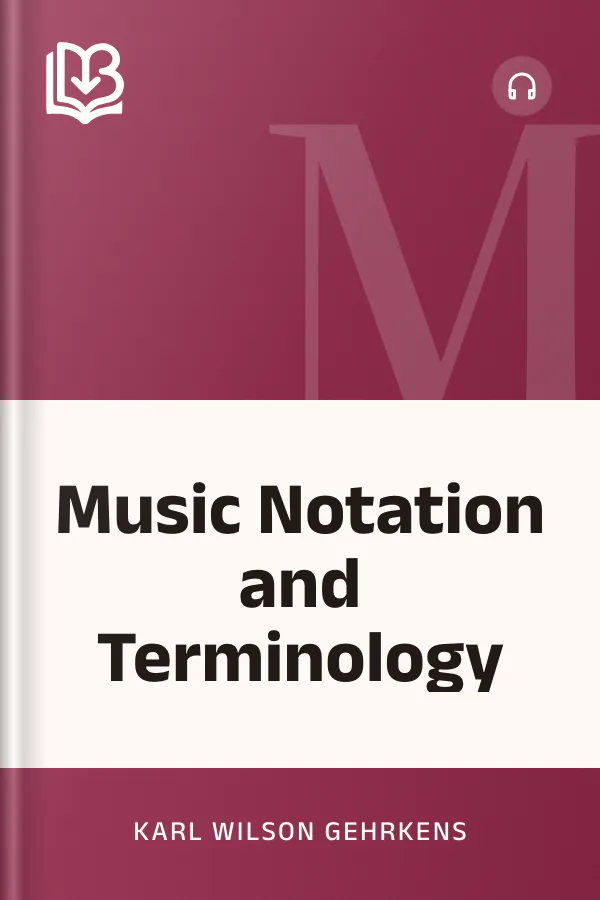
Music Notation and Terminology
- Downloads
- Under 100
- Pages
- 252
Listen to Music Notation and Terminology Audiobook Free
-
00- Preface
5:27 -
01- Some Principles of Correct Notation
9:55 -
02- Symbols of Music Defined
9:04 -
03- Symbols of Music Defined (continued)
8:54 -
04- Abbreviations, Signs, etc.
8:02 -
05- Abbreviations, Signs, etc. (continued)
14:32 -
06- Embellishments
9:47 -
07- Scales
14:10 -
08- Scales (continued)
20:11 -
09- Auxillary Words and Endings
8:39 -
10- Measure
9:46 -
11- Tempo
9:12 -
12- Tempo (continued)
11:42 -
13- Dynamics
15:53 -
14- Terms Relating to Forms and Styles
11:14 -
15- Terms Relating to Forms and Styles (continued)
21:15 -
16- Terms Relating to Vocal Music
15:01 -
17- Rhythm, Melody, Harmony and Intervals
13:29 -
18- Chords, Cadences, etc.
13:25 -
19- Miscellaneous Terms
13:28 -
20- Miscellaneous Terms (continued)
9:37 -
21- Appendix A- The History of Music Notation
26:16 -
22- Appendix B- Musical Instruments
35:51 -
23- Appendix C- Acoustics
14:40 -
24- Appendix D- Terminology Reform
24:02 -
25- Appendix E- Analysis of Beethoven Sonata, Op. 31, No. 3
8:43 -
26- Pronouncing Index
24:03
Music Notation and Terminology (1914) is a public domain work.
The audio edition streams in the page. There is no audio file to download.
About this book
Reading a score involves a vocabulary as well as a set of symbols. In this 1914 handbook, Karl Wilson Gehrkens brings those two parts of musical study together for students and prospective teachers. The chapters move from note stems, clefs and accidentals to scales, tempo, dynamics and musical forms. Definitions sit alongside explanations of word origins, with attention to the spelling and pronunciation a teacher needs when explaining a term.
The discussion of intervals shows the book's method in detail. Gehrkens distinguishes the number assigned to an interval from its specific quality, then uses examples in half-steps and whole-steps to explain the difference. Appendices extend the reference material to instruments, acoustics and the history of notation, while a pronouncing index supports classroom use. Readers studying music today can use it to examine how written signs, technical language and the relationships between pitches fit together.
Contents
About the author

More from this genre
See all- F From Trail to Railway Through the AppalachiansFrom Trail to Railway Through the Appalachians
- I In FashionsIn Fashions
- K Kachina DollsKachina Dolls
- H How to Teach PhonicsHow to Teach Phonics
- S Sweaters He and SheSweaters He and She
- P Précis Writing for BeginnersPrécis Writing for Beginners
Books like this one
- P Principles of Orchestration, with Musical Examples Drawn from His Own Works Principles of Orchestration, with Musical Examples Drawn from His Own Works
- M Music Music
- A Automatic Finger Control Automatic Finger Control
- O The Orchestra and Orchestral Music The Orchestra and Orchestral Music
-
 Stories of Symphonic Music
Discussion
No comments yet. Share a thought, a question or a favourite passage.
Copyright concern? Read our DMCA policy
Read or download
Public domain book This work is in the public domain and free of copyright. Anyone may read, download and share it.
- EPUB 9.4 MB
-
KINDLE Send to Kindle Send
- Download the EPUB file to this device.
- Open Amazon's Send to Kindle page, sign in, and add the file. Open Send to Kindle (opens in a new tab)
On a phone: open the downloaded EPUB and share it to the Kindle app.
You can also email the file to your Kindle address (it ends in @kindle.com) from an email address you approved in your Amazon account.
- PDF 11 MB
Downloads start right away. How to open EPUB on your phone
Book facts
- Author
- Karl Wilson Gehrkens
- Reading time
- About 3 hours
- Pages
- 252
- Language
- English
- Genre
- Educational
- Formats
- PDF, EPUB, Read online, Audiobook
- Audio read by
- Kara Shallenberg (1969-2023), Patrick Wells, Miriam Esther Goldman (1991-2017) and others