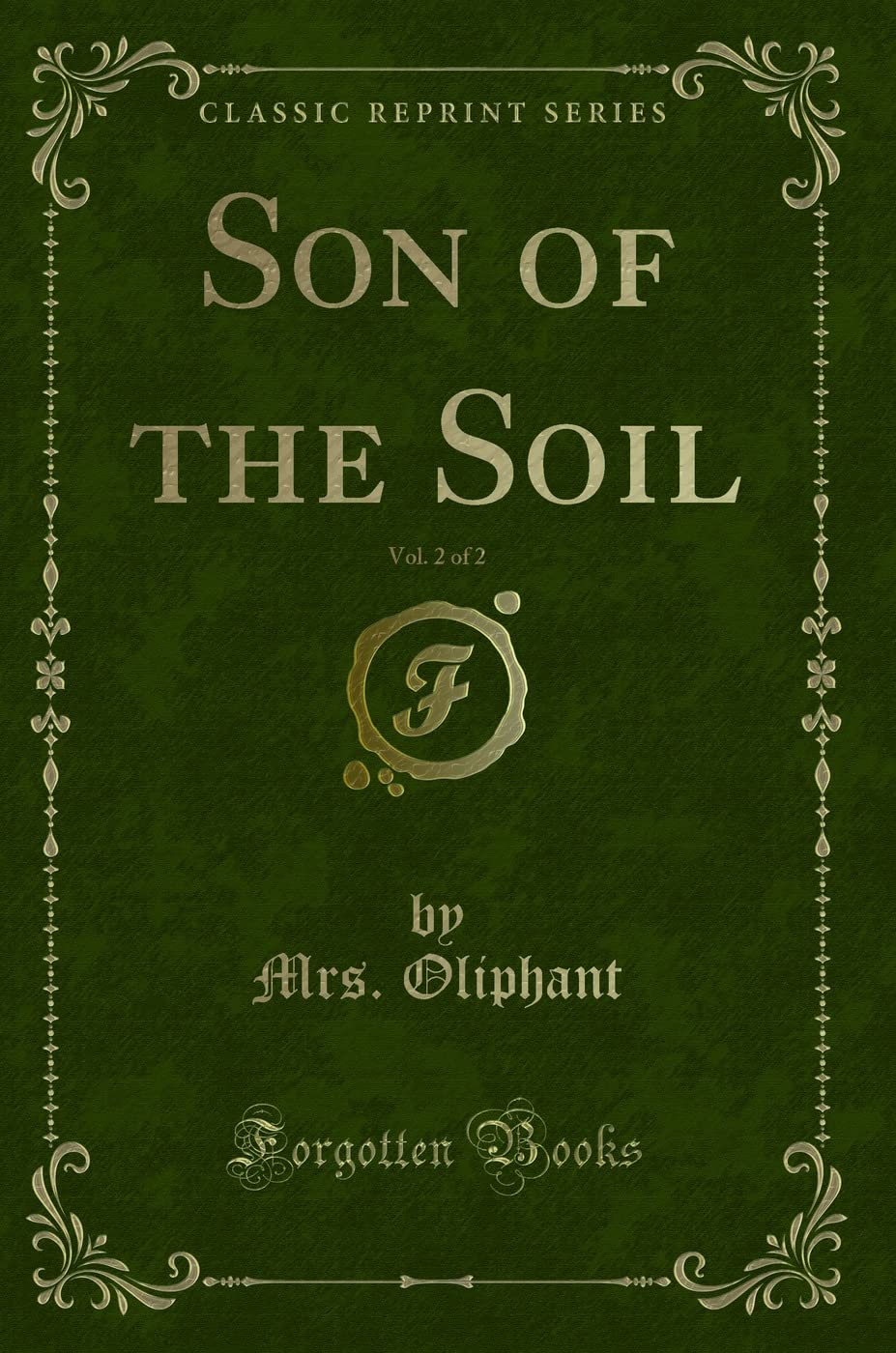
Son of the Soil, Vol. 2
Margaret Oliphant
Son of the Soil is one of Margaret Oliphant’s many Victorian novels of Scottish life, with this volume being the second of the original two volume publication. Oliphant was one of the most prolific and respected writers of the era, with a working career that produced more than ninety novels and hundreds of articles, all written under the financial pressure of supporting her own children and several extended family members after her husband’s early death. Her Scottish novels in particular drew on her own roots in the Borders region of Scotland and on the wider Scottish literary tradition that Walter Scott had helped to establish.
The son of the soil of the title points to the central character, a young man with deep roots in the land and the rural community where he was born. The novel follows his ambitions, his complicated relationships with his family and his community, and the slow working out of what kind of life he is going to make for himself. Oliphant was particularly interested in the tensions between traditional Scottish rural life and the modernizing pressures of nineteenth century British society, and her Scottish novels often deal with characters caught between the worlds.
Oliphant’s prose is unhurried in the way Victorian novels often are, with long passages of psychological observation, careful descriptions of social setting, and dialogue that captures the formal rhythms of Scottish polite speech alongside the more colloquial registers of rural Scottish life. She had a real ear for Scottish dialect and her dialogue is rendered with the kind of accuracy that gives her Scottish novels their particular flavor. The pacing is slower than modern novels and the prose is in the formal late Victorian style, but readers who settle into the rhythm find a strong, character driven novel that takes its time with its themes.
Volume two carries the story toward whatever resolution Oliphant has been building. Her Scottish novels often work toward conclusions that are more melancholy than triumphant, with characters reaching the kind of accommodation with their circumstances that real life more often requires than the more conventionally satisfying resolutions of romance fiction. For readers interested in Victorian Scottish fiction, in the wider catalogue of Margaret Oliphant beyond her famous Carlingford novels, or in the long tradition of Scottish literary realism that Oliphant helped to develop, Son of the Soil is worth knowing.
About the Author
Download free books by Margaret Oliphant on BDeBooks. Read Margaret Oliphant’s works online or download as PDF/EPUB — part of our growing free eBook collection.
See all books by Margaret Oliphant →