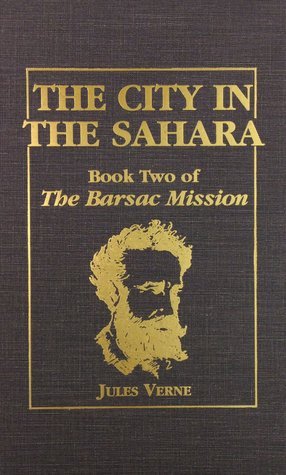
The City in the Sahara
The City in the Sahara is the second half of a Jules Verne novel sometimes published in English as The Barsac Mission and sometimes split into two parts, with The Barsac Mission as the first volume and The City in the Sahara as the second. The book was actually completed by Jules Verne’s son Michel after the elder Verne’s death in 1905 and published in 1919. Scholars now believe Michel did substantial rewriting and may have added entire sections, so the question of how much of the novel is purely Jules and how much is Michel is genuinely unsettled.
The story follows a French parliamentary commission sent to investigate conditions in colonial West Africa. The commission, led by the deputy Barsac, gets caught up with mysterious figures who seem to be operating their own private state somewhere in the Sahara. The City in the Sahara reveals what they find. A hidden modernist city in the desert, run by a mad scientist named Harry Killer, equipped with technology that is far ahead of the early twentieth century world the rest of the characters know. The novel is one of the earliest works in what would become the lost city subgenre of adventure fiction, and its influence on later writers is significant.
The book has the broad colonial assumptions and the racial blind spots of early twentieth century French adventure fiction, which modern readers will need to read through. What is interesting from a historical perspective is how the novel anticipates so many of the themes that would dominate twentieth century thriller and science fiction writing. A secret high tech city, a charismatic megalomaniac running it, a small band of unlikely allies who have to bring it down from inside. The DNA of countless later books and films is here.
For readers interested in early science fiction, French colonial era writing, or the late and posthumous Verne novels, this is worth knowing.
About the Author
Download free books by Jules Verne on BDeBooks. Read Jules Verne’s works online or download as PDF/EPUB · part of our growing free eBook collection.
See all books by Jules Verne →