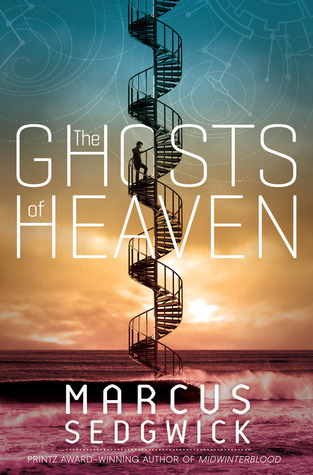
The Ghosts of Heaven
The Ghosts of Heaven is one of Marcus Sedgwick’s most ambitious novels, a formally adventurous young adult work made up of four interconnected quarters that span thousands of years of human history. The connecting thread is the spiral, the geometric and symbolic shape that recurs across cultures from prehistoric cave art to modern science. Sedgwick uses the spiral as a structuring device for the entire book, with each quarter set in a different era and exploring a different facet of the symbol’s meaning.
The first quarter is set in the deep prehistoric past, following a young woman of the Stone Age who is the first of her people to make a mark on a cave wall. The second quarter moves to seventeenth century England, where a young woman accused of witchcraft watches her village turn against her in the witch hunting hysteria of the era. The third quarter takes place in early twentieth century New York, focused on a doctor at a remote island asylum and the patient whose strange drawings haunt him. The fourth quarter projects forward into the distant future, where a deep space astronaut on a one way mission begins to receive transmissions she cannot explain.
Sedgwick wrote the four quarters so that they can be read in any order. The publisher’s note at the front of the book invites readers to choose their own sequence, and the meanings shift depending on the path chosen. The spiral motif binds them together regardless of order, and the cumulative effect is one of those rare YA novels that genuinely rewards rereading.
The book is darker than some of Sedgwick’s earlier work. The witch hunting section in particular is unsparing. But Sedgwick trusts his readers to handle difficult material if it is handled with respect, and the result is one of the more memorable entries in his catalogue. For readers who liked Midwinterblood or She Is Not Invisible, The Ghosts of Heaven continues his project of making YA fiction take real artistic risks.
About the Author
Download free books by Marcus Sedgwick on BDeBooks. Read Marcus Sedgwick’s works online or download as PDF/EPUB · part of our growing free eBook collection.
See all books by Marcus Sedgwick →