The Harmony of Interests
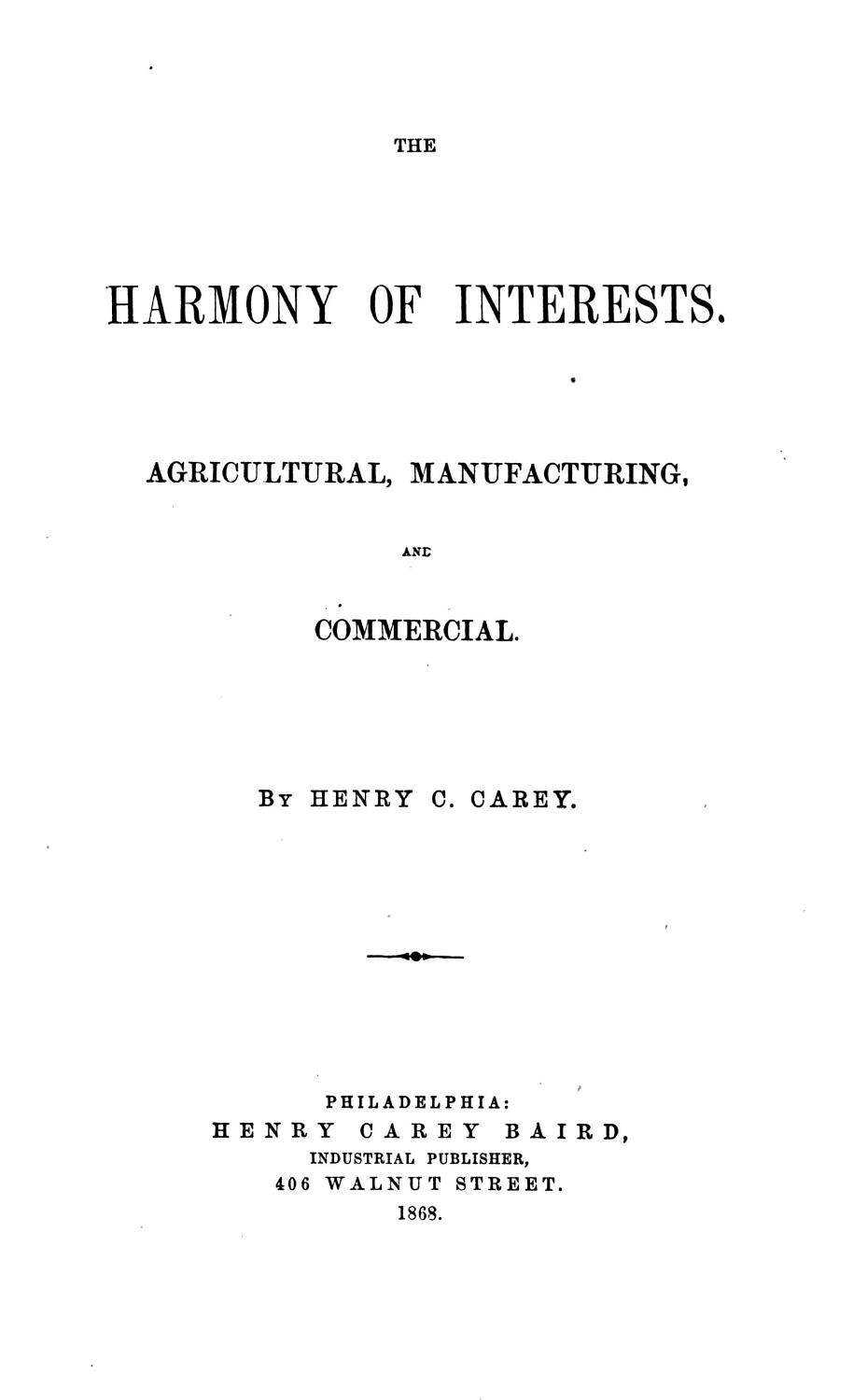
The Harmony of Interests, Agricultural, Manufacturing and Commercial is a major work by Henry Charles Carey, first published in 1851. It is one of his most influential books and the work in which he most clearly set out the general theoretical position that gave the American School of economics its distinctive character in the mid nineteenth century.
The central argument of the book is in the title. Carey held that the interests of agriculture, manufacturing, and commerce are not naturally opposed to each other but are deeply harmonized when an economy is properly developed. The classical economists, particularly David Ricardo, had argued for a fundamental conflict between landlords, capitalists, and labourers, with the gains of any one class coming at the expense of the others. Carey rejected this picture entirely. He argued that the development of manufacturing alongside agriculture creates a domestic market for agricultural products that raises farm incomes, while the spread of agriculture supports the population that staffs the factories and consumes their output. Commerce in turn facilitates the exchange that makes both possible.
The practical political conclusion of this theoretical position is Carey’s lifelong commitment to the protective tariff. He argued that countries with developed manufacturing have already established the harmony of interests within their borders and naturally favour free trade, since it allows them to dominate less developed economies. Countries still developing their manufacturing capacity need protection to allow domestic industry to grow alongside agriculture, so that the same harmony of interests can be established at home. Free trade between unequally developed economies, in Carey’s analysis, simply reinforces the dependence of the weaker economy on the stronger and prevents the development that would otherwise occur.
The book is a sustained polemic against British free trade doctrine, particularly against the work of Adam Smith and David Ricardo as those works were being applied to American policy. Carey was a major influence on the development of Republican Party economic policy in the United States during the second half of the nineteenth century, and his arguments shaped American tariff debates for decades.
The book runs about three hundred pages. For readers interested in the history of American economic thought and in the long debate between free trade and protectionism, this is one of the central nineteenth century documents on the protectionist side. It pairs naturally with Friedrich List’s National System of Political Economy.
About the Author
Read and download 2 free books by Henry Charles Carey on BDeBooks. Browse the complete collection of Henry Charles Carey’s works available as free PDF and EPUB downloads. Discover novels, fiction, and other writings by Henry Charles Carey in our online eBook library.
See all books by Henry Charles Carey → Reconstruction
 Of the Rate of Interest; And of Its Influence on the Relations of Capital and Labor
 Letters to the President on the Foreign and Domestic Policy of the Union
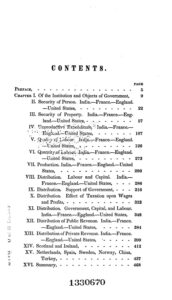 Principles of Political Economy
 Letters on International Copyright; Second Edition
 The Credit System in France, Great Britain, and the United States.