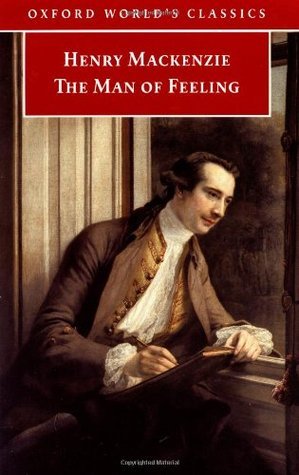
The Man of Feeling
The Man of Feeling is a novel by Henry Mackenzie, first published anonymously in 1771 and almost immediately recognised as one of the central documents of the eighteenth century sentimental movement. Mackenzie was a Scottish lawyer and writer who lived from 1745 to 1831, and this short novel was the book on which his lasting reputation rests, even though he produced other longer fictions later in his life.
The novel has an unusual structure. The narrator presents the manuscript of the story as a fragment that has been found in an old chest. The fragment itself is missing many chapters, with the surviving sections numbered to indicate that much of the original is lost. What remains follows Harley, a young man of acute moral and emotional sensibility, through a series of episodes that test and display his sensibility. He visits a madhouse and weeps at the sight of the inmates. He encounters a soldier reduced to begging and gives him what little he has. He meets a young woman who has been seduced and abandoned, and weeps for her. He falls in love with a woman named Miss Walton and cannot bring himself to declare his feeling. The book moves from one such scene to another with no real plot in the conventional sense.
The Man of Feeling is the central English example of the cult of sensibility that dominated late eighteenth century fiction, a cult that valued strong feeling as a moral good and that took the visible expression of feeling as evidence of moral worth. Harley weeps almost constantly in the surviving fragments. He is unable to act effectively in any practical situation. He is, in the language of the period, exquisitely sensitive in a way that nineteenth century readers eventually came to find ridiculous and that earlier readers found admirable.
The book is short, perhaps a hundred and fifty pages. It is essential reading for anyone studying the eighteenth century novel of sensibility, and it remains a fascinating document of a literary moment that the later nineteenth and twentieth centuries largely rejected. It pairs naturally with Sterne’s A Sentimental Journey, which influenced it, and with Goethe’s The Sorrows of Young Werther, which was published a few years later and which carries the same sensibility into the German tradition with even more devastating consequences.
About the Author
Download free books by Henry Mackenzie on BDeBooks. Read Henry Mackenzie’s works online or download as PDF/EPUB · part of our growing free eBook collection.
See all books by Henry Mackenzie →




Listen to The Man of Feeling Audiobook Free
Listen to The Man of Feeling by Henry Mackenzie free online. The full audiobook (3 hr 31 min, 24 chapters, read by Jim Locke) streams free on this page.
The Man of Feeling (1886) is a public domain work.
| # | Chapter | Length | |
|---|---|---|---|
| 1 | Author's Introduction | 5:33 | |
| 2 | Chapter 11.-- On Bashfulness.-- A Character.--His Opinion | 5:19 | |
| 3 | Chapter 12. Of Worldly Interests | 7:33 | |
| 4 | Chapter 13. The Man of Feeling in Love | 6:35 | |
| 5 | Chapter 14. He Sets Out on his Journey--The Beggar and His Dog | 8:25 | |
| 6 | Chapter 19. He Makes a Second Expedition to the Baronet's. The Laudable Ambition of a Young Man to Be Thought Something by the World | 10:26 | |
| 7 | Chapter 20. He Visits Bedlam.--The Distresses of a Daughter | 9:49 | |
| 8 | Chapter 21. The Misanthrope | 13:09 | |
| 9 | Chapter 25. His Skill in Physiognomy | 7:12 | |
| 10 | Chapter 26. Fruits of the Dead Sea | 5:55 | |
| 11 | Chapter 27. His Skill in Physiognomy Is Doubted. | 2:53 | |
| 12 | Chapter 28. He Keeps His Appointment. | 22:13 | |
| 13 | Chapter 29. The Distresses of a Father | 10:59 | |
| 14 | A Fragment. Showing his Success with the Baronet | 3:26 | |
| 15 | Chapter 33. He Leaves London--Characters in a Stage-Coach. | 12:43 | |
| 16 | Chapter 34. He Meets an Old Acquaitance. | 18:04 | |
| 17 | Chapter 35. He Misses an Old Acquaintance.--An Adventure Consequent Upon It. | 6:56 | |
| 18 | Chapter 36. He Returns Home.--A Description of His Retinue | 4:59 | |
| 19 | A Fragment. The Man of Feeling Talks of What He Does Not Understand.--An Incident | 6:18 | |
| 20 | Chapter 40. The Man of Feeling Jealous. | 17:11 | |
| 21 | The Pupil. A Fragment. | 13:47 | |
| 22 | Chapter 55. He Sees Miss Walton, and Is Happy. | 7:00 | |
| 23 | Chapter 56.The Emotions of the Heart. | 2:05 | |
| 24 | The Conclusion. | 2:00 |
Prefer reading? Read The Man of Feeling online free or download the PDF and EPUB above.