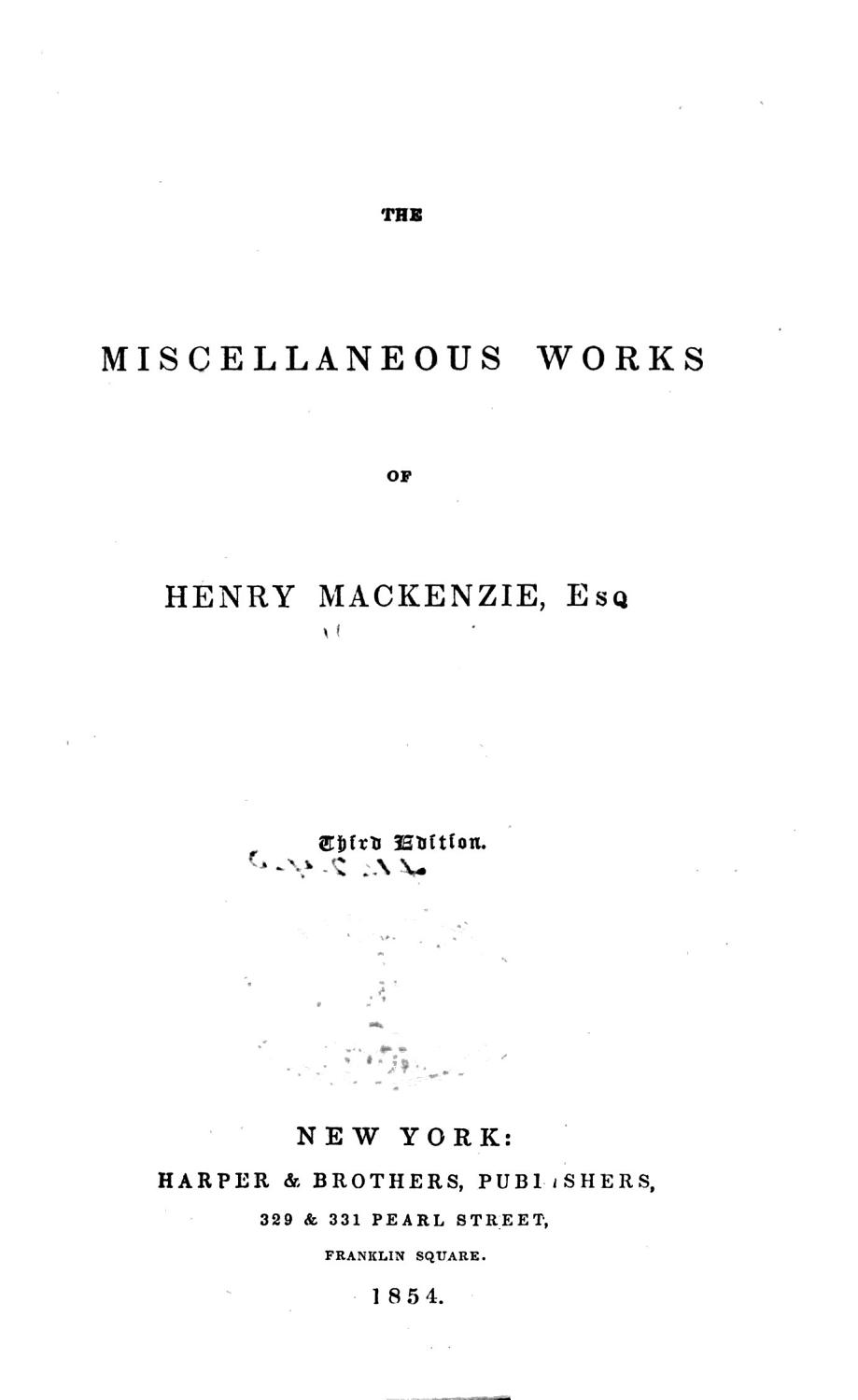
The Miscellaneous Works of Henry Mackenzie
The Miscellaneous Works of Henry Mackenzie is a collected edition of the various shorter writings of Henry Mackenzie, the Scottish lawyer, novelist, and editor who lived from 1745 to 1831. Mackenzie produced a substantial body of nonfiction prose across his long literary career in addition to his three novels, and the Miscellaneous Works editions that appeared in the early nineteenth century gather these shorter pieces into a single substantial collection.
The contents typically include the essays Mackenzie contributed to his periodicals The Mirror and The Lounger, his collected critical essays on literature and on the theater, his biographical sketches of contemporaries, his political pamphlets from various points in his long career, and his occasional pieces on religious and philosophical questions. There are also typically included some of his shorter prose fictions that appeared in the periodicals, including the famous Story of La Roche, a sentimental tale that was widely admired in the late eighteenth century.
Mackenzie was at the center of Edinburgh literary life across most of his adult years and was friendly with most of the major Scottish Enlightenment figures of his generation. His critical essays in particular are valuable documents of how serious literature was being thought about in Edinburgh during the great period of the Scottish intellectual flowering. His essay on the genius of Shakespeare and his early notice of Robert Burns’s poetry helped establish reputations that have not been seriously challenged since. The biographical sketches give first hand portraits of figures including Hume, Adam Smith, and other members of Mackenzie’s Edinburgh circle.
The collected Miscellaneous Works runs to several volumes and several thousand pages in the typical early nineteenth century edition. The selection that any particular reader will want to look at depends on their interests. For readers interested in the Scottish Enlightenment and its literary culture, the critical essays and biographical sketches are the most rewarding. For readers interested in Mackenzie’s relationship to the cult of sensibility, the Mirror and Lounger fiction is the most useful. The book pairs naturally with The Mirror and The Lounger themselves, and with the broader literature of Scottish Enlightenment letters.
About the Author
Download free books by Henry Mackenzie on BDeBooks. Read Henry Mackenzie’s works online or download as PDF/EPUB · part of our growing free eBook collection.
See all books by Henry Mackenzie →