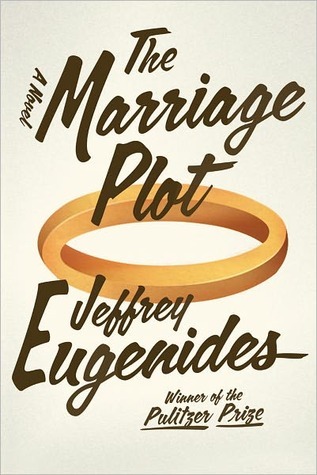
The Marriage Plot
The Marriage Plot was Jeffrey Eugenides’s third novel, published in 2011, nine years after his Pulitzer winning Middlesex. Where Middlesex was a sweeping multigenerational epic about a Greek American family, The Marriage Plot is a tighter, more conventional college novel that follows three Brown University seniors in 1982 as they finish school and try to figure out what to do with their adult lives.
Madeleine Hanna is an English major writing her thesis on the marriage plot in nineteenth century novels. Her thesis premise is that the marriage plot, the central engine of writers like Austen and Eliot and James, no longer works in modern fiction because women now have options other than marriage. The irony Eugenides plays with through the entire novel is that Madeleine herself is caught in a very nineteenth century love triangle. There is Leonard, the brilliant biology major she falls hard for, who is also struggling with bipolar disorder that the novel renders with painful accuracy. And there is Mitchell, the religious studies major who has been quietly in love with Madeleine for years and is heading off on a trip to India that may or may not lead to actual enlightenment.
Eugenides writes about the eighties academic environment with great affection and some sharpness. The semiotics class scenes, the discussions of Roland Barthes, the campus politics, all of it is rendered with detail that anyone who went through a humanities program in that era will recognize. But the book is more than a campus comedy. The pages on Leonard’s bipolar episodes are some of the best fiction has produced on what that condition actually feels like from the inside. For readers who like literary fiction with strong characters and a real interest in ideas, The Marriage Plot is a quieter Eugenides novel that rewards close reading.
About the Author
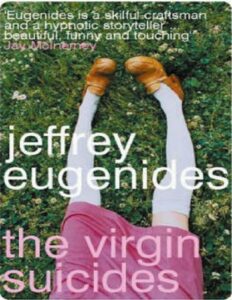
Jeffrey Eugenides is an American author and he is known for his versatile storytelling and ability to create vivid worlds. His debut novel, “The Virgin Suicides” (1993), served as the basis for the 1999 film of the same name. Jeffrey Eugenides continues to captivate readers…
See all books by Jeffrey Eugenides →