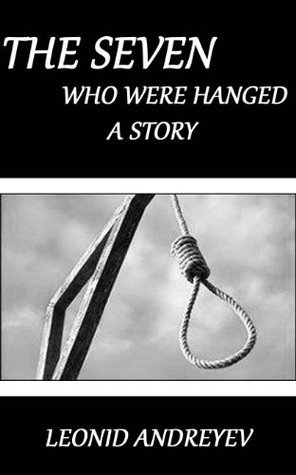
The Seven Who Were Hanged
The Seven Who Were Hanged, originally Rasskaz o semi poveshennykh, is a novella by Leonid Andreyev, first published in Russian in 1908. Andreyev (1871-1919) was one of the most internationally famous Russian writers of the early twentieth century, with substantial reputation across Europe and America before his death from heart failure during the chaos of the Russian Civil War.
The novella was written in the immediate aftermath of the 1905 Russian Revolution and its violent suppression. Five young revolutionaries, two men and three women, have been sentenced to death for an attempted assassination of a Tsarist minister. Two ordinary criminals, a peasant murderer and a robber, have also been condemned for unrelated crimes. The seven are held together in the days before their hanging, and the novella moves between the consciousness of each one as they face their imminent execution.
Andreyev handles the material with the moral intensity that defined his fiction. He does not romanticize the revolutionaries and does not demonize the criminals. The five political prisoners and the two ordinary ones become equally human across the seven sections that focus on each in turn. The novella was widely read as an anti-death-penalty work and as an indictment of the Tsarist regime that was producing so many such executions in the years after 1905.
The story was translated into English in 1909 and into many other languages over the following years. Tolstoy admired it. Western readers including Joseph Conrad and various others wrote about its impact on them. Andreyev’s international reputation in the years before the First World War rested substantially on this novella and on a few other major short fictions including The Red Laugh of 1904, the anti-war story written during the Russo-Japanese War.
The book is short, around a hundred pages, and reads in an evening. For readers interested in early-twentieth-century Russian literature, in the literary response to political violence, or in the broader European modernist short fiction tradition, it is essential reading. It pairs with The Red Laugh, with Andreyev’s plays including The Life of Man, and with the broader pre-Revolutionary Russian short fiction by Chekhov, Bunin, and others.
About the Author
Download free books by Leonid Andreyev on BDeBooks. Read Leonid Andreyev’s works online or download as PDF/EPUB · part of our growing free eBook collection.
See all books by Leonid Andreyev →