
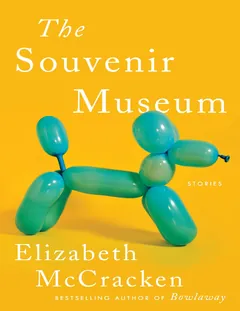
The Souvenir Museum
Mistress Mickle All at Sea
New Year’s Eve in a Rotterdam garret, the whole block blacked out, bottle rockets rattling the casements: Mistress Mickle, villainess of the children’s game show Barnaby Grudge, off duty and far from home, ate a cold canned hot dog in the dark and pronounced it delicious. These were the last minutes of the old year. She’d come from Surrey to visit her half-brother, Jonas, whom she’d last seen in Boston just before their father had retired to Minorca. Expatriation was the family disease, hereditary: thanks to an immigrant ancestor, they all had Irish passports. The world was their oyster.
An oyster was not enough to sustain anyone.
“This happen often?” she asked. “Blackouts, I mean.”
“Off-ten?” he mimicked, then he said, “Nah. I don’t know what’s going on.” His Boston accent was thick as ever, but years in England had bent her diction, and she couldn’t decide which of them should feel superior. The blackout was in its third hour. She’d hated the darkness at first, but it had gone on so long it had become essential. Let the New Year arrive unelectrified, she thought, lit only by pyrotechnics.
Rotterdam did not wait till midnight to celebrate; the enamel tabletop vibrated with the detonations of fireworks, explosion after explosion overhead. It was like life in wartime, if you knew nobody was dying, probably, and the privation would end by morning. She jumped at every salvo; she was a nervous woman. When Jonas fished out a joint she didn’t turn him down, though it had been decades. Maybe it would calm her. Last year she would have had a drink, but she didn’t drink anymore. She was forty-nine, Jonas forty-two, a shock. He had long, insufficient mousy hair he was trying to drum up into dreadlocks and a thick dark beard he’d trimmed to round perfection. Why couldn’t he take care of anything else so
well? He was a fuckup. He said so himself. It was as though fucking up were his religion, and he was always looking for a more authentic experience of it: bankrupted by Scientology, busted for selling a stolen antique lamp, fired from an Alaskan cannery for filching salmon, beaten up by a drug dealer—that is, a ham-headed college kid who dealt ecstasy but took only steroids himself. For the past six months, Jonas had lived in this garret, renting the space beneath an Irishwoman’s kitchen table, with access to her stove and sink and toilet and, occasionally, herself. The Irishwoman had gone back to Kilkenny, would return tomorrow. Tonight her bed would be occupied by Mistress Mickle. The Irishwoman must never hear of this.
Jonas’s pallet was still spread out under the table at which they now sat, his pillow at Mistress Mickle’s feet.
At eleven thirty the lights came back on.
“Oh good,” said Jonas.
“A shame,” said Mistress Mickle.
Jonas shrugged. He was a lifelong shrugger. It was the genuflection of the devout fuckup. “Let’s go to the street,” he said. “Midnight will blow your mind.”
Outside they stood by the murky canal that ran down the street like a median strip. All along the block people set off their rockets, nearly dutifully, and gossiped and smoked. She felt the peculiar calm of not understanding the ambient language, a state she loved: it was like having part of your brain induced into a coma.
“Just wait,” said Jonas.
What were they waiting for? Oh yes: midnight. Mistress Mickle checked her heart the way she might reach into her handbag for a wallet she was continually certain had been pickpocketed but never was. How was her heart? There, but working? She took her pulse at her neck: steady, fine, though her torso felt percolated. She’d read an article online about women’s heart attacks, how they presented differently from men’s, how nearly anything (it seemed to Mistress Mickle) might be evidence. Was that pain in her chest, or in her back? In her chest or her breast? What bodily border must a pain cross to enter another bodily meridian? Insomnia could be a symptom, the article said: well, she had that now. She had all the symptoms, though fly-by-night versions. Intimations of symptoms. Not pains, but twinges. Not racing but trotting. She was dying, she was making it up, she
wouldn’t go to a doctor. She had no natural fear of death, and was vain about this: it was what separated her from the rest of dumb humanity. But she was phobic about embarrassment. That’s what the death certificate would cite under cause: embarrassment, congenital and chronic.
In the middle of the street, a small boy knelt beside a man with 1970s Elvis sideburns. Not father and son, she didn’t think. There was a formality: the man seemed to be the boy’s firework godfather, come from far off to teach him how to light a wick. The boy must have been eight. The man must have been a ghost. Together they held a smoldering twist of paper to the fuse and stepped away. Mistress Mickle felt the rocket’s rising shrill at the back of her throat, absorbed its pop in her tonsils. It tore itself into three red branches, then faded.
“Fucking awesome,” Jonas called to the kid.
“Extraordinary,” she said, in a four-syllabled, English way. Then,
“Yeah, awesome.” Already the man and boy were righting the bottle for a new rocket.
“Sixty-five million euro, according to the papers,” said Jonas. “That’s what the Dutch spent on fireworks this year. Hey, did I tell you? I’m going to apprentice to a hatter.”
“You’re too old to be an apprentice,” she said. Then: “A hatter?”
“Felt hats,” he said. “They’re the next thing. They’re coming back.”
“Come and went, haven’t they?”
He’d been smiling but his smile slipped. Then he smiled more broadly: that his sister might know anything was something he could believe for only seconds at a time. “No,” he said. “Real hats. My friend Matthias. He’s, like, a genius.”
That perfect, round beard: it looked like a hatter’s apparatus, come to think of it. A form for the crown of a derby, a tool to bring up the nap of the felt.
“I’ll give you more money,” Mistress Mickle told him.
“That’s not what I’m saying.” He had his hands in his greasy mechanic’s jacket—he who had never been a mechanic. “I don’t need your money.”
“Oh?”
“No,” said Jonas. “That’s why I invited you here. To show you. I don’t need you anymore. Your help, I mean. Look! I’m standing on two feet.” He added, “I think she’s pregnant. She is pregnant.”
“Who? Oh, Irish.”
“Siobhan,” said Jonas. “Yes.”
“So you’ll want the money, then.”
“Listen to me! That’s why hats.”
“Hats,” said Mistress Mickle.
Bickering into the New Year. Typical. They’d heard no countdown, but the turning of the calendar was unmistakable—the syncopation of bottle rockets replaced by whumps, thunderclaps, the crackling aftermath: beauty.
Ordinarily Mistress Mickle was afraid of both loud noises and house fires, but the fireworks over Rotterdam—no, she realized, not over Rotterdam, the fireworks over this particular neighborhood—she goggled at them.
Nobody was sighing in unison, as in the States. There wasn’t time to sigh.
Every inch of the sky was stitched with flash. Fingers were being blown off, and heart attacks induced, and underneath the explosions you could hear dogs of all sizes bark in agonized registers—but how could Mistress Mickle not marvel? She’d never seen anything like it.
She thought of the invisible woman at the science museum, that mannequin who showed her various systems through her Lucite epidermis: circulatory, nervous, respiratory, reproductive, lit up in turn. The fireworks lit up Mistress Mickle: the blond ones her nerves and the white ones her bones, the red ones her heart, the blue ones her capillaries. They cured her.
She was not just fine but better. Soon they’d finish, and she’d be new. But they didn’t finish. They kept going. Cured, afflicted, cured, afflicted, cured, until she realized there was no waiting for the end. The Dutch would set them off till the dark was done. Maybe Jonas was right: maybe this was the year he’d stand on two feet. Hope saturated her.
“It’s so good to see you,” she said to him. She’d learned through the years that saying made it so, at least sometimes. “Really, Jone.”
“This is going to be the greatest year of my life,” said Jonas, and she said, “Yes, it will, I know it.”
Not blond but ginger ale. Not ginger ale but champagne.
Later, in the Irishwoman’s bed, she heard a clunk against the roof and realized it was fallout from the night’s barrage. Ordinarily she would have stayed awake, waiting for the inevitable smell of disaster. Now she thought, Icarus, Newton’s apple, David Bowie, impossible beautiful falling things. A rocket set off hours earlier by the boy in the middle of the street, flown so
high it had gone into orbit, circumnavigated the globe, and—like so many flying things—gotten homesick, decided to plummet back.
Should she throw something to the kitchen tabletop, to give her brother the same exhilaration on his bedroll beneath? Would it work?
The table was still scattered with empty hot dog cans. In the Netherlands, they were called knaks.
Twelve hours later, Mistress Mickle—her name was Jenny Early, though forty-nine seemed to her too old to be Jenny and too late to be Early—
boarded a ferry at the Hook of Holland, headed for Harwich, where her car was parked. She’d lived in England for twenty years, working as an actress, more or less, all that time: in an experimental theater company (“experimental” meant foodstuff and nudity); as a stilt walker in a new-wave circus; as a minor recurring character on Coronation Street; as the slowest member of an improv troupe; as a reader to the blind; as a voice-over artist in cartoons and, later, video games; and finally as Mistress Mickle, which involved stilts and a multicolored Victorian dress and yelling, week after week, at an audience of children, from which six players were plucked and protected by a young hero named Micah. (The eponymous Barnaby—actual surname O’Malley—had been fired for sleeping with seventeen-year-olds, which he told the papers was unfair, as there were no seventeen-year-olds in his audience.) Mistress Mickle would attempt to kidnap the children, and even when she managed to land one in jail—on stilts! In a hoopskirt!—Micah would always be waiting with the unconvincing cardboard key, which was the size of a leg of lamb. The children would boo her.
Micah was the beautiful child of a Danish mother and a Nigerian father, as genial off camera as on, though in real life guileless, dumb, incapable of outwitting anyone, never mind a woman so many years his senior. He reminded Mistress Mickle of an alternate Jonas, one whose every slapdash decision raised him up instead of knocking him down. She hated Micah for his good luck (though neither Micah nor Jonas believed in luck: they believed in breezily accepting the day), and for his consistent love of the children, for his youth, for the way the game itself was stacked against her.
No children waited for Mistress Mickle on the other side of her journey, nor husband, nor (at the moment) paramour, and that was fine. She liked sex and she liked privacy, and she’d reached her mid-thirties before
realizing life could offer her both. The time that living with another person took up! The small talk! The politeness! Life alone was banal, too, but at least the banality wasn’t narrated.
It was bad for you to say aloud the minor grievances of the day, the rude bank teller and the gum on the bottom of your shoe. It was terrible to alter your diet to what another person liked or didn’t: The last man she’d lived with had hated capers. And so she’d given up capers, until she gave up the man. His name was Philip. He was a theater director who had made fun of her accent, the way she dropped t s in the middle of English expressions and words: Bee’root. Wai’rose. Whi’bait. Qui’right.
All her life she’d felt foreign; landing abroad, she was relieved to assume it as an official diagnosis.
This was a day crossing, but she’d taken an outside cabin, one with a double bed and a single bed and a surprisingly large bathroom with a toilet, shower, sink, and three thick, white towels, more than Jonas had to his name. (What had happened to him, that he lived like that? Shit happens, Jonas would say. Life happens, Micah would say, while you’re making other plans.) A free minibar. She ate both chocolates and the bag of potato chips while the boat was still in port. The strange elation of the previous evening was still in her: she felt calmer than she had in ages. The Irishwoman was pregnant. Their family would continue after all! Aunty Mickle! Still stoned, she thought, though she wasn’t sure that was true, and she lay down on the single bed, because it was on the right side of the cabin, and the homing device in Mistress Mickle’s brain always went right: on busses, on trains, in restaurants. There was a little wall-mounted television; she tuned it to the closed-circuit cameras in the belowdecks kennels. Empty. Empty. Empty.
The channel suited her.
Ordinarily she wanted to watch television but couldn’t bear to watch.
She might see, for instance, an actor in a movie whom she’d met fifteen years ago on a soap: Now how did he get that break? She might see young, talentless, gleaming people. It appalled her, the jealousy of her middle age, though it flared up only occasionally, a trick knee. Lumbago, whatever lumbago was. Spiritual arthritis. As a young woman she was (she believed) mostly generous, entirely sane, and the acting jobs she got, the soaps and reenactment shows and cartoon voice-overs, had seemed like good fortune.
Now everything was a conspiracy, mean and purposeful, designed to hurt her, and while she knew there were people who saw her in the piebald,
pirate-y Mistress Mickle costume on Barnaby Grudge and were filled with jealousy themselves, this knowledge didn’t comfort her: indeed, when she stopped to contemplate it, she felt demeaned.
Knock it off, she told herself. New year. She plumped the pillow. It was a real pillow. It was a good ship. She checked her heart. Beating.
No dogs, still.
She never quite fell asleep, but she observed, as though from a distance, obscure, outlandish thoughts as they alighted: Would Jonas take the Irishwoman’s bed, or would he keep obediently to his mat beneath the kitchen table? Why beneath the table? Oh, to avoid being stepped on. A baby in a hat might crawl by, too—now, what did that mean? she asked herself in an Irish accent. The sea grew rough: every now and then a wave lifted the boat up and set it down with a minor clunk, and the back room of her brain thought, Ah, the plane has landed.
She sat up after thinking this for the third time. Not plane, boat. The television showed its series of empty kennels. It looked like a prison break: I don’t know, Sarge, the cells were all full half an hour ago.
Between the beds a large, lozenge-shaped window. A porthole. A window that would allow nobody to spy on you. She regarded the polished green sea cut through with unpolished white foam. She heard an ululating child run down the corridor outside: toddler Doppler effect. Other than that, the cabin was the most complete privacy one could imagine while still surrounded by hundreds of people, and superb. There was nothing she didn’t like. How to fully enjoy it? She had an urge to transgress, to drink the pygmy minibar red wine, then the white, then the two cans of Heineken, to strip and press her nakedness against the porthole.
Who would know? Some unseen sailor with a telescope. Satellites.
Aliens. Nobody. Fish.
She didn’t drink anymore. Hours to go before Harwich. She needed to get out.
The public areas were on deck nine. She’d been on shitty ferries, but this was a nice one. Coffee bars, wine bars, a cafeteria, even a fancy restaurant with a three-course prix fixe menu. Most of the passengers (there weren’t many) seemed to be Middle Eastern Muslims, the women in chadors and head scarves, a pair of tiny girls hidden in floor-length dresses, the men in blue jeans. Of course, thought Mistress Mickle: everyone else was too hungover on New Year’s Day to chance a ferry. You had to be from
a nondrinking people to survive. Or naval: she had navy on both sides of the family; she never got sick. Still, the roughness of the sea was a low-level prank beneath her feet: three steps fine, and then the deck rose up quick. At the far end of the cafeteria a white-haired man pulled a clattering child’s toy, a dragon that smacked its jaws as it rolled along. The man wore a round embroidered Chinese hat and pants that showed his ankles, and he tweaked balloons into dogs and handed them to children. She supposed she and he were members of the same tribe, or the same theoretical union. Keep your distance, she thought at him.
Where was Jonas now? He’d ridden the bus with her to the central train station, used her credit card to buy her ticket to the port. He was going to be a father. (She resolved to believe it.) Fathers should not sleep beneath kitchen tables. He needed money. She would send it happily, without negotiation or expectation.
She walked through a door out onto an open deck at the end of the boat.
Not end. Stern. She walked to the stern of the boat past the smokers and stared sternly out. The sharp salt air did her some good, though the smokers all looked fucked off with the cold. Why she’d quit: after the ban in restaurants and pubs, smoking had become a standing endeavor, and she had no interest in smoking upright. She stood at the rail and looked at the water.
She thought—as she often did when she saw an opportunity—of doing away with herself. Wait till the deck cleared so nobody would witness her.
Jump in. Drown. How long would it take till she was noticed missing? She might be an enduring mystery, like Judge Crater (US) or Lord Lucan (UK).
You waited to disappear till nobody watched you go. Otherwise you’d be only a dull suicide.
This was a lifelong habit. It didn’t feel suicidal but the opposite, a satisfying of a not-quite-urge. Whenever she moved to a new place, for instance, she looked for the support she’d hang herself from. In her current house, a barn conversion, there were beams everywhere, though the best was in the kitchen, with an iron hook. Finding the spot calmed her. She didn’t want to kill herself, but she did want to think about it. After all, she wasn’t afraid of death.
She decided to live forever or as long as possible. She would learn to be a better person, for her niece’s sake. (Why niece? She couldn’t imagine
Jonas as the father of a son, was all.) Today it felt entirely possible. Was this optimism? Was this what Micah and Jonas felt?
The water behind a boat is the deepest wishing well in the world: It has drag and intention. Throw your dreams into it. If they don’t pull you in and drown you, perhaps they’ll come true.
On a table inside she found a flyer. CHILDREN’ S ENTERTAIMENT, it said, 2:30
IN THE KID ZONE ! MAGIC, BALLOONS ! Well, she thought. Why not. The boat appeared so empty she imagined nobody else might show up, the sea sufficiently turbulent that any children were lying flat and sipping warm water. Professional courtesy, one children’s performer to another. She would be his audience.
But the KID ZONE!, a glassed-in space just beyond the cafeteria, was full.
With palpable delight, a young white woman (English, Mistress Mickle was pretty sure) watched her two-year-old daughter waddle up to the man in the Chinese hat: how lucky, the mother clearly thought, that the world had the chance to experience her child! A plump redheaded boy clutched a model of the very boat they were on, purchased from the gift shop. Two-thirds of the audience seemed to be one large Muslim family, or several families traveling together: kids in the front row, a couple of men leaning against the far wall, four young women in matching robin’s-egg-blue head scarves who could have been mothers to the audience, or older sisters. Not all the teenage girls wore head coverings, so probably they weren’t all related.
They were different strains. Denominations. The God of one allowed you to show your neck, and the God of another allowed you to wear slacks.
Where were they from? Somewhere in the Middle East. Even if she heard them speak, she wouldn’t know. She had a bum ear: probably why the height of her acting career was a villain on a children’s game show. Dutch sounded like German to her, and Portuguese like Russian. Were they Iraqi, Yemeni? Then one of the teenage boys sighed and said to a teenage girl, in a voice of dread and Birmingham, “This is taking for ever. I wish we’d flown.”
“Fly, then,” said his sister. “Go ahead.”
Returning home. At sea with the English, as per usual.
One elderly woman, tucked in a porthole frame, clapped impatiently at a small boy who’d stood up and started to wander. (She was from elsewhere, surely, the original cutting on the family tree.) (They were at sea, they were all from elsewhere.) The boy was little, in elasticized jeans with prominent
belt loops. Mistress Mickle wanted to set him in her own lap, whisper in his ear, Shh, let’s watch the show, lay her cheek against his hot head. She did feel inclined toward some children, little ones, those not yet taught by television to hate her. The boy’s older sister, a girl of six, knit her already comically serious eyebrows and grabbed him by the waist and gave him a good slug on the arm. Then, as though overcome with love, she seized and kissed him.
Mistress Mickle sat on the floor by the door.
The man in the Chinese hat turned to the audience. He held up to the light three balls filled with glittery fluid. Wordlessly he began juggling.
Three balls was relatively easy, Mistress Mickle knew from her years with Circus a Go-Go, and then thought: but hard on a pitching boat. With a military hup, he popped the third ball, then again, again, till all the children were watching.
“Hello,” he said. “I am the Magnificent Jimmy.” He had a London accent, despite the Chinese hat and Moroccan slippers. Then he said, more firmly, “Hello!”
“Hello,” the audience answered, the way you might greet a friendly lunatic in the park.
“That’s rubbish, that is,” said the Magnificent Jimmy. “Hello!”
“Hello!” the children said, loudly this time. He gave a satisfied nod.
At juggling he was fine, he was acceptable, he was delightful: she had forgotten what a good audience member she was. How she liked looking at people who wanted only to entertain, no matter how talented—or untalented
—they might be. That was why she’d begun acting in the first place, to be regarded by strangers in the way she did them, with a kind of open narrative love that made up stories. Had he done this all his life? Did he live on board? No: he lived in a bedsit in Harwich. He’d hoped to be a famous magician but had never thrown that first leg over the gate of success. His elderly mother was still alive. He took care of her.
The toddler girl threatened the Magnificent Jimmy’s knees as her mother looked on in admiration; the redheaded boy kept trying to go back of him, as though the Magnificent Jimmy himself were a trick to get to the bottom of.
“Here we go,” said the Magnificent Jimmy, “keep your eye on the blue ball,” and then the blue ball got away from him. It rolled toward the antsy little boy, who caught it. “Thank you, mate,” said the Magnificent Jimmy,
“toss ’er here,” and the boy did. “You’re a very naughty blue ball,” the Magnificent Jimmy told the blue ball. “Don’t ever leave me again.”
His balloon-animal skills were terrific, balloons inside balloons, all blown up by his own lungs, no tacky hand pump. “I’ll do this in one go,” he said, and he filled a green balloon with one long breath. “I like to do it to annoy the smokers. Not bad for sixty-seven, eh?” An alien in a helmet. A dachshund who’d swallowed a meatball. A red Jelly Baby. “All my dogs are green poodles,” he said. “Reason being: when I was eleven, I painted the neighbor lady’s poodle green, and my father laughed. First good response I ever got from the man. Therefore, green poodles.”
She hoped he’d make balloons for everyone; she felt nervous for the children who didn’t have one yet. When you were a child you believed yourself special, deserving, and every piece of evidence to the contrary broke your heart. As an adult, the same was true. She hated when magicians asked for child volunteers, as the Magnificent Jimmy did: she felt swamped by the longing that rose up. Little kids put up their hands, eighteen-month-olds: they didn’t know they didn’t have a chance.
And yet Mistress Mickle loved the Magnificent Jimmy. It was a condescending love, she knew; she was Mistress Mickle, on television: you could buy a doll of her; he was the Magnificent Jimmy, sixty-seven and performing on a ferry. Perhaps she could get him an appearance on Barnaby Grudge. Or some other CBeebies program: she would talk to them. She would change his luck. He had the melancholy edge of a man acquainted with the dark thoughts of the back of the boat, someone whose life had not quite panned out. Maybe she would invite him to the excellent privacy of her cabin. Her heart scuttled, a sign she was actually considering it. Today she might do anything.
“All right,” said the Magnificent Jimmy, “this doesn’t work for everyone, but it does for some.” He pulled out a large, black-and-white disc on a stick, set it spinning. “Stare at the center. The very center. Keep staring.”
Was he hypnotizing them? She hoped so. She wanted to be changed.
She would stand and do anything the Magnificent Jimmy commanded. For once she would be susceptible. So she concentrated, the good student, on the gyre of the disc. It seemed to go on for hours.
“Stare. Stare. Stare—now look at me!”
Gasps. Laughter. A teenage girl said, “Oh! Look at his head!”
For Mistress Mickle, nothing.
“Now, some people might have seen my head getting bigger,” said the Magnificent Jimmy, and she was stabbed with jealousy: she wanted to snatch that vision straight out of the heads of the underserving children.
“Did you see it?” he asked the girl with the serious eyebrows. The girl nodded, looked thoughtful, and opened her mouth—to vomit, it turned out.
She was only the first. The sea had grown furious, but nobody had quite noticed. You could tell the mothers from the sisters then: the sisters giggled and flinched, the mothers leapt forward, hands open—for what?
“Oh, sweethearts,” said the Magnificent Jimmy. “Poor things. There’s your mother, darling. All right, all right, she’ll take care of you.”
But what about me ? thought Mistress Mickle. She felt a dull and radiating pain in her jaw, and she stood, and threw up, and fled.
She should have gone back to the cabin—to the shower, the clean towels, her full suitcase—but she had the idea that she shouldn’t be sealed in a box.
She should be near other people, just in case. So she pulled her coat over her dress (not an unremitting mess: she had vomited directly into a pool of vomit) and stumbled to the open air. The cold was good, and she felt a flare of the day’s joy. Then it passed and she felt doom.
Throw yourself in. Who would care?
Over the years, she’d gone through the list: her parents (they’d get over it), Jonas (him, too), various lovers (who would mourn her or not, but their lives would not be ruined), her soap opera character (if she were currently playing a character, and if such character were consequential enough for her absence to matter, she would be gently written out of the show).
Wait. Wait, now.
There was no writing Mistress Mickle out of Barnaby Grudge. Was it the water or the realization that made her anxious? The wind boxed her ears. She drew her shoulders up to shield them. She was short of breath.
How would they explain it to the children? Would they simply hire another tall woman with a deep voice and an aptitude for stilts? Would they offer young actresses her corset like Cinderella’s slipper?
The parents of those children: they would be the ones who’d hate her.
They replaced Barnaby. They will replace you.
“Ahoy!” came a voice from behind. She turned. The Magnificent Jimmy, in a pillowy orange Michelin Man down coat, his ankles bare to the
wind and his little velvet slippers horrid, splattered. “You all right?”
She nodded, though it was a lie. “Quite a finish,” she said. “Was that arranged?”
He laughed. “Never had a show end like that before! A chundering ovation. Where’s your child?”
A reasonable question. She looked around before she remembered. “I don’t have one.”
“Oh,” he said, puzzled. Then, “Me neither.”
She’d always thought it was good for a children’s performer to be childless. Otherwise you’d meet children thinking, Not as smart as mine. Or worse: smarter than mine, lovelier than mine. She judged every piece of art sent to the show: Martin, age six, of Sussex, you drew that with your foot.
Penny, age nine, of Walthamstow, that’s the worst fucking fairy I ever saw: it looks like a wingéd footstool.
“I hate children,” said Mistress Mickle, with the force of a criminal confession. It echoed the same way. “Never wanted them.”
The Magnificent Jimmy appeared stricken, and cold. “Oh. Pity. I did.
We did. Wanted them. But it didn’t happen for me and the wife.”
Mistress Mickle felt dizzy. Her whole back ached. Panic. She should say something. Ask for help. Then, “You were great. You were really great.”
“Thanks very much,” he said, but he was turning away, going back in.
“You all right, then?”
“Listen,” she said, “I can get you work.”
“I’ve got work.”
“No, I mean—I’m—”
“I know who you are,” he said, and went back in.
She sat in a chair and pulled her coat around her and threw up again, and then, without knowing it was going to happen, without a single premonition, she shit her pants: it was the most awful and bewildering feeling—all that warmth against her cold, sodden skin. Mistress Mickle was dying. Jenny Early was dying. Not of embarrassment after all. She was embarrassed, but that wasn’t what was killing her.
She was afraid.
Of death? Yes, she felt the edge of it, like a metal box buried in the dirt of the yard that’s worked its way up. All these years she hadn’t been brave about death but incredulous. On the most fundamental level, and despite all
the evidence to the contrary, she hadn’t believed in it. She might have believed when her parents died—her father of a heart attack, her mother of liver cancer—because she did grieve them, miss them. Eventually she cheered up, and it didn’t feel as though it were time healing all wounds, but an incorrect assumption made correct. They weren’t dead, they were elsewhere. Of course, she’d had her mother cremated; she’d gone to the funeral arranged by her father’s second wife. Then she’d seen neither parent for years. But there was no part of her that believed in their permanent absence. That’s why heaven. Heaven was invented not because people believed but because they didn’t.
She could feel the boat of people behind her. They were in the wine bar or the cinema. They were wiping the brows and mouths of their children.
She, she was facing all they’d sailed away from. Jonas in the garret, the Irishwoman home and coming up the stairs, everywhere the tatters of fireworks. Her money would go to Jonas. Her nice house. It would save him or ruin him. The ferry was an hour from Harwich, but she’d never see Harwich again. The crew would find her body an hour after docking.
She tried to say something to the air. She felt like one of those Rotterdam dogs, barking and barking while the humans laughed and set off explosions. Don’t you understand, I’m not unhappy, I’m warning you, I’m telling you this is wrong, dangerous, calamitous: the sky will fall around your ears at any moment. Stop looking up and laughing. It isn’t cute. It isn’t beautiful. It’s the end of the world.
And then—how do we know this? reader, we have it on the highest authority—the ocean came calm and smooth, and Mistress Mickle’s heart did likewise, and she felt entirely better, and safe.