
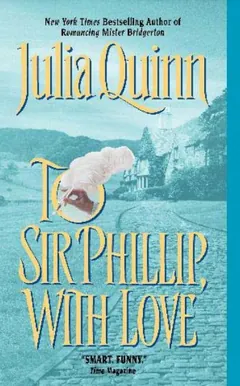
To Sir Phillip, With Love
Chapters
This chapter is long, so it is split into 3 parts.
1
Dear Miss Bridgerton...
2
...and then, I’m sure you will not be surprised to hear...
3
...you will see why I could not accept his suit.
4
...so sorry to hear that Caroline is colicky and...
5
...implore you, Mother, you MUST
punish Daphne.
6
...should not have let him kiss you.
7
...have never been so bored in all of my life.
8
...how fortunate you are to be at school.
TOC.qxd 8/18/2003 4:49 PM Page 2
9
...we all miss Father, especially this time of year.
10 ...you will never know how unfortunate you are, dearest...
11 ...cannot abide a man who drinks to excess.
12 ...and how did you know that you and Simon...
13 ...and as I’m sure you can imagine, they were all...
14 ...I grant that Mr. Wilson’s face does have a...
15 ...I cannot believe that you will not tell me more.
16 ...you do have the right of it, dearest Kate.
17 ...regardless, Daphne, I do not think you should have run off.
18 ...I do not tell you often enough, dear...
19 ...days are filled with endless amusements.
TOC.qxd 8/18/2003 4:49 PM Page 3
Epilogue
About the Author
By Julia Quinn
Cover
Copyright
About the Publisher
TOC.qxd 8/18/2003 4:49 PM Page 4
18855_ch01.001-372.qxd 1/4/04 8:20 AM Page 1
Prologue
February 1823
Gloucestershire, England
<=
It was ironic, really, that it had happened on such a sunny day.
The first sunny day in, what had it been—six straight weeks of gray skies, accompanied by the occasional sprinkling of light snow or rain? Even Phillip, who’d thought himself impervious to the vagaries of the weather, had felt his spirits lighten, his smile widen. He’d gone outside—he’d had to.
No one could remain indoors during such a splendid display of sunshine.
Especially in the middle of such a gray winter.
Even now, more than a month after it had happened, he couldn’t quite believe that the sun had had the temerity to tease him so.
And how was it that he’d been so blind that he’d not expected it? He’d lived with Marina since the day of their marriage. Eight long years to know the
18855_ch01.001-372.qxd 1/4/04 8:20 AM Page 2
2
Julia Quinn
woman. He should have expected it. And in truth . . .
Well, in truth, he had expected it. He just hadn’t wanted to admit to the expectation. Perhaps he was just trying to delude himself, protect himself, even.
To hide from the obvious, hoping that if he didn’t think about it, it would never happen.
But it did. And on a sunny day, to boot. God certainly had a sick sense of humor.
He looked down at his glass of whiskey, which was, quite inexplicably, empty. He must have drunk the damned thing, and yet he had no memory of doing so. He didn’t feel woozy, at least not as woozy as he should have been. Or even as woozy as he wanted to be.
He stared out the window at the sun, which was slipping low on the horizon. It had been another sunny day today. That probably explained his exceptional melancholy. At least he hoped it did. He wanted an explanation, needed one, for this awful tiredness that seemed to be taking over.
Melancholy terrified him.
More than anything. More than fire, more than war, more than hell itself. The thought of sinking into sadness, of being like her . . .
Marina had been melancholy. Marina had spent her entire life, or at least the entire life he’d known, melancholy. He couldn’t remember the sound of her laughter, and in truth, he wasn’t sure that he’d ever known it.
It had been a sunny day, and—
He squeezed his eyes shut, not certain whether the motion was meant to urge the memory or dispel it.
It had been a sunny day, and . . .
* * *
18855_ch01.001-372.qxd 1/4/04 8:20 AM Page 3To Sir Phillip, With Love
3
“Never thought you’d feel the likes of that on your skin again, eh, Sir Phillip?”
Phillip Crane turned his face to the sun, closing his eyes as he let the warmth spread over his skin.
“It’s perfect,” he murmured. “Or it would be, if it weren’t so bloody cold.”
Miles Carter, his secretary, chuckled. “It’s not as cold as that. The lake hasn’t frozen this year. Just a few patchy spots.”
Reluctantly, Phillip turned away from the sun and opened his eyes. “It isn’t spring, though.”
“If you were wishing for spring, sir, perhaps you should have consulted a calendar.”
Phillip regarded him with a sideways glance. “Do I pay you for such impertinence?”
“Indeed. And rather handsomely, too.”
Phillip smiled to himself as both men paused to enjoy the sun for a few moments longer.
“I thought you didn’t mind the gray,” Miles said conversationally, once they’d resumed their trek to Phillip’s greenhouse.
“I don’t,” Phillip said, striding along with the confidence of a natural athlete. “But just because I don’t mind an overcast sky doesn’t mean I don’t prefer the sun.” He paused, thought for a moment. “Be sure to tell Nurse Millsby to take the children outside today.
They’ll need warm coats, of course, and hats and mittens and the like, but they ought to get a little sun on their faces. They’ve been cooped up far too long.”
“As have we all,” Miles murmured.
Phillip chuckled. “Indeed.” He glanced over his shoulder at his greenhouse. He probably ought to take care of his correspondence now, but he had some seeds he needed to sort through, and truly,
18855_ch01.001-372.qxd 1/4/04 8:20 AM Page 4
4
Julia Quinn
there was no reason he couldn’t conduct his business with Miles in an hour or so. “Go on,” he said to Miles. “Find Nurse Millsby. You and I can deal later.
You know you hate the greenhouse, anyway.”
“Not this time of year,” Miles said. “The heat is rather welcome.”
Phillip arched a brow as he inclined his head toward Romney Hall. “Are you calling my ancestral home drafty?”
“All ancestral homes are drafty.”
“True enough,” Phillip said with a grin. He rather liked Miles. He’d hired him six months earlier to help with the mountains of paperwork and details that seemed to accumulate from the running of his small property. Miles was quite good. Young, but good. And his dry sense of humor was certainly welcome in a house where laughter was never in abundance. The servants would never dare joke with Phillip, and Marina . . . well, it went without saying that Marina did not laugh or tease.
The children sometimes made Phillip laugh, but that was a different sort of humor, and besides, most of the time he did not know what to say to them. He tried, but then he felt too awkward, too big, too strong, if such a thing were possible. And then he just found himself shooing them off, telling them to go back to their nurse.
It was easier that way.
“Go on, then,” Phillip said, sending Miles off on a task he probably should have done himself. He hadn’t seen his children yet today, and he supposed he ought to, but he didn’t want to spoil the day by saying something stern, which he inevitably seemed to do.
18855_ch01.001-372.qxd 1/4/04 8:20 AM Page 5
To Sir Phillip, With Love
5
He’d find them while they were off on their nature walk with Nurse Millsby. That would be a good idea. Then he could point out some sort of plant and tell them about it, and everything would remain perfectly simple and benign.
Phillip entered his greenhouse and shut the door behind him, taking a welcome breath of the moist air. He’d studied botany at Cambridge, taken a first, even, and in truth, he’d probably have taken up an academic life if his older brother had not died at Waterloo, thrusting the second-born Phillip into the role of landowner and country gentleman.
He supposed it could have been worse. He could have been landowner and city gentleman, after all.
At least here he was able to pursue his botanical pursuits in relative serenity.
He bent over his workbench, examining his latest project—a strain of peas that he was trying to breed to grow fatter and plumper in the pod. No luck yet, though. This latest batch was not just shriveled but had even turned yellow, which had not been the expected result at all.
Phillip frowned, then allowed himself a small smile as he moved to the back of the greenhouse to gather his supplies. He never minded too terribly when his experiments did not produce the expected outcome. In his opinion, necessity had never been the mother of invention.
Accidents. It was all about accidents. No scientist would admit to it, of course, but most great invention occurred while one was attempting to solve some other problem entirely.
He chuckled as he swept the shriveled peas aside.
At this rate, he’d cure gout by the end of the year.
18855_ch01.001-372.qxd 1/4/04 8:20 AM Page 6
6
Julia Quinn
Back to work. Back to work. He bent over his seed collection, smoothing them out so that he could examine them all. He needed just the right one for—
He looked up and out the freshly washed glass. A movement across the field caught his eye. A flash of red.
Red. Phillip smiled to himself as he shook his head. It must be Marina. Red was her favorite color, something that he’d always found odd. Anyone who spent any time with her would have surely thought she’d prefer something darker, more somber.
He watched as she disappeared into the wooded copse, then got back to work. It was rare for Marina to venture outside. These days she didn’t often leave the confines of her bedchamber. Phillip was happy to see her out in the sun. Maybe it would restore her spirits. Not completely, of course. Phillip didn’t think even the sun had the ability to do that. But maybe a bright, warm day would be enough to draw her out for a few hours, bring a small smile to her face.
Heaven knew the children could use that. They visited their mother in her room almost every evening, but it wasn’t enough.
And Phillip knew that this lack was not made up for by him.
He sighed, a wave of guilt washing over him. He was not the sort of father they needed, he knew that.
He tried to tell himself that he was doing his best, that he was succeeding in what was his only goal when it came to parenthood—that he not behave in the manner of his own father.
But still he knew it wasn’t enough.
18855_ch01.001-372.qxd 1/4/04 8:20 AM Page 7
To Sir Phillip, With Love
7
With resolute motions, he pushed himself away from his workbench. The seeds could wait. His children could probably wait, too, but that didn’t mean they should. And he ought to take them on their nature walk, not Nurse Millsby, who didn’t know a de-ciduous tree from a coniferous and would most likely tell them that a rose was a daisy and . . .
He glanced out the window again, reminding himself that it was February. Nurse Millsby wasn’t likely to locate any sort of flower in this weather, but still, it didn’t excuse the fact that he ought to take the children on their nature walk. It was the one sort of children’s activity at which he truly excelled, and he ought not shirk the responsibility.
He strode out of the greenhouse but then stopped, not even a third of the way back to Romney Hall. If he was going to fetch the children, he ought to take them out to see their mother. They craved her company, even when she did nothing more than pat them on the head. Yes, they should find Marina.
That would be even more beneficial than a nature walk.
But he knew from experience that he ought not make assumptions about Marina’s state of mind.
Just because she’d ventured outside did not mean that she was feeling well. And he hated when the children saw her in one of her moods.
Phillip turned around and headed out toward the copse where he’d seen Marina disappear just a few moments earlier. He walked with nearly twice the speed of Marina; it wouldn’t take very long to catch up to her and ascertain her mood. He could be back at the nursery before the children set out with Nurse Millsby.
18855_ch01.001-372.qxd 1/4/04 8:20 AM Page 8
8
Julia Quinn
He walked through the woods, easily following Marina’s path. The ground was moist, and Marina must have been wearing heavy boots, because her prints had sunk into the earth with clear definition.
They led down the slight incline and out of the woods, then onto a grassy patch.
“Damn,” Phillip muttered, the word barely audible as the wind picked up around him. It was impossible to see her footprints on the grass. He used his hand to shade his eyes from the sun and scanned the horizon, looking for a telltale scrap of red.
Not near the abandoned cottage, nor at Phillip’s field of experimental grains, nor at the large boulder that Phillip had spent so many hours clambering upon when he was a child. He turned north, his eyes narrowing when he finally saw her. She was heading toward the lake.
The lake.
Phillip’s lips parted as he stared down at her form, moving slowly toward the water’s edge. He wasn’t quite frozen; it was more that he was . . .
suspended . . . as his mind took in the strange sight.
Marina didn’t swim. He didn’t even know if she could. He supposed she was aware that there was a lake on the grounds, but in truth, he’d never known her to go there, not in the eight years they’d been married. He started walking toward her, his feet somehow recognizing what his mind refused to accept. As she stepped into the shallows, he picked up speed, still too far to do anything but call out her name.
But if she heard him, she made no indication, just continued her slow and steady progress into the depths.
18855_ch01.001-372.qxd 1/4/04 8:20 AM Page 9
To Sir Phillip, With Love
9
“Marina!” he screamed, now breaking into a run.
He was still a good minute away, even moving at top speed. “Marina!”
She reached the point where the bottom dropped off, and then she dropped off, too, disappearing under the gunmetal gray of the surface, her red cloak floating along the top for a few seconds before being sucked under after her.
He yelled her name again, even though she couldn’t possibly hear. He skidded and stumbled down the hill leading to the lake, then had just enough presence of mind to yank off his coat and boots before diving into the freezing-cold water.
She’d been under barely a minute; his mind recognized that that was probably not enough time to drown, but every second it took him to find her was one second toward her death.
He’d swum in the lake countless times, knew exactly where the bottom dropped off, and he reached that critical point with swift, even strokes, barely noticing the drag of the water against his heavy clothes.
He could find her. He had to find her.
Before it was too late.
He dove down, his eyes scanning the murky water. Marina must have kicked up some of the sand from the bottom, and he had surely done the same, because the fine silt was swirling around him, the puffy opaque clouds making it difficult to see.
But in the end, Marina was saved by her one col-orful quirk, and Phillip pumped through the water, down to the bottom where he saw the red of her cloak floating through the water like a languorous
18855_ch01.001-372.qxd 1/4/04 8:20 AM Page 10
10
Julia Quinn
kite. She did not fight him as he pulled her to the surface; indeed, she had already lost consciousness and was nothing more than a dead weight in his arms.
They broke out into the air, and he took great, big gasps to fill his burning lungs. For a moment he could do nothing but breathe, his body recognizing that it had to save itself before he could save anyone else. Then he pulled her along to the shore, careful to keep her face above water, even though she didn’t seem to be breathing.
Finally, they reached the water’s edge, and he dragged her upon the narrow strip of dirt and pebbles that separated the water from the grass. With frantic movements he felt in front of her face for air, but there was none emerging from her lips.
He didn’t know what to do, hadn’t thought he’d ever have to save someone from drowning, so he just did what seemed most sensible and heaved her over his lap, face down, whacking her on the back.
Nothing happened at first, but after the fourth violent thrust, she coughed, and a stream of murky water erupted from her mouth.
He turned her over quickly. “Marina?” he asked urgently, lightly slapping her face. “Marina?”
She coughed again, her body wracked by spas-modic tremors. Then she began to suck in air, her lungs forcing her to live, even when her soul desired something else.
“Marina,” Phillip said, his voice shaking with relief. “Thank God.” He didn’t love her, had never really loved her, but she was his wife, and she was the mother of his children, and she was, deep down, beneath her unshakable cloak of sorrow and despair, a
18855_ch01.001-372.qxd 1/4/04 8:20 AM Page 11
To Sir Phillip, With Love
11
good and fine person. He may not have loved her, but he did not want her death.
She blinked, her eyes unfocused. And then, finally, she seemed to realize where she was, who he was, and she whispered, “No.”
“I’ve got to get you back to the house,” he said gruffly, startled by how angry he was over that single word.
No.
How dare she refuse his rescue? Would she give up on life just because she was sad? Did her melancholy amount to more than their two children? In the balance of life, did a bad mood weigh more than their need for a mother?
“I’m taking you home,” he bit out, heaving her none too gently into his arms. She was breathing now, and clearly in possession of her faculties, mis-guided though they may be. There was no need to treat her like a delicate flower.
“No,” she sobbed quietly. “Please don’t. I don’t want . . . I don’t . . .”
“You’re going home,” he stated, trudging up the hill, oblivious to the chill wind turning his sodden clothes to ice; oblivious, even, to the rocky soil pressing into his unshod feet.
“I can’t,” she whispered, with what seemed like her last ounce of energy.
And as Phillip carried his burden home, all he could think was how apt those words were.
I can’t.
In a way, it seemed to sum up her entire life.
By nightfall, it became apparent that fever might succeed where the lake had failed.
18855_ch01.001-372.qxd 1/4/04 8:20 AM Page 12
12
Julia Quinn
Phillip had carried Marina home as quickly as he was able, and, with the aid of Mrs. Hurley, his housekeeper, had stripped her of her icy garments and tried to warm her beneath the goose-down quilt that had been the centerpiece of her trousseau eight years earlier.
“What happened?” Mrs. Hurley had gasped when he staggered through the kitchen door. He hadn’t wanted to use the main entrance, where he might be seen by his children, and besides, the kitchen door was closer by a good twenty yards.
“She fell in the lake,” he said gruffly.
Mrs. Hurley gave him a look that was somehow dubious and sympathetic all at the same time, and he knew that she knew the truth. She had worked for the Cranes since their marriage; she knew Marina’s moods.
She had shooed him out of the room once they had Marina in bed, insisting that he change his own clothing before he caught his death as well. He had returned, though, to Marina’s side. That was his place as her husband, he thought guiltily, a place he had avoided in recent years.
It was depressing to be with Marina. It was hard.
But now wasn’t the time to shirk his duties, and so he sat at her bedside throughout the day and into the night. He mopped her brow when she began to perspire, tried to pour lukewarm broth down her throat when she was calm.
He told her to fight, even though he knew his words fell on deaf ears.
Three days later she was dead.
It was what she’d wanted, but that was little com-
18855_ch01.001-372.qxd 1/4/04 8:20 AM Page 13
To Sir Phillip, With Love
13
fort as Phillip faced his children, twins, just turned seven years old, and tried to explain that their mother was gone. He sat in their nursery, his large frame too big for any of their tot-sized chairs. But he sat, anyway, twisted like a pretzel, and forced himself to meet their gazes as he wrenched out the words.
They said little, which was unlike them. But they didn’t look surprised, which Phillip found disturbing.
“I—I’m sorry,” he choked out, once he reached the end of his speech. He loved them so much, and he failed them in so many ways. He barely knew how to be a father to them; how in hell was he meant to take on the role of mother as well?
“It’s not your fault,” Oliver said, his brown eyes capturing his father’s with an intensity that was unsettling. “She fell in the lake, didn’t she? You didn’t push her.”
Phillip only nodded, unsure of how to respond.
“Is she happy now?” Amanda asked softly.
“I think so,” Phillip said. “She gets to watch you all the time now from heaven, so she must be happy.”
The twins seemed to consider that for quite some time. “I hope she’s happy,” Oliver finally said, his voice more resolute than his expression. “Maybe she won’t cry anymore.”
Phillip felt his breath catch in his throat. He hadn’t realized that they had heard Marina’s sobs.
She only seemed to sink so low late at night; their room was directly above hers, but he’d always assumed they’d already fallen asleep when their mother started to cry.
Amanda nodded her agreement, her little blond
18855_ch01.001-372.qxd 1/4/04 8:20 AM Page 14
14
Julia Quinn
head bobbing up and down. “If she’s happy now,”
she said, “then I’m glad she’s gone.”
“She’s not gone,” Oliver cut in. “She’s dead.”
“No, she’s gone,” Amanda persisted.
“It’s the same thing,” Phillip said flatly, wishing he had something to tell them other than the truth.
“But I think she’s happy now.”
And in a way, that was the truth, too. It was what Marina had wanted, after all. Maybe it was all she had wanted all along.
Amanda and Oliver were quiet for a long while, both keeping their eyes on the floor as their legs swung from their perch on Oliver’s bed. They looked so small, sitting there on a bed that was clearly too high for them. Phillip frowned. How was it that he’d never noticed this before? Shouldn’t they be on lower beds? What if they fell off in the night?
Or maybe they were too big for all that. Maybe they didn’t fall out of bed any longer. Maybe they never had.
Maybe he truly was an abominable father. Maybe he should know these things.
Maybe . . . maybe . . . He closed his eyes and sighed. Maybe he should stop thinking quite so much and simply try his best and be happy with that.
“Are you going to go away?” Amanda asked, raising her head.
He looked into her eyes, so blue, so like her mother’s. “No,” he whispered fiercely, kneeling before her and taking her tiny hands in his own. They looked so small in his grasp, so fragile.
“No,” he repeated. “I’m not going away. I’m not ever going away. . . .”
18855_ch01.001-372.qxd 1/4/04 8:20 AM Page 15
To Sir Phillip, With Love
15
* * *
Phillip looked down at his whiskey glass. It was empty again. Funny how a whiskey glass could go empty even after one filled it four times.He hated remembering. He wasn’t sure what was the worst. Was it the dive underwater or the moment Mrs. Hurley had turned to him and said,
“She’s gone”?
Or was it his children, the sorrow on their faces, the fear in their eyes?
He lifted the glass to his lips, letting the final drops slide into his mouth. The worst part was definitely his children. He’d told them he wouldn’t ever leave them, and he hadn’t—he wouldn’t—but his simple presence wasn’t enough. They needed more.
They needed someone who knew how to be a parent, who knew how to speak to them and understand them and get them to mind and behave.
And since he couldn’t very well get them another father, he supposed he ought to think about finding them a mother. It was too soon, of course. He couldn’t marry anyone until his prescribed period of mourning was completed, but that didn’t mean he couldn’t look.
He sighed, slumping in his seat. He needed a wife. Almost any wife would do. He didn’t care what she looked like. He didn’t care if she had money. He didn’t care if she could do sums in her head or speak French or even ride a horse.
She just had to be happy.
Was that so much to want in a wife? A smile, at least once a day. Maybe even the sound of her laughter?
18855_ch01.001-372.qxd 1/4/04 8:20 AM Page 16
16
Julia Quinn
And she had to love his children. Or at least pretend so well that they never knew the difference.
It wasn’t so much to ask for, was it?
“Sir Phillip?”
Phillip looked up, cursing himself for having left his study door slightly ajar. Miles Carter, his secretary, was poking his head in.
“What is it?”
“A letter, sir,” Miles said, walking forward to hand him an envelope. “From London.”
Phillip looked down at the envelope in his hand, his brows rising at the obviously feminine slant to the handwriting. He dismissed Miles with a nod, then picked up his letter opener and slid it under the wax. A single sheet of paper slipped out. Phillip rubbed it between his fingers. High quality. Expensive. Heavy, too, a clear sign that the sender need not economize to reduce franking costs.
Then he turned it over and read: No. 5, Bruton Street
London
Sir Phillip Crane—
I am writing to express my condolences on the loss of your wife, my dear cousin Marina. Although it has been many years since I last saw Marina, I remember her fondly and was deeply saddened to hear of her passing.
Please do not hesitate to write if there is anything I can do to ease your pain at this difficult time.
Yrs,
Miss Eloise Bridgerton
18855_ch01.001-372.qxd 1/4/04 8:20 AM Page 17
To Sir Phillip, With Love
17
Phillip rubbed his eyes. Bridgerton . . . Bridgerton. Did Marina have Bridgerton cousins? She must have done, if one of them was sending him a letter.
He sighed, then surprised himself by reaching for his own stationery and quill. He’d received precious few condolence notes since Marina had died. It seemed most of her friends and family had forgotten her since her marriage. He supposed he shouldn’t be upset, or even surprised. She’d rarely left her bedchamber; it was easy to forget about someone one never saw.
Miss Bridgerton deserved a reply. It was common courtesy, or even if it wasn’t (and Phillip was quite certain he didn’t know the full etiquette of one’s wife dying), it still somehow seemed like the right thing to do.
And so, with a weary breath, he put his quill to paper.
18855_ch01.001-372.qxd 1/4/04 8:20 AM Page 18
Chapter 1
May 1824
Somewhere on the road from
London to Gloucestershire
The middle of the night
<=
Dear Miss Bridgerton—
Thank you for your kind note at the loss of my wife.
It was thoughtful of you to take the time to write to a gentleman you have never met. I offer you this pressed flower as thanks. It is naught but the simple red campion (Silene dioica), but it brightens the fields here in Gloucestershire, and indeed seems to have arrived early this year.
It was Marina’s favorite wildflower.
Sincerely,
Sir Phillip Crane
Eloise Bridgerton smoothed the well-read sheet of paper across her lap. There was little light by which
18855_ch01.001-372.qxd 1/4/04 8:20 AM Page 19
To Sir Phillip, With Love
19
to see the words, even with the full moon shining through the windows of the coach, but that didn’t really matter. She had the entire letter memorized, and the delicate pressed flower, which was actually more pink than red, was safely protected between the pages of a book she’d nipped from her brother’s library.
She hadn’t been too terribly surprised when she’d received a reply from Sir Phillip. Good manners dictated as much, although even Eloise’s mother, surely the supreme arbiter of good behavior, said that Eloise took her correspondence a bit too seriously.
It was common, of course, for ladies of Eloise’s station to spend several hours each week writing letters, but Eloise had long since fallen into the habit of taking that amount of time each day. She enjoyed writing notes, especially to people she hadn’t seen in years (she’d always liked to imagine their surprise when they opened her envelope), and so she pulled out her pen and paper for most any occasion—births, deaths, any sort of achievement that deserved congratula-tions or condolences.
She wasn’t sure why she kept sending her missives, just that she spent so much time writing letters to whichever of her siblings were not in residence in London at the time, and it seemed easy enough to pen a short note to some far-off relative while she was seated at her escritoire.
And although everyone penned a short note in reply—she was a Bridgerton, of course, and no one wanted to offend a Bridgerton—never had anyone enclosed a gift, even something so humble as a pressed flower.
Eloise closed her eyes, picturing the delicate pink
18855_ch01.001-372.qxd 1/4/04 8:20 AM Page 20
20
Julia Quinn
petals. It was hard to imagine a man handling such a fragile bloom. Her four brothers were all big, strong men, with broad shoulders and large hands that would surely mangle the poor thing in a heartbeat.
She had been intrigued by Sir Phillip’s reply, especially his use of the Latin, and she had immediately penned her own response.
Dear Sir Phillip—
Thank you so very much for the charming pressed flower. It was such a lovely surprise when it floated out of the envelope. And such a precious memento of dear Marina, as well.
I could not help but notice your facility with the flower’s scientific name. Are you a botanist?
Yours,
Miss Eloise Bridgerton
It was sneaky of her to end her letter with a question. Now the poor man would be forced to respond again.
He did not disappoint her. It had taken only ten days for Eloise to receive his reply.
Dear Miss Bridgerton—
Indeed I am a botanist, trained at Cambridge, although I am not currently connected with any university or scientific board. I conduct experiments here at Romney Hall, in my own greenhouse.
Are you of a scientific bent as well?
Yours,
Sir Phillip Crane
18855_ch01.001-372.qxd 1/4/04 8:20 AM Page 21
To Sir Phillip, With Love
21
Something about the correspondence was thrilling; perhaps it was simply the excitement of finding someone not related to her who actually seemed eager to conduct a written dialogue. Whatever it was, Eloise wrote back immediately.
Dear Sir Phillip—
Heavens, no, I have not the scientific mind, I’m afraid, although I do have a fair head for sums. My interests lie more in the humanities; you may have noticed that I enjoy penning letters.
Yours in friendship,
Eloise Bridgerton
Eloise hadn’t been certain about signing with such an informal salutation, but she decided to err on the side of daring. Sir Phillip was obviously enjoying the correspondence as much as she; surely he wouldn’t have finished his missive with a question, otherwise?
Her answer came a fortnight later.
My dear Miss Bridgerton—
Ah, but it is a sort of friendship, isn’t it? I confess to a certain measure of isolation here in the country, and if one cannot have a smiling face across one’s breakfast table, then one might at least have an amiable letter, don’t you agree?
I have enclosed another flower for you. This one is Geranium pratense, more commonly known as the meadow cranesbill.
With great regard,
Phillip Crane
18855_ch01.001-372.qxd 1/4/04 8:20 AM Page 22
22
Julia Quinn
Eloise remembered that day well. She had sat in her chair, the one by the window in her bedchamber, and stared at the carefully pressed purple flower for what seemed like an eternity. Was he attempting to court her? Through the post?
And then one day she received a note that was quite different from the rest.
My dear Miss Bridgerton—
We have been corresponding now for quite some time, and although we have never formally met, I feel as if I know you. I hope you feel the same.
Forgive me if I am too bold, but I am writing to invite you to visit me here at Romney Hall. It is my hope that after a suitable period of time, we might decide that we will suit, and you will consent to be my wife.
You will, of course, be properly chaperoned. If you accept my invitation, I will make immediate plans to bring my widowed aunt to Romney Hall.
I do hope you will consider my proposal.
Yours, as always,
Phillip Crane
Eloise had immediately tucked the letter away in a drawer, unable to even fathom his request. He wanted to marry someone he didn’t even know?
No, to be fair, that wasn’t entirely true. They did know one another. They’d said more in the course of a year’s correspondence than many husbands and wives did during the entire course of a marriage.
18855_ch01.001-372.qxd 1/4/04 8:20 AM Page 23
To Sir Phillip, With Love
23
But still, they’d never met.
Eloise thought about all of the marriage proposals she’d refused over the years. How many had there been? At least six. Now she couldn’t even remember why she’d refused some of them. No reason, really, except that they weren’t . . .
Perfect.
Was that so much to expect?
She shook her head, aware that she sounded silly and spoiled. No, she didn’t need someone perfect.
She just needed someone perfect for her.
She knew what the society matrons said about her. She was too demanding, worse than foolish.
She’d end up a spinster—no, they didn’t say that anymore. They said she already was a spinster, which was true. One didn’t reach the age of eight and twenty without hearing that whispered behind one’s back.
Or thrown in one’s face.
But the funny truth was, Eloise didn’t mind her situation. Or at least she hadn’t, not until recently.
It had never occurred to her that she’d always be a spinster, and besides, she enjoyed her life quite well. She had the most marvelous family one could imagine—seven brothers and sisters in all, named alphabetically, which put her right in the middle at E, with four older and three younger. Her mother was a delight, and she’d even stopped nagging Eloise about getting married. Eloise still held a prominent place in society; the Bridgertons were universally adored and respected (and occasionally feared), and Eloise’s sunny and irrepressible personality was such that everyone sought out her company, spinsterish age or no.
18855_ch01.001-372.qxd 1/4/04 8:20 AM Page 24
24
Julia Quinn
But lately . . .
She sighed, suddenly feeling quite a bit older than her twenty-eight years. Lately she hadn’t been feeling so sunny. Lately she’d been starting to think that maybe those crotchety old matrons were right, and she wasn’t going to find herself a husband. Maybe she had been too picky, too determined to follow the example of her older brothers and sister, all of whom had found a deep and passionate love with their spouses (even if it hadn’t necessarily been there at the outset).
Maybe a marriage based on mutual respect and companionship was better than none at all.
But it was difficult to talk about these feelings with anyone. Her mother had spent so many years urging her to find a husband; as much as Eloise adored her, it would be difficult to eat crow and say that she should have listened. Her brothers would have been no help whatsoever. Anthony, the eldest, would probably have taken it upon himself to personally select a suitable mate and then browbeat the poor man into submission. Benedict was too much of a dreamer, and besides, he almost never came down to London anymore, preferring the quiet of the country. As for Colin—well, that was another story entirely, quite worthy of its own paragraph.
She supposed she should have talked to Daphne, but every time she went to see her, her elder sister was so bloody happy, so blissfully in love with her husband and her life as mother to her brood of four.
How could someone like that possibly offer useful advice to one in Eloise’s position? And Francesca seemed half a world away, off in Scotland. Besides, Eloise didn’t think it fair to bother her with her
18855_ch01.001-372.qxd 1/4/04 8:20 AM Page 25
To Sir Phillip, With Love
25
silly woes. Francesca had been widowed at the age of twenty-three, for heaven’s sake. Eloise’s fears and worries seemed terribly inconsequential by comparison.
And maybe all this was why her correspondence with Sir Phillip had become such a guilty pleasure.
The Bridgertons were a large family, loud and boisterous. It was nearly impossible to keep anything a secret, especially from her sisters, the youngest of whom—Hyacinth—could probably have won the war against Napoleon in half the time if His Majesty had only thought to draft her into the espionage service.
Sir Phillip was, in his own strange way, hers. The one thing she’d never had to share with anyone. His letters were bundled and tied with a purple ribbon, hidden at the bottom of her middle desk drawer, tucked underneath the piles of stationery she used for her many letters.
He was her secret. Hers.
And because she’d never actually met him, she’d been able to create him in her mind, using his letters as the bones and then fleshing him out as she saw fit.
If ever there was a perfect man, surely it had to be the Sir Phillip Crane of her imagination.
And now he wanted to meet? Meet? Was he mad?
And ruin what had to be the perfect courtship?
But then the impossible had occurred. Penelope Featherington, Eloise’s closest friend for nearly a dozen years, had married. And what’s more, she’d married Colin. Eloise’s brother!
If the moon had suddenly dropped from the sky and landed in her back garden, Eloise could not have been more surprised.
18855_ch01.001-372.qxd 1/4/04 8:20 AM Page 26
26
Julia Quinn
Eloise was happy for Penelope. Truly, she was.
And she was happy for Colin, too. They were quite possibly her two most favorite people in the entire world, and she was thrilled that they had found happiness. No one deserved it more.
But that didn’t mean that their marriage hadn’t left a hollow spot in her life.
She supposed that when she’d been considering her life as a spinster, and trying to convince herself that it was what she really wanted, Penelope had always been there in the image, spinster right beside her. It was acceptable—almost daring, even—to be twenty-eight and unmarried as long as Penelope was twenty-eight and unmarried, as well. It wasn’t that she hadn’t wanted Penelope to find a husband; it was just that it had never seemed even the least bit likely.
Eloise knew that Penelope was wonderful and kind and smart and witty, but the gentlemen of the ton had never seemed to notice. In all her years in society—
eleven in all—Penelope had not received one proposal of marriage. Nor even a whiff of interest.
In a way, Eloise had counted on her to remain where she was, what she was—first and foremost, Eloise’s friend. Her companion in spinsterhood.
And the worst part—the part that left Eloise wracked with guilt—was that she’d never given a thought to how Penelope might feel if she married first, which, in truth, she’d always supposed she would do.
But now Penelope had Colin, and Eloise could see that the match was a splendid thing. And she was alone. Alone in the middle of crowded London, in the middle of a large and loving family.
It was hard to imagine a lonelier spot.
18855_ch01.001-372.qxd 1/4/04 8:20 AM Page 27
To Sir Phillip, With Love
27
Suddenly Sir Phillip’s bold proposal—tucked away at the very bottom of her bundle, at the bottom of the middle drawer, locked away in a newly purchased safebox, just so that Eloise wouldn’t be tempted to look at it six times a day—well, it seemed a bit more intriguing.
More intriguing by the day, frankly, as she grew more and more restless, more dissatisfied with the lot in life that she had to admit she’d chosen.
And so one day, after she’d gone to visit Penelope, only to be informed by the butler that Mr. and Mrs.
Bridgerton were not able to receive visitors (uttered in such a way that even Eloise knew what it meant), she made a decision. It was time to take her life into her own hands, time to control her destiny, rather than attending ball after ball in the vain hope that the perfect man would suddenly materialize before her, never mind that there was never anybody new in London, and after a full decade out in society, she’d already met everyone of the appropriate age and gender to marry.
She told herself that this did not mean she had to marry Sir Phillip; she was merely investigating what seemed like it might be an excellent possibility. If they did not suit, they would not have to marry; she’d made no promises to him, after all.
But if there was one thing about Eloise, it was that when she made a decision, she acted upon it quickly.
No, she reflected with a rather impressive (in her opinion, at least) display of self-honesty, there were two things about her that colored her every action—
she liked to act quickly and she was tenacious. Penelope had once described her as akin to a dog with a bone.
18855_ch01.001-372.qxd 1/4/04 8:20 AM Page 28
28
Julia Quinn
And Penelope had not been joking.
Once Eloise got her claws into an idea, not even the full force of the Bridgerton family could sway her from her intended goal. (And the Bridgertons constituted a mighty force, indeed.) It was probably just dumb luck that her goals and those of her family had never crossed purposes before, at least not over anything important.
Eloise knew that they would never countenance her going off blindly to meet a man she’d never met.
Anthony would have probably demanded that Sir Phillip come to London to meet the entire family en masse, and Eloise couldn’t imagine a single scenario more likely to scare off a prospective suitor. The men who’d previously sought her favor were at least familiar with the London scene and knew what they were getting into; poor Sir Phillip, who had—by his own admission in his letters—not set foot in London since his school days, and never participated in the social season, would be ambushed.
So the only option was for her to travel to Gloucestershire, and, as she came to realize after pondering the problem for a few days, she had to do it in secret. If her family knew of her plans, they might very well forbid her to go. Eloise was a worthy opponent, and she might prevail in the end, but it would be a long and painful battle. Not to mention that if they did allow her to go, whether after a protracted battle over the subject or not, they would insist upon sending at least two of their ranks to accompany her.
Eloise shuddered. Those two would most probably be her mother and Hyacinth.
Good gad, no one could fall in love with those two
18855_ch01.001-372.qxd 1/4/04 8:20 AM Page 29
To Sir Phillip, With Love
29
around. No one could even form a mild but lasting attachment, which Eloise thought she might actually be willing to settle for this go-around.
She decided that she would make her escape during her sister Daphne’s ball. It was to be a grand affair, with hordes of guests, and just the right amount of noise and confusion to allow her absence to go unnoticed for a good six hours, maybe more. Her mother had always insisted that they be punctual—
early, even—when a family member was hosting a social event, so they would surely arrive at Daphne’s no later than eight. If she slipped away early on, and the ball did not wind down until the wee hours of the morning . . . well, it would be nearly dawn before anyone realized she was gone, and she could be halfway to Gloucestershire.
And if not halfway, then far enough to ensure that they wouldn’t find it too terribly easy to follow her trail.
In the end, it had all proven almost frighteningly easy. Her entire family had been distracted by some grand announcement Colin planned to make, and so all she’d had to do was excuse herself to the ladies’ retiring room, slip out the back, and walk the short distance to her own home, where she’d hidden her bags in the back garden. From there, she needed only to walk to the corner, where she’d arranged to have a hired coach waiting.
Goodness, if she’d known it would be this easy to make her own way in the world, she would have done so years ago.
And now here she was, rolling toward Gloucestershire, rolling toward destiny, she supposed—or hoped, she wasn’t sure which—with nothing but a
18855_ch01.001-372.qxd 1/4/04 8:20 AM Page 30
30
Julia Quinn
few changes of clothing and a pile of letters written to her by a man she’d never met.
A man she hoped she could love.
It was thrilling.
No, it was terrifying.
It was, she reflected, quite possibly the most fool-hardy thing she’d done in her life, and she had to admit that she’d made a few foolish decisions in her day.
Or it might just be her only chance at happiness.
Eloise grimaced. She was growing fanciful. That was a bad sign. She needed to approach this adven-ture with all the practicality and pragmatism with which she always tried to make her decisions. There was still time to turn around. What did she know about this man, really? He’d said quite a lot over the course of a year’s correspondence—
He was thirty years of age, two years her elder.
He had attended Cambridge and studied botany.
He had been married to her fourth cousin Marina for eight years, which meant that he’d been twenty-one at his wedding.
He had brown hair.
He had all of his teeth.
He was a baronet.
He lived at Romney Hall, a stone structure built in the eighteenth century near Tetbury, Gloucestershire.
He liked to read scientific treatises and poetry but not novels and definitely not works of philosophy.
He liked the rain.