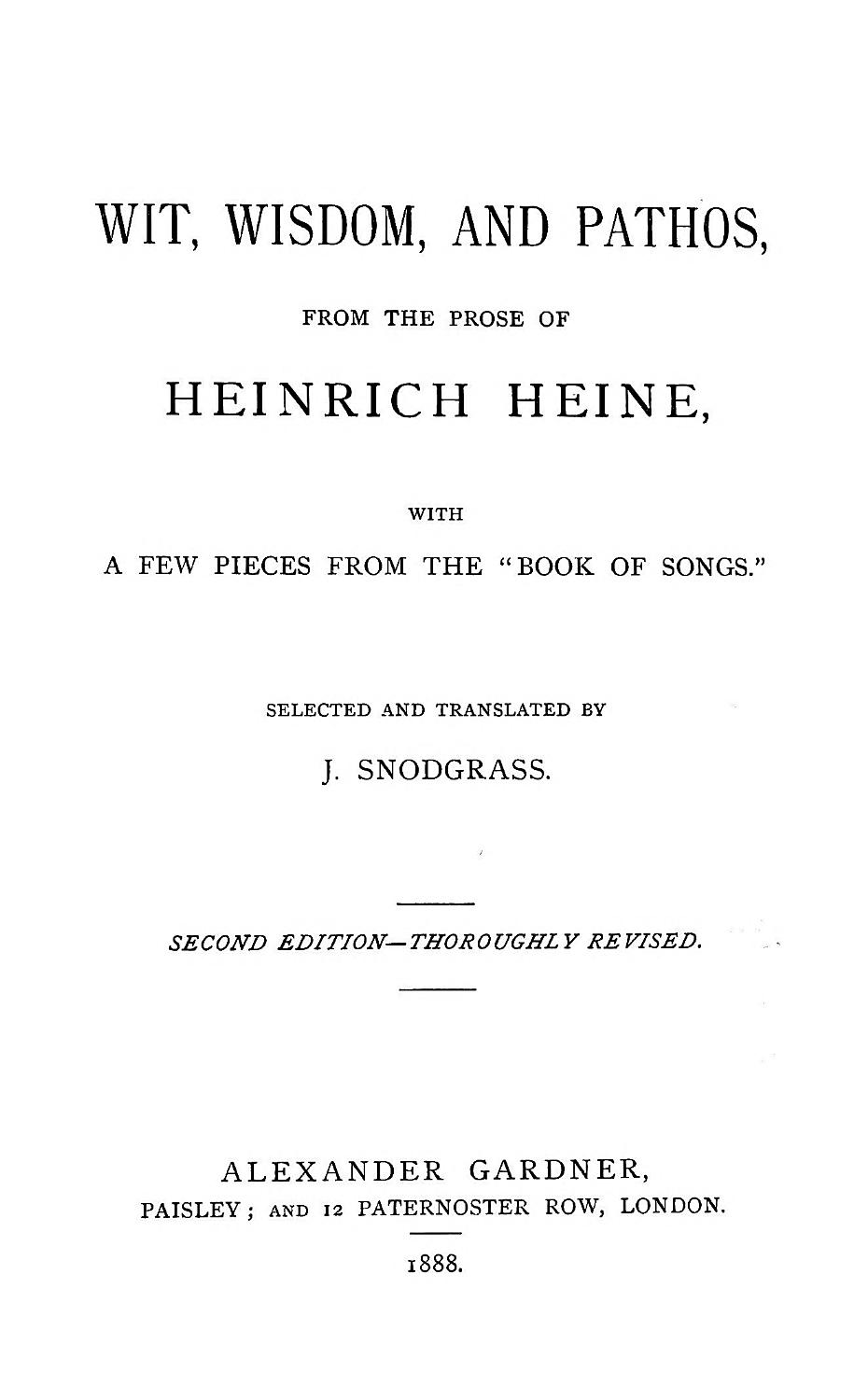
Wit, Wisdom, and Pathos
Wit, Wisdom, and Pathos is an English language selection from the writings of Heinrich Heine, the great German Romantic poet and prose writer who lived from 1797 to 1856. Heine is one of the central figures of nineteenth century German literature and one of the most widely translated German writers in the English speaking world. Various selection volumes of his work appeared in English in the late nineteenth century to make accessible the range of a writer whose complete works in German ran to many volumes and to many different genres.
The selection brings together passages from across Heine’s enormous body of work, organized to display the three qualities the title identifies. The wit is drawn principally from his prose writings, including the essays, the travel pieces like the Reisebilder, and the various critical and polemical works that occupied much of his career as a journalist in Paris during his long exile from Germany. The wisdom is drawn from his more reflective prose and from his many aphorisms and short philosophical observations scattered through his work. The pathos is drawn largely from his poetry, particularly from the Buch der Lieder which contains the lyric poems that established his reputation as one of the great German poets and that inspired the many musical settings by Schubert, Schumann, Mendelssohn, and others that have kept his name alive in European concert culture.
Heine was one of the most distinctive voices in nineteenth century European literature. He combined the lyric intensity of the German Romantic tradition with a sharp ironic wit that constantly punctured romantic sentiment, often within the same poem. The famous device of the romantic statement followed by the deflating final line is essentially his invention. The prose has the same combination of seriousness and irony. He was a fierce critic of German political reaction and German philistinism, a sympathetic observer of French political and cultural life, and one of the most acute Jewish voices of his century writing on the situation of Jews in a Christian Europe.
The selection runs about three hundred pages and gives a reasonable introduction to Heine for readers who do not read German. For readers wanting more, the natural follow ons are larger translations of the Buch der Lieder and of the prose travel pieces. It pairs naturally with the English translations of his Reisebilder and Atta Troll.
About the Author
Download free books by Heinrich Heine on BDeBooks. Read Heinrich Heine’s works online or download as PDF/EPUB · part of our growing free eBook collection.
See all books by Heinrich Heine →