
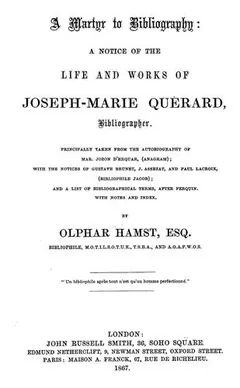
A martyr to bibliography
Start
Ce chapitre est long, il est donc découpé en 3 parties.
This work singular as it is, is far from being so well known
as it should be, because the whole edition is in the libraries
of amateurs of bibliographical propensities. It is now very
rare and another edition is everywhere called for. Often are
amusement and instruction looked for side by side, and on this
score few books are so captivating as this fearless compendium
of literary frauds discovered. And if this or that name is
the object of an accumulation of pages, it is all the more
deplorable, because they are true. We must refer the reader
to the names of supposed authors. (Having given the titles of
several works the critic proceeds to say:)—
This as is apparent is an assemblage of considerable works.
They have not made the fortune of their indefatiguable author;
they have only given him renown, with a certain number who
appreciate the difficulty and the range of such a work and who
are astonished that one man, who has been able to execute them,
does not occupy a high position in our National Library. That
which M. Quérard has experienced is the inevitable misfortune
which attaches to all who attempt to disseminate truth. And
in fact his numerous works demand from their merits, a kind
of implacability, it was necessary to say all. He has made
numerous and powerful enemies. It was for the public to
compensate him, as it was to enlighten and instruct the public
that this pitiless, and too precise bibliographer encountered
the hatred which is the cause of his poverty. I nevertheless
doubt, even if he could begin his career anew, with a
fore-knowledge of all the dangers of truthfulness before him,
whether a man of his stamp of integrity would be able to allow
himself to make the least concession to pride, were it even to
those men who vote at the “Palais Mazarin”! M. Quérard is of a
family of incorrigibles and truth is his idol.[25]
“The title alone of this book promises a great scandal: the most interesting revelations. What a bait for malignity! What attraction for legitimate curiosity! There are some articles in it which of themselves would make the reputation of any book, such as the long notice of Cagliostro where M. de Courchamp is so severely treated, and that on Catherine, the great Catherine, she whom Voltaire, Diderot and d’Alembert, whom the prince de Ligne called “Catherine the great,” and whom M. P. R. A.-S the coadjutor of M. Quérard successively strips of all the literary titles by which she was gratified; and even of the familiar letters leaving her nothing in French, but an incorrect and barbarous style devoid of talent, wit, or understanding.”[26]
The original title of this work was Les Auteurs &c.[27] Les Supercheries Littéraires Dévoilées was added on the cover to the third part and afterwards to the title-page.
“As will be seen M. Quérard has changed the title (during publication) and made it even a little more satirical than it was before.”[28] But the principal articles from which a book might be composed is devoted to M. Alexandre Dumas. One of M. Quérard’s coadjutors[29] has nurtured this article with affection or rather with ingenious and indefatigable hatred. We cannot but deplore that a talented writer should so often allow himself to overlook the dictates of delicacy, and be led away by the ardour of his unexampled industry. We ought to say that the article in which M. Dumas is placed, as if upon his trial, breathes a tone that should render the most legitimate criticism suspicious. The articles of accusation begin at page 404, and end at 480. “This only embraces the dramatic pieces of the accused, or rather the condemned one. The novels come next, and heaven knows what that promises.[30] In this part, the critic who has taken charge of M. Alexandre Dumas finishes with a furious and unparalleled slaughter; he gives the last blows with a sledge hammer. No doubt M. Dumas will not die of the effects; he will only come out bruised and scratched; but the knowing reader will have had his laugh, and that is a great point in this “vale of tears.” In running over the other articles, we do not recover from our surprise when we find M. Quérard well posted up in so many intrigues, initiated in so many mysteries and artifices. He is as terrible as remorse, and formidable as conscience. The preliminary discourse upon literary frauds ancient and modern is equally full of singular and curious incidents.”[31]
It has lately been said, but we do not believe it, that the
author of that terrible pamphlet against Alexandre Dumas in
the SUPERCHERIES is chiefly the work of Signor Florentino,
who is supposed to be one of the coadjutors of the celebrated
dramatist-novelist, and who says he is author of the first part
of Monte Christo. One thing which no one can explain astonishes
us; that of all the writers who pretend to have so nobly sold
their genius to Alexandre Dumas, there is not one who has been
able to write a line for his own profit which anyone will
buy.[32]
In the notice on the death of Louis Philippe, King of the
French, some observations will be found on Quérard’s in the
SUPERCHERIES.[33]
The name of Quérard, already of European reputation by his
numerous writings, will one day be graven in letters of gold
over the portals of every library in the French dominions, as
that of the most faithful guide of the librarian devoted to the
study of French Literature.[34]
An article in La Silhouette for 30 January 1848, signed “Le Rat,” (Pseud. Auguste Vitu) imputed numerous errors to Quérard, and at the word “Rat,” in Les Supercheries, he reprints the article, and convicts the “Rat” of numerous errors and shows that he was right. We however cannot but consider that a work like this is not the place for a discussion, which certainly should not have occupied its pages, and doubtless in the second edition all such blemishes as these would have been removed. The Baron de Reiffenberg, though a great friend and coadjutor of Quérard, having contributed many articles to the Supercheries, is exposed like all the rest. Quérard says that he much regrets the task imposed upon him, but he should lose the good opinion of the shade of the Baron, if he were not conscientiously to carry out the article. No doubt if the Baron had been alive this article would have been just the same, though at the risk of losing one of his best friends.
The article on Alexandre Dumas, occupying 170 octavo pages, contains the most extraordinary disclosures of literary frauds and peccadillos ever exposed in any nation or in any age. By this article it seems that M. Alexandre Dumas has committed every imaginable literary fraud, and a great many unimaginable ones. This is only a sample, the book from beginning to end is the same, only every one it exposes or discloses is not of such world-wide renown.
In a note at p. 483, we learn that Thackeray concerned himself about M. Dumas and the length of French novels, which he satirically wishes would never end. Almost as a fulfilment of his wish M. Dumas published Les Mémoires d’un Médecin, which the circulating libraries announced would be in 80 volumes.[35]
Here we find that those extraordinary and popular works Les Trois Mousquetaires, Vingt ans après, &c., are not written by Alexandre Dumas, and much other interesting information relative to the works themselves. But disappointment borders on disgust when we learn that we have been cheated into thanking M. Dumas for Monte Christo.
An Index to the Article is given, and one of authors “whom M. Dumas has snatched from bad society to introduce into good;” in all 73.
Quérard began the second edition, under the following title:—_Les Supercheries L. D. G. des E. F. de toute l’Europe qui se sont déguisés sous des anagrammes, des astéronymes, des boustrophédons, des criptonymes, des initialismes, des noms littéraires, des pseudonymes facétieux et bizarres, etc., découverts ou non; des auteurs apocryphes, etc. Précédé d’un introduction intitulée “Des Supercheries littéraire anciennes et moderne, plus particulièrement en France.” Par &c. avec le concours de bibliothécaires et bibliophile Français Belges, Suisses, etc._ But death carried him off when the first part only was published. The articles instead of 9430 would have been about 30,000.[36]
There is probably no necessity for a work on literary frauds in so caustic a style as Quérard’s, but that there is ample scope for such a work in English literature there cannot be the least doubt. Some of our pseudonyms are the most grotesque, some are harmless, some absurd, and some infamous.[37]
We trust that the second edition of the Supercheries will be taken up by one of France’s numerous talented bibliographers. But do not let it be an expurgated edition; if there are passages which the editor might think would be better softened down let him not touch it. Let Quérard speak. The editing should be confined to revision and correction. The reflections in the second cannot be more severe than in the first edition, and the worst complaint he had was only that of a second-rate writer, who said that Quérard had falsely ascribed a pseudonym to him, which was partly true. Quérard himself says:—“L’Auteur tenait beaucoup, et non sans raison, à publier lui-même ses matériaux si laborieusement rassemblés, et, qui pouvaient plus tard tomber en des mains étrangères à la science de toute sa vie qui n’hésiteraient pourtant point à les éditer, malgré la conviction de n’y rien entendre, si nous pouvons en juger par ce qui se passe journellement sous nos yeux.”[38]
So entirely was he absorbed by his laborious studies that our learned bibliographer never gave his own interests present or future a passing thought, so that from the time when he first made known his talents to the world in 1827, up to the date of his death he was constantly in a most precarious position. The years 1845 and 1854 were worse than any others.
In 1845, the brothers Daguin, publishers of the Littérature Française contemporaine, bought a number of French classics, expurgated in favor of the methodist protestants, which swallowed up the capital their father had left them two years before. One of them seeing that the bankruptcy of the firm was imminent (it effectually disappeared the same year) put himself in a position to continue the Littérature contemp., though without the slightest knowledge or preparatory study, required for such a work, of which in fact he was only the publisher. The agreement Quérard had made with him in good faith, but which was only an extract of one Messrs. Didot had imposed upon him, received a most perfidious interpretation, as we have seen above, for the author was unjustly though legally deprived of the result of his own labors: of the emanation of his brain. He appealed, but only made the case worse, the judges confirmed the award of the arbitrator, and mulcted him not only in damages and interest, but in the costs with a stipulation that he was to be arrested if he did not pay. M. F. Daguin desirous that every one should know the sort of man he was, pressed Quérard with unheard of severity, and pushed his barbarity so far as to get him condemned to five years imprisonment at Clichy. Luckily the information had been improperly laid; there was a flaw in the instructions, and Quérard was freed after only three months imprisonment. But he had to pay this man who had deprived him of his means of living, 1600 francs, more than he received for editing a volume and a half of his work. The cowardly indignities of the publisher, who in one of his letters has the impudent hypocrisy to say that he had been lenient with Quérard, and had not prosecuted him to the utmost rigor of the law, did not cease there. Knowing that he had effectually deprived our bibliographer of every means of establishing his rights, he put the finishing stroke to his perfidy. In the preface of Vol. VI. of La France Littéraire, Quérard promised a supplement to that work when finished, to include all additions and corrections, from 1700 to 1842. To deprive him of this resource, the publisher no sooner possessed himself of La Litt. Française Contemporaine than he altered its plan, and introduced additions which were totally out of place. Then the Supercheries and the XI. Vol. of La France Littéraire appeared, and as each new part was published, so was it pillaged to ameliorate and supply the defects of the publisher’s book. Thus nearly 1200 articles whether belonging to the original plan or not of La Littérature contemporaine were stolen from the former to enrich the latter. The only answer to the author’s complaints was that “Les Supercheries of Quérard belonged to everybody!”
Un Feuillet pour les Supercheries littéraires dévoilées de Quérard; par S. P. Y. de Moscou [_Serge Poltoratzky_] et J.-M. Quérard. In Bibliographie de la France, XXXVII. année. Paris. Pillet aîné, 1848. 8ᵛᵒ.
(XIV.)—_Bibliographie la Mennaisienne. Notice Bibliographique des ouvrages de M. de la Mennais, de leurs réfutations, de leurs apologies, et des biographes de cet écrivain. Troisième édition augmenté. 1850; 2 fr. 50 c. (1st ed. 1849; 149.)_
This pamphlet was extracted from the SUPERCHERIES, with
additions.
The Biographie La Mennaisienne presents a lamentable spectacle.
We have a Priest, first orthodox, then sincere, and anon
gradually inclining towards apostacy and impiety, choked with
pride and spleen, up to the very day when the verse of Tartuffe
could be applied to him:—
“Voilà je vous l’avoue, un abominable homme.”[39]
(XV.)—_Omissions et bévues du livre intitulé “La Littérature Française Contemporaine,” par M. M. Louandre et F. Bourquelot, ou Correctif de cet ouvrage, avec cette épigraphe: Male parta, male dilabuntur. (Première livraison). (Bon.-Chr.)_ 1848, 8ᵛᵒ.; xx. 33, 2 fr.; L. P. 4 fr. Double columns, with two lithographs.
Réponse aux calomnies que M. Quérard a dirigées contre moi dans son dernier pamphlet intitulé Omissions et bévues de la L. F. C. (signed F. Daguin.) Paris. 1848; 8ᵛᵒ.
M. Félix Daguin, after having agreed with M. Quérard for the
continuation of his FRANCE LITTÉRAIRE broke his agreement
without any real (or rather avowable) motive and then obtained
the services of M. M. Louandre, and Bourquelot, men of talent.
M. Quérard’s absence however very soon became apparent.
Everybody had not his intrepid capacity for exploration, nor
his incessant desire for exactitude, qualities which no vices
of editorship can obscure. M. Quérard attributes the errors in
the continuation of his work to the publisher, rather than to
the gentlemen who edit it. He takes up the work where he left
it, and carries on his revision slowly but surely. The errata
of the second volume is perfectly frightful. It is evidence to
which there is no reply. To an argument of this kind there is
no opposition but silence.[40]
(XVI.)—_Encyclopédie du Bibliothécaire. Prospectus 1850._ Another under this title:—_Encyclopédie du B. de l’homme d’études et du bibliophile Français. Dernier Prospectus—spécimen 1851; r. 8; 24._ We then have 8 pages of the names of 382 subscribers; he had eventually 800, but had determined not to publish under 1000.
This is a work so vast that the life of one man would have been insufficient to execute it unaided. A long list of co-editors is given, comprising all the bibliographical talent of France.
This prospectus suggested M. M. Denis and Pinçon the idea of their very excellent Nouvel Manuel de Bibliographie Universelle. Paris. 1857; 8ᵛᵒ. A microscopical miniature of the one Quérard dreamt of, and one day would have published, we believe, had he lived. A comparison with the table of Brunet’s great work will generally prove to the advantage of the former. It was to have been in 15 royal octavo volumes, of about 800 pages each, double columns, with engravings; six specimen portraits are given in this prospectus; each volume 25 francs.
(XVII.)—_Notice des travaux Bibliographiques de M. J.-M. Quérard, de Rennes (Ille-et-Vilaine), (né le 25 Décembre 1797), avec les jugements portés par les critiques._ No title-page. Paris, 1850; 32. Includes Nos. II., VII., X., XII., XIII. There are thirteen pages of critiques on this work quoted. XIV., five pages of critiques quoted, and XVI.
(XVIII.)—_Les Plagiats Reiffenbergiens dévoilés. Extrait du tome IV. des “Supercheries Littéraires.” Paris._ 1851; 8ᵛᵒ. 39; 2 francs. Only 50 copies printed.
(XIX.)—_Notice sur les études littéraires, historiques et bibliographiques, de M. Bajot. Paris._ 1852; 8ᵛᵒ.; 16.
(XX.)—_Notice sur M. Serge Poltoratzky bibliophile et bibliographe russe, membre honoraire de la Bibliothèque Impériale publique de Saint-Pétersbourg. Paris, imprimerie de W. Remquet et Cie. successeurs de P. Renouard, rue Garancière, No. 5, Novembre 1854; 20. Signed J.-M. Quérard._ Only 100 copies printed. An extract from Vol. XI. of L. F. L. Not in double columns.
Moucherat de Longpré. Problème littéraire definitivement résolu en 1854, par M. Quérard.[41] An article upon this subject by that noble-minded Russian, M. Serge Poltoratzky.
In 1854, the son of a man of ninety-three having disputed the right of the author of Les supercheries littéraires dévoilées, to extract from the Moniteur of the time a notice of his father, delayed judgment for two years, and prevented the completion of Quérard’s work, and finally imposed upon him the circulation of an extra sheet containing an historical falsehood. Not only was the printing suspended, but the printers who were pestered by the incessant demands of the son, wanted to be rid of so troublesome a customer as Quérard. They therefore required an authority to receive for three years the pension allowed the bibliographer by the minister of public instruction, to cover the expenses of printing which were then due. It was then, when deprived of every means of support, as he had been in 1845, always of course reckoning on the sympathy of his habitual readers, that he founded in 1855 a bibliographical Journal entitled after his own name:—
(XXI.)—_Le Quérard. Archives d’histoire littéraire de biographie et de bibliographie française. Complément périodique de la France littéraire. Par l’auteur de La France Littéraire, des Supercheries Littéraires Dévoilées, etc. etc. (Mottoes:)—Arrière, camarades et ereinteurs; mais à nous les hommes de vrai savoir et de conscience.—Ceci est un livre de bonne foi.—Montaigne. Paris, au bureau du Journal, passage Dauphine, escalier_ H. 1855-6; 8ᵛᵒ; 587—II. 648. The index, pages 645 to 648, vol. II., is frequently wanting. This, unfortunately, turned out another bad speculation for its unlucky editor. An article of several pages is devoted to this journal, in the Bulletin du Bib. Belge, XI. 145; 246, XII., 151.
As this work is almost a supplement to his others, and contains some valuable articles not elsewhere, we give a summary:—
Les Bridel, I. 88. by Ph. Bridel.—La Bibliographie devant les
Tribunaux M. de Saint-Albin v. Quérard p. 183.—Bibliothèque
des frères Gébéodé.—Coup d’œil retrospectif sur le Zombi du
Grand-Pérou, p. 187. II: 328. Livres intéressants pour la
France dans la Bibliotheca Grenvillana, p. 189. Les Aventures
de Faublas, 388. Sur les Mélanges publiés par la Philobiblion
Society, London, 374. Remon Sebon, 447. Indiscrétions d’un
vieux bibliographe. Additions aux Supercheries Littéraires
Dévoilées, 451. Anagramme et Cryptonyme (Blocquel), 553. Du
Catalogue Fortsas, 537, & II., 11. Pourquoi une souscription
Quérard, 542. Vol. II. Sur la Famille d’Honoré Balzac, 7.
Charles Dickens, Fautes d’impressions, 12. Ouvrages de Quérard
49, 643. Etat des livres et des Bibliothèques avant l’invention
de l’imprimerie, 45. Recherches sur quelques écrivains
ridicules, 1, Pierre le Loyer—2, Ch.-Joseph de Grave, 3, Le P.
Maimbourg, 4, Les théologiens jésuites d’Ingolstadt du XVIe
siècle, 49. Technologie Bibliographique, ou vocabulaire de la
Bibliographie érudite, 154. Feuillets de l’Encyclopédie inédite
du Bibliothécaire. Marguerite d’Autriche, Gœthe, 163. France.
Academies, 317. Marie Antoinette d’Autriche, 401-479. Charlotte
Corday, 440. De Stael, 507. Montaigne. 522. Biographie,
Garneau, Historien de Canada, 172. Le Comte Falloux du Coudray,
241. Les contes de Perrault, 251. L. Curmer, 267. De Tribus
Impostoribus, 270. “Le Portrait du Loquettes,” 275. H.-L. Wolff
de Spa, 275. George de Tours, 301. Bibliothèque de Racine;
de Grolier; de Napoleon, 394. Jean Paul Marat, 489. M. Jozon
d’Erquar, 488. Les Clubs de Bibliophiles en Angleterre et les
bibliothèques particulières de Londres, 550. La Roumanie, 567.
La Famille Guizot, 601.[42]
In Le Quérard, he seems first to have used the anagram “d’Erquar,” after a capital explanation of his reasons for publishing parts of the Encyclopédie. He uses it again (Vol. 2. 488) to supplement the monograph of Charlotte Corday. We fancy we trace Quérard’s style in other articles, and it is probable that he used other signatures; thus he quietly indulged sometimes in a little self-adulation, which did no harm, and was probably a source of considerable amusement and satisfaction to him.
Unfortunately from the first year it had not the success Quérard required to clear him of his embarrassments. This last reverse induced him to make another attempt with the minister of public instruction. M. H. Fortoul, who was fond of, and sympathised with the industrious, received the timid petitioner, who lived only in his study, and who was much disconcerted by his visit to the Minister, with great kindness. M. Fortoul spontaneously suggested to him that his right place was in one of the libraries of Paris, and promised to give it his serious consideration on the first vacancy. But M. H. Fortoul died:[43] there was nobody to keep the promise he had made. Our unfortunate bibliographer had still to wait and still to suffer! And he did. He waited and suffered to the last.[44]
M. Beriat-Saint-Prix had compassion on the unfortunate and precarious position of our bibliographer, and one of the most worthy publishers of Paris, whose father of old had put fortune in Quérard’s way by sending him to Austria as an agent, M. Hector Bossange, took the initiative at the beginning of 1855 of a subscription in favor of him, who for upwards of thirty years rendered a service by his estimable labors, not only to literature, but to the literary establishments of every country, and who was yet left without reward. M. Bossange was fortunate enough to make Messrs. Didot brothers and J.-B Baillière join in his sympathy, and the announcement of the subscription was sent forth. M. Bossange, who from the year 1825 always gave Quérard proofs of his esteem and friendship, put his whole soul and prodigious activity to endeavor to make it a success. Truly never was bibliographer the subject of so flattering an ovation. In this subscription which was only got up with the view of asking the aid of French publishers, librarians joined with bibliophiles and foreign librarians; and in the list of those who gave Quérard evidence of their regard, we read the names of Germans, Americans, Spaniards, English, Belgians, Danes, Italians and Russians. The absence of several names is remarkable. For instance the library of the Bibliothèque Impériale of Paris is not represented by a single man, whilst in this list we read the names of three Librarians of the British Museum,[45] one of the Astor Library of New York, one of Moscow, and several others; this was unpatriotic, and in flagrant bad taste, to a man whose works had frequently assisted their learning when at fault. The name of the author of the “Manuel du Libraire” is conspicuous by its absence.
Quérard now thought he was rid of his embarrassments, but he had not reckoned upon that fatality which seemed to attach to him. The subscription was not yet closed when another misfortune struck him. Under the insignificant pretext of a confusion of names, which neither affected his influence nor his interests, a pious writer who wished to occupy the public mind with himself, summoned our bibliographer before the court for this error, which offended his vanity. This devout man consecrated a fraud, of which he had been guilty, and obtained against our poor bibliographer a decree and costs which amounted to 2000 francs! to be deducted from the subscription already reduced one-half by the debts of the journal Le Quérard.
Have we now sufficiently justified the title, as applied to the national bibliograph of France, of “A Martyr to Bibliography?”
(XXII.)—_M. le Baron Modeste de Korff, directeur en Chef de la Bibliothèque Impériale publique de Saint Petersbourg._ 1856; 8ᵛᵒ; 8.
He sometimes spells Korff—Korf.
(XXIII.)—_La Famille Guizot. Monographie bibliographique. Paris. L’auteur, rue Mazarine 27._ 1857; 8ᵛᵒ; 32.
Notices extracted from Le Quérard, and signed by Quérard.
(XXIV.)—_Un Martyr de la Bibliographie. Notice sur la vie et les travaux de J.-M. Quérard, auteur de la F. L., Supercheries L. D. etc., etc., suivie de la liste générale des personnes qui, en Europe et en Amérique, ont pris part à la souscription Quérard en 1855. (Extrait du tome XI. de la France Littéraire) Paris, l’éditeur, rue Mazarine, 27._ 1857; 8ᵛᵒ; 15
+ 8.
The “notice” begins on page 5, and ends at 15, and is subscribed:—_Un compatriote et ami du Bibliographe Mar Jozon d’Erquar_ [anagram of Quérard]; then follows:—_Pièces dans la souscription-Quérard lettre des Promoteurs_.
It is signed Ambroise-Firmin Didot, J.-B. Baillière, Hector Bossange et fils. Dated, Paris, 15 Nov., 1855. From the Feuilleton de la Bibliographie, de la France, 23 Nov., 1855. Then follows:—_Pourquoi une souscription Quérard?_ signed by the latter and extracted from Le Quérard of Dec. 1855. We then have:—_Liste générale de M. M. les libraires, bibliophiles littérateurs et bibliothécaires de l’Europe et de l’Amérique qui ont pris part à la souscription proposée par M. M. F. Didot, J.-B. Baillière, et H. Bossange et fils, en faveur du Bibliographe Français J.-M. Q. pp. 8_.
It is headed by the Emperor of the French 500 francs. The last name is “Watts (Thomas).” It amounts to nearly 4,500 francs.
(XXV.)—_Une question d’histoire littéraire résolue. Réfutation du paradoxe bibliographique de M. R. Chantelauze: le comte Joseph de Maistre auteur de “L’antidote au congrès de Rastadt.” Par l’auteur des S. L. D. Paris, l’auteur, rue Mazarine, 27. Lyon: Marius Conchon, libraire, rue Impériale, 15. 16 Juillet._ 1859; 42. Not in double columns.
Notice on La vie et ouvrages du P. N. Grose. Par le P. A. A. Cadrès. Paris, 1862, in the Bulletin du Bouquiniste of Aubry. Paris, 8ᵛᵒ. p.
202.
He continued the Feuillets de l’Encyclopédie (inédite) du Bibliothécaire (_E. H. A. Gaullieur_) in the Bulletin du Bouquiniste of Aubrey. Paris, 1863, p. 371, et seq.
(XXVI.)—_Retouches au nouveau Dictionnaire des Ouvrages Anonymes et Pseudonymes de M. E. De Manne par l’auteur Des Supercheries Littéraires dévoilées. Paris, chez l’auteur, Quai Saint-Michel, 21. Juillet, 1862_; 8ᵛᵒ; VIII. 46 double columns, 4 francs. De Manne’s came out in May.
We advise any one who wishes to get an idea of these corrections to go through the six pages of errata at the end. Well may Quérard call De Manne an amateur bibliograph, when he allows such errors and defects to appear.
Dr. Petzholdt praises these “Retouches” very highly.[46]
“As for the Dictionary of M. de Manne, the “Retouches”
comprises a table of authors, and a considerable errata of
great ability, which will be precious for those who possess the
work. This shows that M. Quérard does not consider the work of
De Manne beneath his notice, as he takes the trouble to make it
complete.”[47]
(XXVII.)—_Monographie Bibliographique._ (Half-title). Les Robespierre. Monographie Bibliographique. Par J.-M. Q. Paris: L’Éditeur, Quai Saint-Michel, No. 21. Mars, 1863. 8ᵛᵒ; 44; 4 francs. Double columns. It has no index.
Extracted from Vol. XII. of La France Littéraire. 100 copies printed. Comprises 320 articles.
“A little masterpiece, the perusal of which will greatly
interest amateurs of historical researches. M. Quérard does not
limit himself to the titles of books, he considers it necessary
to know the contents. Thus arise certain prejudices against
him. If he had written in more measured terms of authors his
superior merit as a bibliographer would, we doubt not, be
generally appreciated; for to him we owe several works which
are among the best published in France.”[48]
(XXVIII.)—_De la Bibliographie Générale au dix-neuvième siècle et plus particulièrement du Manuel du Libraire et de l’amateur de livres. Lettre à M. Jacques-Charles Brunet, Chevalier de la Légion d’honneur, par J-M. Quérard, auteur de la France Littéraire, des Supercheries Dévoilées, du Quérard, etc., correspondant de la Société littéraire de Lyon. Paris: L’Éditeur, Quai Saint-Michel, 21. Avril, 1863; r. 8ᵛᵒ; 24._
Every one must regret the cause, and the unfortunate feelings, which prompted this bitterly written pamphlet, but which we, as biographers, must relate. At the same time no one can regret that the information contained in it was published. In 1844, Quérard inserted in his paper (see VIII.) a most severe, though just, criticism, by Joseph-Marie Guichard, on the 3rd edition of Brunet’s Manuel.[49]
According to Quérard, the whole of Brunet’s ill-feeling arose from this article; and, indeed, no one can be surprised, for the criticism is most damaging, and all the more effective for being written by a bibliographer thoroughly cognizant of his subject. Quérard begins with a few observations, in which he tells Brunet that he was at a loss to account for his animosity until the fourth volume of his Manuel appeared. He then (2) gives a short life of Brunet, and a masterly summary of the different important bibliographical works published during the nineteenth century. (3) He reprints the learned criticism of Guichard, entitled Du Manuel du Libraire et de l’Amateur de Livres, par M. J.-C. Brunet, IVᵉ édition. Tomes I.-III., et de La Littérature Française Contemporaine par M. J.-M. Q. Tomes I. et II. Extrait du Moniteur de la Librairie numéros des 10 et 20 février, 1844. We then have (4) Notices des Travaux Bibliographiques de J.-M. Q. Par M. J.-C. Brunet Remaniée au point de vue de la vérité altérée, and Quérard’s observations upon Brunet’s notices in his Manuel. We are bound to say that Brunet scarcely gives even the titles of Quérard’s works correctly, whether on purpose or by accident we know not. Then (5) Calomnies de M. Brunet.
In his Manuel, Brunet remarks the disparity between the letters A to K, in his Écrivains Pseudonymes (see p. 13), which are unproportionately short. Quérard explains that this volume (XI.) was, originally, only the commencement of the index for the Supercheries. But the editing of the Littérature Contemporaine was so loose, so full of errors and omissions, that he felt sorry his name should be attached to it. He, however, enlarged his plan, so that he included in his book most of the omissions in the other. But as the work proceeded, he found that a great part of his matter was adopted by the editors of the last-mentioned work, and he then stopped his publication till the other was finished. He always intended to publish a second edition of this volume which would have then formed two or three, making it uniform with Vol XII., by which he wished his merits as a bio-bibliographer to be judged.[50]
(XXX.)—_Quelques mots sur M. Bossange père, doyen des imprimeurs et des libraires de Paris. Paris, 1864._ 4ᵗᵒ; 7.
Quérard’s quarrel with M. S. P. is one of the things most to be regretted in his career, but he does not seem to have had that valuable quality of making friends, and such was the obstinacy of his character, that he would have sacrificed his dearest friendship to an idea. In fact it is only from materials such as this that we ever obtain works of the nature of Quérard’s.
He has been called “the chief of French bibliographers,”[51] “the Patriarch and Apostle of men devoted to bibliographical studies,”[52] and many other equally flattering, though not unmerited, epithets. He was the first, and probably the last, person in France who attempted—with what success our readers have seen—to make a profession, and an honourable means of support out of the science of books. He must long have known the madness of the endeavour, yet such was his devotion to his darling art, he was totally unable to deviate from the path which inevitably led to failure, for one which might have brought success. Bibliography is an occupation that no one would follow with a fore-knowledge of the incessant sacrifices, the continuous labour, this introduction to all science claims at the hands of its votaries. But each one who comes fresh to the study, brings with him hopes and aspirations which are sufficient to buoy him up for many years in the struggle for knowledge; though ultimately to be, like all predecessors, disappointed by neglect, ignorance, and want of appreciation,[53]
Quérard was pre-eminently endowed with all the qualities which form a bibliographer, the principal being indefatigable perseverance and the strictest accuracy.[54] Of his character little is said; he was of a retiring disposition, modest and unpretending, with a just idea of the magnitude and importance of his labours, and a full knowledge of the most unmerited neglect and of the cause of that neglect. He was indefatigable in his application and worked unremittingly, a necessity, in fact, for any one who wishes to execute any bibliographical undertaking. For himself, though not for the literature of his country, it is to be deplored that this love of research was not exercised in some other calling in which such constant labour would have ensured an ordinary competency, if not the highest position. The bibliography of his works is, in fact, almost his biography. A most interesting feature of the latter, however, as he himself remarks, would be his relations with authors and publishers, and others with whom his publications brought him in contact; whether he has left such, time will probably show.
FOOTNOTES:
[1] It is curious that this work, like that of Quérard, should have been composed away from the repositories one would have expected the authors to consult. Many parallel circumstances may be traced both in the lives and works of these men, who so much benefited the literature of their country: without any benefit to themselves. Quérard was robbed of his work, as we shall presently see, and so was Watt. The former never recovered his. The Watts had a year’s labour before they recompiled the stolen sheets. CHAMBERS’ BIOG. DICT. OF EM: SCOTCH: IV. 439, 1856.
[2] We doubt whether so far as the public are concerned they are not gainers by his not being pensioned off with some such post. If he attended to his duties, would he have been able to go on with his work? In 1856, he himself complained that the Officers in the Imperial Library attended more to their own pursuits than to the Library or the public; although it is only open from 10 till 3, and no books to be asked for after ½ past 2. LE QUÉRARD, II., 564.
We have often thought what an amount of erudition a certain gentleman at the British Museum must possess: it always reminds us of the sphinx, it never speaks, nor does it impart its knowledge concealed behind that expansive forehead. Even if some of the knowledge were imparted, should we not then complain that our library was ill-attended to?
Upon this point we would refer the reader to Mr. Panizzi’s characteristic evidence taken before the “Select Committee on the British Museum 1836,” commencing at 4919.
[3] We cannot resist the temptation of giving this letter entire:—
“Mon cher ami, je suis toujours votre abonné naturel,
ordinaire, et extraordinaire pour toutes vos publications. Je
lis votre journal avec un vif intérêt, et je vois que vous
gagnez du terrain dans ce grand désert de la bibliographie,
où le sol aride produit à peine des pommes de terre. La note
que vous avez mise à l’occasion de la mort du ministre m’a
serré le cœur en me rappelant une des plus grosses injustices
de ce temps-ci; mais que voulez-vous? il est arrêté en
principe ministériel que les bibliothécaires ne sont pas des
bibliographes; les choses allaient de même sans doute avant
la Révolution puisque comme le dit Beaumarchais, il fallait
un calculateur et ce fut un danseur qu’on choisit. Vous
protestez contre cette énormité en publiant de bons travaux: le
meilleur serait encore une seconde édition revue, et augmentée
de votre ‘France Littéraire.’ Quant à ‘l’Encyclopédie du
bibliothécaire,’ c’est tout du monde et le jour des créations
n’appartient qu’au bon Dieu.
Croyez à mes sentiments bien dévouée,
“PAUL LACROIX, bibliophile JACOB.”
(LE QUÉRARD, II., 462, 1856.)
[4] INDÉPENDANCE BELGE, 3 August, 1856.
[5] The Bibliothèque Impériale at present possesses a keeper of the same calibre. Being asked one day by Quérard if he had works on “La Gaellique” and “Le Demotique.” What are those two things?—They are two languages.—Oh, then we have nothing. Note by Q. in 1854. He does not give the date of the above book?
[6] To show how hollow was the pretext for this legal robbery, the book though edited by four persons was not completed till 1857, and then in VII. vols. the last two subjects promised on the title-page have never been carried out.
[7] It is amusing for instance to find a translation of GULLIVER’S TRAVELS catalogued under the Christian name, as if “Lemuel (Gulliver)” were the author. See LA LITTÉRATURE CONTEMP. V. 80.
[8] For the criticisms on the part by Quérard, see REVUE DE BIB. ANA. 1840, p. 1094; and 1842, p. 994; and Nos. XVII. and XXIV.
[9] L’organe des chartistes, l’Athenæum français a cessé de paraître. Plan et titre étaient empruntés a un journal littéraire anglais qui compte un grand nombre d’années d’existence. LE QUÉRARD, II. 530. That is the Athenæum, and which contains a mass of authentic and useful matter next to perfectly useless for want of a GENERAL INDEX.
[10] One critic, who rejoiced in the name of Hippolyte Babou, fortunately gives us some guide to the value of his criticisms. The following is the order in which M. Hippolyte Babou would give biographical particulars:—1st, The names, Christian names or pseudonyms of the author. 2nd, A succinct biography, if any: the dates of his death, and birth; the principal events of his life. L’ATHENÆUM FRANÇAIS, 1854; 666.
[11] The insane prejudice against Mr. Panizzi, because he was of Italian birth, which was exhibited some years ago by a number of grossly ignorant detractors, will no doubt be recollected. For ourselves, though we have not the honor of knowing him, we consider Mr. Panizzi a patriotic Englishman, and whether he is or not proud of England, England ought to be proud of him.
[12] BULLETIN DU BIBLIOPHILE BELGE, I. 142-431. 1845. This article of M. Guichard is reprinted in No. XXIV.
[13] BULLETIN DU BIBLIOPHILE BELGE, I. 357. 1845.
[14] In the preface the following observations occur:—The English who have so many special bibliographers, have not one who has occupied himself with anonyms and pseudonyms; we will not say universal, but not even of their own nation. Watt does not cite any in his BIBLIOTHECA BRITANNICA. M. Philarète Chasles, one of those French writers who has been greatly instrumental in introducing foreign literature to us, has recently traced out a most exhaustive plan for English literature, similar to that which other civilized nations already possess. The REVUE DES DEUX MONDES, (Series 5, VI. 757, 1844) contains an excellent article from his pen, which begins thus:—“In the whole history of literature, there is not a more fantastical group of whimsicalities than that of the English pseudonyms which abound between 1688 and 1800; nor is there any subject so new and unexplored, and yet so little explained. It was at that time some hundreds of writers, amongst whom I shall only take certain notabilities, deliberately renounced the lustre of their own names, and sacrificed their vanity to their interest or passion. If they concealed their names and disguised their hand it was to carry out their work better: one wishes to destroy an ancient reputation which is in his way; another wants to popularise sentiments which he considers useful; others to glorify the national vanity; the greater part to make their fortunes. There are the innocent and honest, as De Foe; the violent and imprudent, like Chatterton; the foolish, like Ireland; the unskilful and the calumniators, like Landor; and lastly, the expert, the Scotchman Macpherson, who deceived an entire generation of Europe and America.” Burke’s “imitation” of Bolingbroke may amongst numerous others be mentioned. It would perhaps be difficult to find a better example of the necessity there is for a good English bibliographical work, like LA FRANCE LITTÉRAIRE, than the information Bohn’s LOWNDES gives about Burke’s writings. The “imitation” is not even mentioned, and in the life, by Prior, there is scarcely a scrap of bibliographical information. Generally, we concur in Mr. Hazlett’s very severe condemnation of Lowndes, though it must not be forgotten it is the only one we have. Mr. H. while professing not to be critical, in reality “damns the book.” “It may have been a well-meant scheme.” HAND-BOOK TO EARLY ENGLISH LITERATURE, 1867, p. VI.