
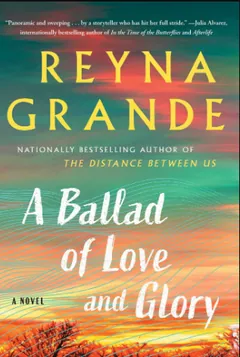
A Ballad of Love and Glory
Reading Group Guide
A Ballad of Love and Glory
Reyna Grande
This reading group guide for A Ballad of Love and Glory includes an introduction, discussion questions, a Q&A with author Reyna Grande, and ideas for enhancing your book club. The suggested questions are intended to help your reading group find new and interesting angles and topics for your discussion. We hope that these ideas will enrich your conversation and increase your enjoyment of the book.
Introduction
The year is 1846. After the controversial annexation of Texas, the US Army marches south to provoke war with Mexico over the disputed Río Grande boundary.
Ximena Salomé is a gifted Mexican healer who dreams of building a family with the man she loves on the coveted land she calls home. But when Texas Rangers storm her ranch and shoot her husband dead, her dreams are burned to ashes.
Vowing to honor her husband’s memory and defend her country, Ximena uses her healing skills as an army nurse on the front lines of the ravaging war.
Meanwhile, John Riley, an Irish immigrant in the Yankee army desperate to help his family escape the famine devastating his homeland, is sickened by the
unjust war and the unspeakable acts against his countrymen by nativist officers. In a bold act of defiance, he swims across the Río Grande and joins the Mexican Army—a desertion punishable by execution. He forms the St. Patrick’s Battalion, a band of Irish soldiers willing to fight to the death for Mexico’s freedom.
When Ximena and John meet, a dangerous attraction blossoms between them.
As the war intensifies, so does their passion. Swept up by forces with the power to change history, they fight not only for the fate of a nation but for their future together.
Topics and Questions for Discussion
1. The story begins with the main characters being thrust into the oncoming war. What are your rst impressions of Ximena and John Riley?
2. In chapter 6, John compares Ireland and Mexico, saying, “’Tis Mexico’s bad luck to have the United States as its neighbor…Just as ’twas our bad luck to have England loomin’ across the Irish Sea.” Discuss why the Irish deserters feel such a kinship with the Mexican citizens. See how many examples you can nd throughout the book.
3. The deaths of Joaquín and Sul ivan change the course of Ximena and John’s lives. Compare and constrast the ways Ximena and John entered.
Could they have made di erent choices?
4. Grande references church bel s throughout the novel. What signi cance do the church and religion play in the story? Why do you think this writing device was used?
5. Grande uses vivid imagery to bring the experiences of Ximena and John to the reader. What imagery was most striking? What other techniques does the author use to involve the reader in the setting and events?
6. After receiving the news that his wife has passed away, John wonders what right he has now to happiness. In chapter 30, he decides he must abandon his love for Ximena to atone for the sins against his wife. Do you agree with John’s decision to leave Ximena? Do you think he had another choice?
7. Nana Hortencia tel s Ximena in chapter 12 that “it is true that the path God has chosen for you is one ful of thorns.” As Ximena’s spiritual guide and teacher, Nana Hortencia passes down to al her knowledge of traditional healing and spiritual beliefs. How do Nana Hortencia’s teachings help Ximena survive the path before her?
8. Why is it important for Ximena to have dreamed of both Joaquín’s death and the hangings of the St. Patrick’s Battalion?
9. As a book focused on war, loss is a prominent theme throughout. Which character’s death felt the most consequential to Ximena, John, and the story as a whole? Why?
10. Maloney’s punishment at the beginning of the story foreshadows Riley’s punishment when the Saint Patrick’s Battalion is captured by the Yankee army. Discuss other examples of foreshadowing in the book.
11. The story is divided into three parts. Discuss the importance of the titles of each part and how they describe the stages of the war as experienced by Ximena and John.
12. Even though they wil “always carry battle scars within them,” John and Ximena are able to start anew in Ireland. What do you think life wil be like for them in Ireland?
A Conversation with Reyna Grande
Historical ction was a bit of a departure for you. Why did you choose to focus on this genre?
When I rst heard of the Saint Patrick’s Battalion I became fascinated, especial y with John Riley. But my biggest fascination was with the war itself. This is a time in history I knew so little about because growing up in the US meant I didn’t learn about the Mexican-American War in my K–12 classroom. Like most Americans, I learned lots about the Revolutionary War and the Civil War, but the Mexican-American War of 1846 to 1848 was a mere footnote in the history textbook. I never thought I would ever write historical ction, but my desire to explore this moment in history and to learn more about the ght for the southern border, the con ict between the US and Mexico that in a way continues to this day, inspired me to give historical ction a try. I’m so glad I did because I learned so much in the process about myself, and it helped me to reframe my identity as a Mexican living in the US. Writing this book was empowering on a personal level and a professional level.
What were your main sources for research? Did you travel to any of the areas mentioned in the book?
I rst began my research by googling the Saint Patrick’s Battalion. Then I read the books by Robert Ryal Mil er, Michael Hogan, and Peter Stevens. From there, I bought as many books as I could nd on the Mexican-American War—
history books but also rst-person accounts written by soldiers. I read books about the Irish famine and stories of the peasantry. I read books on curanderismo and herbal healing, on cock ghting, on the ora and fauna of northern Mexico (and what is now South Texas). I read books on the Texas Rebel ion, on Santa Anna—including his memoirs. I read the memoirs of Juan Seguín and some books on Juan Cortina. I lost track as to how many books I read in total, but I would say about a hundred! I also visited the battle sites in Palo Alto (near Brownsvil e) and Port Isabel (what used to be El Frontón de Santa Isabel), and Churubusco and Chapultepec (in Mexico City). I visited Santa Anna’s hacienda in Veracruz, which is now a museum, and I went to John Riley’s hometown in Clifden, Ireland.
What was one of the more fascinating facts you learned from your research for this novel?
That the US deliberately provoked this war with Mexico by sending its troops to occupy Mexican lands, and the declaration of war against Mexico was based on a lie. I shouldn’t have been so surprised because the US has justi ed wars with other countries based on lies (e.g., Iraq). I was also fascinated (but again, not surprised) that the president of Mexico—Antonio López de Santa Anna—had made secret agreements with the US president at the time so he could restore him to power. The theme of divided loyalties fascinated me. I explored this theme with John Riley as wel because back in Ireland he and other Irishmen joined the British Army, the very army that was oppressing his homeland. As a redcoat, he must have been seen as a traitor by his own people. In my novel, this is something that haunts Riley. I explored this theme of divided loyalties in the plight of the Tejanos—the native Mexicans who got caught up in the Texas Rebel ion, many of whom al ied themselves with the white insurgents to rebel against Mexico and who, after the rebel ion, became second-class citizens in their own homeland. Tejanos like Juan Seguín betrayed the Mexican people only to discover that he was no longer welcome in the new Texas republic.
The story alternates between John’s and Ximena’s points of view. Did you prefer writing from one character’s perspective over another?
John Riley was very easy to write so, for the rst couple years, I mostly wrote from his point of view. Because he is a real historical gure, I knew enough about his participation in the war to be able to track his timeline and gure out his plot points. I knew what he had done but not why. The chal enge in rendering him onto the page as a three-dimensional character was guring out his motivations, his dreams, his yearnings, and his psychological wounds. So, I had to dig real y deep into his psyche to understand what drove him to desert and what kept him ghting. I had to draw from my own experience as wel .
Riley was a father (and maybe a husband) who had left his family behind in Ireland—a country ravaged by poverty and hunger. Similarly, my own father had left his wife and children in Mexico in extreme poverty. My father also fel in love with a nurse (a nurse assistant) when he was here in the US, and he ended up
leaving my mother for this woman. I thought of my father when I wrote about John Riley.
John Riley was an actual gure in history, but Ximena was inspired by a John Greenleaf Whittier poem. How did you develop her character and the struggles she faced throughout the war?
Ximena was extremely chal enging to write, and for the rst few years of working on this novel I had nothing but blank pages in her chapters. Honestly, my manuscript had so many holes it looked like Swiss cheese. Because she was based on a short poem, I had to create her from scratch. It took me a long time to gure out her backstory—a Tejana who witnessed the Texas Rebel ion; her grandmother being an Indigenous healer; her husband a ranch owner and horse trainer. Once I had enough pieces of her to guide me, she began to come alive.
When I got to the part where she meets Santa Anna, she was a living, breathing person to me, and I was deeply invested in her character. It was so much easier for me to write Ximena’s chapters in part III because by then I knew who she was, I knew how she saw the world, and I had found her voice.
The Mexican setting often feels like another character in the story, the land itself as a living, breathing thing. What connections to this land do you hope readers come away with after reading?
I wanted to show the beauty of the Mexican landscape because that is something I deeply care about. The reader gets to see this beauty through Ximena’s eyes, especial y of the Río Grande region where she lived. The loss of the land is even more heartbreaking considering what happened to this region after the war—a lot of this natural beauty is gone. The mesquite and huisache groves are mostly gone, the chaparral and the prairies were stripped away in favor of giant cattle ranches, farms, and cotton plantations. Not to mention a big, ugly border wal .
The Río Grande is not what it used to be due to al the river dams, overuse of water, and pol ution, which have weakened it so much it is no longer the erce, beautiful river it once was. The land has seen its fair share of trauma, as have the Mexican people who live there.
I deeply enjoyed writing John Riley’s impressions of Mexico. Seeing my native country through his eyes made me so nostalgic for it! I real y wanted Riley to engage deeply with the Mexican setting, so I made him very aware of it. He is actively noticing the di erences and similarities to his homeland, including the Catholic religion. Riley fal s in love with Mexico in a way I wanted the reader to fal in love with it as wel .
In any story about war, there are losses. Was there one death in the book that was particularly hard to write?
Al of them were di cult—Sul ivan, Maloney, Joaquín, Patrick Dalton and the other San Patricios hanged at the gal ows…but the one that was deeply personal to me was Nana Hortencia’s death. She is based on my own grandmother, Jacinta Benítez Catalán, who was a healer. She died quite suddenly after being stung by a scorpion. I got to Mexico three hours after my grandma died, so I never got to say goodbye. This is why I write so much about her. In fact, my grandma has appeared in every single one of my books in di erent versions.
Every time I wrote a scene with Ximena and her grandmother, it felt real to me, as if I could hear my grandma speaking to me through Nana Hortencia.
Do you have a next project in mind? And, if so, what is it?
In between writing A Ballad of Love and Glory I coedited an anthology by and about undocumented Americans. Somewhere We Are Human: Authentic Voices on Migration, Survival, and New Beginnings is due out June 2022 from HarperVia, and includes forty-three contributors who are or were undocumented like me. As an immigrant, my goal is to continue to write stories about immigration but also to create opportunities for others to tel their stories as wel .
Enhance Your Book Club
1. A portion of John Greenleaf Whittier’s poem “The Angels of Buena Vista”
opens the novel. Read the ful poem and discuss the woman named Ximena. How did she end up on the battle eld? What do you think she represents?
2. Throughout A Ballad of Love and Glory, Grande activates al ve senses.
There are the scents of war and the tastes of the food cooked in each city. We can hear the cannon re and church bel s, see the rol ing Mexican landscape, and feel the textures of the fabrics. Come up with other examples for each of the ve senses!
3. John Riley leading the St. Patrick’s Battalion is based on a real moment in history. Not much is known about his early years, as parish records were destroyed in a re in Ireland, but there are military records placing him in both armies, and his participation in the battles is wel documented. There are statues to commemorate him and the battalion in his birthplace of Clifden, Ireland, and Mexico City. If you want to read more about the battalion, other resources include The Irish Soldiers of Mexico by Michael Hogan, The Rogue’s March by Peter Stevens, and Shamrock and Sword by Robert Ryal Mil er. There is also an album by the Chieftains cal ed San Patricio in honor of the battalion.
4. In the author’s note, Grande writes that “the Mexican-American War has been cal ed the war that the US cannot remember and Mexico cannot forget.” What did you know of the war before reading this novel? Why do you think in the US this particular war has been erased from the col ective consciousness? What can be done to help future generations remember this war?
More from the Author
A Dream Called Home
The Distance Between Us
Dancing with Butterflies
Across a Hundred
Mountains
The Distance Between Us