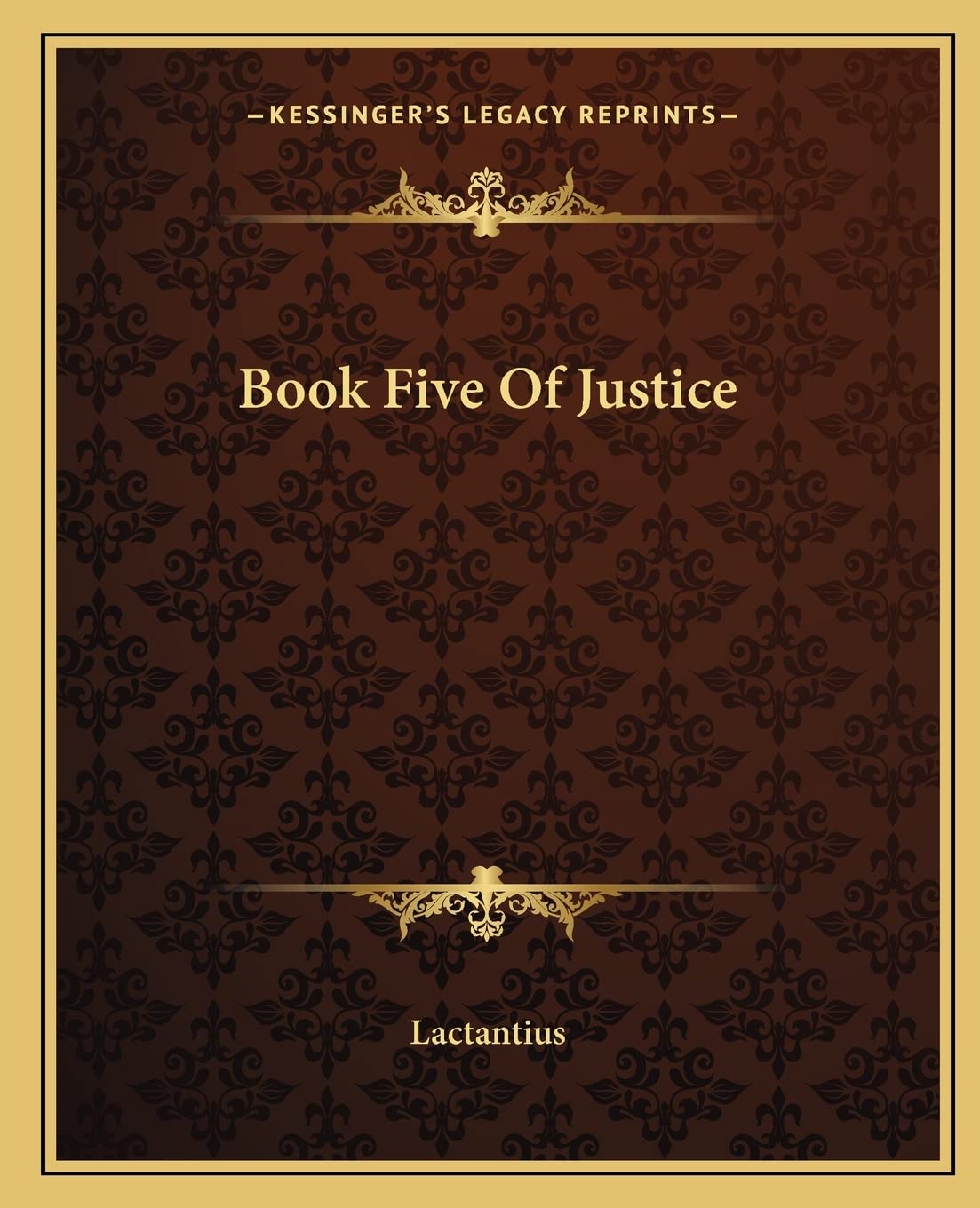
Book Five Of Justice
Book Five of the Divinae Institutiones, often given the subtitle De Iustitia or On Justice, is the central book of the seven volume defense of Christianity that Lactantius wrote in the early fourth century. The larger work was aimed at educated pagan readers in the late Roman Empire, the kind of people who could quote Cicero and who needed to be addressed in their own intellectual language if they were going to take the new religion seriously.
This particular book takes up the question of justice as a fundamental human and divine concern, working through what Lactantius saw as the failures of pagan philosophy and pagan religion to provide an adequate account of justice and what Christianity offered as an alternative. The argument is structured around the contrast between the actual practice of pagan religion, with its sacrifices and its civic rituals, and the Christian claim that real justice requires both right belief about God and right conduct toward other human beings. Lactantius draws extensively on Stoic philosophy, on Cicero’s De Republica, and on the Old Testament prophets, weaving them together in the comparative mode that was his signature.
The book is also notable for its historical content. Lactantius was writing in the immediate aftermath of the Diocletian persecution, the worst sustained attempt by the Roman state to suppress Christianity, and Book Five contains some of his most direct accounts of the violence and the moral horror of that period. He names persecutors, describes specific incidents, and argues that the conduct of the persecutors itself proves the moral bankruptcy of the religious and political system in whose name they acted.
For students of late antiquity, of patristic literature, of the history of Christian political and ethical thought, or of the long tradition of Christian engagement with classical philosophy, this is a primary text worth knowing. The English translation is generally readable and the historical importance of the work is significant.
About the Author
Download free books by Lactantius on BDeBooks. Read Lactantius’s works online or download as PDF/EPUB · part of our growing free eBook collection.
See all books by Lactantius →