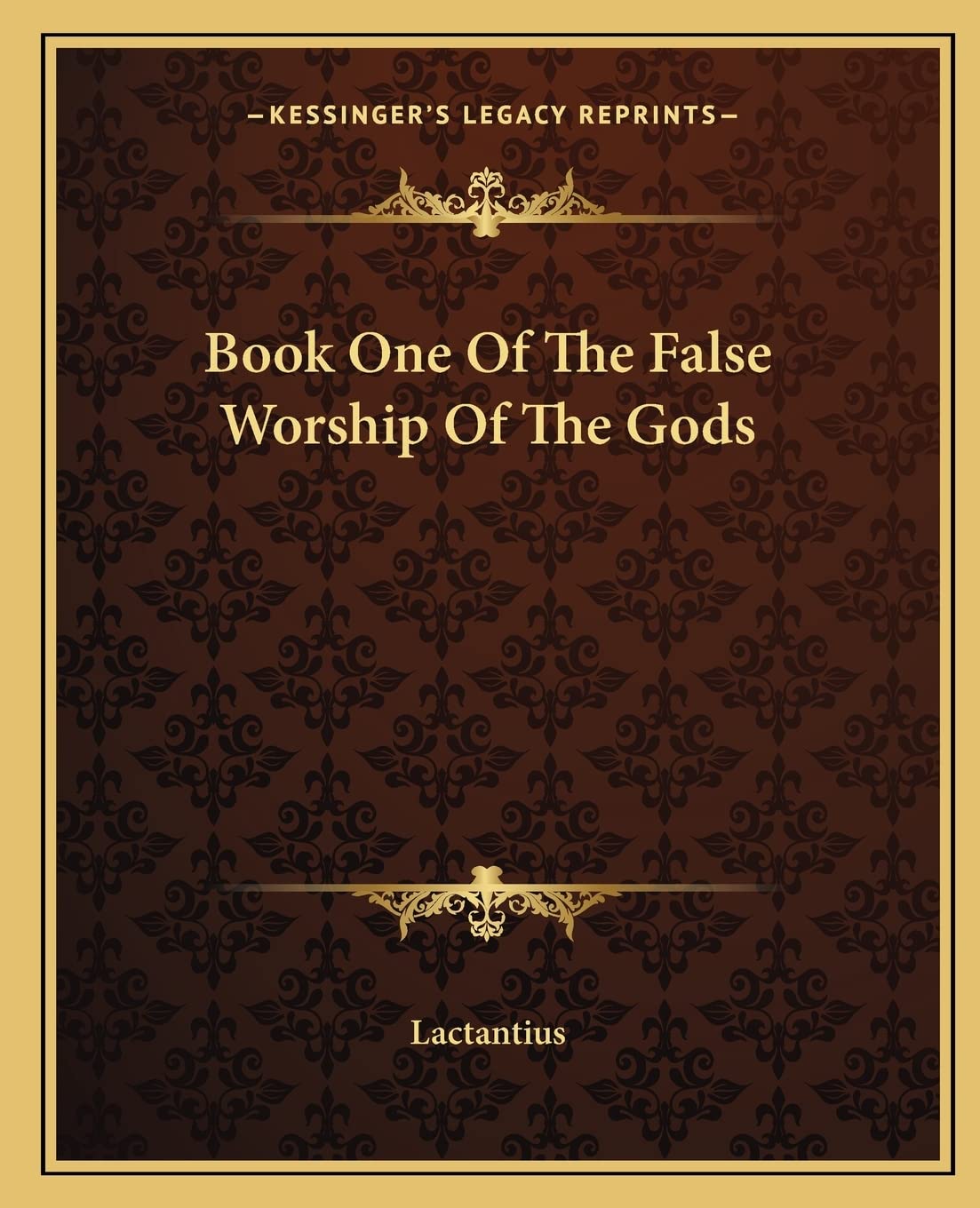
Book One Of The False Worship Of The Gods
Book One of the Divinae Institutiones, often given the subtitle De Falsa Religione or On the False Religion, is the opening book of Lactantius’s seven volume defense of Christianity, written in the early fourth century and aimed at educated pagan readers in the late Roman Empire. Book One takes up the foundational task of arguing that the worship of the traditional Greco Roman gods is mistaken, and it works through both philosophical arguments and a wide ranging survey of pagan religious practices to make the case.
Lactantius opens the larger work with this critique because the rest of his argument depends on first clearing away what he sees as the false religion that has occupied the spiritual life of the Roman Empire for centuries. He works through the various pagan deities. Jupiter, Juno, Saturn, Mars, Venus, and the wider pantheon. He examines their origins in human inventions and historical figures, the contradictions between their official theological characters and the stories told about them in the classical literature, and the moral problems with worshipping beings whose own behavior in the myths often falls below ordinary human ethical standards. The argument draws extensively on classical sources, including the philosophical critics of popular religion among the Greek and Roman writers themselves.
What distinguishes Lactantius’s approach from a lot of contemporary anti pagan polemic is his willingness to engage seriously with the educated pagan reader’s perspective. He does not simply dismiss pagan religion as foolish. He acknowledges the long historical and cultural weight that the traditional religion has carried, the genuine moral and intellectual achievements of the pagan philosophical tradition that grew up alongside the religion, and the difficulty for any educated person of breaking with the religious framework that their ancestors and their society have always taken for granted. The respect Lactantius shows for his interlocutors is part of what made the Divinae Institutiones so influential.
The book is in the formal Latin style of late antiquity, with the polished prose that earned Lactantius the nickname the Christian Cicero in the Renaissance. For students of late antiquity, of patristic literature, of the long history of Christian engagement with classical paganism, or of the wider development of Western theology in its formative period, Book One is essential reading.
About the Author
Download free books by Lactantius on BDeBooks. Read Lactantius’s works online or download as PDF/EPUB · part of our growing free eBook collection.
See all books by Lactantius →