
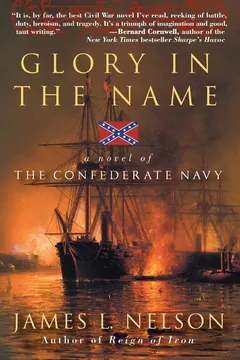
Glory in the Name
Chapter 25
On Tuesday afternoon, the 27th of August, about 4 o’clock, I discovered a large fleet in sight off Hatteras… On the morning of the 28th, between 8
and 9 o’clock, a heavy fire was opened from the steamers Minnesota, Wabash, Susquehanna, and other war vessels…Being a fire of shells only, it might well be spoken of as a flood of shells.
– Report of Colonel William F. Martin, 7th Regiment Infantry, North Carolina Volunteers
The Cape Fears fired five shells from the ten-pound Parrott rifle, at maximum elevation, before they decided with absolute certainty that they could not reach the anchored Yankee fleet. Their gunfire did, however, attract the Yankees’ notice, and soon shells were falling all around them, sending plumes of water as high as the boat deck as they dropped in Pamlico Sound.
Hieronymus Taylor clumped up the ladder to the wheelhouse. He was in shirtsleeves, the wet patches of sweat radiating out from under his arms and under the straps of his braces, turning his otherwise brilliant white shirt gray. In his mouth, the ubiquitous cigar. He paused, squinting around, the corners of his eyes crinkled with amusement.
Samuel Bowater, in the middle of issuing his orders to Lieutenant Harwell, paused, turned his head, as the spray from a shell, landing no more than thirty feet away, lashed across himself and the lieutenant and Taylor.
“Damn,” Taylor said.
“They are getting the range on us, I perceive,” Bowater said, changing the course of his orders. “Once I am away, please shift the anchorage, say, one hundred yards north. That should put us out of most of their line of sight. No need to expose ourselves to fire if we cannot return it.”
“Aye, aye, sir.”
“We’ll keep steam up, then, Cap’n?” Taylor asked.
“I think so, Chief.”
“Pity the fort can’t shift one hundred yards off,” Taylor said.
Fort Hatteras did not seem to be returning fire. Bowater wondered if the garrison was out of ammunition, or if the fleet was out of range. With a
small garrison and an enemy pounding them mercilessly, it did not seem a very hopeful situation.
“See that there?” Taylor said, nodding south, and Bowater turned and looked.
“What?”
“Ocracoke Island. That’s where Lieutenant Maynard come and ambushed Blackbeard the pirate. Cut his head right off, hung it from the bowsprit. Another case of them damned Yankees comin down here and givin grief to a good Southern boy, just lookin for his fun.”
“Hmm. I’m not certain your history is entirely correct there, Chief Taylor.”
“No, I…” A shell whistled by, passing close, and plunged into the sound right astern of Cape Fear. “No, I’m sure it happened right there.”
“I mean about Maynard being a Yankee. Or Blackbeard being a Southerner, for that matter.”
“You sure? Blackbeard spent a power of time in the South. Spent some time in Charleston, I do recall. Where you’re from. Hell, he may be your great-great-granddaddy. They say he had fourteen wives.”
“He most certainly…” Another shell came in, screaming down on the starboard side, exploding inches above the water, and Bowater’s comment was drowned in the rat-tat-tat of shell fragments hitting the Cape Fear’s side and shrieking past their heads.
“Sir?” Ordinary Seaman Dick Merrow was standing on the wheelhouse roof, scanning around with the big telescope.
“Yes?” Bowater said, happy for a distraction from the silly conversation into which Taylor had drawn him.
“Small side-wheeler coming down sound…I reckon she’s about three miles off.”
“Let me see.” Merrow handed the glass down and Bowater focused it in the direction the sailor pointed. He could see the side-wheeler, smoke belching from her stack, could see the dot of white under her bow as she drove hard. From her masthead flew a flag, and though it was blowing straight aft, it appeared to be the broad pennant of a commodore, which made Bowater smile despite himself.
“This would be Barron in Winslow, ” he said to Harwell. “Let us hope he comes with some plan for salvation.”
The Cape Fear’s boat was lowered and Bowater climbed down to the stern sheets, with Eustis Babcock as bow man and Tanner at stroke oar.
They pulled for the beach, ground up on the barrier island, splashed out, and pulled the boat up on the sand.
Bowater tramped up the beach, stopped, and looked around.
Extraordinary. Shells were falling in a nonstop hail, exploding on the ramparts, within the fort, on the beach around the fort. With the sun heading toward the west, the fort and the sprays of dirt from the exploding shells were washed in an orange light. The noise was constant-the scream of the shells, the blast of exploding ordnance. And then every so often, by coincidence, there would be no firing, just silence, which was strangest of all. But it never lasted above ten seconds, and then the next shell, and the next, was hurled at the fort.
Bowater led his crew up the sloping shore. A young army lieutenant-he introduced himself as Lieutenant Evans-let them in through the thick oak door set in a rough wooden frame embedded in earthen walls. The Cape Fears huddled under the parapet with the rest of the garrison, while the lieutenant led Bowater up to the ramparts.
The Yankees were hitting the fort hard. With a relatively calm sea, and anchored ships firing on a fixed target, it was not too difficult for the invaders to hone their aim until nearly every one of their shells found its mark.
Bowater walked through the storm of iron, amazed at the amount of ordnance dropping on the fort, amazed that he had not yet been blown away. He moved with a strange calm, as if he was encased in ice.
He was not afraid, despite the shelling, despite the fact that any rational person would be terrified, cowering under whatever might offer some protection. It was a phenomenon he had experienced before. It was what they called bravery under fire, but he knew it had nothing to do with bravery. It was more a trick that the mind played on itself, a turning off of the machinery of fear, in the face of insupportable terror.
When he thought of it, he imagined a Stephenson link and reversing lever, the long iron bar that shifted an engine from forward to reverse. But in his mind the link shifted from fear to fight. The real courage, Bowater knew, was in getting yourself to the place where your mind could shut off.
Bowater mused on these things as he followed Lieutenant Evans up the rough wooden stairs, past craters of brown dirt where the shells had landed,
past guns that stared silent and impotent out at the Union fleet.
Fort Hatteras was no marvel of engineering. It was mostly wood-frame, dirt-filled walls, the work of slaves who had been ferried out to the low island to throw up some defense against the inevitable arrival of the Yankees. Albemarle Sound was the gateway to the rivers that ran deep into Confederate country, and Pamlico Sound served as a base for privateers to race out and snatch up Yankee prizes as they labored around Cape Hatteras.
Hatteras Inlet was too important for the Yankees to leave alone.
“Colonel?” Lieutenant Evans stopped and addressed an officer, sitting on the top of a small barrel and slumped against the earthen wall of the fort, one arm resting on the top of the parapet. “Colonel Martin, this is…”
“Captain Samuel Bowater, Confederate States Navy, sir, at your service.”
Martin looked from the lieutenant to Bowater, his head turning slowly from one to the other, as if it was a great weight that needed to build momentum. His eyes looked sunken and his face pale. Colonel Martin was very tired.
“Captain,” he said and made to stand, but Bowater said, “Please, sir, don’t stand on my account,” and Martin, without protest, remained seated.
“It has not been a good day for us, Captain,” Martin said, staring over the low wall at the Union ships. “The firing has gone on like this since daybreak. We were forced to abandon Fort Clark this afternoon. No ammunition for the guns, Union troops landing on the beach…spiked the guns as best we could. Had to use nails, didn’t even have proper spikes. Got most of the boys over here, but we still didn’t have enough to man the guns proper.”
Bowater nodded. It was a hopeless situation that Martin found himself in, and he had done what he could.
“Shelling’s slackened,” Lieutenant Evans noted.
Bowater and Martin looked around, as if they could see the absence of shells. The lieutenant was right. The artillery was coming in sporadically now, shells exploding once a minute, perhaps, or less, the fall of shot tapering off like the rain at the end of a quick-moving squall.
“It’s getting a bit dark for naval gunnery,” Bowater noted. The fleet was getting underway; some of the ships had already moved out to sea, where they could spend the night away from the beach and the guns of Hatteras.
“Well, it is some relief to see the Yankee navy is not immune to the laws of nature,” Martin said. “They are damn near immune to everything else.
Hardly a shell has missed, and nothing we could do but take cover and endure it. I don’t know what more we can do.”
Bowater nodded and looked out at the anchored fleet, the big men-of-war washed in the evening light. They mounted nine-, ten-, and eleven-inch guns that could easily hurl shells from a distance that the fort’s eclectic artillery could never match. If they so chose, they could batter Fort Hatteras until it was indistinguishable from the sand dunes on which it sat. Samuel felt a bit of Martin’s despair play over him.
Damn, he thought, I am too damned late… And then he corrected that notion. The moment that the Union navy sailed for Hatteras, it was too damned late.
“Sir,” said Bowater, “I do believe Commodore Barron, who is in command of naval forces here in the sound, is underway and will arrive in an hour or so. Perhaps he has news of reinforcement.”
Martin seemed to brighten at that, just a bit. “Perhaps. Lieutenant Evans, please send word to the commodore that I would like a conference with him, at the earliest possible convenience.”
“Yes sir,” the lieutenant said, and he saluted and hurried off.
The shelling tapered away and then stopped as the evening settled down on the ocean and the tortured sands of Hatteras Island. Bowater sat on the parapet, looked out over the water, at his old navy, looked down the length of Hatteras Island, his old flag now flying over Fort Clark. The few stands of trees on the island looked like black patches on gray as the day faded to night, and lights like low-lying stars began to appear on the distant ships.
Colonel Martin slept where he sat, his breathing sometimes rhythmic, sometimes labored.
It was full dark when Commodore Barron arrived, tramping up the wooden steps, led by Lieutenant Evans, who brought a lantern with him, and trailed by three other men, who turned out to be Colonel Bradford, colonel of artillery and engineers and chief of ordnance of North Carolina, and Lieutenants Murdaugh and Sharp, C.S. Navy.
Barron was a trim and energetic man, with thick white hair swept back over his head. Bowater guessed him to be in his sixties. They had crossed paths on a few occasions during their time in the old navy. He knew that Barron had entered the United States Navy on the first day of the year 1812,
had been aboard the Brandywine when she conveyed General Lafayette to France in 1825.
“Commodore Barron,” Martin was saying, and it seemed a great effort for him to speak. “Our fort is armed with naval guns, as you can see, and my men are strangers to such ordnance, and I am played out, sir, I will freely admit it. Allow me to formally request that you take command here, Commodore, and do what you can.”
Barron made some grunting noise, looked up at the string of lights on the water where the fleet lay at anchor. He could refuse. He was a naval commander; forts were not his affair. He would put himself in the way of no glory by accepting responsibility for an effort that was certainly bound for failure. But for all that, Barron said, “I will accept command, sir, and do what I am able.”
Colonel Martin’s relief was evident, and he said nothing as Barron began to issue orders. “Captain Bowater, what have you brought down with you?”
“We have powder in barrels, sir, shell for the Columbiad and for the other guns, fuses, round shot, and some cartridges. We have not yet landed any of it, not knowing the state of things here.”
Barron looked around the fort, which, with the moon now rising, was all dark shadows and deep blue light. He pointed to the gun that looked out over Pamlico Sound. “No point in leaving that there. Yankees aren’t going to pass through the inlet till they’ve beaten us into the sand. We’ll shift that gun around so it can do us some good. Bowater, detail some of your men to get the ordnance you brought ashore, and whoever is left, get them on shifting that gun. Lieutenant Murdaugh, Sharp, same for you. We’ll take whatever men your ships can spare. We’ll fill out the gun crews with navy men. We have to make every effort, be ready for them when they open up on us at first light.”
Bowater returned to the Cape Fear, issued his orders, led his detail back to the fort. They joined with the others in the onerous task of creating a new gun emplacement and shifting tons of guns and carriages so that every available weapon was bearing on the Yankee fleet.
Barron was relentless. He drove the men hard and expected as much from the officers, and he got it. Sweating in the cool night, grunting, shouting, cussing, they hauled the big gun from its former position, used
levers and block and tackle, staging and brute force to wrestle it to the newly created artillery platforms, one hundred feet away.
Two hours before dawn the men were stood down, allowed to sleep on the dirt parapets around the guns to which they were assigned. They dropped as if they had been drugged, and were not easily stirred when the first streaks of light appeared over the ocean, and the bells of the Yankee fleet rang out, two bells in the morning watch, 5:00 a.m.
They stood, cussed, staggered about, scratched and stretched. They gulped what passed for coffee, ate the porridge served out from the big cast-iron pot.
The men were still eating when signal flags broke out at the masthead of the flagship Minnesota and Barron, watching through a long telescope, announced, “That’s ‘Prepare to engage and follow my motions.’”
Bowater nodded. He was standing thirty feet away at the thirty-two-pounder smoothbore that he and the Cape Fears were manning.
Prepare to engage… It seemed there must be something they should do to prepare the fort for the coming onslaught. But there was nothing. Every gun that would bear was manned, loaded, run out. There was nothing that they could do now but wait.
Ruffin Tanner sat on the dirt parapet, looked out over the water, and Bowater looked at his face in profile, the morning light falling on him.
“Tanner?”
The sailor turned. “Yessah?”
“Have we met before?”
“Yessah. I was the one steerin’ the boat when we fought that Yankee side-wheeler,” he said, but seeing that Bowater was not in a joking mood added, “And I think I seen you once, up to the dockyard in New York, oh, five years back. But we didn’t talk, sir.”
Bowater nodded. “I suppose not,” he said, but still there was something about Tanner’s face, some vague recognition, almost like that fleeting sensation of having experienced a place before, but more solid than that, more real.
The morning was quiet, just the sound of the surf on the beach and the scream of the sea birds, and soon the distant clank of chain coming aboard, as steam windlasses hauled up the Yankee fleet’s anchors.
It took the Union fleet an hour to get underway, and another hour to close with the fort. It was eight o’clock, the day already hot under the
brilliant sun, when Susquehanna, leading the big ships, opened up. The shell whistled through the air with a sound that, once heard, was perfectly familiar. It landed on the beach, one hundred feet away, exploded in a spray of sand.
“Here they come, boys!” Commodore Barron shouted from where he stood on the parapet. “Get ready to fire on my word.”
Bowater watched the ships, felt the sweat on his palms, the crackling of electricity in his fingers, the jerky, excited motion in his limbs, the churning in his stomach. They were under fire now, and he wanted nothing more than to run and duck under the parapet. It was grit time, and all he could do was to stand there and fight it until his mind was merciful enough to shut down that instinct for self-preservation.
Another shot from Susquehanna, and then Wabash, both shells falling short as the Union gunners worked to get their range again. And still Barron stood unmoving on the parapet and did not give the order to return fire, as certain as was Samuel that Hatteras’s guns would not reach.
One by one the big ships paraded past, then backed their engines and dropped anchor. Together they made a movable fortress with seventy big guns bearing on the fort, against the three guns with which the fort could fire back.
Soon they were all firing, all the Yankee guns, the rain of shells coming in again, the burst of dirt and sand marching closer and closer to Fort Hatteras as the gunners adjusted aim from their stable platforms.
“Let ’em have it, boys!” Barron shouted and hopped down from the parapet as the Confederate gunners cheered. Bowater felt exuberant as he leaned over the barrel of his gun and sighted down its length; he felt charged and ready and all trace of fear was gone now. He yelled with the others, despite himself, yelled to let off the tension like a relief valve on a boiler.
He stepped back, pulled the lock cord taut. No need to adjust the lay of the gun; they had been fiddling with it obsessively for half an hour, waiting for the order to fire. The old thirty-two-pounder was aimed square at the high black side of the steam frigate Wabash, once the command of Samuel Barron. Bowater stepped back and jerked the cord, and the gun blasted off with a deafening roar, flung itself back against the breeching.
Bowater kept his eyes on Wabash, hoping to see splinters fly, but instead he saw a spout of water where his shot fell three hundred feet short.
“Another pound of power in the charge, Tanner,” he instructed, as he stepped over to the breech, twisted the elevation screw to raise the muzzle another few inches. He looked at the screw. Not much travel left. That had better do.
“Look, sir!” Tanner pointed over the parapet and Bowater followed his arm. Cumberland was underway, standing into the line of battle under a reefed fore course, topsails and topgallants, with no ugly plume of smoke belching out amidships. She was the only pure sailing vessel there, on either side.
Bowater shook his head. “Lovely.” But she was an anachronism, a ship from another time, from Lafayette’s age, and not the present. One had only to look at the Union fleet and the manner in which they moved onshore and off, oblivious to the state of wind and tide, to see that the days of the sailing ship were over, rail though the likes of Samuel Bowater might. He watched the stately, silent progress of the sailing man-of-war and felt a soft kind of a sadness come over him.
And then the first of the Union shells to find the parapet exploded, shook the earthworks on which Bowater stood, pelted him with dirt, and romantic notions fled.
“Run out!” he shouted, and the heavy gun was hauled up to the wall, Johnny St. Laurent and Nat St. Clair, landsmen Francis Pinette, Harper Rawson, and Bayard Quayle, Ordinary Seaman Dick Merrow, Cape Fears all, hauling on the gun tackles.
Bowater leaned over the barrel, called for the handspike until the gun was pointed again at Wabash’s midships, stood back, and fired. And once again, a spout of water for their efforts.
Boom, boom, the shells were coming in regular now, marching up the beach, landing on the parapets and the grounds contained within the fort.
Bowater guessed that for every Union shell that dropped short, six hit the fort. He heard another gun, from the north, and when he looked in that direction he could see that Fort Clark was opening up on them as well, their own guns now loaded with Yankee shells and turned on them.
Oh, dear God…
A shell hit near enough that the flying dirt stung him in the face, made him flinch, but his men did not hesitate in their swabbing, loading, running out. Bowater twisted the elevation screw until it would turn no more. The
gun was pointed as high as it would go, the barrel stuffed with all the powder it would bear.
Run out, aim, fire. A white spout of water, in perfect line with Wabash.
Two hundred more feet and they would have smashed the heavy ball right through her side. But there was no physical way to coax another two hundred feet from the gun.
“Cease fire! Cease fire!” Barron shouted, the exasperation as clear as the words, and the sound in the fort of men working guns died away, and the only sound left, and it filled the air, was the whistle of shells, the explosion of shells, the flying earth, and the screams of the men whose luck had run out.
Samuel turned toward Number 8 gun, mounted on a naval carriage alongside his own. It was commanded by Lieutenant Murdaugh of the Winslow. Bowater met Murdaugh’s eye, and the lieutenant frowned in dismay, shook his head, and Bowater nodded his agreement.
And then Murdaugh and the gun and the men around it and the parapet seemed to be ripped apart in a blast of dirt and noise and brilliant light and screaming fragments of metal. Bowater saw the sky and the earthen wall spin past him, heard men screaming and metal screaming and a ringing in his ears like the note of a huge bell, sustained for an impossibly long time.
He hit the dirt with a jarring blow that knocked the wind from him, and for a second all he could do was thrash around, gasping, wide-eyed, thoughtless of anything but getting air into his lungs.
And then he caught his breath, pulled a deep lungful of air into his chest. He felt a burning pain in his leg and arm and shoulder, isolated points of hurt amid the general ache. He could hardly hear through the ringing in his head, and what he could hear was more and more shells dropping on the fort, exploding around him, a percussion section gone mad, and, under that sound, the men shouting and running were like the orchestra’s other instruments, fighting to be heard.
He pushed himself up on his arms, struggled to achieve a sitting position. Strong hands grabbed his shoulders, and he looked up to see Tanner and St. Laurent easing him up. They leaned him against the wall, and Tanner pulled roughly at the buttons of his coat. Bowater was too shaken to speak.
He looked over Tanner’s head. Number 8 gun was pointing skyward at a crazy angle, its carriage smashed. The bloody, distorted corpse of one of the
gun crew lay sprawled over the rough boards of the gun platform.
Lieutenant Murdaugh, with whom Bowater had just a second before been silently commiserating, was leaning against the gun, his right arm a horrible, bloody, mangled wreck. White bone jutted out from the torn fabric of his sleeve and the arm lay on his lap at an unnatural angle, and Murdaugh, silent, just stared, as if he was unsure of what he was looking at.
“This ain’t too bad, sir, I don’t reckon,” Tanner said, looking at the bleeding gash in Bowater’s arm and shoulder. Bowater turned his head, looked at the blood and the shredded shirt. One of the best shirts to be had in all Charleston, and now it was a rag.
Samuel swallowed, summoned the energy to speak. “Leg…” he said and Tanner looked down.
“Oh, damn,” the sailor said. He pulled his knife, slit the pants. A pool of blood spilled out from the pant leg. The wound swam in front of Bowater’s eyes. He was reminded of fresh butchered meat. He closed his eyes, leaned his head back, breathed hard. He gritted his teeth as Tanner’s hands, rough but sure, lifted his thigh and passed bandages around the deep laceration.
Through the din of the shells and the ringing in his ear he heard Barron’s voice, ever in command, issuing unequivocal orders. He opened his eyes. Lieutenant Murdaugh was lying on his back and men were attending to his shattered arm, and more men were swarming around the other injured gunners. There were men enough to tend to the wounded, with the Union fleet beyond the range of the guns and the gun crews idle.
“Sharp, get Murdaugh back to the Winslow, get Dr. Greenhow to attend to him.” Barron turned to Bowater, standing over him, and Bowater had the impression of a stern father looking down on his young son. “Captain Bowater, how are you?”
“I’ll live, sir, I should think.” Some of the sense which the shell had knocked from his head was coming back, the reality of the fort and the shelling and the silent Confederate guns resolving again.
“Good. Get your men to bear you back to your ship. Get steam up and get the hell out of here.”
“Get…out?”
“Yes, Captain, get out. Another hour and I’m going to surrender the fort.
No reason to lose your ship as well.”
Bowater nodded. Of course. Barron was not making a bad choice. There was no choice at all.
OceanofPDF.com