
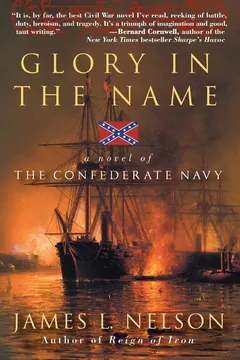
Glory in the Name
Chapter 45
On the morning of the 25th the enemy’s fleet advanced upon the batteries and opened fire, which was returned with spirit by the troops as long as their powder lasted, but with little apparent effect upon the enemy.
– Major General Lovell, C.S. Army, Commanding Defenses of New Orleans
There was no plan, no organized waterborne defense. There were not enough Confederate ships to warrant it, and with the River Defense Fleet doing what it wished to do in any event, it had never seemed worth trying.
Sally forth and fight, that had been the only plan. Captain Bowater rang up half ahead, called down to Lieutenant Asa Quillin to slip the stern anchor which held them head downstream.
The noise of the chain running out came rattling through the deck. The bitter end went overboard and the Yazoo River twisted in the stream, free of the muddy bottom. The quartermaster, wide-eyed with the shock of being roused from sleep by cannon fire, still trying to button his pants, turned the wheel with one hand, held his pants with the other, brought her on a heading for the battle.
Risley, the pilot, climbed up to the platform beneath the pilothouse.
Without a word he took the wheel, let the helmsman get his pants in order.
“Heading, Captain?”
Bowater watched the battle for a moment before replying. It was as if the night had exploded, great flashes of red and orange, the concussion of the great guns making the casement of the Yazoo River shudder, even half a mile upstream. In just a few moments of fighting the smoke had become thick enough to make some of the gunfire look muted, dull bursts of color in the dark and the gloom.
Quillin appeared in the pilothouse looking for orders.
“You recall, Mr. Risley, Horatio Nelson’s words, just before Trafalgar?”
Bowater said. “‘No captain can do very wrong if he places his ship alongside that of an enemy.’ That must be our strategy tonight, because I think we’ll get no instructions from the flag. So let us plunge right in.”
“Aye, aye, sir,” Risley said. The quartermaster took the helm again.
“Find the closest damn Yankee and steer right for her,” the pilot instructed.
More footsteps on the platform and Hieronymus Taylor appeared, ubiquitous cigar in mouth, his frock coat open, his hands in his trouser pockets. “Forgive my intrusion,” he said. He looked forward, out the slit of a window, at the panorama of violence under their bow. “Ho-ly God…”
“What is the report from the engine room?” Bowater asked, irritated. He was irritated about the Negroes, irritated about Taylor’s being there in the pilothouse, irritated in general with the man.
“All’s well, Cap’n Bowater. Boilers blown down, fires are clean, grates are clean, steam’s up.”
“You have coal heavers enough?”
“We have coal heavers enough.”
Bowater turned back to the fight before him, tried to ignore Taylor. The rest of the mosquito fleet was scrambling, slipping anchors, steaming downriver. Risley ordered a hard turn to starboard to avoid collision with one of the River Defense Fleet. It was helter skelter, with no organized line of battle, and Bowater wondered if there wasn’t as much danger of colliding with friend as there was of being run down by their enemies.
“Well, reckon I’ll crawl back in my hole,” Taylor said, and when Bowater failed to respond, added, “Captain?”
Bowater turned. Taylor wore a strange look on his face. Not contrition, not arrogance, not apology. Something else. A touch of sentiment, perhaps.
“Cap’n Bowater, we have been through quite a bit together, you and me.
I got to say it now. You are one cold, patrician son of a bitch, but you got grit. It’s been a pleasure.”
Taylor extended his hand, and the words and the gesture were so genuine that Bowater was taken aback. He would not have credited the man with such sincerity.
Bowater took the extended hand, enveloped it in his two hands, and shook. “Chief Taylor, you are one insufferable pain in the ass, but you are a hell of an engineer.”
Taylor smiled around his cigar. “Cap’n, if you live through this here jaunt, and I don’t, I would surely admire it if you could see that put on my headstone.”
“It’ll be done.”
Taylor regarded the men in the pilothouse. He snapped a crisp salute.
“Morituri te salutamus,” he said, then turned, disappeared into the gloom of the ironclad’s lower deck.
They had halved the distance in the time that he had spoken with Taylor, the fast-flowing Mississippi River sweeping them down on the enemy. The fight had mounted in its intensity, the smoke and noise and gunfire building on itself. The first of the Yankee ships was just now coming between the forts, blasting away with both broadsides, pushing on upriver.
And the forts were giving it back. Five days of shelling seemed to have made no difference. The big guns were blazing away so that the walls of the forts might have been on fire, so solid was the sheet of muzzle flash.
The smoke rolled over the river, more and more smoke, hanging like an acrid fog, glowing orange. And through that smoke the ships moved, the big, slow-moving Yankee screw steamers, the little ships of the Confederate defenders. Into that hailstorm of iron, Samuel Bowater pushed the Yazoo River.
He turned to the midshipman, Mr. Worley, and said, “Go below. Tell the gun captains to fire at any target on which their guns will bear. They are to fire at will.”
“Aye, aye, sir!” the mid said, a bit too loud and high-pitched, and he hurried off.
A gunboat was leading the Yankee line, a schooner-rigged screw-driven craft, 150 feet or so in length. “There! Steer for her!” Bowater said, pointing through the slot, and as he did a tugboat appeared out of the gloom, crossing their bow, starboard to port. In the flashing gunfire Bowater could make out the Confederate flag on her stern. He got out no more than the first syllable of a helm command before they struck.
The men in the pilothouse staggered as the two vessels hit, and Quillin shouted, “Damned idiot!”
Bowater looked out the slot. The tug was hung up on their bow and men were rushing along her deck, shouting, waving arms. The gunfire was so continuous now that the whole scene was lit in orange, the tug silhouetted against the flames of Fort Jackson’s barrage.
Bowater grabbed the telegraphs, gave a ring, shoved the handles to full ahead. No time for this horseshit… The engines responded immediately, the Yazoo River surged ahead, pushing itself into the tug. With a snapping and crunching sound, audible over the gunfire, the tug peeled off the Yazoo
River’s bow, bumped against her side, disappeared astern, and the ironclad was once again racing toward the fight.
The Yankee gunboat was surrounded, Confederate ships pounding her from all sides, more maneuvering to board. No room for another. “Pilot, do you see that big ship, the one coming up next?” Bowater was shouting now, he could not be heard otherwise over the gunfire.
“Aye!”
“We’ll make for her!”
The broadside below opened up, the guns of the ironclad Yazoo River firing for the first time in anger. The casement shuddered, the smoke swirled up from the gundeck, sucked out of the slits in the pilothouse. With it, the squeal of carriage wheels on the deck, the rumble of the guns being run out, and another gun, and another. The flames from the muzzles lashed out from the side of his ship, the muzzles themselves hidden from his view over the edge of the casement.
The embattled Yankee gunboat passed down the Yazoo River’s port side and the next ship in line loomed up, and Bowater sucked in his breath. It is the Pensacola! Dear God, it is my Pensacola!
Four years he had served as second officer aboard that ship. There was not one inch of her that he did not know, that he had not been personally involved with in some way or another. Four years of his life played out on those decks, and though he would not admit to the sentiment, he had come to love her dearly, as much as any man had ever loved a ship, and that was very much indeed. And there she was and she was trying to kill him.
Forward and below, the Yazoo River’s guns fired away, point-blank range, nine-inch shells and thirty-two-pound round shot, right into the guts of his old ship. Bowater clenched his fists. Pensacola must hit back, and no one knew better than he how hard a punch she could throw.
They were just abreast the Pensacola’s foremast when the Yankee sloop opened up on them, eleven nine-inch Dahlgrens to a broadside, a forty-two-pound rifle. For an instant there was nothing to be seen through the pilothouse slot but a sheet of flame. A shell glanced off the casement, whirled past with a hysterical scream, but more hit square, made the iron ring out with a deafening clang-like being trapped in a church bell-made the entire vessel shudder and roll.
The Yazoo River fired back, even as the last of the Pensacola’s shells were slamming into her armored sides, but now there was a new sound that
cut though the gunfire. Screaming. The wounded.
Bowater looked around for Quillin, but the luff had gone below to supervise the guns. “Mr. Risley, you have the con! Back and fill to keep alongside Pensacola…the big Yankee there! I’m going below for a moment!”
“Aye, sir!” Risley said. Bowater took the steps at a run, plunged down into the gloom of the gundeck. It was a dark place, even on a sunny day, but in the night, with the smoke of battle, it was like a place from another world. The row of lanterns amidships swayed with the slight rocking of the ironclad in the river and cast their pools of pale light over the scene. Men swarmed around the guns, toiling at their charges-they put Bowater in mind of Roman slaves condemned to the mines.
It was hot in the casement, certainly above one hundred degrees.
Samuel felt the sweat stand out on his forehead and back, felt the running perspiration trace cool lines on his skin and sting his eyes. He blinked it away, wiped a shirtsleeve over his face.
The place was filled with smoke and noise, men shouting, guns running out, the wounded screaming. Minie balls pinged like hail against the armored sides, thudded in the deck when they managed to find an open gunport, twanged off the muzzles of the guns. Quillin appeared out of the gloom. “Sir, we have five down, three of them are dead.”
“Did shot pierce our armor?”
One of the Yazoo River’s guns went off, then another, then the Pensacola’s broadside hit again. The casement shuddered and rang, the ironclad staggered under one hammer blow after another. The air was filled with the scream of metal, the sound of shrapnel slamming into the wooden sides.
Bowater could do nothing but stand, arms out, trying not to fall as the deck shuddered under him. There was Harper Rawson in front of him, pulling a swab from the muzzle of his gun, stepping back to give the loader room. He saw Bowater, gave him a half-smile, and then another shell hit the casement outside and Rawson’s chest seemed to explode as if a grenade had gone off inside him. He lunged at Bowater, a surprised expression frozen on his face, as something hit Bowater’s shoulder and sent him spinning to the deck.
“Sir! Sir!” Quillin was kneeling beside him.
“What the hell…?”
“It’s the bolts, sir! The bolts holding the iron plate! The impact of the enemy’s shells sends the nuts flying!”
Dear God… The nut would have killed him if Rawson’s body had not slowed it down. He struggled to sit up, with Quillin’s help, put his hand down in a pool of Rawson’s warm, slick blood. He struggled to his feet. The men were working like madmen in the gloom, apparently oblivious to the threat from their own vessel. They had their fighting blood up-Bowater recognized it-they would not be frightened by the proximity of death.
“Get some hands to clean this up! Try to keep the blood off the decks!
Get the wounded out of the way!”
“Aye, sir!” The hammer blows fell against the Yazoo River’s side; the ship staggered under the impact. Iron screamed across the casement, slammed into the wooden framework, but Bowater’s fighting blood was up too, and he took no notice as he climbed back up to the pilothouse.
Pensacola was nearly past them now, pushing upriver, working her way across the stream as if she had lost her bearings. “She’s too fast, sir, I couldn’t keep on her!” Risley shouted, and Bowater nodded. His shoulder hurt like hell but he did not think it was broken. He stared out the slot at the night and the smoke and fires.
Behind Pensacola came another of the big ships. A side-wheeler.
Mississippi, Bowater had no doubt. Not too many like her in the navy anymore, her big paddle wheels so exposed and vulnerable. She was twenty years old, Commodore Perry’s flagship when he opened Japan; now she was an anachronism in the age of the screw propeller and the ironclad.
“Here is Mississippi! ” Bowater shouted, pointing to the bull of a ship charging upstream. “Right for her! We’ll ram her if we can!”
“Aye, sir!” shouted Risley, with the first hint of hesitation. But ramming was their only hope. Their pathetic battery could do little against the frigate’s thick sides.
Bowater looked at the telegraph. Risley had ordered slow astern to keep the Yazoo River where she was. He grabbed the handles, rang the engine room, shoved the indicator to full ahead. Ramming, like the ancient galleys, but with two condensing horizontal side-lever engines to take the place of the poor bastards chained to the benches, working the oars.
Bowater felt the speed build, felt the deck tremble, the Mississippi looming ahead. Her paddle wheels dug into the river and her broadside
lashed out at the night, but her shot went high. Bowater fixed his eyes on the place abaft her paddle wheels where he would hit.
“Captain!” Risley shouted. “Look at that sumbitch!”
Bowater looked though the slot on the port side. A low hump in the water, the wake washing over her bow, the flash of gunfire glinting off her round, wet sides. The ironclad Manassas was steaming for the Mississippi, her throttles wide, smoke rolling from her stack.
“Come right! Come right!” Bowater shouted to the helmsman. They were on a collision course, Yazoo River and Manassas, would hit one another before either hit the Yankee.
The Yazoo River sheered off, her bow turning from her intended target, her chance to ram the side-wheeler gone. Bowater watched with some irritation as Manassas raced forward. The Mississippi was firing wildly, blasting away, like a man frantically slapping at bees, but her guns could not be depressed enough to hit either ironclad.
Hit them, hit them, hit them… Bowater thought as he watched the whale-shaped former tug charging the big side-wheeler. He could see it all, in shades of orange and black, the man-of-war pushing hard upstream, the half-submerged ram racing for her side.
And then the Manassas struck. The Mississippi rolled hard to starboard with the impact, her paddle wheel thrashing as it lifted out of the water. The current swept Manassas past; Bowater could see the gaping hole the ironclad had ripped in the big ship’s side. The Mississippi rolled back on an even keel, a great bear baited by dogs, and as she did she fired her broadside, the flash of her eight-inch guns dancing off Manassas’s wet sides.
Bowater felt the deck jerk underfoot as a shell entered one of the Yazoo River’s gunports and exploded. The dark gundeck below the pilothouse was filled with brilliant light for just a fraction of a second, the already noisy place filled with the blast of exploding powder, the shriek of flying metal.
Jonathan Paine watched Theodore Wilson as Theodore Wilson watched the battle through the wheelhouse window. The Abigail Wilson was making turns for slow astern, holding her place in the river, half a mile upstream from Fort St. Philip.
Wilson said he wanted to think about his strategy. Wilson was afraid, Jonathan Paine knew it.
Wilson did not know that he had less than sixty seconds to either steam ahead or die. Less than sixty seconds to grab on to the bell rope for the engine room and ring up full speed ahead before Jonathan would pull his pistol-a.44 Adams and Deane he had retrieved from Paine Plantation-and shoot him in the head.
Twenty-three, twenty-four, twenty-five…
Wilson had been all bluff talk steaming downriver, but his bravado had begun to waver when the sounds of the gunfire mounted, the flash of the ordnance became visible over the low-lying marsh. Now he toyed with the bell rope, twisted it in his fingers, stared downstream.
Twenty-eight, twenty-nine, thirty…
It was a mesmerizing sight, the big ships moving through the clouds of smoke, half hidden, lit up orange with the flash of guns, the smaller Confederate vessels thrashing around in a disorganized attack. Jonathan understood the effect that such a scene could have. He recalled looking down the slope of Henry House Hill, watching the chaos of battle, wondering how he could ever plunge into it himself.
But he had done so, and the fear of it was gone, and though he understood Wilson’s trepidation, he had little time for it. He did not doubt that his father was there, somewhere in that maelstrom. Nothing would prevent Jonathan’s finding him. There was no time to waste. Less than thirty seconds, in fact.
Forty-one, forty-two, forty-three…
“The thing of it is, I’m not quite sure what we should do…” Wilson broke the uncomfortable silence. “I had hoped to get here in time to meet with the commanding officer, get orders from him. Now…?”
“Time for orders is gone, I reckon,” Jonathan said. He did not much care what Wilson decided to do. He figured he would have to shoot him at some point, and hold the pilot and helmsman at gunpoint, in order to use the Abigail Wilson to locate Robley Paine. “Looks to me like it’s every man for himself, those boats getting in where they can hit the hardest.”
Wilson nodded, considered the strategic situation.
Fifty-three, fifty-four, fifty-five…
“All right, damn it!” Wilson said with finality. “Let’s go!” He rang the bell, three bells, full ahead. He grinned with the relief of having made a decision. Jonathan took his hand from the butt of the.44.
With turns ahead and the swift-moving current, the Abigail Wilson surged forward, steaming from the anonymity of the dark river into the fire and the light. A quarter mile from that stretch of river where Forts St. Philip and Jackson covered the water with their withering crossfire, where the big Yankee ships were struggling through the smoke, blind, firing away, where the Confederates swarmed like feral dogs, biting, dodging, biting again.
Wilson stepped out of the wheelhouse and Jonathan followed behind.
Down below on the foredeck, the men were gathered around the old six-pounder smoothbore.
My gun… Jonathan thought with some amusement. Wilson had been careful to tell him that, to ask permission to put it aboard the tug. As if Jonathan Paine could care about such a thing, as if he could ever wish to own, or even see, a cannon.
“Here we go, boys!” Wilson shouted to the gun crew, his voice a little too loud, a little too exuberant.
Bobby was standing back some from the bow, leaning on the rail, keeping out of the way, ready to jump in and help, the way he always was.
The flash of gunfire lit his dark skin. Like the others, his face was turned to Wilson, but his eyes shifted, met Jonathan’s. Jonathan gave him a little wave and Bobby gave a half-smile and waved back.
The men at the six-pounder cheered, waved their hats. Jonathan knew where they were at, in their heads, knew the blood lust and the apparent insanity that made men willing, even desire, to charge into such a fight. He did not feel it himself. Nor did he feel fear, or anger, or hatred of the Yankees, or much of anything at all, beyond a profound need to look into his father’s living eyes, at least one more time.
Then they were there, like steaming into a hurricane, right in the middle of the gunfire. The shells screamed over their low deck and wheelhouse, the smoke embraced them so that everything beyond the Abigail Wilson’s bow became dull and indistinct. The fires and the muzzle flashes lit the smoke from within. The guns were deafening.
Dead ahead of them loomed one of the big Yankee ships, a ghost ship in the smoke, and the Wilson’s gun crew fired at its dull outline. The six-pounder sounded puny against the backdrop of serious artillery. There was no way to know if they had hit the Yankee, or if they did, whether their shot had done any damage.
A tug emerged from the smoke astern, passed close, the Confederate flag snapping at the ensign staff, a raft of some sort made off to the bow.
One hundred feet beyond the Wilson and the raft burst into flames, lighting up the tug and the big Yankee for which she was steaming.
Fire raft! Jonathan thought. He had heard of such things. The idea went back to Sir Francis Drake, and further. He watched, fascinated. The tug looked for all the world as if she was on fire, with the mounting flames of the raft sweeping back toward her, and Jonathan figured if she was not, she soon would be.
The Yankee was turning, trying to avoid the threat, but the big ship could not outmaneuver the smaller tug. The flames on the raft cut through the smoke, illuminated the tug and her target.
The fire raft slammed into the Yankee, the impact making the flames leap high, catching the Yankee ship’s rigging, sweeping along her painted sides. She was engulfed. Jonathan could not see how she could avoid burning to the waterline.
The tug backed off, leaving the raft against the Union ship’s side, turned hard, making her escape. But the flames had not distracted the Yankee gunners. From the ship’s side, ten guns opened up, point-blank range, ripping the tug to pieces. The wheelhouse and deckhouse were shattered, the boat slewed around as the helmsman was killed, the steering gear wrecked. She turned a half circle and began to settle fast, water pouring in through some unseen rent aft. She listed to starboard, her bow lifted from the river.
“Helmsman!” Wilson shouted. “Make for the tug there!” He was pointing at the sinking vessel. “We’ll see if any of those poor bastards are still alive!”
The Abigail Wilson turned north, turned toward the blazing Yankee ship and the thundering fort beyond. The Confederate gunners in the forts had seen the Yankee man-of-war’s distress, were concentrating their fire on her, while she was hitting back as hard as she could. Jonathan could see men swarming around the flames, heard the hiss of steam as hoses played on the fire. On her stern he could read the name Hartford.
They came up with the sinking tug. Wilson stepped over to the rail, oblivious of the shells whistling past, the occasional minie ball hitting the deck.
“No one alive there,” Wilson said and turned his back on the sinking tug. Jonathan looked for himself. The vessel was a wreck, torn apart, sinking fast. There was no sign of life aboard, no one yelling for help. With one broadside the Yankee ship had reduced it to a complete wreck, as if a furious storm had been pounding the hull against a reef for two days.
“That son of a bitch is done for! Let’s get downriver!” Wilson shouted.
It was not clear to whom he was speaking or to whom he was referring, but the helmsman put the helm over to port and the tug turned, plunging into the fight, the men at the bow firing at anything too big to be a Confederate vessel.
Jonathan Paine could not have imagined a scene such as the one around him. The Battle of Manassas seemed a well-organized, leisurely affair compared to this. It was madness, the dark night lit up only by cannon fire and burning ships, the war elephants of the Yankee fleet pushing upriver.
Confederate vessels everywhere, ripping around the water, looking for their chance, or listing from shots below the waterline, or in some cases fleeing upstream. There were Rebel boats surrounded on all sides, blasting away at every point on the compass, Union ships hounded by gunfire on every quarter.
Into that madness the Abigail Wilson steamed, engine full ahead, her bow gun barking out as fast as the men could load and fire. Bobby was hauling on one of the train tackles now; three men lay dead or wounded against the bulwark. Minie balls were splintering the wood, a shell took off part of the boat deck as it screamed past.
Jonathan looked up. A big side-wheeler was passing them, firing into the night as it went. Most of the shot was high-perhaps the gunners were concentrating on the forts, perhaps it was the accidental shell that had hit the Abigail Wilson. It would take only one well-placed accident to end them.
“There!” Wilson shouted, slapping Jonathan’s arm, pointing.
Jonathan followed his arm. There was a boxy-looking ironclad, two hundred yards downstream, just visible through the smoke. She looked to be in some difficulty, did not look as if she was fully under control.
“What?”
“That’s her! That’s the Yazoo River! Your father’s ship!”
Jonathan sucked in his breath. After all this long journey, the proximity to his father seemed unreal, and suddenly he was afraid. He looked again at
the ironclad. Smoke was coming from her stack, and from the many holes in her stack, and from her gunports it seemed. Jonathan could see the smoke in the bright light that seemed to pour out of her, and stupidly he wondered why they had her lit so bright below, how many lanterns it would take to do that.
The Abigail Wilson closed with her, and the shock of coming up with his father’s boat passed and with it the dull stupidity that had numbed Jonathan’s mind. Of course they were not lighting up the interior of the boat with lanterns. The ironclad’s gundeck was on fire.
OceanofPDF.com