
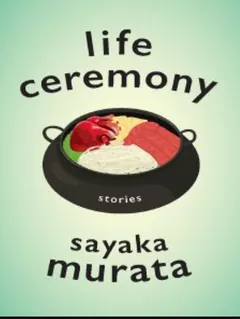
Life Ceremony
Life Ceremony
I was having lunch in the meeting room with five women colleagues from the same department when one of them suddenly stopped eating and looked up, dangling her chopsticks in midair.
“Oh, I almost forgot. I heard that Mr. Nakao from General Affairs passed away.”
We all looked at her.
“What? Really?”
“Seems it was a stroke.”
I pictured Mr. Nakao’s good-natured smile. He was an elegant man with silver-gray hair and often shared sweets he received from clients with us. He’d retired just a few years ago.
“So young!”
“You can say that again. When did it happen?”
“The day before yesterday, apparently. This morning the company was informed that the ceremony will be held tonight. They said the deceased would have wanted as many of us as possible to come along.”
“Really? I’d better hold back on lunch today, then. Maybe I’ll skip dessert.”
We all put our custard desserts back, unopened, into the bag from the convenience store.
“I bet Mr. Nakao tastes good,” said a woman a year older than me as she ate her pork and potato stew.
“Maybe a bit tough, don’t you think? He was thin and muscular, after all.”
“I’ve eaten someone with a similar physique as Mr. Nakao before, and he was actually quite tasty. A bit stringy, maybe, but smooth on the tongue.”
“Really? They say you get better soup stock from men, don’t they?”
“You’ll be going, won’t you, Ms. Iketani?” another woman asked me as she put away the bag of desserts. “To the life ceremony, that is.”
“Ah, um . . . I’m not sure,” I said vaguely, tilting my head doubtfully as I tucked into the noriben lunch box I’d bought at a nearby convenience store.
“Seriously? But why? Oh, come to think of it, you’re one of those people who doesn’t really eat human flesh, aren’t you?”
“No, no—it’s not that! I just have a bit of an upset stomach, and I’m on my period.”
“Oh, on your period. No wonder.” She nodded, apparently satisfied. “But you can get pregnant even on your period, you know.
You really should go. It’s a life ceremony! You might get inseminated, mightn’t you?”
Laughing it off, I washed down the fried fish and excess sauce with some tea from a plastic bottle.
When I was little, it was forbidden to eat human flesh. I’m certain it was.
Now, however, the custom of eating flesh has become so deeply ingrained in our society that little by little, I’m becoming less
confident about what things were like before. But thirty years ago, when I was still in kindergarten, I’m sure it was strictly taboo.
Riding the school bus, we’d already gotten tired of playing at word chains and had started naming things we wanted to eat. The children followed one after another, saying things like “A cloud! So soft and yummy!” “Candy floss! ’Cos it’s sweet!” and then someone said, “An elephant! They’re huge, and I’ll feel stuffed after eating it!”
After that greedy child, others followed with the names of animals.
“Well then, a giraffe!” “A monkey!” This last comment was from my best friend, and as a joke, I’d followed it unthinkingly with “A human!”
The whole bus erupted at my answer.
“Whaaat?”
“Creepy!”
Even my best friend was in tears. “Maho, I can’t believe you’d say something so scary!!!” she stuttered, sobs punctuating her words and snot running from her nose.
In no time at all, like a chain reaction, everyone on the bus was crying and wailing.
After hearing what had happened, the teacher was furious with me. “Maho, you mustn’t say things like that, even as a joke. You’ll get into big trouble,” she said, her face grim. I was crestfallen. I simply couldn’t understand why it was okay to joke about eating a monkey, but not about eating a human.
Even now, I could still clearly recall the eyes of the stern-faced bus driver glaring at me, not to mention the terrifying expression on the face of our normally kind teacher and all my friends wailing behind her. I was scared stiff, sitting in the bus with my head bowed, unable to utter a single word.
All the humans on the bus, filled with righteousness, were reviling me. White-faced and tense, I shrank into my seat and held my breath. If anyone had shouted at me, my fear would have exploded and I would have wet myself.
Since then, however, the human race had changed little by little.
The population shrank abruptly, and the world has become gripped with the fear that the human race might actually go extinct. This has had the effect of procreation morphing into a form of social justice.
We humans had gradually transformed over the past thirty years.
Nowadays, few people ever talked about sex, referring to it rather as insemination with the specific aim of creating new life, and this became the mainstream view.
And whenever somebody died, it was customary to hold a type of ritual called a life ceremony instead of a funeral. Some people still held an old-fashioned wake and funeral, but financial subsidies were available for life ceremonies, so the vast majority opted for this considerably cheaper alternative.
Guests at a life ceremony would eat the deceased’s body, and also seek an insemination partner among the other guests. As soon as a man and woman coupled off, they would leave the ceremony and go outside for insemination. Based on the idea of birthing life from death, this ceremony was a perfect fit for the mentality of the masses and their unconscious obsession with breeding.
Recently I’d been getting the feeling that humans had begun to resemble cockroaches in their habits. Cockroaches would apparently all gather to eat a deceased one of their number, and I’d also heard that a cockroach about to die would lay a huge number of eggs.
Tribes that gathered to mourn and eat the deceased had existed
since antiquity, though, so it wasn’t as though the custom had only now just sprung up among humans.
Yamamoto lit up a 1mg American Spirit, then chuckled. “Are you telling me you still hold a grudge about something that happened to you as a kid?”
The smoking room at work was in one corner of a space we called the common room that had a vending machine and a few chairs. It was partitioned off by glass, and I often met people from other departments in there. It was here that I first got talking to Yamamoto, too.
Yamamoto was short and plump and good-natured, and, at thirty-nine, three years older than me. He was good-natured and I liked the way he always listened to what I had to say, and though he often laughed, he never laughed my opinions off. I always felt comfortable with him and ended up telling him things I wouldn’t tell anyone else.
Sulkily I chewed the filter of my Hi-lite menthol cigarette. “It’s not that I hold a grudge particularly. It’s just that thirty years ago a completely different sense of values was the norm, and I just can’t keep up with the changes. I kind of feel like I’ve been betrayed by the world.”
Yamamoto blinked. His eyes were small and round, with long lashes. “Well, I guess I know what you mean. I think it was forbidden to eat human flesh around the time I was in kindergarten.”
“Right? I’m totally certain it was! Yet nowadays everybody says it’s such a great thing to do. That’s what I can’t get my head around.”
“Oh well. So, what about tonight? Are you going to Mr. Nakao’s life ceremony?”
“What about you?”
Yamamoto wasn’t one of those who adamantly opposed eating human flesh, but he didn’t particularly like to, so I found it reassuring when he was around. Even now that eating human flesh had become mainstream, there was still a deeply rooted faction opposed to it and groups campaigned against it, saying it was unethical.
However, it wasn’t that Yamamoto or I opposed eating it on ethical grounds. In Yamamoto’s case, at the age of twelve he’d suffered a bout of food poisoning after eating some slightly raw flesh at his grandfather’s life ceremony. In my case, I didn’t think there was anything particularly wrong about eating human flesh—after all, when I was little I’d said that I wanted to eat it, even if it was a joke—
but I felt indignant that the ethic by which I’d been judged had turned out not to exist in the first place.
“Maybe I’ll go,” Yamamoto said, scratching the back of his neck.
“It’d be good if I end up inseminating someone.”
“Really? Maybe I’ll go too, then.”
I’d run out of cigarettes, so I took one from Yamamoto’s box of American Spirits. “Do you like these?” I asked him. “You only smoke more when they’re weak, which means you spend more and it ends up being worse for your health, too.”
“It’s okay—I like them better like this.” He blew out smoke, savoring the taste.
Not many people smoked, so Yamamoto and I had the space to ourselves.
It was tiny, less than one tatami mat in size, and looking out through the glass gave the sensation of being a goldfish in a bowl.
I blew out smoke from the cigarette I’d cadged from him. We chatted in the white fog we’d created from the smoke, gazing at the
clear world outside.
That evening, Yamamoto and I headed out together to Mr. Nakao’s life ceremony. The objective of a life ceremony was to give birth to new life, so skimpy clothing or showy outfits were the norm. I was still dressed in my gray work suit, but Yamamoto was wearing a red-checkered shirt with white pants.
“It’s best to dress flashily for a life ceremony,” he said cheerfully, but the outfit didn’t really suit his dark complexion.
Mr. Nakao’s house was in an expensive residential area in Setagaya ward. It was dinnertime, and cooking smells hung in the air all around. No doubt Mr. Nakao’s flesh being boiled was mixed in with them.
“Here it is,” said Yamamoto, checking the map on his phone. It was a large house, beginning to show signs of age, and an aroma of miso came from inside.
“Miso soup! Maybe with some white miso mixed in? Smells delicious!” Yamamoto said happily, sniffing the air as he went inside.
In the entrance hall, a sign on pink paper read MASARU NAKAO LIFE
CEREMONY.
We called out “Good evening” as we opened the door, and an elegant white-haired woman wearing an apron, apparently Mrs.
Nakao, came out to greet us.
“Oh, so good of you to come. Please do come in. We’re just about to start,” she said, ushering us through to the living room. Two large earthenware cooking pots were already on the table in the center of the room, which had been decorated with lots of seasonal flowers. It occurred to me that the pots must have been the beloved possessions of Mr. Nakao when he was alive. For many years, he
had used them for cooking rice with seasonal ingredients, which he would share with us at work.
Human flesh has quite a strong smell and taste, so it isn’t considered suitable for simple grilling with a little salt and pepper.
Most people thoroughly parboil it, then add it to a hotpot with vegetables and plenty of miso for flavor. And it is common to have a specialist company help with the preparation. As I went in, a number of men in overalls were on their way out, bowing their heads as they left.
Men and women dressed to the nines were seated around the hotpots. Some of them were already exchanging flirtatious looks and starting a conversation with someone they found attractive. It appeared the life ceremony was already well underway.
“Thank you, everyone, for coming to my husband’s life ceremony,”
Mrs. Nakao said, opening the lids of the hotpots to reveal Mr. Nakao, boiled together with Chinese cabbage, enoki mushrooms, and other vegetables. “Please partake of his life, and create new life.”
“Itadakimasu!”
Everybody held their hands together and gave thanks for the meal, then began tucking into Mr. Nakao, praising him as they took neat, thin slices of his meat to their mouths.
“Delicious! Mrs. Nakao, your husband is really tasty.”
A white-haired elderly man nodded as he put some meat into his mouth. “It really is a good custom, isn’t it? We partake of life, we create life . . .”
Mrs. Nakao dabbed her eyes with a handkerchief upon hearing these words. “That’s right. My husband will be pleased, too,” she said. “These parts over here are the ones closest to the innards, and
really tasty. Please do eat them up. You youngsters, eat as much life as you can, then get on with insemination.”
The elderly man tried to give me a bowl of the meat, so I hastily said, “Just some Chinese cabbage for me.”
“I’ll have some shiitake and enoki mushrooms,” said Yamamoto.
“Oh? You two dislike human flesh, do you?” the old man said, tilting his head in bemusement.
“It’s not that, it’s just I got food poisoning from it once long ago,”
Yamamoto replied. “Ever since, I always seem to get diarrhea whenever I try it, so I prefer to stick to vegetables, really.”
“And having heard this, I also find it hard to eat it . . . I’m sorry,” I apologized. It was a lot of work to prepare a human body for cooking. Even with the help of professionals, Mrs. Nakao must have been hard at work since morning.
She smiled sadly and served me some Chinese cabbage. “It’s okay, don’t worry. But Mr. Nakao would be so pleased if you ate him, so please do help yourself anytime you feel like it.”
Just then a young woman in a pink dress and a man in a white jacket stood up, holding hands. They had been whispering to each other and touching knees as they ate the flesh hotpot.
“Well, we’re going to go ahead with insemination now.”
“Oh, I’m so glad to hear that. Congratulations!”
There was some applause as the couple bowed to Mrs. Nakao.
“Thank you so much. We will do our best to create a new life,” they said, and left, still holding hands.
“Wouldn’t it be wonderful if Mr. Nakao were reborn in a new life!”
Yamamoto said with a smile. He drank some of the soup made with the stock from Mr. Nakao’s body.
“Wouldn’t it!” Mrs. Nakao said. “I wonder how many inseminations will happen tonight? I do hope lots of new lives will be created!” She gazed affectionately at the pots. The soup made from red and white miso mixed together was a rich brown color, and you couldn’t really see Mr. Nakao inside it.
In the end, Yamamoto and I took our leave from the life ceremony, neither of us having found an insemination partner.
Yamamoto slipped and almost fell as we walked along a back alley. “Argh!”
“Are you okay? Have you had too much to drink?”
“No, it’s not that.”
Yamamoto looked sadly at his shoe. He’d apparently stepped in some semen that had spilled on the street.
I’d heard that in the old days, sex was considered dirty, and it was normal to do it out of sight. I’d never been inseminated at a life ceremony, but it was true that whenever I’d done it with a lover, we’d always used a bedroom or some other place where we wouldn’t be seen. The old customs were probably still left in my body, even if I wasn’t aware of them.
Nevertheless, insemination after a life ceremony was generally considered sacred and could be carried out anywhere. I’d seen it being done on the street at night any number of times, and it looked to me just like plain copulation. I had the feeling that humans were becoming more and more like animals.
“So they’ve built another center out here too, eh?” Yamamoto said, his breath smelling of alcohol.
He was referring to another children’s center. Of course, children conceived during insemination were mostly raised in a family, but
recently there were more and more cases where nobody knew who the child’s father was. This was particularly true of pregnancies that followed life ceremonies. But the priority was to increase the population, so everyone was happy about the children born in these circumstances too.
As a result, centers were set up to take care of children so that women could carry on working while also producing children whenever they wanted to. After giving birth in the hospital within the center itself, some mothers simply left the baby there while others took the baby home for a while and delivered it to the center later.
Roughly half of the children were raised in a family, and half were left as babies for the center to raise.
Many people were strongly against the centers, as they believed it would lead to the family system breaking down. The new childbirth system evidently hadn’t received the same level of acceptance as life ceremonies. Nevertheless, at this rate, more and more children were likely to be raised outside the family system, and it was no longer possible to predict what would become of the human race.
Various researchers were publishing their findings, expressing both positive and pessimistic views.
We may be headed in a dangerous direction, but the vague conclusion seemed to be that we wouldn’t know unless we tried.
“I wonder what will happen if more and more children are raised at centers,” Yamamoto murmured.
Nobody knew the answer to that. All I knew was that we were undergoing radical changes in society.
“Good morning!”
A woman who had been off work the last two weeks was greeted back in the office with a round of applause. At the age of thirty-six, she had taken leave to give birth to her third child.
“Did you pop the baby out at the center?”
“Yep, and I’m leaving it to them. I’m exhausted!”
“Thank you.”
“Good job, well done.”
Everyone was grateful for her having given birth for the benefit of the human race. She looked pleased as she accepted the bouquet of flowers presented to her.
At the centers, children were carefully raised as children of the human race, not of individual parents. The facilities were well equipped, and there was one counselor for every five children.
I had been inseminated by a lover, but it hadn’t resulted in pregnancy, and I was relieved to see women like her who had given birth to lots of children. I was a member of the human race too, so I suppose I was keen for my own animal species to continue.
After accepting the bouquet, the woman went to her desk.
“I’ve been inseminated by my lover many times, but all three pregnancies were from a life ceremony,” she said. “It’s amazing, isn’t it? It seems the pregnancy rate from life ceremonies is pretty high.”
“Miraculous!” a younger woman said, enraptured.
“I can see why, really. Human meat is special, isn’t it? It feels sacred, and it tastes good too.”
“I hear you. I feel like it’s human instinct to want to eat human flesh.”
I felt like pointing out that until a moment ago they had been talking about a different human instinct. Instinct doesn’t exist. Morals
don’t exist. They were just fake sensibilities that came from a world that was constantly transforming.
“What’s up, Maho? You look angry!”
“No, not at all,” I said quietly, and drank up the rest of my tea.
“Don’t you think everyone’s being weird with this instinct thing?” I asked Yamamoto. I drained my glass of beer in one gulp, slammed it down on the counter, and glared at him.
It was only Monday, but I really felt like having a drink and, having bumped into him in the smoking room, I’d dragged him out with me to an izakaya near the office. He was the only person I could talk to about these kinds of things.
Yamamoto listened to me, nodding now and then, without agreeing or disagreeing. It was that sense of respect for distance that made me feel comfortable with him.
“You know,” I said, “when it comes to insemination, my mother said that back in the old days, it was good manners to wear a condom when you had sex. Do that now, and you’re told off for copulating for pleasure and not in order to give birth to new life. It doesn’t make any sense!”
“Well, there’s no need to get so worked up about it,” Yamamoto said, leisurely taking a piece of fried chicken to his mouth.
“Listen to me!”
“I am. But you know, you’re a bit stubborn. You’re the one who sees things in absolutes. It’s like you want to have everything your way.”
“What do you mean?”
Yamamoto put down his chopsticks, wiped his hands with the disposable towel, and pursed his lips, his expression unusually stern.
“Seriously, though,” he said. “It’s the way the world is, right?
Everyone always says that things like common sense or instinct or morals are carved in stone. But that’s not true—actually, they’re always changing. That’s what I think. And this isn’t something that’s happened all of a sudden, like you seem to think. It’s always been that way. Things keep transforming.”
“If that’s the case, I wish they’d stop judging people! It’s like their position has been the right one for the last hundred million years or something. If it’s always changing, it means it’s not certain, right?
And even though it’s uncertain, everyone believes in it like a religion.
It’s so weird.”
He shrugged. “Well, anyway, the world is but a brilliant mirage, a temporary illusion. I mean, it’s an illusion you can only see now, so how about enjoying it to the full while you can?” He picked up his chopsticks again and started putting some pork kimchi and chorizo on his plate.
“Have some veggies too,” I commented. “It’s not good for you to eat only meat.”
“No way. Omnivorous animals aren’t supposed to taste very good, are they? When I ate human flesh as a kid, I thought it tasted great, but that’s because Grandpa was a vegetarian. So I’ve decided to be a meat-arian in order to be tasty when it’s my turn.”
“Oh, c’mon!”
“Anyway. Eat delicious food, enjoy life, and taste good when I die so that those who eat me can summon the energy to give birth to new life. I don’t think that’s such a bad life. Oh, thanks.”
He took the freshly heated flask of sake with a smile, poured himself some, and began drinking.
Feeling irritable, I was about to light a cigarette when Yamamoto chuckled and glanced around the lively izakaya.
“You know what? I don’t think this world is all that bad. And I don’t think the world that you remember from thirty years ago was bad either. It’s always changed over time. The world here and now is just a momentary tint.”
“Huh?”
“I really like Disneyland, you know.”
“Ugh.” I screwed up my face. “I hate it.”
“I thought so.” He chuckled. As always when he laughed, his small round eyes went all black and his long eyelashes fluttered.
“Nobody ever mentions the person inside the cartoon-character costume, do they? Everyone’s lying a bit. That’s what makes it a dream country. Our world isn’t any different, is it? Everyone keeps telling little lies, and that’s how the mirage is created. That’s why it’s beautiful—because it’s a momentary make-believe world.”
“What about the real world? Where the hell is that, then?”
“It’s the mirage that’s real. All our little lies are gathered together and become a reality that you can see only now.”
“I don’t understand. I don’t want to understand!”
Yamamoto laughed, and some sake spilled out of his cup. “Life must be tough for you, Iketani! Why not just enjoy yourself in this momentary world of lies?”
I blew out smoke. Maybe he was right. Maybe the world hadn’t just started transforming recently and we had been continually changing long before thirty years ago.
Even though I could understand the logic of what Yamamoto was saying, I was probably hoping for some kind of concrete certainty.
That felt terribly childish. I felt a chill around my shoulders and rubbed them to warm up, then drank down my shochu topped up with hot water.
Yamamoto patted me on the back. “Don’t overthink things!” he teased. “When you go to an amusement park, you don’t wonder how the roller coaster is put together or how a merry-go-round is powered, do you? Just relax and live your life!”
I felt warmed by the comforting feeling of his hand rhythmically patting my spine and the taste of the strong alcohol flowing down my throat.
Yamamoto had something of a teddy bear about him. When I told him this, he said sadly, “Yes, there is. And that’s why women never fancy me.”
I burst out laughing. All of a sudden the chill had left me, and Yamamoto removed his large, warm hand from my back and took out a cigarette. The white smoke rising from where he was sitting on my right clouded my vision. Through the fog, Yamamoto’s long eyelashes fluttered as he laughed.
That weekend, I heard that Yamamoto was dead.
I was in my apartment doing the laundry. It was the first time in ages we’d had nice weather on the weekend, and I had just put some pillowcases and cushion covers into the washing machine when the phone rang. It was a colleague, a younger woman.
Yamamoto had apparently been on his way home on Friday night, after being out drinking with a friend from college days, when he was hit by a car. He didn’t have much in the way of visible injuries, but he’d hit his head badly.
“His life ceremony is tonight. You’ll go, won’t you, Iketani? You got along well with him, after all . . .” I could hear her sniveling as she spoke.
I don’t remember how I answered, or even when I hung up. The next thing I knew, I was kneeling on the floor, gripping my cell phone.
I badly wanted to call Yamamoto and ask him if it was true that he had died.
I don’t know how long I remained sitting there in a daze. I heard the washing machine beep for the end of the cycle, and I stood up reflexively. Moving mechanically, I mutely hung the pillowcases and cushion covers up to dry. I knew it wasn’t the time to be doing this, but I didn’t know what else to do.
My parents were still going strong, and my grandparents had died before I was born, so it was my first experience of someone close to me dying. The movement of my hands and the sensation of the wet cushion cover felt distant. As I came back inside from the balcony, I staggered and caught hold of the mosquito screen.
Just then my phone rang again.
“Hello. Is this Maho Iketani?”
“Um, yes?”
“I’m Keisuke Yamamoto’s mother.” I held my breath, and the voice continued. “I’m sorry to call you suddenly like this. It’s just that your name comes up a lot in my son’s phone call history . . .”
“Oh . . . I mean, I knew him from work. He was very kind to me.
He, um . . . please accept my deepest sympathies for your loss,” I stuttered.
“Oh, I am sorry! So you were his work colleague . . . I thought you might be a close friend.”
It appeared that she’d mistaken me for her son’s girlfriend or something. Come to think of it, Yamamoto had complained that although his mother wasn’t opposed to life ceremonies, she was against the breakdown of the family system and was always going on at him to start a proper family rather than having a child brought up in a center. To stop her from worrying, he’d even told her that he had a steady girlfriend and didn’t really bother with life ceremony inseminations. In reality, however, there was no such person in his life, and since mine was the female name that occurred most often in his call history, she had assumed it must be me.
“Um, Yamamoto was in a different department, but he was a good friend, and we often used to go out drinking together. I would like to come to today’s life ceremony too, if I may.”
“Thank you. My son would be delighted.”
“What time will it start?”
I must have heard this from the earlier call, but I had no recollection of it at all and felt again how very shaken up I was. I needed to hold on to something, and realized I was already gripping my skirt with my free hand.
“Well, we’re planning to start around six p.m., but it might have to be a bit later . . .”
“Oh, really?”
“My daughter and I are busy with the preparations, but we’re not making very good progress, so I think it’ll probably be a bit later.”
“Are you arranging it just between the two of you?” I was surprised. It was a huge amount of work to prepare for a life ceremony, so people usually got the professionals in, unless there were very good reasons not to. They couldn’t possibly do the whole
thing by themselves, I thought. “Er, would you like me to come and help?”
“What?”
“Yamamoto was a friend, so . . . please do let me help,” I insisted, given her hesitation.
After I got her to agree, I immediately started getting ready to leave. I changed into some old jeans and trainers that I didn’t mind getting dirty and immediately went over to Yamamoto’s place.
It was imperative to serve human meat fresh, so unless there was any sign of foul play, the body was usually taken to the professionals right away. The accident had happened the night before last, so Yamamoto’s meat must be ready for cooking by now.
Yamamoto’s condo was in central Tokyo. When I arrived, his mother opened the auto-lock to let me in the building and hastily came out to greet me.
“I’m so sorry about this,” she said.
“No, really, it’s fine. I’m not sure how much use I’ll be, but . . .”
The polystyrene boxes containing Yamamoto had just been delivered and were still sitting in the hall.
“We don’t have many relatives, so the two of us are basically his only immediate family . . . I should have asked the professionals to do the cooking for us too, but it was a bit difficult for various reasons, and we decided to do it ourselves . . .”
“What do you mean, difficult?”
Yamamoto’s mother smiled uncomfortably. “He left detailed recipes. If you get the professionals to do it, all you’ll get is miso hotpot. My son apparently didn’t like that, and wants us to make him into meatballs in a grated daikon hotpot.”
“Grated daikon hotpot . . .?”
I was taken aback. Human meat was known for having a gamy taste, so it was standard to use strong flavorings with it. Would it be okay to use it in a hotpot that was known for its delicate flavor? My unease must have shown, as his mother nodded.
“It’s not going to be easy, but . . . I mean, that boy was such a foodie. He always was fussy about food, and it’s no different with the meal we are to make with his flesh. It isn’t just hotpot, you know. Stir-fry with cashew nuts, braised meat . . .”
“What? Not just hotpot?”
“That’s right. I want to respect his will as much as possible, but really, it’s a tall order!”
“Can I see the recipes?”
I looked at the file she held out for me. It contained numerous recipes on loose-leaf paper, organized according to ingredients. It was just like Yamamoto, a keen cook who loved food, to do something like this, I thought. There were numerous headings, such as pork, chicken, salmon, cabbage, daikon, and so forth, and at the very end was a final category: “My flesh.”
I leafed through that section to see that it was just as his mother had said, with detailed recipes for “Cashew Nut and Me Stir-Fry,”
“Meatballs of Me in Grated Daikon Hotpot,” and so forth.
“It looks like he just jotted them down when they occurred to him,”
his mother said, “and didn’t necessarily mean it as a will to follow.
But still, he did write them down, and somehow it makes me want to respect his dying wishes . . .”
“I understand.”
It was true. Yamamoto had always gone on about wanting everyone to have a wonderful time at his own life ceremony.
He had jotted down instructions in tiny letters in the corners of the recipes, things like “Decorate the room cheerfully, like at Christmas”;
“I really want everyone to savor this one”; “Make it a splendid ceremony so that there will be lots of insemination!”
Yamamoto had always had this girly side to him. The words in the recipes began to blur, and I hastily closed the file and rolled up my sleeves.
“Anyway, let’s get on with it. Where’s the arm flesh?”
“In a box out there.”
I was just getting on with things in the kitchen when I heard the door open, and Yamamoto’s younger sister came in.
“I’m back! I bought some mizuna and daikon and—oh! Hello!” she said, apparently surprised to see me.
“I—er—I’ve come over to help,” I said, bowing my head in greeting.
“She’s from Keisuke’s workplace,” the mother explained simply.
The daughter frowned. “You see? I told you he didn’t have a girlfriend. He was too vain . . . I’m sorry that you got roped in like this.”
“No, not at all. Yamamoto was really kind to me.”
I couldn’t very well say that he was a smoking partner, so I simply took the supermarket shopping bags from his sister. They were stuffed full of items from Yamamoto’s recipes, like mizuna and cashew nuts.
“Okay, well, in that case, please do help. We’d better start with the more complex recipes or we’ll never be ready in time.” Glancing at the clock, she hurriedly tied her hair back.
I nodded. “Sure. I’ll start making the meatballs.”
I went out into the hall and looked at the Styrofoam boxes piled up there. There were seven or eight of them, filled with dry ice, so they felt cool to the touch.
All the difficult jobs, like draining his blood, skinning him, removing his innards, and processing waste and the part around his anus and so forth had been done by the professionals, and what was in the boxes was Yamamoto turned into meat on the bone. Normally the flesh was removed from the bone and sliced thinly, ready to put into the hotpot; this was the first time I’d ever seen human flesh prepared in various shapes and forms.
Yamamoto had been a bit worried about developing metabolic syndrome, but now, with him turned into meat, I could see that he wasn’t as fatty as I’d expected. Seeing the fresh red mixed with white, I thought how pretty he was.
I found the box with
written on it, lifted it up, and took it
into the kitchen. I took out Yamamoto’s arms, skinned and drained of blood, and began the task of cutting the flesh away from the bone.
Meanwhile, his sister rushed in with another Styrofoam box and took out Yamamoto’s thighs.
“Okay,” she said. “I’ll get on with preparing the meat for braising.
Mom, can you boil some water to be ready for parboiling?”
With his sister briskly issuing instructions, we quickly got on with making Yamamoto into the recipes he’d prepared.
The professionals had done a good amount of the work for us, but you could still make out the form of Yamamoto in the meat. He and I had often gone out drinking together, and now, as I stripped the flesh from the bone, I remembered his strong, hairy arms lifting his beer glass.
These very arms had patted me on the back when I was down, and had dragged me out of the road when I was unsteady on my feet after drinking too much. Once, in the smoking room, I’d dropped ash on his arm, and he’d blown on the red patch and said reproachfully,
“Ouch, that’s hot.”
And just last Monday this hand had given me an encouraging pat on the back. His big, gentle arms were now meat on the bone, lying quietly on the chopping board.
“It’s the first time I’ve ever cooked human meat,” I said. “It’s chunky, isn’t it? The only time I’ve seen raw human meat at a life ceremony, it had already been cut into thin slices.”
“Oh, really? Yes, it is chunky. Not like chicken or something. You can use milk to get rid of the smell, you know. It might be a good idea to soak it awhile before braising it.”
Stripping the meat off Yamamoto’s arm bone was hard work, a bit like dealing with a giant chicken wing. When I was done, I put Yamamoto, now just bone, back into the Styrofoam box, then started grinding batches of his meat in the food processor. It was slow going, and we’d never make it in time with that alone, so his mother was also mincing some with a kitchen knife.
Together we put Yamamoto into bowls, added some starch, onions, sake, and so forth, and then kneaded him before making him
into a heap of meatballs. Meanwhile, his sister grated several large daikon radishes.
His mother had put two large pots of water on to boil. After seasoning the water with grated ginger, soup stock, and sake, we checked the flavor, then started putting in the meatballs.
Lastly we added enoki mushrooms, grated daikon, and mizuna, followed by sliced green onions and Chinese cabbage.
There wasn’t quite enough grated daikon, so I was grating some more when a pleasant aroma rose from the frying pan. Yamamoto’s sister was making the cashew-nut stir-fry.
“You’re a good cook, aren’t you,” I said.
“It’s my hobby,” she said shyly. “I go to cookery classes. Though it never occurred to me that they might come in handy for something like this, though.”
Now that the meatballs were cooking, we started on the braised meat. The recipe indicated braising the meat in salt, which tended to bring out a strong flavor. I took out the chunks that his sister had marinated in milk. The meat from Yamamoto’s thigh was bigger and heavier than I’d expected, and I thought that he probably had been suffering from metabolic syndrome after all.
I diced the meat and put it into a large pot, added green onions, garlic, and ginger, and brought it to a boil. Thanks to the milk, it didn’t smell too strong, but it wasn’t yet cooked enough for a bamboo skewer to pass through.
“Looks like it’s going to take some time,” I said.
“While it’s cooking, shall we decorate the room?”
We covered the meat with aluminum foil and left it to simmer while we started tidying up Yamamoto’s apartment. For seating, we placed
his kotatsu in the center of the living room and alongside it two folding tables his mother had brought. It was quite a large apartment for someone living alone, but with three tables, there wasn’t much space for people to sit.
“It’ll be a bit cramped, but it can’t be helped.”
“People will be coming and going. It’ll be fine.”
Yamamoto’s sister began decorating the room with flowers and wreaths, as indicated in the scribbles on his recipes.
Meanwhile, the braising meat was tender enough to add some broth, sake, salt, and black pepper and put it back on to simmer on a low heat for a bit longer. When it was more or less done, we seasoned it with watercress, yuzu-flavored pepper paste, Japanese pepper, and mustard. We’d just served it up on a large dish when the doorbell rang.
“Do come in!” his sister said into the interphone, opening the auto-lock door. It was time for the life ceremony to begin. Hurriedly, I added some yuzu peel to the reheated large hotpot for the finishing touch.
Yamamoto’s condo was full of people who had come for his life ceremony.
“I’m sorry . . . we should have rented a larger venue,” his mother said, opening some red wine and bringing it to the table.
“Miss Iketani, the hotpot should be ready now,” his sister said to me as she attended to the frying pan, so I nodded at her and took the Yamamoto grated daikon hotpot into the living room.
“Oh! Daikon hotpot!”
“Wow!”
A chorus of exclamations went up, and everyone peered into the pot.
“There’s ponzu sauce and yuzu, so please help yourself. And here’s some more grated daikon too, so be sure to add it as you eat.”
“Iketani, did you come to help out?” asked some of my colleagues who had come along.
“Yes, that’s how it ended up. Please eat as much as you like!”
“Thank you!”
Just then, Yamamoto’s sister came in with the cashew-nut stir-fry and the stew. “Sorry to have kept you waiting,” she said.
“Oh my, so it’s not just hotpot?”
“Amazing! That must have been so much work.”
Seeing everyone’s beaming faces, I felt somehow proud.
Yamamoto was the sort of guy who liked to see everyone looking happy. It was perfectly fitting to his character to wish for such a warm atmosphere at his own life ceremony.
Just as he had hoped, everyone was smiling. I thought he must be the only person in the whole world to have been made into such a sumptuous feast.
After each of the various meat dishes had been met with applause as they were lined up on the table, Yamamoto’s sister said, “Well then, let’s begin.”
Everyone put their hands together, said “Itadakimasu,” then started eating.
“Come on, you too, Iketani!”
I sat down at the end of the table and helped myself to a plateful of Yamamoto meatballs.
“I thought you didn’t like human meat, Iketani,” a younger colleague said in surprise.
“Oh no, it’s not that I don’t like it. It’s just that it usually gives me an upset stomach,” I replied. “But today it’s daikon hotpot, so I’ll stuff myself!”
I picked up my chopsticks, placed an entire Yamamoto meatball steeped in broth in my mouth, and gently chewed.
The meat juices spread through my mouth, filling it with different flavors: the acidity of the yuzu juice, the fresh-mouth feel of the grated daikon, and the mellow yet full flavor of the meat, stronger than beef or pork but not as gamy as wild boar.
“Oof, it’s hot!” I huffed with my mouth open, relishing the taste. It was not at all strong-tasting, as we had prepared it so thoroughly, nor was it gristly, despite being ground meat.
The umami of the meat blended with the tang of the broth and slowly melted on my tongue. The slightly spicy grated daikon covering the meatballs added an extra accent, enhancing the flavor.
Next I served myself some of the Yamamoto braised meat. It was packed with flavor. The yuzu pepper paste really suited the rich flavor of human meat. The condiments had elegantly settled the slight tang of wild animal, and it would have gone well with some white rice. The more I chewed on it, the mix of firm and chewy chunks of meat with the plump, fatty bits yielded an even deeper flavor. I added a little mustard, which drew out yet more umami, and the meat and its juices spread through my mouth.
“I always thought red wine was best suited for human meat, but this would go well with white too, wouldn’t it?”
“There’s some white too, if you like,” Yamamoto’s mother said as she went around happily filling people’s glasses.
The life ceremony that day was a grand celebration. A lot of people came and went, and many couples paired off for insemination and left hand in hand.
The hotpot was emptied any number of times, and we kept bringing in more vegetables and meatballs from the kitchen to replenish it.
People who had loved Yamamoto were eating him, using his life force to create new life.
For the first time, it occurred to me that the life ceremony was actually a wonderful ritual. I was completely absorbed in eating Yamamoto, and also running around bringing in more of him to replenish the dishes.
The dreamlike event came to an end, the meatballs and braised meat were finished, and the life ceremony was declared over.
As we were clearing up afterward, Yamamoto’s sister came over to me with two Tupperware boxes.
“Miss Iketani, thank you so much for all your help today. Please take this home with you.”
Inside was some of the Yamamoto cashew stir-fry and some rice balls.
“Oh, are you sure?”
“I put some aside for you before it was all eaten up. I didn’t have any special ingredients for the rice balls, so I just filled them with some of the braised meat. You were so busy that you didn’t really get to eat much. Please have it as a late-night snack, or something.
It’s not much, but a small token of our gratitude.”
“That’s lovely. Thank you so much,” I said, taking the Tupperware boxes of food. It had gone cold, but the delicious aroma still rose from it.
I left Yamamoto’s condo and suddenly decided to go and have a picnic. I had some rice balls and a dish to go with them. Apart from anything, I was too worked up to sleep even if I did go straight home.
I saw traces of semen here and there in the area around Yamamoto’s condo. Hopefully it was all from people who had paired off for insemination at the ceremony. I had the feeling that Yamamoto’s life, like the fluff from a dandelion, had flown out into the world.
The late train I’d taken finally came out by the seaside in Kamakura.
Yamamoto had loved the sea. When we’d gone on the company trip to Misaki Port, he’d rolled up his jeans to go paddling in the water, ignoring everyone who tried to stop him, and his clothes had gotten soaked.
The seaside is great. Humans have lived by the ocean since ancient times, so our DNA responds to it fondly. That’s what he’d said at the time.
This was the world that Yamamoto had treasured. We humans were here for only a moment, the time it takes to blink in the flow of time experienced by the big lump we call Earth. In that enormously long moment, we continued to evolve and transform. I was here in a momentary scene of the never-ending kaleidoscope.
I slowly opened the Tupperware boxes. Three rice balls filled with Yamamoto braised meat were neatly packed inside one, and in the other was some of the Yamamoto cashew stir-fry, with lots of red peppers and other vegetables.
“Um, what are you doing?” a voice suddenly asked.
I turned around in surprise. A man I didn’t know was standing there with a flashlight.
“Oh, I’m sorry.”
“No, not at all . . . I live in the neighborhood and happened to see you walking unsteadily toward the sea at night, and I was a little worried about you.”
He must have thought I was about to commit suicide. I held up the boxes of food for him to see.
“I’m just having a picnic. I’m sorry to have surprised you.”
“No, no, it’s fine . . . but it’s a weird time of night to be having a picnic, isn’t it?”
“This is a friend of mine called Yamamoto. I’ve been at his life ceremony all day, and I was given these leftovers, so brought them here to eat.”
“Oh, I see.”
“Um, would you like to share him with me?” I asked, thinking it’d be quite nice to have someone to talk to, but the man tilted his head to one side, uncertain of how to respond.
“I’d like to, but since you’re talking about a life ceremony . . . I mean, I’m gay.”
I held out a rice ball for him. “It’s okay. I didn’t mean it like that.
The food is made from recipes my friend himself devised.”
The man peered curiously into the boxes and sat down next to me.
“That is unusual, isn’t it? I’ve only ever eaten human meat in a miso hotpot.”
“That’s the usual way. But it’s also delicious stir-fried like this.”
“Well, if you’re sure you don’t mind.”
We started eating the food, watching the nighttime sea.
“This is delicious. Actually, I hadn’t had dinner yet and was feeling hungry.”
“I’m so glad. Please eat as much as you like.”
Fragments of Yamamoto were being scattered out into the world, turning into energy in people’s stomachs. That delighted me enormously.
“Having eaten this, it’s a pity I can’t carry out the insemination, isn’t it? If it wasn’t so late, I’m sure there would have been a lovely man for you to do it with around here.”
“No worries. It’s not like I absolutely have to do it.” I smiled and then burst out laughing. “Put like that, it kind of makes us sound like plants sending out pollen, doesn’t it? When a life ends, it flies far away and fertilizes new life.”
“True. Yeah, that’s the way it is. Pretty mysterious when you think about it.”
“But then, if I’m a pistil, it would be odd for me to fly.”
“Why? So what if a pistil flies?” The man picked up some of the cashew stir-fry with his disposable chopsticks and carried it to his mouth.
“Yamamoto’s cashew-nut stir-fry really is super delicious,” he added, narrowing his eyes in pleasure.
“Right? He goes well with cashew nuts, doesn’t he? I never realized it when he was still alive.”
I listened to the sound of the ocean, then suddenly thought of something.
“Um, can you remember what it was like thirty years ago?”
“What?”
I bit into a rice ball, feeling somehow like I was floating in the sound of the waves. Maybe I was still a little drunk from the wine.
“Back then we didn’t have the custom of eating human meat,” I murmured. “Do you remember that time?”
“Oh . . . but I wasn’t born yet. I’ve only just turned twenty-four.
When I was little, it was already kind of normal to eat it.”
“Oh, I see . . .”
The man tilted his head inquiringly as if to ask, What about it?
“What if people back then could see us eating Yamamoto in a cashew-nut stir-fry now?” I blurted out. “They’d think we were out of our minds, wouldn’t they?”
He thought about it for a moment, then nodded. “Yes, I think they would.”
“Do you think that’s strange? The world is changing so fast I no longer know what’s right or wrong, and now we are here following the current custom eating Yamamoto like this. Do you think we’re weird?”
He shook his head. “No, I don’t. I mean, normal is a type of madness, isn’t it? I think it’s just that the only madness society allows is called normal.”
“Eh?”
“So I think it’s fine. As things are now, Yamamoto is delicious and we are normal to think so, even if people in a hundred years’ time think we’re mad.”
I listened to the sound of the waves. The sound Yamamoto had loved.
The man finished eating his rice ball and stood up. “Thank you so much for sharing that. I’d better be going now.”
“Okay.”
“Are you sure you don’t want me to accompany you back into town?”
“No, that’s fine. I want to walk a little more; then I’ll find somewhere to stay for the night.”
“Okay, then.”
We said goodbye, and I walked along the beach.
There was a couple engaged in insemination on the beach. What would that have looked like back when it was still called sex? Was it treated as a sacred action the way insemination is now? Or was it considered dirty? It must have been considered dirty, given that it was done out of sight.
I was vaguely wondering about such things when I felt a tap on my back.
Surprised, I turned to see the man again.
“Sorry to make you jump. Um . . . this is for you.”
“What?”
He held out a small bottle. “I put it in there just now, so please do accept it.”
I peered at the bottle and saw a white liquid inside it.
“I went to the toilets to do it. They say it dies when it comes into contact with the air, so I don’t know whether it’ll work. But I wanted to do what I could for Yamamoto’s life ceremony.”
“Thank you!”
I took the still-warm bottle from him. “I’m so happy. I’m sure it’s still alive. I heard somewhere that sperm is protected by the outer layer
of semen, so even when it comes into contact with the air, it can live for three days in the right conditions. Thank you so much! I’ll use it very carefully.”
He was sweating slightly from his recent effort. “You’re welcome.
Yamamoto really was delicious. I hardly ever go to life ceremonies, but having eaten him, I wanted to participate even if only in some small way,” he said with a smile.
“I’m so pleased. Yamamoto would be happy too.” I looked at the bottle in my hand.
“The bottle originally had star sand in it. It was in my bag, and the only suitable container I had at hand.”
“Are you sure, really? It’s so pretty,” I murmured. The white liquid teeming with life was so pretty that I wanted to think it was the star sand itself.
“Wow, what’s going on?” the man muttered suddenly, as if surprised.
“What?”
“Incredible! Did you bring them with you?”
I turned and saw that all of a sudden there were a lot of people on the beach. I strained my eyes for a closer look and realized that they were all engaged in insemination.
“Whenever there’s a life ceremony, the beaches around here are always full of people doing this. I didn’t hear of anything happening today, though.” He tilted his head, puzzled. “Well, there wasn’t any need for me to bring that bottle after all, was there?” He sounded quite embarrassed.
“Oh no, not at all. I’ll use it! Definitely, I’ll inseminate myself with it.”
He laughed bashfully. “Okay, I’ll be off now, then,” he said, and left.
Now that I was on my own, I rolled my jeans up to the knees and walked into the sea.
The beach was full of people engaged in insemination, their white arms dimly flickering as they writhed on the sand.
It was like a scene from antiquity, ancient life-forms coming out of the sea onto the land. I hadn’t witnessed such a thing, but what was happening that night felt like a nostalgic, important memory, and I watched the white shapes and black waves unblinkingly. I could understand Yamamoto’s fondness for the ocean.
I made my way between the copulating couples, the waves lapping at my legs as I moved deeper into the water.
The entangled bodies resembled plants in the moonlight. I carried on through the numerous white trees, a whole forest immersed in water.
I carried on until I was up to my knees in the water, then pulled my jeans down. I poured the white liquid from the bottle into my hand and slowly inserted it into my body.
Semen spilled from my fingertips.
Yamamoto’s life, dispersed from the warm meal in his condo into the ocean and into the world.
Maybe a miracle would occur, and I would conceive. Even if I didn’t, the world in which we exchanged sperm like this somehow struck me as beautiful.
As I stood there enveloped in the sound of the waves, semen trickled down my legs. Water teeming with life caressed my thighs.
Right now, in the absolute normality that existed only in this brief moment in the long flow of time on this planet, semen was being sucked up into my body.
For the first time in my life I dissolved into this normality. Dyed by the colors of the ever-changing world, I became part of the tint of this unique moment.
The night deepened, and the sky and sea turned pitch-black.
Yamamoto’s life was slowly absorbed into my flesh. As I blended with him into one life, I closed my eyes, my legs still immersed in our beloved water. The sound of the waves caressed the eardrums of all of us there engaged in insemination.