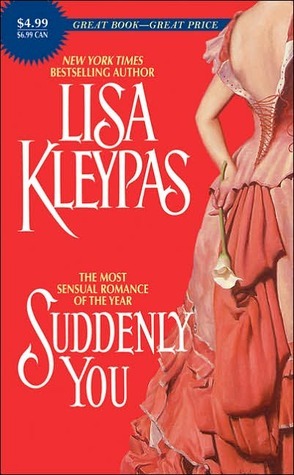
Suddenly You
Suddenly You is Lisa Kleypas’s 2001 historical romance, a Victorian era standalone that has remained one of her most beloved books with longtime readers despite not being part of any of her famous connected series. The novel is set in 1830s London and centers on Amanda Briars, a thirty year old novelist who decides on her thirtieth birthday that she is tired of being a virgin and arranges a discreet liaison with a young man whose company she will pay for the night. The young man who arrives at her door is Jack Devlin, a notorious London publisher with a reputation that no respectable woman should be aware of.
The complications start immediately. Jack is not the escort Amanda was expecting. He has been sent in error or by some interfering party. He is also the publisher whose attempts to acquire her novel she has been politely rebuffing for months. The night that does not go as planned in any of the directions either of them expected becomes the foundation for a slow building romance that has to overcome class differences, professional complications, and the kind of secrets that nineteenth century men of Jack’s background tended to carry.
Lisa Kleypas writes the kind of historical romance that combines real period detail with the emotional satisfaction of the genre at its best. Amanda is one of her most distinctive heroines, an independent older woman by Regency standards who has built her own life and is not interested in being rescued. Jack is a particular kind of Kleypas hero, a self made man whose origins in the London underworld have given him a different perspective on respectability than the gentlemen of Amanda’s literary circle have. The Victorian London setting is rendered with care, with attention to the publishing industry of the era, the social codes that constrain Amanda even as a successful novelist, and the city itself.
For longtime Kleypas fans who came up through her Hathaway and Wallflowers series, Suddenly You is an essential standalone that some consider her best book. For new readers, it works perfectly on its own.
About the Author
Read and download 7 free books by Lisa Kleypas on BDeBooks. Browse the complete collection of Lisa Kleypas’s works available as free PDF and EPUB downloads. Discover novels, fiction, and other writings by Lisa Kleypas in our online eBook library.
See all books by Lisa Kleypas →