
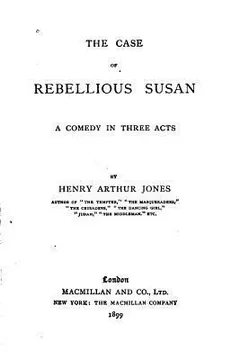
The Case of Rebellious Susan, A Comedy in Three Acts
The case of rebellious Susan; a comedy in three acts
This chapter is long, so it is split into 3 parts.
Jones, Henry Arthur, 1851-1929
This book was produced in EPUB format by the Internet Archive.
The book pages were scanned and converted to EPUB
format automatically. This process relies on optical character recognition, and is somewhat susceptible to errors. The book may not offer the correct reading sequence, and there may be weird characters, non-words, and incorrect guesses at structure. Some page numbers and headers or footers may remain from the scanned page. The process which identifies images might have found stray marks on the page which are not actually images from the book. The hidden page numbering which may be available to your ereader corresponds to the numbered pages in the print edition, but is not an exact match; page numbers will increment at the same rate as the corresponding print edition, but we may have started numbering before the print book's visible page numbers. The Internet Archive is working to improve the scanning process and resulting books, but in the meantime, we hope that this book will be useful to you.
The Internet Archive was founded in 1996 to build an Internet library and to promote universal access to all knowledge. The Archive's purposes include offering permanent access for researchers, historians, scholars,
people with disabilities, and the general public to historical collections that exist in digital format. The Internet Archive includes texts, audio, moving images, and software as well as archived web pages, and provides specialized services for information access for the blind and other persons with disabilities.
Created with abbyy2epub (v.1.7.6)
THE LIBRARY
OF
THE UNIVERSITY
OF CALIFORNIA
LOS ANGELES
GIFT OF
Kenneth Maogowan
Digitized by the Internet Archive
in 2008 with funding from
IVIicrosoft Corporation
http://www.archive.org/details/caseofrebelliousOOjone
N^»
.4,
-pr-e.
4B2J
PERSONS REPRESENTED.
Sir Richard Kato, Q.C. ^ tt l t
Admiral The Hon. Sir Joseph [ lTd^Susan.
Darby. )
James Harabin (Lady Susan's Husband). Fergusson Pybus. LuciEN
Edensor. Mr. Jacomb. Kirby. Footmen. Hotel-Waiter.
Lady Susan Harabin. Lady Darby. Mrs. Quesnel (Inez). Elaine Shrimpton.
Act L—Drawing-room at Mr. Harabin's in Mayfair. (Ten months pass.) Act n.—Sir Richard Kato's sitting-room at the St. Mildred's Hotel, Westbay.
{Fifteen months pass.)
Act HL—At Sir Richard Kato's house in Harley Street.
a 2
5725SS
Dear and Honoured Madam,
In dedicating this little comedy to you I have no other object in view than that of bribing and blinding your well-known susceptibilities, and
of endeavouring to win over and conciliate that large body of English playgoers who take their opinions and morals ready-made from you, the august and austere effigy of our national taste and respectability.
The truth is, my dear lady, I am a little fearful that without some such shelter as your powerful protection, many excellent persons may be in doubt as to the exact moral which this comedy sets forth; or indeed may go further and doubt whether there is a moral in it at all; or, dreadest and cruellest alternative, may actually proclaim that it is immoral. The mere possibility of this latter alternative is so painful to me, that I am obliged to recall a conversation which I recently overheard in a railway carriage.
" Ah, who wrote that play ? " I heard one passenger inquire of another.
"That man Henry Arthur Jones," replied his neighbour.
" I hate that fellow," said the other. " He's always educating the people."
Now though I cannot honestly credit myself with any such unselfish motive in writing plays as my fellow-passenger ascribed to me, I could not help feeling a glow of virtuous pride when I found that my natural ingrained tendencies were so salutary and so patriotic. And if I have in any way contributed to the State Education grant, or lowered the School Board rate in any parish, I hope I shall not be deprived of the merit that attaches to such public benefactions merely because they have been quite involuntary and unsuspected on my part.
Now, my dear Mrs. Grundy, I will not go so far as to say that I know with any degree of certainty what the moral of this comedy is. I will leave that for you and the public to discover. And I am very hopeful in this respect when I remember that one of our keenest and most analytical critics, in interpreting for us a recent masterpiece of the lobworm-symbolic school, declared that though he was very doubtful what the play did mean, yet he was quite sure that it meant a very
great deal. And so, my dear ma'am, I will not pin myself down to any one, definite, precise, hard-and-fast, cut-anddried moral in this comedy. Why should I ? Why should I needlessly limit the possible scope of its beneficent operation, or curb my boundless desire that all sorts of unexpected collateral good may TO MRS. GRUNDY vii
haphazardly visit those who witness its representation?
I know of no task wherein the generosity and the ingenuity of the critical playgoer may be more profitably employed than in finding a profound significance in passages where the author himself has never detected it; and in dragging to light profound moral truths from hiding-places where the author himself has never imagined them to be lurking. Therefore, my dear Mrs. Grundy, if you will be pleased to wink at any little outside indiscretion, and if the public will set its wits to work, I have no doubt a very serviceable moral is to be extracted from this comedy.
Look at life itself, my dear lady. The moral of it is not very obvious at first sight, but there must be a tremendous moral hidden somewhere in it. Nay, there must be hundreds of morals in it, and I am not without a suspicion that in claiming only one moral for this comedy I have done myself a very grave injustice. For all I know it may be teeming with morals.
But perhaps you will say that my comedy is quite unlike life. I am aware that I have no warrant in the actual facts of the world around me for placing on the English stage an instance of English conjugal infidelity. There is, I believe, madam, a great deal of this kind of immorality in France, but I am sure you will rejoice to hear that a very careful and searching inquiry has not resulted in estab viii TO MRS. GRUNDY '
lishing any well-authenticated case in English life. And even had the inquiry revealed a quite opposite state of things, I know you will
agree with me that it would be far better to make up our minds that the facts are wrong and stick to that, than to allow the possibility of anything hurtful to our continued self-esteem and self-righteousness.
I am too sensible, madam, of the honour of belonging to the same nation as your own revered self to do anything to impair its holy self-esteem and worship of its own conviction that it is the most moral, most religious, most heaven-favoured nation under the sun.
Happily, as I say, there is not the slightest necessity for disturbing our cherished national belief that immorality is confined to the Continent, and especially to France. Let us, therefore, again thank Heaven that we are not as other nations are, and let us avoid seeing or hearing anything that may disturb our belief in our own moral superiority.
So, my dear madam, I have frankly to own that I have not the slightest justification in fact for laying the scene of my comedy in England, and I am again justly open to the charge, so often made against me, of beingquite false to life as my countrymen see it.
And now, my dear lady, having endeavoured to win your approbation by every means in my power, let me again say that all I am anxious for is that you should not too hastily condemn the piece because its morality is intrinsic and not extrinsic. For I do Stoutly afifirm, adorable arbitress of British morals, that there is a profound moral somewhere in this piece. Only, if I dare hint so much to you, dear lady, it is well at times not to be too ferociously moral.
There is a time to be ferociously moral, and a time to refrain. The present, my dear Mrs. Grundy, is an eminently suitable time to refrain. Let us not be always worrying books and plays for their morals. Let us not worry even life itself for too plain, or too severe a moral. Let us look with a wise, sane, wide-open eye upon all these things ; and if a moral rises naturally from them let us cheerfully accept it, however shocking it may be ; if not, let us not distress ourselves.
If, my dear ma'am, you cannot see any moral in this little comedy, take it for granted there is one, and—go and see the play again. Go
and see it, my dear Mrs. Grundy, until you do find a moral in it. And remember that it is not only trifles like this that are naturally repugnant to you. Remember how hateful to you are all the great eternal things in literature and art. So much so, that if our English Bible itself were to be now first presented to the British public, you would certainly start a prosecution against it for its indecency and its frightful polygamistic tendencies.
Refrain, my dear lady ! Refrain ! Refrain ! And if you must have a moral in my comedy, suppose it to be this—" That as women cannot retaliate openly, they may retaliate secretly—and lie I "
X TO MRS. GRUNDY
And a truly shocking moral it is, now we have got it. But oh, my dear Mrs. Grundy, Nature's morality is not your morality, or mine. Nature has ten thousand various morals, all of them as shocking as truth itself. The very least of them would fright our isle from its propriety if it were once guessed at.
Refrain, my dear madam ! Refrain ! And—excuse me—isn't that foot of yours rather too near that tender growing flower—I mean the English drama ? And your foot is so heavy ! Don't stamp out the little growing burst of life. Refrain, my dear lady ! Refrain ! Adieu !
Yours, with the deepest reverence for all things worthy of reverence, Henry Arthur Jones. Dieppe, August 28M, 1894.
P. S. My comedy isn't a comedy at all. It's a tragedy dressed up as a comedy.
ACT I.
Scene. Drawing-room at Mr. Harabin's ; an elegantly furnished room in Mayfair. At back, in centre, fireplace, with fire burning. To right of fireplace a door leading to Lady Susan's sittingroom. A door down stage left.
Enter Footman left showing in Lady Darby.
Lady Darby \a lady oj about fifty\ Where is Lady Susan now ?
Footman. Upstairs in her sitting-room, my lady. [Indicating the door right. Lady D. Where is Mr. Harabin ? Footman. Downstairs in the Ubrary, my lady.
Enter left Inez, a widow of about thirty.
Lady D. \To First Footman.J Tell Lady Susan I wish to see her at once.
Inez. And will you say that I am here too ?
[Exit Footman at door right.
Lady D. [Going affectionately to Inez, shaking hands very sympathetically.\ My dear Mrs. Quesnel, you know?
2 REBELLIOUS SUSAN act i
Inez. Sue wrote me a short note saying that she had discovered that Mr. Harabin had and that she'd made up her mind to leave him.
Lady D. Yes, that's what she wrote me. Now, my dear, you're her oldest friend. You'll help me to persuade her to—to—look over it and hush it up.
Inez. Oh, certainly. It's the advice everybody always gives in such cases, so I suppose it must be right. What are the particulars ?
Lady D. I don't know. But with a man like Harabin—a gentleman in every sense of the word —it can't be a very bad case.
Enter Lady Susan, about twenty-seven^ door right, followed by the Footman, who crosses and goes off at door left. Lady Darby goes to Lady Susan very affectionately and sympathetically, kisses her in silence. Lady Susan, havi?tg kissed Lady Darby, goes to Inez, kisses her.
Lady S. Inez ! I'm so glad you've come ! I knew I could rely upon you.
Inez. Yes, dearest—naturally ! What can I do ?
Lady S. [Taking a bundle of letters from her pocket.'] Read those letters. I found them in his secretaire. They explain it all. And then tell me if you wouldn't do as I'm going to do.
Lady D. [Very sympathetically.'] My poor girl! My poor girl!
ACT I REBELLIOUS SUSAN 3
Lady S. Oh! please don't. I'm not an object of pity. At least, if I am now, I won't be one very long.
Lady D. What do you mean ?
Lady S. I'm going to follow Jim's example. I'm going to pay him back in his own coin.
Lady D. [Soothingly.'] Yes, dear, yes ! That's what we all say at first, but we don't mean it. And it can't be as bad as that.
Lady S. As bad as what ?
Lady D. Mr. Harabin may have been indiscreet Lady S. Indiscreet! [Enraged laugh.
Lady D. And infatuated
Lady S. Infatuated ! [Enraged laugh.
Lady D. And led away
Lady S. Indiscreet! Infatuated ! Led away !
Lady D. My dear, we may call it what we like, but men are men, and they are led away, and the rest of it.
Lady S. Very well. I'm going to be indiscreet, and infatuated, and the rest of it.
Lady D. My dear child, that's impossible.
Lady S. Not at all, my dear aunt.
[Inez gives back the letters to Lady Susan with a little sigh and a sympathetic look, and a little shake of the head. Lady Susan takes them.
Lady D. My dear Sue, of course you're angry and upset for the moment—and quite right—quite right!
4 , REBELLIOUS SUSAN act i
I don't blame you—but after all it can't be such a very bad case.
Lady S. Every case is a bad case.
Lady D. Oh no, my dear ! Some cases are much worse than others; and when you come to my age you'll be thankful that yours is no worse than a respectable average case.
Lady S. Respectable average case! No! that's just what my case shall not be. It sha'n't be average, and perhaps it won't be respectable. Read those letters.
[Giving letters to Lady Darby. Lady Darby takes the letters a)id reads them apart.
Lady S. [To Inez.] Well?
Inez. Well, dearest, it is rather dreadful Lady S. Rather ?
Inez. But look at poor dear Mrs. Barringer !
Lady S. [Etiraged.'] Ah ! that's it! And in a few days all my friends wU
be saying, " Look at poor dear Lady Sue ! " They sha'n't say that.
They shall say, " Look at poor dear Jim Harabin ! " If somebody is to be pitied, it shall be Jim.
Inez. But, dear, you won't do anything in a hurry ?
Lady S. If I don't, I can't do anything at all. I can't rake it up in a year's time.
Inez. No, but I should wait till
Lady S. Till the next time. No ! I've made up my mind. I'm going back home with you now
ACT I ■ REBELLIOUS SUSAN 5
—that is, if you'll have me for a day or two till I can make my plans.
Inez. Certainly, dearest; you know you're welcome.
Lady S. There's a dear ! Phillips is packing my things. I shall be ready in an hour.
Inez. Of course, dear, I'm delighted. But I'm going to Egypt in a few days.
Lady S. Oh, that's splendid ! We can go together, and have a good time. Ah, Inez, how lucky you've been! [Inez looks surprised?^ No, I don't mean that, dear, but still a widow's position has some advantages, hasn't it ?
Lady D. [Having read the letters, sighs very deeply, and shakes her head.] The old story ! The old story ! [Gives them back to Lady Susan.
Lady S. [Taking letters, putting them in pocket.] And what would you advise me to do ?
Lady D. I should give him a good sound talking to, I should make his life a misery to him for a fortnight; then—I should never mention the matter again.
Lady S. [Enraged laugh.] Ha, ha! Ha, ha! [To Inez.] And what would you advise me to do?
Inez. Well—I shouldn't nag him. I should be utterly broken-hearted and mutely reproachful. I should look more intensely interesting, and a little paler, and wear prettier frocks, and give him a better dinner each evening, and when he had begged
6 REBELLIOUS SUSAN act i
forgiveness for a long while, I should find it in my heart to—to forgive him.
Lady S. [Outburst of enraged laughter.'] Ah ! that's it! We are such traitors to ourselves. If we could only bind ourselves together Lady D. A trades-union of our sex? My dear, seven-eighths of us are natural blacklegs to start with.
Lady S. Yes, and that's why men are spoilt. •; It's our cowardice and weakness and falsehood that make them such brutes.
Lady D. They are brutes !
Inez. Yes, but that's God's fault more than woman's.
Lady D. I don't know whose the fault is, but there's no denying they are brutes.
Inez. [Sighs.'] I'm afraid they are; but I don't see what we are to do except take them as we find them and make the best of them.
Snter ¥ootma.n a/inouna'ng Sir Richard Kato. Sir Richard Kato, a bright, shrewd mati of the world about fifty, enters. Exit Footman.
Sir R. [ Very sympathetically^ My dear Sue ! How d'ye do. Lady Darby ? How d'ye do, Mrs. Quesnel ? [Shakes hands—a pause—Sir Richard looks keenly from one to the other?] Anything important under discussion ?
ACT I REBELLIOUS SUSAN 7
Lady S. You may speak out, Uncle Dick; they know all about it.
Sir R. Then I'm sure they are of the same opinion that I am.
Lady D. I've strongly advised Sue to—to make the best of it.
Inez. And so have I. ■' Lady S. Oh, yes! " Patch it up !" " Don't make a fuss about it!" That's what outsiders always say to a woman.
Sir R. And, my dear Sue, as outsiders see most of the game, you may depend, in ninety-nine cases out of a hundred, outsiders are right.
[Lady Darby and Inez talk together a little apart.
Lady S. Ah, you've never been deceived.
Sir R. Well, I've never been married. But I've had twenty-five years'
practice in the Divorce Court, and if I'm not qualified to give advice in a matter of this kind, I don't know any man in England who is.
Lady S. {^Impetuously.'] I don't want advice. I want sympathy.
Sir R. Well, I am sure you will have the deepest sympathy from all Lady S. {Enraged.] I don't want sympathy. I won't have it.
Sir R. My dear Sue, what do you want ?
Lady S. I want somebody to show me some way of paying him back without—without
B
8 REBELLIOUS SUSAN act i
Sir R. Without losing your place in society and your self-respect. Ah!
that's the difificulty. There's an immense reputation to be made as a moralist by any man who will show you ladies the way to break the seventh commandment without leaving any ill effects upon society.
Lady S. Well, he'd better make haste or we shall find out the way ourselves.
Sir R. [Shakes his head.'\ My dear Sue, believe me, what is sauce for the goose will never be sauce for the gander. In fact, there is no gander sauce, eh, Lady Darby?
Lady D. No. If there had been, our grandmothers would have found it out and left us the receipt for it.
Sir R. [ Very affectionately.'\ Come, come. Sue ! [Putting his arm very tenderly on hers.^ Come, now ! Let us talk this over quite calmly and sensibly. [ IVith great tenderness^
Lady S. Oh, yes ! I know what you mean. But I won't listen to another word unless you promise you won't advise me to patch it up.
Sir R. I promise. Now, what is the exact point at which we have arrived ? Where are we ? What were you saying when I came in ?
[Looking from one to the other?\
Lady S. I'd just said that men are brutes.
Lady D. And I had agreed.
Inez. And I too—with some qualifications. '
.Sir R. And I agree with you—without any quali ACT I REBELLIOUS SUSAN 9
fications. Men are brutes. Once recognise that simple fact in all its bearings, and we start on a basis of sound philosophy.
Lady S. I don't want any basis, or any sound philosophy. I want my revenge.
Sir R. [To Lady Darby.] Leave her to me for a little while, and.come back again.
Lady D. And what's to be done with Mr. Harabin?
Sir R. What can be done with him ?
Lady D. Somebody ought to give him a good sound talking to.
Sir R. Leave him to me, too.
Lady D. [Suddenly bethinking herself.'] Good gracious !
Inez. What's the matter?
Lady D. I was going to Waterloo to meet Sir Joseph when Sue's letter came, and I forgot all about him. His ship's just come into Portsmouth. I shall miss him now. [Takifig out watch.'] And I haven't seen the dear man for six months.
[Exit very hurriedly. Inez is following.
Lady S. Inez!
Inez. Yes, dearest.
Lady S. I'm coming with you.
Inez. No, dearest—I'll go and get your room ready, and come back in half-an-hour, and if you are still in the same mind Lady S. You'll take me with you ?
B 2
lo REBELLIOUS SUSAN act i
Inez. We'll see about it. [Exit
Sir R. [ Very tender/y.] Come, Sue, I've only your welfare at heart.
I've no personal interest to serve.
Lady S. Why did you let me get married ?
Sir R. My dear, if you remember, you were so anxious and so sure of happiness
Lady S. But why didn't you tell me what marriage was?
Sir R. My dear, in the first place you wouldn't have listened Lady S. [Con^denf/y.] Oh, yes, I should.
Sir R. In the second place you wouldn't have heeded Lady S. Oh, yes, I should—if you had painted marriage in its true colours.
Sir R. It has so many true colours.
Lady S. No, it hasn't. It's a hateful, wretched institution.
Sir R. Marriage is not a hateful, wretched institution. On the contrary, after twenty-five years' constant practice in the Divorce Court, I am pre^ pared to affirm that marriage is a perfect institution Lady S. What ?
Sir R. Worked by imperfect creatures. So it's like a good ship manned by a mutinous crew.
Lady S. It's men that make it what it is.
Sir R. Yes—and women. And the result is a condition that varies in each case with all the vary
ACT I REBELLIOUS SUSAN ii
ing tastes, tempers, dispositions, infirmities, prejudices, habits, etc., etc., etc., of the contracting parties. Now you yourself are a perfect woman
Lady S. I ? perfect ? I've never pretended to that.
Sir R. Well, you see, dear, that introduces one little kink into the working of the institution in your case. Still, however, as Jim Harabin is perfect
Lady S. Jim perfect ?!
Sir R. You thought him perfect at the time of your engagement, if you remember.
Lady S. Never!
Sir R. Well, you see, that introduces another little kink into the working of the institution in your case. So you saw his faults?
Lady S. Always—heaps of faults.
Sir R. Then, my dear, if that didn't stop you from marrying him, do you think it would have stopped you if I had hinted at, or even described, certain other faults ? No; you would have been Shocked and grieved. He would have promised amendment. And in the end you would have forgiven him. And at this precise moment we should be at the very precise point at which we have now arrived.
Lady S. Oh no! I shouldn't have forgiven him.
Sir R. Then, my dear, you'd have been on the high way to be an old maid, and at this precise moment you would have been raiUng at me for
12 REBELLIOUS SUSAN act i
having spoilt your chances. And that reminds me, while you're blaming me for letting you marry, Elaine is blaming me for trying to stop her from thro^i^ing herself away on this—what's the fool's name
?—Fergusson Pybus.
Lady S. She's written to him to come to see you at once.
Sir R. What for ?
Lady S. She knows there has been a misunderstanding between Jim and me, and she knows that I am leaving the house. When I've gone, of course I can't chaperon her any longer.
Sir R. And so you intend to throw her bacjc on my hands.
{Perplexed?^ Now, my dear Sue, do be a sensible girl, and—and Lady S. No. You promised me you wouldn't advise me to patch it up.
Sir R. Well, will you listen to what Jim has to say?
Lady S. I have. It's no use.
Sir R. Have you thoroughly rowed him ?
Lady S. Not so much as he deserves.
Sir R. No—no—but still considerably, eh ? And he's thoroughly ashamed of himself?
Lady S. Not so much as he ought to be.
Sir R. No—no—but still considerably, eh ? Well now \Making a dart at the bell-handle and pulling zV.] —we'll have him up.
Lady S. [Very decidedly.'] No. I won't meet him.
Sir R. My dear Sue, if you're going to leave him, ACT I REBELLIOUS SUSAN 13
don't give him a chance to say that you didn't thoroughly explain your reasons for taking the step. [Footman appears at door ieftl] Will you tell Mr. Harabin I should like to see him for a minute ? [Exit Footman.
Lady S.> It's no use—[Going off?\
Sir R. [Going to door left, stopping /ler.] My dear Sue, let's hear what the accused has to say.
Lady S. I have heard.
Sir R. Well, perhaps there is something else.
Lady S. Yes; he has thought of some fresh excuses.
Sir R. Perhaps he's more sorry and ashamed.
Lady S. Well, what then ?
Sir R. Then you'll forgive him. [Lady Susan shakes her head.^ It will come to that at the last, my dear Sue. Why not spare yourself and all of us no end of trouble and anxiety, and forgive him at first?
Lady S. No ! Not till I have something to be forgiven on my side.
[Sir Richard shrugs his shoulders.
Enter James Harabin, an average English gentleman about forty, a little inclined to stoutness. He comes in hesitatingly, evidently very uncomfortable and ashamed, his eyes averted.
Sir R. [The moment he has entered begins very sternly?^ Now, Harabin, this is really disgraceful. I haven't words to characterise your conduct. Sue
14 REBELLIOUS SUSAN act i
has my countenance in all she is^saying and doing. Frankly, I don't counsel her to forgive you, and you'll be very lucky indeed if you can persuade her. Now what have you got to say for yourself? At least, don't try to excuse yourself. The only thing to do is to throw yourself on her mercy, and if she does forgive you, it's a thousand times more than you deserve. And let me tell you it's only one woman in a thousand who would be magnanimous enough to do it. Now!
Har. [Very lamely and hesitatingly.'\ I know I've behaved in a very foolish and blackguardly way
Sir R. You have. Go on.
Har. \_Same distressed, uncoinfortable manner!\ And Fm very sorry now—that
Lady S. Now that you're found out. Yes, that is a pity.
Sir R. [Same stern, sharp tone.'\ But are you genuinely sorry—
deeply, sincerely, truly, lastingly, penitent ?
Har. I am indeed.
Lady S. Of course. But can he give me any reason for his conduct—
one single little reason ?
Sir R. No, he can't. Fm sure he can't.
Lady S. Then I don't see any reason that I should look over it. [Going off left. Sir Richard gets towards the door and stops her.]
Sir R. [To James Harabin very sternly.] Can you give one single little reason for your conduct?
Lady S. Is my company unpleasant? Is my ACT I REBELLIOUS SUSAN 15
temper bad? Has he found me flirting with anybody ? Have I given him his dinners badly cooked ? He must surely be able to give some shadow of a reason.
Sir R. Come, sir, you must surely be able to give some shadow of a reason.
Har. {Fumbling, uncomfortable?^ I must own, Sir Richard, that I can't.
Sir R. I thought not. I'm glad you have the grace to own that.
Lady S. What, no reason ?
Har. Except [Turns to Sir Richard.]—Well, Kato, you'd find it out if you were married yourself
Sir R. Stick to the point. I'm not married. Find out what ?
Har. Well^rmarried life, even with the' best and sweetest of wives, does grow confoundedly unromantic at times.
Lady S. [ With a peal of ironic laughter.'] Unromantic ! Ha! ha ! ha ! If it comes to romance, I think I'm rather a more romantic person to live with than you. Unromantic! Married life isn't very romantic with you, Jim.
Sir R. Married life isn't very romantic anywhere, with anybody, and it ought not to be. When it is, it gets into the Divorce Court. You ought to have finished with romance long ago, both of you.
Lady S. Jim is twelve years older than I am, so l6 REBELLIOUS SUSAN act I
if he hasn't finished with it, I'm twelve years to the good yet.
Unromantic ! Don't you think that married life grows unromantic for women ? Don't you think we want our little romance as well as you ?
Unromantic ! Ha ! ha ! [She is going off again, Sir Richard again stops her?\
Sir R. \Stoppi7ig her and turning sternly to James Harabin.] There, Harabin, you see what your conduct has done ! See the extremities to which you are driving the best of wives. The unwomanly, unfeminine attitude you have forced her to take up Lady S. Unwomanly ! Unfeminine !
Sir R. {Soothingly^ Yes, my dear, but it isn't your fault. Your language and behaviour are quite natural under the circumstances. {Very sternly turning to James Harabin.] Harabin ! why don't you do something to repair your fault ?
Har. {Satne lame uncomfortable manner^ I've offered to take the villa at Cannes she liked last year.
Lady S. Ha ! {Contemptuously^
Har. And I have asked her to go to Hunt and Roskell's and choose something. I don't mind what I do to show my regret.
Sir R. Well, that's something. If I were Sue, I should accept the villa at Cannes and a diamond ring and bracelet from Hunt and Roskell's; not in the least as any reparation of your fault—nothing can repair that—but as a sign of belief in the
ACT I REBELLIOUS SUSAN 17
genuineness of your—your remorse. What else can you do ?
Har. Anything that you can suggest.
Sir R. You have of course absolutely broken off ?
Har. Absolutely. I have given Sue assurances and proofs of that.
Sir R. And you promise that nothing shall ever induce you to renew the acquaintance ?
Har. I promise.
Sir R. You hear, Sue ?
Lady S. Oh, yes. Of course. But will he promise that nothing of this kind shall ever happen again ? \Lookuig at James Harabin.
Har. Yes, certainly.
Lady S. Will you give me your word of honour as a gentleman that it shall never happen again ? Your sacred word—Uncle Dick, listen to this !—now, sir, your sacred word of honour, your parole.
[James Harabin is about to promise, then checks himself.
Lady S. [Fiercely?^ Ha! \To Sir Richard.] There ! You see ! I knew !
He promises it shall never happen again—until the next time. \To James Harabin.] You needn't give your promise— I'll save you the trouble of breaking it.
\Exit fiercely left. James Harabin and Sir Richard stand and look at each other notiplussed for some moments without speaking.
i8 REBELLIOUS SUSAN act i
Sir R. I gave it you hot, Jim, but, upon my word, you deserve it.
Har. I know I do.
Sir R. Why didn't you make haste and give your word of honour it shouldn't happen again ?
Har. So I should in another moment. But hang it all, Kato, I didn't like to pledge myself irrevocably—in case, you know
Sir R. But don't you mean it never to happen again ?
Har. Yes, of course. But, after giving my word of honour as a gentleman, I should have felt so jolly uncomfortable if it had. I say, Kato, what can I do ?
Sir R. I don't know. I've done all I can to bring her round.
Elder Footman, left, announcing Sir Joseph Darby.
\Enter Admiral Sir Joseph Darby, a jovial English gentleman of about sixty. Exit Footman.
Admiral. {Very cordially^ My dear Jim— \_Shakes hands.'] Sir Richard. Is Lady Darby here ?
Sir R. She left a little while ago to meet you at Waterloo.
Admiral. I've been home, and they told me she'd come here. I haven't seen her for six months, bless her heart! Well, I'll be oif back.
[Going.
ACT I REBELLIOUS SUSAN 19
Sir R. You'd better wait. She's coming back here.
Admiral. Coming back here ?
Sir R. Yes. The fact is, we've had a Uttle— matrimonial upset.
[Fause.
Admiral. What's the matter, eh, Jim ?
Har. Lady Susan and I
Admiral. That's bad ! That's very bad ! You've been married six years. There never ought to be any quarrels after the first year.
Sir R. Or even then.
Admiral. Oh, yes. I allow every married couple twelve months for what I call the shaking-down process; that is, to learn each other's tempers, to learn the give and take of married life. In all wellregulated households, for the woman to learn that she has got a master. In all ill-regulated households, for the man to learn that he has got a master. The first year of our married life Lady Darby and I lived a thorough cat and dog life. [A roar of reminiscent laughter.
We had a battle royal, I assure you, every day of our life. Ho ! Ho! Ho
! But we shook down comfortably after that—God bless her ! God bless her ! You're sure she's coming back here ?
Sir R. Oh, yes.
Admiral. \Turning to James Harabin.] Now, Jim, how is it the shaking-down process isn't complete in your case ? What is it ?
Extravagance ?
20 REBELLIOUS SUSAN act i
debts ? incompatibility of temper ? jealousy ? She's jealous, eh ?
Har. Worse, I'm afraid, Sir Joseph, and—I regret to say I've given her only too much cause.
Admiral. That's awkward, that's very awkward. So she's found you out. Well, then, you must own up like a man. And, above all, mind your p's and q's till things have shaken down again.
Har. But she won't let things shake down.
Admiral. Oh, yes, she will. That's what it always comes to. Women are noble creatures— bless 'em ! bless 'em ! My wife, now—I've been a sad rascal, Jim—I won't mince matters—I've been a thorough out and out rascal. [^Miich affected^ I can't forgive myself. But she's forgiven me. Ah ! what angels women are ! Yes, she's forgiven me freely ! \Slight pausel\ I haven't told her all. But she's forgiven me freely what I have told her. So I thought I wouldn't grieve her by
telling her any more. \Sits in his chair and ponders his past transgressions much affected.'\
Enter Footman.
Footman. \To Sir Richard.] I beg pardon. Sir Richard, Mr. Fergusson Pybus is below and would like to speak to you.
Sir R. Jim, here is this creature that is running after Elaine. Can I see him here for a few moments ?
ACT I REBELLIOUS SUSAN 21
Har. Certainly. [To Footman.] Show Mr. Pybus up. [ExiV Footman.
Sir R. I've done my best to break off the match, but Elaine seems determined to have him. Why I should saddle myself with another ward when I'd already got Sue to look after, is a mystery to me.
Enter Footman announcing Mr. Fergusson Pybus.
Enter Fergusson Pybus, a lank, dreamy young man of twenty-five, with longish light hair, afid precise, nervous, and rather affected manner. Exit Footman.
Pybus. How d'ye do. Sir Richard ? [Sir Richard gives a curt nod in return. Pybus bows to Admiral, who is seated in gloomy reflection on his past transgressio7is, and takes no notice. Goes very sympathetically with timid, ingratiating manner to James Harabin.]
My dear Harabin, \Takes James Harabin's hand, holds it between both of his for a moment with an expression of the deepest sympathy^ You have my deepest, my most heartfelt sympathy.
Har. {Gruffly?^ What for?
Pybus. Miss Shrimpton has acquainted me with the regrettable fact that there is a serious misunderstanding between you and Lady Susan. [James Harabin roughly withdraws his hand?\ I trust I am not
indiscreet. \To Admiral.] Sir Joseph Darby, I believe. [Admiral bows?\ Then I'm speaking
22 REBELLIOUS SUSAN act i
en famille. My dear Harabin, I can't say how much I regret this. I do not seek to know the nature of this misunderstanding—I do not ask who is to blame. There is to me in all matrimonial disagreements such a want of—of symmetry, a want of—a—proportion— of harmony—a want of beauty, so to speak. It affects me like a wrong note in music, like a—{Descriptive gesture'\ like a faulty dash of colour in a picture—it distresses me.
Sir R. Does it ?
Pybus. Woman is to me [Admiral begins to listen'] something so priceless, so perfect, so rare, so intolerably superior in every way to man, that I instinctively fall upon my knees before her.
Admiral. [In a tone of contemptuous inquiry.'] Are you married, sir ?
Pybus. [Undecidedly.] No—no—not at present. Now, my dear Harabin, may I offer my services as a—what shall I say?—
ambassador between you and Lady Susan ?
Har. Thank you, that's not necessary.
Pybus. I'm delighted to hear it. But I do implore you to lose no time in placing yourself in the most abject position before your offended deity. [James Harabin looks at Pybus with rather angry impatience, turns his back on him and goes 2ip stage. Following James Harabin
«/.] Pardon me, I have never disguised from you or Sir Richard
[Turning to Sir Richard] that it is only by the constant companionship and influence of Miss Shrimpton in
ACT I REBELLIOUS SUSAN 23
the tenderest union that I can hope to gain that power over myself, that ascendency over my fellows, that—that divine afflatus which—
which will, I trust, enable me to—a—to—stamp myself upon the age.
Har. Sir Richard is Miss Shrimpton's guardian. I'll leave you to speak to him. \_Goes over to Sir Richard. In a low tone.] What can I do about Sue?
Sir R. Try another coax.
Admiral. \PuUing out his watch.] Are you sure. Sir Richard, that Lady Darby is coming back here ? Sir R. Oh, yes. Go up with Jim and see Sue, and get her to listen to reason.
Har. Yes, Sir Joseph, perhaps she'll listen to you.
Admiral. I can't think what's coming over women. They never used to make this fuss. I never had any nonsense of this sort with Lady Darby. She used to make things very uncomfortable for about a fortnight, and then she dropped it. Ah ! what an angel my wife is !
\_Exeunt James Harabin and the Admiral. Pybus. [^To Sir Richard.] I cannot tell you how an affair of this kind distresses me. It seems to me so strange, so extraordinary, so impossible, that a man and a lady, united in the tenderest bonds, with every inducement to make each other supremely happy; with nothing to offer but worship and reverence on the man's side, nothing but cour c
24 REBELLIOUS SUSAN act i
tesy and divine condescension on the lady's side, it seems so strange that two such beings should bicker and wrangle and bring discord into the harmony of life. Why should they do it ? Why should they do it ?
Sir R. Ah ! why should they ?
Pybus. Sir Richard, I have already approached you with regard to—
to—her
Sir R. [Jiings de//.] Let me see, what is your exact position ?
Pybus. I have now been her humble suitor for more than six months.
Sir R. Yes, I know. But your pecuniary position?
Pybus. My father left me a modest annual income in consols.
Footman appears at door left.
Sir R. Will you ask Miss Shrimpton to come here for a few moments
? \Exit Footman.] What is the amount of this modest annual income
?
Pybus. It is not so much the exact amount of my income as the fact that with—with her to inspire me, I feel I shall be able to—a—in some way —stamp myself upon the age.
Sir R. And is that likely to be very lucrative ?
Pybus. What?
Sir R. Stamping yourself upon the age. What's it likely to bring in ?
Pybus. \Undecidedly?^ Well—of course—that ACT I REBELLIOUS SUSAN 25
would depend upon the way in which I—a—stamp myself upon the age.
Sir R. Just so. It seems a trifle problematic. So I'm afraid we must come back to the precise amount of this modest annual income.
How much?
Pybus. Well—a—it is a capitalised sum of—a— ten thousand pounds.
Sir R. Bringing in an annual income of two hundred and seventy-five pounds. Miss Shrimpton's fortune is—perhaps you know the amount
?
Pybus. I do not seek to know. There is something inexpressibly repulsive to me in the bare idea of receiving money with Elaine. It seems like a crime. I want my wife to be a fairy creature, incessantly, perpetually, a fairy creature.
Sir R. [Dryly.] Ah !
Pybus. I should wish her to come to me penniless, shoeless, without even rags
Enter Elaine Shrimpton, a raw, self-assertive modern young lady, with brusque and decided manner. Pybus assujnes an attitude of devotion, props his head upon his hand, sighs, afid worships her from afar.
Elaine. How d'ye do, Sir Richard ? Fergusson has told you of our decision ?
[Looking inquiringly at Pybus. Pybus. [Nervously.] I have hinted to Sir Richard
that [Leaves off nervously.
c 2
26 REBELLIOUS SUSAN act I
Elaine. In a few months I shall be twenty-one. I find I cannot stay any longer with Lady Susan, so I wish to know definitely if you will give your consent to our immediate marriage.
Pybus. [Same nervous, timid, deprecating manner.^ Of course—we should wish to be guided by your advice, Sir Richard—that is—if Sir R. That is, if my advice concides with your own wishes.
PvBus. Yes; and even if it did not, we should at least—a—a Sir R. You would at least listen to it. Thank you.
Elaine. [ Very decidedly.^ At the same time we feel that we have duties and responsibilities that we shall allow no worm-eaten conventionalities of society to interfere with.
Pybus. I feel that it is only by the—a—the—a —constant stimulus and charm of her presence that I can—a—[Musingly, looking at her devotedly?\ Ye— es—Ye—es
Elaine. Fergusson has a career before him ; I, too, have a career before me. Why should we blind our eyes to the plainest and most sacred duties that lie before us—our duties to ourselves ?
Sir R. [Trying to get a word in.^ Well—I
Elaine. [Stopping kim.] Why should we check the natural, self-ordained, self-consecrated development of our characters ?
Sir R. Well
ACT I REBELLIOUS SUSAN 27
Elaine. Why should we dwarf and stunt ourselves physically, morally, intellectually, for the sake of propping up a society that is decrepit and moribund to its core ? Why should we ?
Sir R. I wouldn't if I were you.
Pybus. I trust you don't think. Sir Richard, that we are taking up this attitude in any disrespect to you as Elaine's guardian.
Sir R. No, but
Elaine. [Stopping Aim.] We have thoroughly sifted the matter, and we are prepared to argue it out point by point, and step by step, from beginning to end, if you wish to discuss it.
Sir R. Not at all, thank you.
Elaine. Then, as you have nothing to say
Sir R. Excuse me, as I'm your guardian, and as I have the command of your fortune until you're twenty-five, I have just a word or two to say.
Elaine. [Jiesigns herself in a bored attihidei\ Well?
Sir R. In the first place I should advise you not to marry. [Elaine suddenly turns roicnd on hini.^ At least, not at present.
Elaine. I thought we had already dismissed that point as settled, eh, Fergusson ?
Pybus. Ye—es—I really thought—I assure you, Sir Richard, we value your advice immensely, immensely—but
Sir R. But you won't take it. Very well, we'll 28 REBELLIOUS SUSAN act i
consider that point settled. You marry as soon as Elaine's twenty-one.
Pybus. And I assure you when we find ourselves in any difficulty we shall always come to you, sha'n't we, Elaine ?
Elaine. We are scarcely likely to find ourselves in any difficulty where our own good sense will not be an ample guide.
PvBUS. No, no ! but if we do we'll come to you, Sir Richard.
Sir R. Thank you. Well, we'll consider you married. Mr. Pybus, you have an annual income of two hundred and seventy-five pounds. I shall allow Elaine precisely the same sum annually until she is twenty-five.
Elaine. What ? You will hold back my money ! It's cowardly! But so like a man ! Brute force ! —brute force !—never anything but brute force! Never any other argument!
Sir R. My dear Elaine, an allowance of two hundred and seventy-five pounds a year
Elaine. \Taking him up quickly.\ Is at bottom, when you analyse it, nothing more or less than an exhibition of brute force. What else is it
?— Analyse it.
Sir R. [ Very ca/m.] Thank you, no! We'll adopt the synthetic method, and call it brute force. Well, that point's settled. I think that's all. I had a little advice to bestow.
Elaine. Advice ? Well, go on.
ACT I REBELLIOUS SUSAN 29
Sir R. On second thoughts I really feel I'm taking a mean advantage of my age and experience.
Elaine. No—no. We'll hear what you have to say.
Pybus. I assure you, Sir Richard, that although we haven't adopted your advice we have the highest opinion of it.
Sir R. Thank you. \_They both assume a bored expression, half supercilious, half benevolent^ I hope you won't mind my telling you, Mr. Pybus, that Elaine is a rather ignorant, impulsive girl, with a smattering of pseudo-scientific knowledge, chiefly picked up from unwholesome feminine novels. [Elaine looks defiant. Pybus coughs, a bored, distressed, supercilious, remonstrative cough. Sir Richard,
takitig no notice, continues^ If you want to be happy with her, you'll put her with some good housewife for a few months \ where she will gain some rudimentary knowledge of housekeeping, and learn those little arts which are necessary to make a home comfortable on an income of five hundred and fifty pounds a year. A few cooking lessons might not be out of place. [Elaine throws up her arms with a gesture of contemptuous despair at Sir Richard's stupidity. Pybus exchanges gla?ices with her, and coughs arid fidgets. Sir Richard, taking no notice, continues.^ And I hope you won't mind my telling you, Elaine, that Mr. Pybus, although
doubtless a very clever and talented man
[Pybus coughs his cough.
30 REBELLIOUS SUSAN act i
Elaine. Fergusson is a genius, if ever there was a genius on this earth !
Sir R. [Same calm lone.] I've no doubt! I've no doubt! And I'm sure he will stamp himself upon the age in some highly interesting and original way. [Pybus coughs again.] I should advise him to choose the most lucrative, and stick to that.
[PvBUS again coughs ivlth more pity and contempt.
Elaine. Have you anything more to say ?
Sir R. So much for you individually. For the pair of you, as a mere matter of duty, and quite in a perfunctory way, without expecting you to pay the least attention to what I am saying, let me assure you that you'll find marriage a very trying and difficult position, full of cares and anxieties, that this romantic attachment of yours will probably wear away before long— [Incredulous protestation oti the part of both.] And then you will have to face the coarse and brutal bread and cheese realities of life. You'll find that you have tempers to train and subdue, whims and obstinacies of your own to check, whims and
obstinacies of your partner to indulge. There will be the need of daily, hourly, forbearance and kindliness, a constant overlooking of each other's faults and imperfections. And if towards the close of your married life you can look back upon it, not indeed without regrets, but without remorse, and on the whole with
ACT I REBELLIOUS SUSAN 31
pleasure and thankfulness, it will only be because you have shut your eyes to much, forgiven much, and utterly forgotten a good deal more.
Elaine. Sir Richard, you're talking about what you have absolutely no experience of.
Sir R. [Rather angrily.^ No experience ?
Elaine. You have never been married. [Sir Richard ?nakes an impatient gesture.^ And why do you advise us ?
Sir R. [Hurriedly.l I don't! I don't! Kindly let me know when you have fixed the date of your marriage, and if I can be of the least use in any possible way, pray command me.
[Exit.
Elaine. [Looking after him.^ Sir Richard grows more brutally cynical every day. And to refuse me my money !
Pybus. My dear Elaine, let us at the very outset of our married life make it a rule to avoid all that is mean and petty and commonplace in life. What I want you to do, my dearest, is to surround me with—
[Descriptive gesture.']—with all that is sweet and dainty and graceful and beautiful. Do you understand, my darling?
Elaine. [Dubiously.] Ye—es.
Pybus. To create a lovely lonely world for me to dwell in, so that I may be able to bring all my powers to their full fruition. Do you see,
my dearest ?
32 REBELLIOUS SUSAN act i
Elaine. Yes, dearest. We will help each other. I feel, too, that I have a message for this age.
Pybus. Ye—es. Ye—es. Still, I think, darling, it would be more profitable—I don't use the word in a pecuniary sense—if you were chiefly to devote yourself to—as I say—{Descriptive gesture?^—as it were—do you see, dear ?
Elaine. Oh, yes. But still, of course, I shall be free to develop my own character.
Pybus. Of course, dearest, of course. Still, I think Admiral enters right, very excited, and hurriedly.
Admiral. Excuse me, I've just seen Lady Darby drive up in a cab.
Enter Footman showing in Lady Darby left. Exit Footman.
Admiral. My dear girl
{Embracing her very effusively.
Lady D. My dear Jo
[Pybus coughs and seems uncomfortable. Admiral. \Glancing at him and speaking very sternly.] I have not seen Lady Darby for some months, sir. \ Takes Lady Darby up stage.
Pybus. [To Elaine.] Come, dearest, we will go into the morning room.
I do not like these coarse manifestations of affection.
[Exeunt Pybus and Elaine.
ACT I REBELLIOUS SUSAN 33
Admiral. My darling girl, [Looks at her with great admiration.'] how well you're looking ! Upon my word, Victoria, you're worth forty bread-andbutter misses ! You are ! Now, come, sit down, my dear; tell me all the news.
Enter Footman showing in Inez. Admiral shows great impatietice.
Inez. How d'ye do, Sir Joseph ? Admiral. How d'ye do ?
\Beckons Lady Darby to get her away.
Re-enter Sir Richard right, very downcast.
Inez. Well, Sir Richard ?
Sir R. \Shakes his head.] Sue is determined to leave him.
Inez. What's to be done ?
Sir R. Nothing, except give her her head till she comes round.
Lady D. We must keep people from knowing it; and, above all, we must keep it out of the papers. What can we do ?