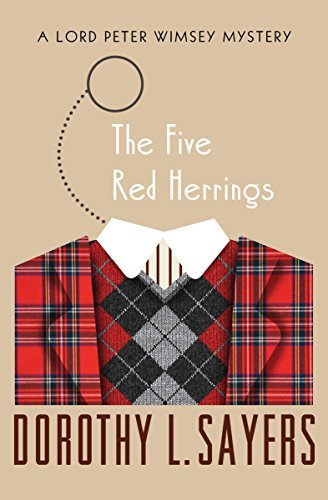
The Five Red Herrings
The Five Red Herrings was published in 1931 and is sometimes considered Sayers’s most strictly puzzle-oriented novel. The setting is the Scottish artist colony at Kirkcudbright in Galloway, where a quarrelsome landscape painter named Sandy Campbell has been found dead at the bottom of a riverbank. The local police consider it an accident. Lord Peter, on holiday in the area, immediately spots small inconsistencies in the scene.
The novel is more interested in the mechanics of train timetables, alibis, and tube-paint application than in character or social commentary. Six artists in the local colony had reasons to want Campbell dead. Five of them are red herrings. The eventual reveal of which one is the actual killer turns on a piece of evidence Sayers withholds from the reader until the end, which has historically frustrated some readers and delighted others. The book is unusually procedurally focused for Sayers and serves as a kind of love letter to the puzzle-mystery as a form. Strong on landscape, slightly thinner on people, recommended for connoisseurs of the form.
About the Author
Dorothy Leigh Sayers was born in 1893 in Oxford, the only child of the chaplain of Christ Church, and grew up in the East Anglian Fens after her father took up a country parish. She read Modern Languages at Somerville College, Oxford, was among the…
See all books by Dorothy L. Sayers →