
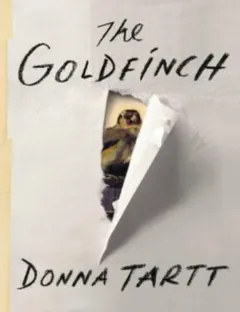
The Goldfinch
Chapter 12. The Rendezvous Point
This chapter is long, so it is split into 4 parts.
Chapter 12.
The Rendezvous Point
i.
THE DAYS LEADING TO Christmas were a blur, since thanks to il ness and what amounted to solitary confinement I soon lost track of time. I stayed in the room; the Do Not Disturb sign stayed on the door; and television—instead of providing even a false hum of normalcy—only racketed-up the variform confusion and displacement: no logic, no structure, what was on next, you didn’t know, could be anything, Sesame Street in Dutch, Dutch people talking at a desk, more Dutch people talking at a desk, and though there was Sky News and CNN
and BBC none of the local news was in English (nothing that mattered, nothing pertaining to me or the parking garage) though at one point I had a bad start when, flipping through the channels past an old American cop show, I stopped astonished at the sight of my twenty-five-year-old father: one of his many non-speaking roles, a yes-man hovering behind a political candidate at a press conference, nodding at the guy’s campaign promises and for one eerie blink glancing into the camera and straight across the ocean and into the future, at me. The multiple ironies of this were so layered and uncanny that I gaped in horror. Except for his haircut and his heavier build (bulked up from lifting weights: he’d been going to the gym a lot in those days) he might have been my twin. But the biggest shock was how straightforward he looked—my already (circa 1985) criminal y dishonest and sliding-into-alcoholism father. None of his character, or his future, was visible in his face. Instead he looked resolute, attentive, a model of certainty and promise.
After that I switched the television off. Increasingly, my main contact with reality was room service, which I ordered up only in the blackest pre-dawn hours when the delivery boys were slow and sleepy. “No, I’d like Dutch papers, please,” I said (in English) to the
Dutch-speaking bel hop who brought up the International Herald Tribune with my Dutch rol s and coffee, my ham and eggs and chef’s assortment of Dutch cheeses. But since he kept turning up with the Tribune anyway, I went down the back stairs before sunrise for the local papers, which were conveniently fanned on a table just off the staircase where I didn’t have to pass the front desk.
Bloedend. Moord. The sun didn’t seem to rise until about nine in the morning and even then it was hazed and gloomy, casting a low, weak, purgatorial light like a stage effect in some German opera.
Apparently the toothpaste I’d used on the lapel of my coat had contained peroxide or some other bleaching agent since the scrubbed spot had faded to a white halo the size of my hand, chalky at the outer edges, ringing the just-visible ghost of Frits’s cranial plasma. At about three thirty in the afternoon the light began to go; by five p.m. it was black out. Then, if there weren’t too many people on the street, I turned up the lapels of my coat and tied my scarf tight at the neck and—taking care to keep my head down—ducked out in the dark to a tiny, Asian-run market a few hundred yards from the hotel where with my remaining euros I bought pre-wrapped sandwiches, apples, a new toothbrush, cough drops and aspirin and beer. Is al es? said the old lady in broken-sounding Dutch. Counting my coins with infuriating slowness. Click, click, click. Though I had credit cards I was determined not to use them—another arbitrary rule in the game I’d devised for myself, a completely irrational precaution because who was I kidding? what did it matter, a couple of sandwiches at a convenience shop, when they already had my card at the hotel?
It was partly fear and partly il ness that clouded my judgment, since whatever cold or chil I’d caught wasn’t going away. With every hour, it seemed, my cough got deeper and my lungs hurt more. It was true about the Dutch and cleanliness, Dutch cleaning products: the market had a bewildering selection of never-before-seen items and I returned to the room with a bottle featuring a snow white swan against a snow-topped mountain and a skul -and-crossbones label on the back. But though it was strong enough to leach the stripes out of my shirt it wasn’t strong enough to lift the stains at the col ar, which had faded from liver-dark blobs to sinister, overlapping
outlines like bracket fungi. For the fourth or fifth time I rinsed it, eyes streaming, then wrapped it and tied it in plastic bags and pushed it to the back of a high cupboard. Without something to weigh it down, I knew it would float if I dropped it in the canal and I was afraid to take it to the street and shove it in a rubbish bin—someone would see me, I’d be caught, this was how it would happen, I knew it deeply and irrational y like knowledge in a dream.
A little while. What was a little while? Three days tops, Boris had said at Anne de Larmessin’s. But then he hadn’t factored in Frits and Martin.
Bel s and garlands, Advent stars in the shop windows, ribbons and gilded walnuts. At night I slept with socks, stained overcoat, polo-neck sweater in addition to coverlet since the counterclockwise turn of radiator knob as advertised in the leather-bound hotel booklet didn’t warm the room enough to help my fever aches and chil s.
White goosedown, white swans. The room reeked of bleach like a cheap Jacuzzi. Could the chambermaids smel it in the hal ? They wouldn’t give you more than ten years for art theft but with Martin I’d crossed the border into a different country—one way, no return.
Yet somehow I’d developed a workable way of thinking about Martin’s death, or thinking around it, rather. The act—the eternity of it
—had thrown me into such a different world that to al practical purposes I was already dead. There was a sense of being past everything, of looking back at land from an ice floe drifted out to sea.
What was done could never be undone. I was gone.
And that was fine. I didn’t matter much in the scheme of things and Martin didn’t either. We were easily forgotten. It was a social and moral lesson, if nothing else. But for al foreseeable time to come—
for as long as history was written, until the icecaps melted and the streets of Amsterdam were awash with water—the painting would be remembered and mourned. Who knew, or cared, the names of the Turks who blew the roof off the Parthenon? the mul ahs who had ordered the destruction of the Buddhas at Bamiyan? Yet living or dead: their acts stood. It was the worst kind of immortality.
Intentional y or no: I had extinguished a light at the heart of the world.
An act of God: that was what the insurance companies cal ed it, catastrophe so random or arcane that there was otherwise no taking the measure of it. Probability was one thing, but some events fel so far outside the actuarial tables that even insurance underwriters were compel ed to haul in the supernatural in order to explain them
— rotten luck, as my father had said mournful y one night out by the pool, dusk fal ing hard, smoking Viceroy after Viceroy to keep the mosquitoes away, one of the few times he’d tried to talk to me about my mother’s death, why do bad things happen, why me, why her, wrong place wrong time, just a fluke kid, one in a mil ion, not an evasion or cop-out in any way but—I recognized, coming from him—
a profession of faith and the best answer he had to give me, on a par with Al ah Has Written It or It’s the Lord’s Wil , a sincere bowing of the head to Fortune, the greatest god he knew.
If he were in my shoes. It almost made me laugh. I could imagine him holed up and pacing al too clearly, trapped and prowling, relishing the drama of the predicament, a framed cop in a jail cel as portrayed by Farley Granger. But I could imagine just as wel his second-hand fascination at my plight, its turns and reversals as random as any turn of the cards, could imagine only too wel his woeful shake of the head. Bad planets. There’s a shape to this thing, a larger pattern. If we’re just talking story, kid, you got it. He’d be doing his numerology or whatever, looking at his Scorpio book, flipping coins, consulting the stars. Whatever you said about my dad, you couldn’t say he didn’t have a cohesive world view.
The hotel was fil ing up for the holidays. Couples. American servicemen talking in the hal s with a military flatness, rank and authority audible in their voices. In bed, in my opiated fevers, I dreamed of snowy mountains, pure and terrifying, alpine vistas from newsreel films of Berchtesgaden, great winds that crossfaded and blew with the windwhipped seas in the oil painting above my desk: tiny tossed sailboat, alone in dark waters.
My father: Put down that remote control when I’m talking to you.
My father: Wel , I won’t say disaster, but failure.
My father: Does he have to eat with us, Audrey? Does he have to sit at the table with us every fucking night? Can’t you make Alameda feed him before I get home?
Uno, Battleship, Etch-A-Sketch, Connect Four. Some green army figures and creepy-crawly rubber insects I’d got in my Christmas stocking.
Mr. Barbour: Two flag signal. Victor: Require Assistance. Echo: I am altering my course to starboard.
The apartment on Seventh Avenue. Rainy-day gray. Many hours spent blowing in and out monotonously on a toy harmonica, in and out, in and out.
On Monday, or maybe it was Tuesday, when I final y worked up the nerve to pul up the blackout shade, so late in the afternoon that the light was going, there was a television crew on the street outside my hotel waylaying Christmas tourists. English voices, American voices. Christmas concerts at Sint Nicolaaskerk and seasonal stal s sel ing oliebol en. “Almost got hit by a bicycle but apart from that it’s been a fun time.” My chest hurt. I drew the blackouts again and stood in a hot shower with the water beating down until my skin was sore. The whole neighborhood sparkled with fairy-lit restaurants, beautiful shops displaying cashmere topcoats and heavy, hand-knit sweaters and al the warm clothes I’d neglected to pack. But I didn’t even dare phone down for a pot of coffee thanks to the Dutch-language newspapers I’d been thrashing through since wel before sunrise that morning, one featuring a front page photo of the parking garage with police tape across the exit.
The papers were spread on the floor on the far side of my bed, like a map to some horrible place I didn’t want to go. Repeatedly, unable to help myself, in between drowsing off and fal ing into feverish conversations I wasn’t having, with people I wasn’t having them with, I went back and scoured them over and over for Dutch-English cognates which were few and far between. Amerikaan dood aangetroffen. Heroïne, cocaïne. Moord: mortality, mordant, morbid, murder. Drugsgerelateerde criminaliteit: Frits Aaltink afkomstig uit Amsterdam en Mackay Fiedler Martin uit Los Angeles. Bloedig: bloody. Schotenwisseling: who could say, although, schoten: could that mean shots? Deze moorden kwamen als en schok voor—what?
Boris. I walked to the window and stood, and then walked back again. Even in the confusion on the bridge I remembered him instructing me not to cal , he’d been very firm on the point though
we’d parted in such haste I wasn’t sure he’d explained why I was supposed to wait for him to contact me, and in any case I wasn’t sure it mattered any more. He’d also been very firm on the point that he wasn’t hurt, or so I kept reminding myself, though in the swamp of unwanted memories that bombarded me from that evening I kept seeing the burnt hole in the arm of his coat, sticky black wool in the rol of the sodium lamps. For al I knew, the traffic police had caught him on the bridge and hauled him in for driving without a license: an admittedly shitty break, if indeed the case, but a lot better than some of the other possibilities I could think of.
Twee doden bij bloedige… It didn’t stop. There was more. The next day, and the next, along with my Traditional Dutch Breakfast, there was more about the kil ings on the Overtoom: smal er column inches but denser information. Twee dodelijke slachtoffers. Nog een of meer betrokkenen. Wapengeweld in Nederland. Frits’s photograph, along with the photos of some other guys with Dutch names and a longish article I had no hope of reading. Dodelijke schietpartij nog onopgehelderd… It worried me that they’d stopped talking about drugs—Boris’s red herring—and had moved on to other angles. I’d set this thing loose, it was out in the world, people were reading about it al over the city, talking about it in a language that wasn’t mine.
Huge Tiffany ad in the Herald Tribune. Timeless Beauty and Craftsmanship. Happy Holidays from Tiffany & Co.
Chance plays tricks, my dad had liked to say. Systems, spread breakdowns.
Where was Boris? In my fever haze I tried, unsuccessful y, to amuse or at least divert myself with thoughts of how very likely he was to show up at just the moment you didn’t expect him. Cracking his knuckles, making the girls jump. Turning up half an hour after our state issued Proficiency Exam had begun, widespread classroom laughter at his puzzled face through the wire reinforced glass of the locked door: hah, our bright future, he’d said scornful y when on the way home I’d tried to explain to him about standardized tests.
In my dreams I couldn’t get to where I needed to be. There was always something keeping me from where I needed to go.
He had texted me his number before we left the States, and though I was afraid to text him back (not knowing his circumstances, or if the text could be traced to me somehow), I reminded myself continual y that I could reach him, if I had to. He knew where I was.
Yet, hours into the night, I lay awake arguing with myself: relentless tedium, back and forth, what if, what if, what harm could it do? At last, at some disoriented point—night light burning, half-dreaming, out of it—I broke down and reached for the phone on the nightstand and texted him anyway before I had the chance to think better of it: Where are you?
Over the next two or three hours I lay awake in a state of barely control ed anxiety, lying with my forearm over my face to keep the light out even though there wasn’t any light. Unfortunately, when I woke from my sweat-soaked sleep, somewhere around dawn, the phone was stone dead because I’d forgotten to switch it off, and—
reluctant to negotiate the front desk, to ask if they had chargers for loan—I hesitated for hours until final y, mid-afternoon, I broke down.
“Certainly, sir,” said the desk clerk, hardly looking at me. “United States?”
Thank God, I thought, trying not to hurry too much as I walked upstairs. The phone was old, and slow, and after I plugged it in and stood for a while, I got tired of waiting for the Apple logo to come up and went to the minibar and got myself a drink and came back and stared at it a bit more until at last the lock screen came up, old school photo I’d scanned in as a joke, never had I been so glad to see a picture, ten year old Kitsey flying midair at the penalty kick. But just as I was about to type in the pass code, the home screen popped off, then fizzed for about ten seconds, bands of black and gray that shifted and broke into particles before the sad face came on and clicked with a queasy down-whir to black.
Four-fifteen p.m. The sky was turning ultramarine over the bel gables across the canal. I was sitting on the carpet with my back against the bed and the charger cord in my hand, having methodical y, twice, tried al the sockets in the room—I’d switched the phone on and off a hundred times, held it to the lamp to see if maybe it was on and the display had just gone dark, tried to re-set it, but the phone was fried: nothing happening, cold black screen, dead
as a doornail. Clearly I’d short-circuited it; the night of the garage it had gotten wet—drops of water on the screen when I took it from my pocket—but though I’d had a bad minute or two waiting for it to come on, it had seemed to be working just fine, right up until the moment I tried to put a charge in it. Everything was backed up on my laptop at home, apart from the only thing I needed: Boris’s number, which he’d texted me in the car on the way to the airport.
Water reflections wavering on the ceiling. Outside, somewhere, tinny Christmas caril on music and off-key carolers singing. O
Tannenbaum, O Tannenbaum, wie treu sind deine Blätter.
I didn’t have a return ticket. But I had a credit card. I could take a cab to the airport. You can take a cab to the airport, I told myself.
Schiphol. First plane out. Kennedy, Newark. I had money. I was talking to myself like a child. Who knew where Kitsey was—out in the Hamptons, for al I knew—but Mrs. Barbour’s assistant, Janet (who stil had her old job despite the fact that Mrs. Barbour had nothing much she needed assisting with, any more), was the kind of person who could get you on a plane out of anywhere with a few hours’
notice, even on Christmas Eve.
Janet. The thought of Janet was absurdly reassuring. Janet who was an efficient mood system al her own, Janet fat and rosy in her pink shetlands and madras plaids like a Boucher nymph as dressed by J. Crew, Janet who said excel ent! in answer to everything and drank coffee from a pink mug that said Janet.
It was a relief to be thinking straight. What good was it doing Boris, or anyone, me waiting around? The cold and damp, the unreadable language. Fever and cough. The nightmare sense of constraint. I didn’t want to leave without Boris, without knowing if Boris was okay, it was the war-movie confusion of running on and leaving a fal en friend with no idea what worse hel you were running into, but at the same time I wanted out of Amsterdam so badly I could imagine fal ing to my knees upon disembarkation at Newark, touching my forehead to the concourse floor.
Telephone book. Pencil and paper. Only three people had seen me: the Indonesian, Grozdan, and the Asian kid. And while it was quite possible Martin and Frits had col eagues in Amsterdam looking for me (another good reason to get out of town), I had no reason to
think the police were looking for me at al . There was no reason they would have flagged my passport.
Then—it was like being struck in the face—I flinched. For whatever reason I’d been thinking that my passport was downstairs, where I’d had to present it at check-in. But in truth I hadn’t thought of it at al , not since Boris had taken it away from me to lock in the glove box of his car.
Very very calmly, I set down the phone book, making an effort to set it down in a manner that would look casual and unstudied to some neutral observer. In a normal situation it was straightforward enough. Look up the address, find the office, figure out where to go.
Stand in line. Await my turn. Speak courteously and patiently. I had credit cards, photo ID. Hobie could fax my birth certificate.
Impatiently, I tried to beat back an anecdote Toddy Barbour had told at dinner—how, upon losing his passport (in Italy? Spain?) he’d been required to haul in a flesh-and-blood witness to vouch for his identity.
Bruised inky skies. It was early in America. Hobie just breaking for lunch, walking over to Jefferson Market, maybe picking up groceries for the lunch he was hosting on Christmas Day. Was Pippa in California stil ? I imagined her tumbling over in a hotel bed and reaching sleepily for the telephone, eyes stil closed, Theo is that you, is something wrong?
Better a fine and talk our way out of it in case we are stopped.
I felt il . To present myself at the consulate (or whatever) for a round of interviews and paperwork was asking for far more trouble than I needed. I hadn’t put a time limit on waiting, on how long I would wait, and yet any movement—random movement, senseless movement, insect-buzzing-around-a-jar movement—seemed preferable to being cooped up in the room even one minute more, seeing shadow people out of the corner of my eye.
Another huge Tiffany ad in the Tribune, bringing me Season’s Greetings. Then on the opposite page a different ad, for digital cameras, scrawled in artsy letters and signed Joan Miró:
You can look at a picture for a week and never think of it again. You can also
look at a picture for a second and think of it all your life
Centraal Station. European Union, no passport control at the borders. Any train, anywhere. I pictured myself riding in aimless circles through Europe: Rhine fal s and Tyrolean passes, cinematic tunnels and snowstorms.
Sometimes it’s about playing a poor hand wel , I remembered my dad saying drowsily, half asleep on the couch.
Staring at the telephone, lightheaded with fever, I sat very stil and tried to think. Boris, at lunch, had spoken of taking the train from Amsterdam to Antwerp (and Frankfurt: I didn’t want to go anywhere near Germany) but, also, to Paris. If I went to a consulate in Paris to apply for a new passport: maybe less likelihood of connection with the Martin stuff. But there was no getting away from the fact that the Chinese kid was an eyewitness. For al I knew I was on every law-enforcement computer in Europe.
I went to the bathroom to splash water on my face. Too many mirrors. I switched off the water and reached for a towel to pat my face dry. Methodical actions, one by one. It was after nightfal when my mood always darkened, when I began to be afraid. Glass of water. Aspirin for my fever. That too always began to climb after dark. Simple actions. I was working myself up and I knew it. I didn’t know what warrants Boris had out on him but though it was worrying to think he’d been arrested, I was a lot more worried that Sascha’s people had sent someone else after him. But this was yet another thought I could not al ow myself to fol ow.
i .
THE NEXT DAY—CHRISTMAS Eve—I forced myself to eat a huge room-service breakfast even though I didn’t want it, and threw away the newspaper without looking at it since I was afraid if I saw the words Overtoom or Moord one more time there was no way I could make myself do what I had to. After I’d eaten, stolidly, I gathered the week’s accumulation of newspapers on and around my bed and rol ed them up and put them in the trash basket; retrieved from the
cupboard my bleach-rotted shirt and—after checking to see the bag was tied tight—slipped it into another bag from the Asian market (leaving it open, for carrying ease, also in case I happened to spot a helpful brick). Then, after turning up my coat col ar and tying my scarf over it, I turned around the sign for the chambermaid, and left.
The weather was rotten, which helped. Wet sleet, blowing in sideways, drizzled over the canal. I walked for about twenty minutes
—sneezing, miserable, chil ed—until I happened upon a rubbish bin on a particularly deserted corner with no cars or foot traffic, no shops, only blind-looking houses shuttered tight against the wind.
Quickly I shoved the shirt in and walked on, with a burst of exhilaration that sped me four or five streets along very rapidly, despite chattering teeth. My feet were wet; the soles of my shoes were too thin for the cobblestones and I was very cold. When did they pick up the garbage? No matter.
Unless—I shook my head to clear it—the Asian market. The plastic bag had the name of the Asian market on it. Only a few blocks from my hotel. But it was ridiculous to think this way and I tried to reason myself out of it. Who had seen me? No one.
Charlie: Affirmative. Delta: I am proceeding with Difficulty.
Stop it. Stop it. No going back.
Not knowing where a taxi stand was, I trudged along aimlessly for twenty minutes or more until final y I managed to flag down a taxi on the street. “Centraal Station,” I told the Turkish cab driver.
But when he left me off in front, after a drive through haunted gray streets like old newsreel footage, I thought for a moment he’d taken me to the wrong place since the building from the front looked more like a museum: red-brick fantasia of gables and towers, bristling Dutch Victoriana. In I wandered, amidst holiday crowds, doing my best to look as if I belonged and ignoring the police who seemed to be standing around nearly everywhere I looked and feeling bewildered and uneasy as the great democratic world swept and surged around me once more: grandparents, students, weary young-marrieds and little kids dragging backpacks; shopping bags and Starbucks cups, rattle of suitcase wheels, teenagers col ecting signatures for Greenpeace, back in the hum of human things. There was an afternoon train to Paris but I wanted the latest one they had.
The lines were endless, al the way back to the news kiosk. “This evening?” said the clerk when I final y got to the window: a broad, fair, middle aged woman, pil owy at the bosom and impersonal y genial like a procuress in a second rate genre painting.
“That’s right,” I said, hoping I didn’t quite look as sick as I felt.
“How many?” she said, hardly looking at me.
“Just one.”
“Certainly. Passport please.”
“Just a—” voice husky with il ness, patting myself down; I’d hoped they wouldn’t ask—“ah. Sorry, I don’t have it on me, it’s in the safe back at the hotel—but—” producing my New York State ID, my credit cards, my Social Security card, pushing them through the window.
“Here you go.”
“You require a passport to travel.”
“Oh, sure.” Doing my best to sound reasonable, knowledgeable.
“But I’m not leaving til tonight. See—?” indicating the empty floor at my feet: no luggage. “I’m seeing my girlfriend off, and since I’m here I thought I’d go ahead and get in line and buy the ticket if that’s al right.”
“Wel —” the clerk glanced at her screen—“you have plenty of time. I’d suggest you wait and purchase your ticket when you return this evening.”
“Yes—” pinching my nose, so I wouldn’t sneeze—“but I’d like to purchase it now.”
“I’m afraid that’s not possible.”
“Please. It’d be a huge help. I’ve been standing here for forty-five minutes and I don’t know what the lines wil be like tonight.” From Pippa—who had gone al over Europe by rail—I was fairly sure I remembered hearing they didn’t check passports for the train. “Al I want is to buy it now so I have time to run al my errands before I come back this evening.”
The clerk looked hard at my face. Then she picked up the ID and looked at the picture, then again at me.
“Look,” I said, when she hesitated, or seemed to hesitate: “You can see it’s me. You have my name, my Social Security card—here,”
I said, reaching in my pocket for pen and paper. “Let me duplicate the signature for you.”
She compared the two, side by side. Again she looked at me, and the card—and then, al at once, seemed to make up her mind. “I can’t accept this documentation.” Pushing my cards back to me through the window.
“Why not?”
The line behind me was growing.
“Why?” I repeated. “It’s perfectly legitimate. It’s what I use in lieu of passport to fly in the U.S. The signatures match,” I said, when she didn’t answer, “can’t you see?”
“Sorry.”
“You mean—” I could hear the desperation in my voice; she was meeting my gaze aggressively, as if defying me to argue. “You’re tel ing me I’ve got to come al the way back here tonight and stand in line al over again?”
“Sorry, sir. Can’t help you. Next,” said the clerk, looking over my shoulder at the next passenger.
As I was walking away—pushing and bumping my way through crowds—someone said behind me: “Hey. Hey, mate?”
At first, disoriented from the ticket window, I thought I was hal ucinating the voice. But when, uneasily, I turned, I saw a ferret-faced teenager with pink-rimmed eyes and a shaved head, bouncing up and down on the toes of his gigantic sneakers. From his darting side-to-side glance I thought he was going to offer to sel me a passport but instead he leaned forward and said: “Don’t try it.”
“What?” I said uncertainly, glancing up at the policewoman standing about five feet behind him.
“Listen, mate. Back and forth a hundred times when I had the thing, and they never checked once. But the one time I didn’t have it? Crossing into France? They locked me up, didn’t they, France immigration jail, twelve hours with they rubbish food and rubbish attitude, horrible. Horrible dirty police cel . Trust me—you want your documents in order. And no funny shit in your case either.”
“Hey, right,” I said. Sweating in my coat, which I didn’t dare unbutton. Scarf I didn’t dare untie.
Hot. Headache. Walking away from him, I felt the furious gaze of a security camera burning into me; and I tried not to look self-conscious as I threaded through the crowds, floating and woozy with
fever, grinding the phone number of the American consulate in my pocket.
It took me a while to find a pay phone—al the way at the other end of the station, in an area packed with sketchy teenagers sitting in quasi-tribal council on the floor—and it took even longer for me to figure out how to make the actual cal .
Buoyant stream of Dutch. Then I was greeted by a pleasant American voice: welcome to the United States consulate of the Netherlands, would I like to continue in English? More menus, more options. Press 1 for this, press 2 for that, please hold for operator.
Patiently I fol owed the instructions and stood gazing out at the crowd until I realized maybe it wasn’t such a great idea to let people see my face and turned back to the wal .
The telephone rang so long I’d drifted off into a dissociated fog when suddenly the line clicked on, easy American voice sounding fresh off the beach in Santa Cruz: “Good morning, American Consulate of the Netherlands, how may I help you?”
“Hi,” I said, relieved. “I—” I’d debated giving a false name, just to get the information I wanted, but I was too faint and exhausted to bother—“I’m afraid I’m in a jam. My name is Theodore Decker and my passport’s been stolen.”
“Hey, sorry to hear that.” She was keying in something, I could hear her on the other end. Christmas music playing in the background. “Bad time of year for it—everyone travel ing, you know?
Did you report to the authorities?”
“What?”
“Stolen passport? Because you have to report it immediately. The police need to know right away.”
“I—” cursing myself; why had I said it was stolen?—“no, sorry, it just happened. Centraal Station”—I looked around—“I’m cal ing from a pay phone. To tel you the truth I’m not sure it was stolen, I think it fel out of my pocket.”
“Wel —” more keyboarding—“lost or stolen, you stil have to make a police report.”
“Yeah, but I was just about to catch a train, see, and now they won’t let me on. And I have to be in Paris tonight.”
“Hang on a sec.” There were too many people in the train station, damp wool and muggy crowd smel s blooming horribly in the overheated warmth. In a moment she clicked back on. “Now—let me get some information from you—”
Name. Date of birth. Date and city of passport issue. Sweating in my overcoat. Humid breathing bodies al around.
“Do you have documentation establishing your citizenship?” she was saying.
“Sorry—?”
“An expired passport? Birth or naturalization certificate?”
“I have a Social Security card. And a New York State ID. I can have a copy of my birth certificate faxed from the States.”
“Oh, great. That should be sufficient.”
Real y? I stood motionless. Was that al ?
“Do you have access to a computer?”
“Um—” computer at the hotel?—“sure.”
“Wel —” she gave me a web address. “You’l need to download, print, and fil out an affidavit regarding lost and stolen passport and bring it here. To our offices. We’re near the Rijksmuseum. Do you know where?”
I was so relieved that I could only stand there and let the crowd noises babble and stream over me in a psychedelic blur.
“So—this is what I need from you,” California Girl was saying, her crisp voice recal ing me from my varicolored fever reverie. “The affidavit. The faxed documents. Two copies of a 5x5 centimeter photograph with a white background. Also, don’t forget, copy of the police report.”
“Sorry?” I said, jarred.
“Like I was saying. With lost or stolen passports we require you to file a police report?”
“I—” Staring at an eerie convergence of veiled Arabic women, gliding past silently in head-to-toe black. “I won’t have time for that.”
“What do you mean?”
“It’s not like I’m flying to America today. It’s just that—” it took me a moment to recover; my coughing fit had brought tears to my eyes
—“my train to Paris leaves in two hours. So, I mean—I don’t know
what to do. I’m not sure I can get al this paperwork done and make it to the police station too.”
“Wel ”—regretful y—“hey, actual y you know, our offices are only open for another forty-five minutes.”
“What?”
“We close early today. Christmas Eve, you know? And we’re gone tomorrow, and the weekend. But we’l be open again at eight-thirty a.m. on the Monday after Christmas.”
“Monday?”
“Hey, I’m sorry,” she said. She sounded resigned. “It’s a process.”
“But it’s an emergency!” Voice rasping with il ness.
“Emergency? Family or medical?”
“I—”
“Because, in certain very rare situations we do supply emergency after-hours support.” She wasn’t so friendly any more; she was rushed, reciting from her script, I could hear another cal ringing in the background like a radio phone-in show. “Unfortunately this is confined to urgent situations of life or death and our staff has to determine that domestic emergency is warranted before we issue a passport waiver. So unless circumstances of death or critical il ness require you to travel to Paris this afternoon, and unless you can supply information establishing the critical emergency such as an affidavit with attending physician, clergy, or funeral director—”
“I—” Monday? Fuck! I didn’t even want to think about the police report—“hey, sorry, listen—” she was trying to ring off—
“That’s right. You get it al together by Monday the twenty-eighth.
And then, yes, once the application is in we’l process it for you as quickly as we can—sorry, wil you excuse me a second?” Click. Her voice, fainter. “Good morning, United States Consulate of the Netherlands, wil you please hold?” Immediately the phone began to ring again. Click. “Good morning, United States Consulate of the Netherlands, wil you please hold?”
“How fast can you have it for me?” I said, when she came back on.
“Oh, once you get the application in we should actual y have it for you within ten working days, tops. That’s working days. Like—
normal y I’d do my best to rush it through for you in seven? but with
the holidays, I’m sure you understand, the office is a little backed up right now, and our hours are real y irregular until New Year’s. So—
hey, sorry,” she added, in the stunned silence that had fal en, “it may be a while. Rotten news, I know.”
“What am I supposed to do?”
“Do you need travel er’s assistance?”
“I’m not sure what that means.” Sweat pouring off me. Rank heated air, heavy with crowd odors, barely breathable.
“Money wired? Temporary accommodations?”
“How am I supposed to get home?”
“You’re a resident of Paris?”
“No, United States.”
“Wel with a temporary passport—a temporary passport doesn’t even have the chip you need to enter the United States so I’m not sure that there are real y any short cuts that wil get you there a whole lot faster than I can get you there by—” Ring ring, ring ring.
“Just a moment, sir, wil you please hold?
“Now, my name is Hol y. Would you like me to give you my extension number, just in case you run into any problems or need any assistance during your stay?”
i i.
MY FEVER, FOR WHATEVER reason, tended to spike at nightfal . But after so long on my feet in the cold, it had begun to shoot up in ragged jumps that had the jerky quality of a heavy object being hauled by fits and starts up the side of a tal building, so that on the walk home I hardly understood why I was moving or why I didn’t fal down or indeed how I was proceeding forward at al , a sort of groundless gliding unconsciousness that carried me high above myself on rainy canal side-streets and up into disembodied lofts and drafts where I seemed to be looking down on myself from above; it had been a mistake not to get a cab back at the station, I kept seeing the plastic bag in the garbage bin and the shiny pink face of the ticket clerk and
Boris with tears in his eyes and blood on his hand, clutching at the burnt place on his sleeve; and the wind roared and my head burned and at irregular intervals I flinched at dark epileptic flutters at elbow’s edge: black splashes, false starts, no one there, in fact no one on the street at al except—every now and then—a cyclist dim and hunched in the drizzle.
Heavy head, bad throat. When, final y, I managed to flag down a cab on the street, I was only a few minutes from the hotel. The one good thing, when I got upstairs—bonechil ed and shaking—was that they’d cleaned the room and restocked the bar, which I’d drunk clear down to the Cointreau.
I retrieved both mini-bottles of gin and mixed them with hot water from the tap and sat in the brocade chair by the window, glass dangling from my fingertips, watching the hours slide: barely awake, a half-dreaming state, solemn winter light tilting from wal to wal in paral elograms that slipped to the carpet and narrowed until they faded out to nothing and it was dinnertime, and my stomach ached and my throat was raw with bile and there I stil sat, in the dark. It was nothing I hadn’t thought of, plenty, and in far less taxing circumstances; the urge shook me grandly and unpredictably, a poisonous whisper that never whol y left me, that on some days lingered just on the threshold of my hearing but on others roared up uncontrol ably into a sort of lurid visionary frenzy, why I wasn’t sure, sometimes even a bad movie or a gruesome dinner party could trigger it, short term boredom and long term pain, temporary panic and permanent desperation striking al at once and flaring up in such an ashen desolate light that I saw, real y saw, looking back down the years and with al clear-headed and articulate despair, that the world and everything in it was intolerably and permanently fucked and nothing had ever been good or okay, unbearable claustrophobia of the soul, the windowless room, no way out, waves of shame and horror, leave me alone, my mother dead on a marble floor, stop it stop it, muttering aloud to myself in elevators, in cabs, leave me alone, I want to die, a cold, intel igent, self-immolating fury that had—
more than once—driven me upstairs in a resolute fog to swal ow indiscriminate combos of whatever booze and pil s I happened to have on hand: only tolerance and ineptitude that I’d botched it,
unpleasantly surprised when I woke up though relieved for Hobie that he hadn’t had to find me.
Black birds. Disastrous lead-colored skies out of Egbert van der Poel.
I stood and snapped on the desk light, swaying in the weak, urine-colored glow. There was waiting. There was running away. But these were not so much choices as endurance measures: the useless scurries and freezes of a mouse in a snake tank, serving only to prolong discomfort and suspense. And there was also a third choice: since for various reasons I felt that a consulate member would be fairly speedy to return my cal if I left an after-hours message stating that I was an American citizen wishing to turn myself in for capital murder.
Act of rebel ion. Life: vacant, vain, intolerable. What loyalty did I owe it? None whatsoever. Why not beat Fate to the punch? Throw the book on the fire and be done with it? There was no end in sight to the present horror, plenty of external, empirical horror to line up with my own endogenous supply; and, given enough dope (inspecting the bag: less than half left), I would happily have set up a fat line and toppled right over: great-souled darkness, explosion of stars.
But there wasn’t enough to be sure of finishing myself off. I didn’t want to waste what I had on a few hours of oblivion only to wake up again in my cage (or, worse: in a Dutch hospital with no passport).
Then again my tolerance was down and I was pretty sure I had enough to do the job if I got good and drunk first and topped it off with my emergency pil .
Bottle of chil ed white in the mini-bar. Why not? I drank the rest of my gin and uncorked it, feeling resolute and jubilant—I was hungry, they’d restocked the crackers and cocktail snacks but this was al going to work a lot better on an empty stomach.
The relief was immense. Quiet dismissal. Perfect, perfect joy of throwing it al away. I found a classical station on the radio—
Christmas plainchant, somber and liturgical, less melody than a spectral commentary on it—and thought about running myself a bath.
But that could wait. Instead I opened the desk and found a folder of hotel stationery. Gray cathedral stone, minor hexachords. Rex virginum amator. Between fever, and canal water lapping outside, the space around me had fal en quietly into haunted doubleness, a border zone which was both hotel room and the cabin of a gently tossing ship. Life on the high seas. Death by water. Andy, when we were kids, tel ing me in his eerie Martian-boy voice that he’d heard on the Learning Channel that Mary protected sailors, that one of the protections of the Rosary was that you would never die by drowning.
Mary Stel a Maris. Mary Star of the Sea.
I thought of Hobie at midnight mass, kneeling in the pew in his black suit. Gilding wears away natural y. On a cabinet door, on the flap of a bureau, there are often a quantity of tiny indentations.
Objects seeking out their rightful owners. They had human qualities. They were shifty or honest or suspicious or fine.
Real y remarkable pieces do not appear on the scene from nowhere.
The hotel pen wasn’t great, I wished I had a better one, but the paper was creamy and thick. Four letters. Hobie’s and Mrs.