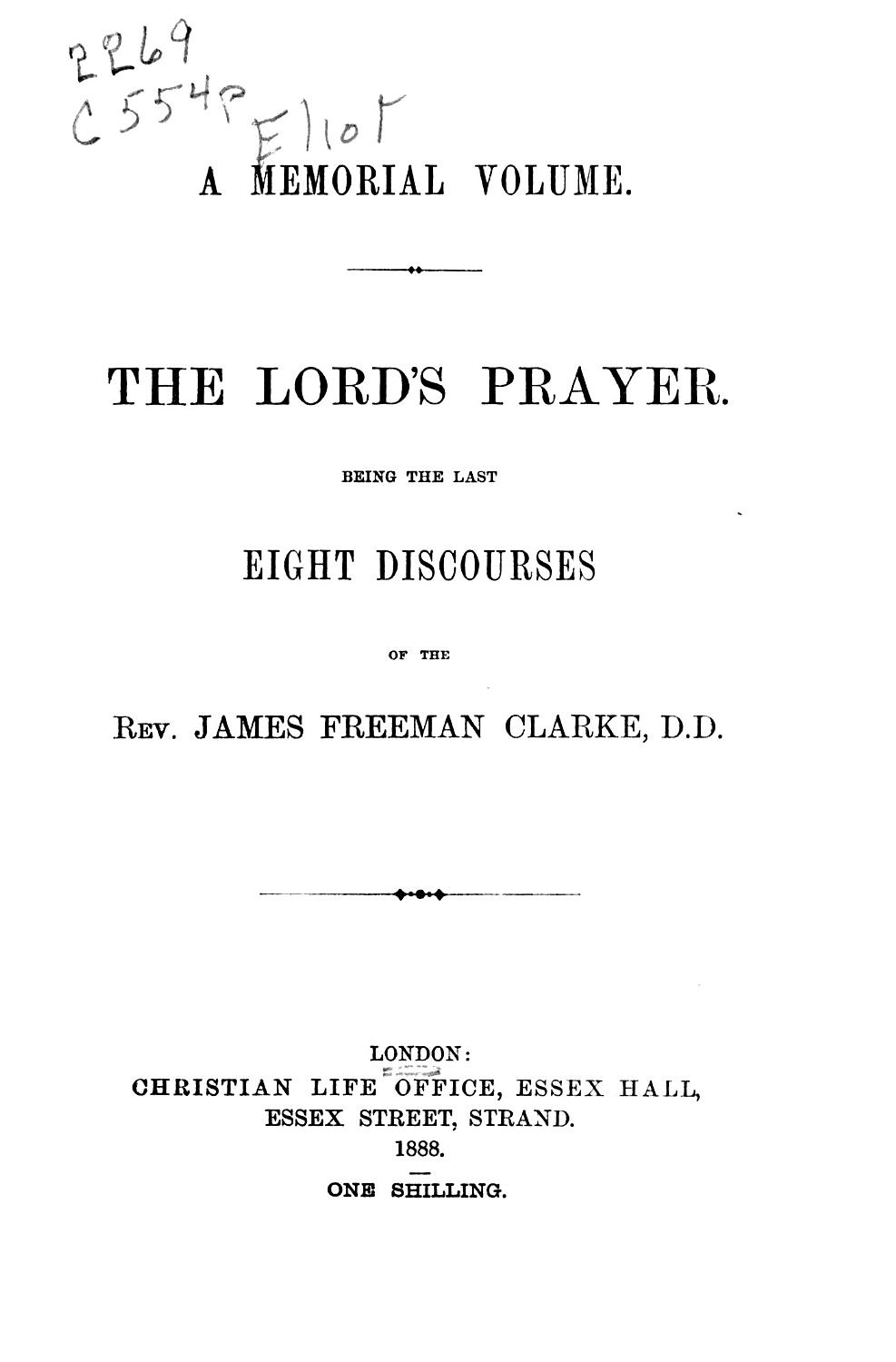
The Lord’s Prayer: Being the Last Eight Discourses
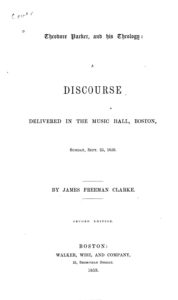
The Lord’s Prayer, Being the Last Eight Discourses is a sermon series by James Freeman Clarke. Each sermon works through one phrase of the prayer that Jesus taught his disciples in Matthew 6 and Luke 11. The series moves from the opening invocation through the petitions for daily bread, forgiveness, and deliverance to the closing doxology.
Clarke had been pastor of the Church of the Disciples in Boston for nearly five decades by the time he gave the discourses, and the sermons carry the weight of a long pastoral life. He had buried generations of his congregation, counseled people through every kind of crisis, and watched how the prayer functioned in actual lives rather than in theological abstraction. The treatment combines careful attention to the Greek text and the early Christian context with practical application to the moral and spiritual life of his New England congregation.
Clarke’s Unitarian theological position shapes the readings throughout. He reads the prayer as Jesus taught it and as the early church received it, before the later doctrinal elaborations of the Trinitarian creeds. The petitions are interpreted in terms of the practical ethical demands they make on those who pray them seriously, rather than in terms of the more strictly doctrinal questions that orthodox traditions emphasized.
The series belongs to a nineteenth-century American Protestant tradition of extended sermon sequences on particular biblical texts. Henry Ward Beecher, Phillips Brooks, and Horace Bushnell produced similar sequences on the Lord’s Prayer, the Beatitudes, the parables, and other major New Testament passages. Clarke’s contribution represents the Boston Unitarian voice within that broader pulpit tradition.
The collected sermons run about three hundred pages. They read best one at a time across an extended period rather than straight through. The series pairs naturally with Clarke’s other published sermon volumes and with the wider mid-century American liberal Protestant preaching tradition.
About the Author
Download free books by James Freeman Clarke on BDeBooks. Read James Freeman Clarke’s works online or download as PDF/EPUB · part of our growing free eBook collection.
See all books by James Freeman Clarke →