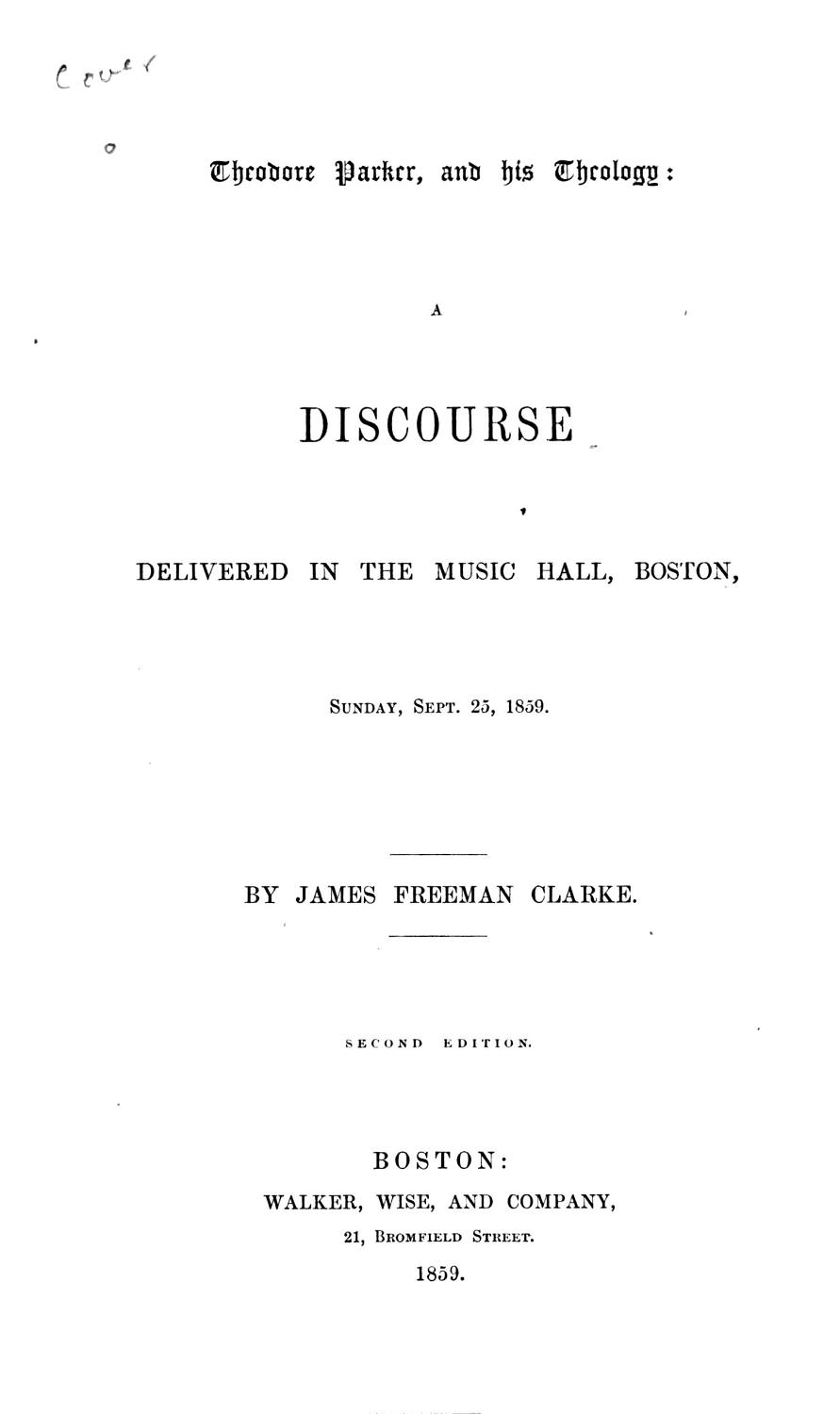
Theodore Parker, and His Theology: A Discourse Delivered in the Music Hall, Boston
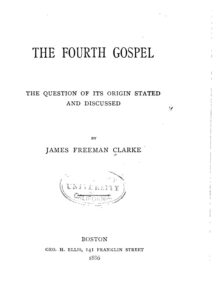
Theodore Parker, and His Theology is a memorial discourse by James Freeman Clarke, delivered shortly after Parker’s death in May 1860 and published as a small book the same year. Clarke (1810-1888) was a leading Unitarian minister in Boston and had known Parker for decades through the close-knit Transcendentalist circle that included Emerson, Margaret Fuller, and the broader liberal Protestant community of mid-century New England.
Theodore Parker had been the most controversial American Unitarian minister of his generation. He pushed the tradition further from orthodox Christianity than most of his colleagues would go, with positions on miracles, biblical authority, and the divinity of Christ that even the broadly liberal American Unitarian Association struggled to absorb. He was also among the most active abolitionist preachers in Boston and was deeply involved in the practical resistance to the Fugitive Slave Law during the 1850s.
Clarke’s discourse handles Parker with sympathy but also with honest disagreement. The two men shared moral and political commitments but differed on important theological points. Clarke does not flatten the differences and does not paper over the controversies. The result is one of the better contemporary assessments of Parker by someone who knew him well enough to read him fairly.
Clarke himself was a major figure in Boston’s intellectual world. He founded the Church of the Disciples in 1841, served as its pastor for nearly fifty years, and produced wide-ranging work in comparative religion, biography, and history. His Ten Great Religions of 1871 was one of the earliest serious American books on the world religious traditions.
The discourse is short and reads in an evening. For readers of mid-nineteenth-century American Unitarian and Transcendentalist thought, it pairs naturally with Emerson’s Divinity School Address and with Parker’s own collected sermons.
About the Author
Download free books by James Freeman Clarke on BDeBooks. Read James Freeman Clarke’s works online or download as PDF/EPUB · part of our growing free eBook collection.
See all books by James Freeman Clarke →