
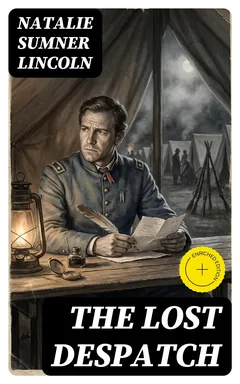
The Lost Despatch
The Lost Despatch
This chapter is long, so it is split into 7 parts.
"I ask your indulgence for precipitating such a scene. I returned to this room intending to ask a stay of proceedings so that I could have time to gather evidence against Mrs. Bennett; but, on hearing the judge advocate's argument against postponement, I saw my opportunity to force a confession from the guilty woman by giving details of Captain Lloyd's murder which would induce her to think there had been an eye-witness to her crime.
"Sitting there, confident that another was practically convicted for Captain Lloyd's murder, the shock of my unexpected words affected her as I hoped they would, and she betrayed herself."
"Is that the only evidence you can offer to prove Mrs. Bennett's guilt?"
demanded the judge advocate, harshly.
"My next witness is Miss Mary Phelps, a nurse of the United States Sanitary Commission," was Warren's noncommittal reply.
After the usual preliminaries Miss Phelps told how she found the hypodermic syringe and why she gave it to Doctor Ward. She was then excused, and her place taken by Doctor Ward, who in a few concise words described how he discovered that the syringe was not his, and that it contained a solution which, on examination, proved to be a form of curari. He produced the syringe and gave it to the judge advocate.
As he left the court-room Doctor John Boyd's name was called, and the famous surgeon limped into the room and to the witness chair, followed by a low ripple of excited comment from the spectators which was quickly quelled by Colonel Andrews' peremptory demand for silence. When Doctor Boyd had satisfactorily answered the judge advocate's first question after being sworn, Warren began his direct examination.
"Doctor, are you acquainted with the poison known as curari or curarine?"
"I am. Some of the drug was given to me when I was last in South America. It is almost impossible to procure it in this country now."
"How many people knew that you owned this drug?"
Doctor Boyd reflected a moment before answering. "I am sure only two people beside myself—my former assistant and Mrs. Bennett."
Colonel Andrews had no need to call for silence; one could hear a pin fall in that quiet room as court and spectators bent forward, the better to hear Doctor Boyd's low voice.
"How did Mrs. Bennett learn that you had some curari?"
"She came in to my consulting room one day last November. I had just been
making some physiological tests, and the bottle containing the curari was on my table. After I had given her the prescription she had come for she asked me what the bottle contained.
"Curari is a curious poison, and one that is not much known, at least at this date.
I explained that the South American Indians used it on their arrow points in the chase, animals killed by it being quite wholesome. I also told her that curari may, except in very large doses, be swallowed with impunity, but if introduced into a puncture of the skin, so as to mix with the blood, the effect is instantly fatal, and leaves no trace of poison behind it. She asked me how to obtain a solution of the drug, and I explained in detail; then, seeing she was ready to go, I rose and put the bottle of curari back on its shelf in the small medicine cabinet that hangs near my table."
"Is the cabinet kept locked?"
"No. My old housekeeper, Martha Crane, has charge of my private office and would not think of disturbing any of my belongings."
"Did you know Captain Lloyd?" read the judge advocate, pasting Warren's last question in his book.
"I first met Captain Lloyd on New York Avenue one morning in January, but I saw him again that same night." The surgeon paused.
"Give a full account of that last occasion," directed Warren.
"I was attending a supper party at Senator Warren's," began Boyd. "We were having a pleasant evening when the bell rang and the servant told the senator that a gentleman wished to speak to Major Goddard. Senator Warren immediately asked Captain Lloyd to step into the parlor, but he declined, saying he preferred to wait in the hall for his friend.
"Suddenly I was startled by a half-stifled moan, and turned to see where the sound came from. Mrs. Bennett was crouching on the sofa behind me; her face livid, her eyes starting from her head. I followed her glance and saw Captain
Lloyd standing directly under the hall light."
"Did Captain Lloyd see Mrs. Bennett?"
"No; we were sitting in the darkest part of the room, besides which he was too occupied in staring at Major Goddard and Miss Newton to notice anyone else."
"What happened next?"
"Major Goddard joined his friend almost at once and they went away together.
Then, before I could catch her, Mrs. Bennett fell fainting on the floor. If ever I saw naked fear it was in her livid countenance when she gazed at Captain Lloyd.
"Naturally I was curious to know what connection there was between Mrs.
Bennett, a society butterfly, and Captain Lloyd of the Secret Service, particularly as I was informed that she was a Union spy, but my professional duties claimed all my attention. And I forgot about the scene until it was recalled to my mind by Mrs. Bennett herself."
"In what way?"
"I was talking with her at the President's levee on March 2nd, and spoke of Major Goddard. She asked me if Captain Lloyd had returned to town with him, and I replied in the negative."
"Was that the last time you saw Mrs. Bennett?"
"No. I saw her on the afternoon of the 6th of March going in to Mrs. Lane's. My housekeeper, Martha," he added, before the judge advocate could speak, "told me, when I entered my office a few seconds later, that Mrs. Bennett had just left, having waited for me in the front office for some time."
"Is the communicating door between the office and your consulting room kept locked when you are absent?"
"No, never."
"Then a patient could enter your consulting room without disturbing your housekeeper?"
"Yes."
"Did you see Mrs. Bennett waiting on Mrs. Lane's doorstep?"
"No, she was just turning the front doorknob and entering when I passed the house."
"Did she see you?"
"No, I think not. Her back was turned to me."
"Is your usual office hour at that time in the afternoon?"
"No."
"Then Mrs. Bennett knew that you were likely to be out at that hour?"
"Yes; she told my housekeeper that she had a bad attack of neuralgia, and had called on the chance of finding me in."
"Where have you been during the past month, Doctor?"
"I left Washington that very afternoon on my way to Richmond."
"Just a moment," interposed Warren, and handed another slip to the judge advocate, who read the question aloud. "Did Mrs. Bennett know you expected to leave town?"
"She did. I told Mrs. Arnold in her presence that I expected to go away at any moment, and did not know exactly when I would return."
"Continue your statement," directed Warren.
"I went to Richmond to see my brother. On my arrival there I found him in one of the hospitals, dying." Boyd's keen eyes grew misty. "I stayed with him to the
end. I found my services needed in that unhappy city, so remained; but just before the evacuation I went over to Petersburg to assist in the field hospitals. I only returned to Washington this morning."
"When did you first hear of the charges against Miss Newton?"
"When I reached my house this morning I found Doctor Ward there making inquiries of Martha as to my whereabouts. We went into the office, and Ward told me of Miss Newton's arrest and trial, finally mentioning his suspicions that curari had been used. I sprang out of my chair, walked over and pulled open the door of the cabinet. The bottle of curari was empty. I also found on further search that one of my hypodermic syringes and needles, which I keep in the top drawer of my table, were missing."
"Did any one have access to your offices during your absence from the city?"
"No. I locked both the doors and bolted the windows of those rooms before I left that afternoon, and took the keys with me, knowing that I might be away from home for some time."
"What did you do on discovering the curari was gone?"
"Doctor Ward and I agreed that Senator Warren should be sent for. On his arrival we consulted together and decided that Mrs. Bennett must have killed Captain Lloyd."
"That is all, Doctor," announced Warren. "Mr. Judge Advocate, take the witness."
"Do you know any motive for Mrs. Bennett's crime?" inquired the judge advocate.
"Fear, deadly fear."
"Do you know what inspired that fear?"
"No, sir; I do not."
"You are excused." And the doctor, bowing to the court and to Nancy, withdrew.
"May it please the court to recall Major Goddard," said Warren.
"Major Goddard is under close arrest and cannot leave his quarters," replied the President.
"But there are no longer grounds for such arrest," retorted Warren, warmly. "He cannot now be accused of being an accessory after the fact. By President Lincoln's permission I was allowed to see the major this morning, and I say to you in all earnestness that his testimony is needed to clear up this mystery. I have here an order from the Secretary of War," extending a long envelope which had been delivered to him a moment before, "releasing Major Goddard from arrest."
Convinced by Warren's earnest appeal, the presiding officer despatched an orderly for Goddard.
Nancy's color had returned, and her eyes sparkled with relief and renewed courage as she talked in a low tone with Warren and Dwight during the short wait that followed. Goddard soon made his appearance, for his conversation with Warren had prepared him for such a summons. His whole bearing had changed.
He entered the room erect and smiling, and despite his blindness moved with quick, decisive step as the orderly guided him to the witness chair.
"State to the court Captain Lloyd's full name," ordered Warren.
"George Lloyd Irving." His announcement caused low voiced comment, and Colonel Andrews pounded for order.
"Why did Captain Lloyd drop his family name?"
"Because he desired to lose his identity after a certain tragedy in his family."
"Give a full account of that tragedy."
"After graduating from West Point I was ordered West, and I did not see Captain Lloyd until seven years later. I found him greatly changed from the kindly, happy
boy I had known in former days. After we had been together for a month we drifted into our old friendly ways, and one night Lloyd confided his troubles to me and why he had dropped his surname.
"Three years before that date, when on a visit in the West, he had met a very pretty, charming girl, became infatuated with her, and after a brief courtship they were married. Shortly after the honeymoon they both realized they had made a fearful mistake. She had married Lloyd for the social position his name could give her. She found that Lloyd hated society and would go nowhere. He was also comparatively poor and could not supply her with the luxuries her shallow nature craved. So they endured a parrot and monkey life of it. After the birth of their baby there was continuous friction, for Lloyd declared that to cut down expenses to meet additional bills they would have to live in a farm house which he owned near a village in New Jersey.
"They moved there and things went from bad to worse. Mrs. Irving hated the village people. Their church socials and the sewing circles seemed to mock her; for she craved balls and brilliant receptions. She never troubled to return the calls of the friendly farmers' wives, and finally she was shunned. Lloyd, who went to and from his work every day, was wrapped up in the baby, a sickly little girl, and paid but little attention to his wife's tempers.
"One day, driven to desperation by the monotony of her existence, for which she chiefly had herself to blame, Mrs. Irving decided to leave Lloyd. He had been sent to Philadelphia to investigate a criminal case, and was expected back the next afternoon. Mrs. Irving dismissed her servant, and at noon the next day, after writing a note to Lloyd, she shut up the house and trudged into town, reaching the station in time to catch the train to the city."
Goddard stopped his long narrative, and cleared his throat nervously. Nancy had never taken her eyes from him, and, as if he felt their appeal, he turned and spoke as if addressing her alone.
"Unfortunately, Lloyd was detained in Philadelphia by illness. When he reached his home he found his house closed, his wife gone, and his delicate baby dead
from starvation and exposure in the bitter weather. His farm was on a little-frequented road; his nearest neighbor six miles away. No one had noticed the closed house; no one had approached near enough to hear the baby's cries.
"From that moment Lloyd was a changed man. He waited until after his child was buried; then started in pursuit of her unnatural mother. I do not suppose,"
added Goddard hastily, "that it ever occurred to Mrs. Bennett that Lloyd might be prevented from returning home that afternoon. She had no particular affection for the child, and decided that having a baby with her would be a drag. She also undoubtedly reasoned that Lloyd would not trouble to find her, but if she took the child away he would instantly institute a search for her.
"Lloyd spent months trying to trace his wife. Finally word reached him that she had sailed on an ill-fated ship which was wrecked, and his wife was reported among those drowned. Convinced that she was dead, he let the matter drop. But, knowing Lloyd as I did, I am convinced that, had he suspected his wife really was alive, he would have killed her, for he worshipped that baby. Many a night I have been wakened by his calling: 'Baby-tot! baby-tot!' in heart-rending tones in his sleep, as I told Senator Warren this morning."
"Why did you not relate this narrative when you testified yesterday?" asked the judge advocate, after Warren signified that he could cross-examine Goddard.
"Because I never connected Lloyd's unhappy married life with the cause of his murder. I thought his wife was dead."
"Did you ever see Captain Lloyd—Captain Irving's wife?"
"No, sir. You can prove my statements by going to the village where the child is buried. I don't doubt you can find some farmers who can identify Mrs. Irving."
"Then you have no direct proof to adduce that Mrs. Irving and Mrs. Bennett are one and the same person?"
"I have no such proof," admitted Goddard, "but any one of average intelligence
——" His hot-tempered speech was interrupted by a request that the judge
advocate see Mrs. Bennett, who had regained consciousness.
Interest was keyed to the highest pitch, and the judge advocate's return to the room was hailed by a low murmur of suppressed excitement. He laid down a paper and announced gravely: "Mrs. Bennett has confessed."
For the moment there was absolute stillness; then spontaneous applause broke out from Nancy's friends, which was instantly checked by Colonel Andrews.
"In her signed confession Mrs. Bennett states that she is Mrs. Irving," continued the judge advocate. "She bribed a poor woman who was sailing on that ill-fated ship to assume her name, thinking it would mislead her husband should he try to find her. When she heard the woman was drowned Mrs. Irving considered that she was safe. She altered her appearance by dyeing her hair and by other artificial means. Her pleasing address and good education assisted her, together with a forged reference, in securing a position as companion to a rich invalid.
Some months after that she heard of the death of her child, and she considered one of the links binding her to the past had been broken. Two years went by; then she met Colonel Bennett at Saratoga, and three months later they were married.
"Mrs. Irving states that she spent December and the first part of January in the North, and only returned to Washington the day before Senator Warren's supper party. On her arrival she had an interview with Secretary Stanton and agreed to find out and report which women in society were sending aid and comfort to the enemy. When she saw and recognized Lloyd she was panic-stricken; not only had she knowingly committed bigamy, a criminal offence, but exposure meant social ruin. And while only indirectly responsible for her child's death, she knew Lloyd, and realized that he would stop at nothing to revenge what he considered the child's murder.
"From that night she planned to get rid of Lloyd. It was easy for her to keep out of his way, for he was in Winchester most of the time. Then she remembered the curari—the poison that left no trace!
"Accompanied by Mrs. Arnold, she visited Major Goddard, and then found out
where their rooms were located and how to reach them. Fate played into her hands, for on that sixth of March she met Aunt Dinah, whom she knew, having lived at Mrs. Lane's with her husband when he was first ordered to duty in Washington. Aunt Dinah, who was returning from executing an errand at Brown's drug store, told her that Captain Lloyd had returned and was lying down in his room. Mrs. Lane had said he was not to be disturbed, as he was asleep.
Aunt Dinah announced she was dead tired herself from answering the front door in addition to her other work. Mrs. Irving promptly suggested that she leave the front door on the latch, and she watched the old colored woman follow out her suggestion. At last the way was clear. Mrs. Irving knew the house; knew the hours kept by the boarders; if she was seen in the house she had a plausible excuse to explain her presence there. So she secured the poison and committed the murder as already described.
"Mrs. Irving declares that she stole the pocketbook thinking it might contain some papers which referred to her. She burned the case and its contents without examining them, such was her haste to get rid of what might prove incriminating evidence against her. She only took the pocketbook, because she dared not linger long enough to search Lloyd's other belongings, as she could not lock the hall door, and she was in deadly terror for fear some one would walk in on her.
"That is all in the confession which refers to this trial," ended the judge advocate, as he laid down the paper.
"I respectfully submit to the court," began Warren, rising, "that my client has been absolutely vindicated, and demand that she be released from imprisonment."
"The accused has been proven not guilty of the charge of wilful murder," said Andrews, slowly. "But, Mr. Senator, she has not been cleared of the first charge.
We must first hear Private Belden's testimony."
The judge advocate rose. "I have here," he announced, taking up an envelope, "a telegram which was handed to me as I entered the room just now. I have not had a moment in which to read it." As he spoke he tore open the envelope. Quickly
he scanned the lines, then read them aloud:
"Cavalry Headquarters, April 12, 1865.
Captain George Foster,
—th Infantry,
War Department, Washington.
"I have to report that Private Belden was killed during the battle of Sailors' Creek, April 6th, 1865.
"H. K. YOUNG,
Chief of Scouts".
CHAPTER XXVII
WITH MALICE TOWARD NONE
The judge advocate handed the telegram to the presiding officer as Warren stepped forward.
"I respectfully submit to the court," he said, quietly, "that the first charge against my client is quashed. You have ruled not to admit hearsay evidence. Symonds'
testimony in regard to the securing of that despatch from Major Pegram is hearsay. Furthermore, he declares on direct examination that my client's handwriting is not the same as that of the despatch. My client has already been vindicated of the second charge; the first is non-proven. Again I demand my client's honorable acquittal at your hands."
The judge advocate rose to sum up his case, but his argument was interrupted by the entrance of an orderly who handed him a note which he read in haste; and he changed the words almost on his lips.
"May it please the court," he said. "I have received word that new and most important testimony has been discovered relating to the first charge against the accused——"
"You are too late, Mr. Judge Advocate," exclaimed Warren, hotly. "I have already presented my argument to the court. The case is closed!"
"Not so." The judge advocate picked up a book from the table and read aloud:
"'The court may, in the interest of truth and justice, call or recall witnesses, or permit their recall at any stage of the proceedings; it may permit material testimony to be introduced by either party quite out of its regular order and place, or permit a case once closed by either or both sides to be reopened for the
introduction of testimony previously omitted, if convinced that such testimony is so material that its omission would leave the investigation incomplete.'"
The judge advocate closed the book with a snap and laid it back on the table. "I respectfully contend that Colonel Baker's testimony is necessary before this case is closed. Here is the colonel's note, Mr. President," and he passed the paper to Colonel Andrews, who, after perusing it, handed the paper to the other members.
"The court rules that it is both permissible and necessary to hear further testimony," announced the colonel. "Call Colonel Baker to the stand."
Vexed and angry, Warren resumed his seat. Was victory to be snatched from him at the crucial moment. He dared not glance at Nancy, and sick at heart he listened to the judge advocate's slightly hoarse voice administering the oath to the new witness.
"Do you know the accused?" asked the judge advocate after Baker had given his full name and rank in the service.
"I do. I placed her under arrest as a rebel spy."
"What evidence have you to prove that fact?"
"This." Baker put his hand in his pocket and drew out a small red leather cardcase which was caked with mud. Nancy's eyes distended with fear, and she whitened perceptibly. "I have searched Miss Newton's house a number of times, but without success. To-day I decided to make one more effort, and so ransacked the place thoroughly. When in the stable I noticed that a red-brown field spaniel was doing a lot of snooping around in the rose garden, and I watched him for about ten minutes. Finally he located his bone and dug it up, and with it a tin box which contained this leather case."
Nancy almost cried out. Misery had betrayed her—her pet companion, her little dumb, loyal friend, whose companionship she had longed for for many days. She could hardly see Baker's movements through the stinging tears that surged into her eyes.
Baker took from the case a much-worn paper, and without further comment handed it to the judge advocate, who cleared his voice and read its contents aloud:
WAR DEPARTMENT,
"Special Left
Richmond, Va., June
Order
Bracket
25th, 1862.
No. 17
(Extract)
"2 . . . The Bearer, Miss Nancy Newton, of Washington, District of Columbia, having volunteered her services, is hereby appointed as Special Agent of Confederate States Government, subject to the approval of this Department. Commanders of Posts, Officers of Guards and Patrols will render all assistance in their power.
"Quartermasters will furnish all necessary transportation.
"By Command of the President.
"Description
"Age—21
Stature—5 ft. 7½ in.
Forehead—Broad
Eyes—Hazel
Nose—Rather short and straight
Mouth—Medium size
Chin—Round, with deep dimple
Hair—Red-golden
Complexion—Fair
Face—Oval
"JAMES A. SEDDON,
Sec'y of War."
Silently the presiding officer accepted the paper, inspected it, then passed it over
to the members of the court.
"Have you any questions to ask the witness, Mr. Senator?" asked the judge advocate.
"Who was present when you found that paper, Colonel Baker?"
"The provost marshal and two of his men," answered Baker; then added: "The leather case is stamped with the prisoner's initials."
"That is all. I have no further questions to ask," said Warren, and Baker departed.
"Do you desire to present argument, Mr. Senator?" asked the judge advocate.
Warren glanced at Nancy's averted face.
"The case rests on its merits," he said slowly. "The evidence is before the court; but I must plead that in reviewing it the court will remember the youth of the prisoner and her sex."
"Stop!" Nancy was on her feet in an instant, her slender form drawn to her full height. "It is my right to make a statement in my own behalf. I desire no such plea entered. My sex prevented my taking arms in the field for the cause I love; so I strove to aid the Confederacy in the only way I could, by woman's wit. Like the Cause," her voice trembled, "I have failed.
"Gentlemen, I am a spy; that most despicable of characters. You are soldiers.
You fight in the open and die, honored; I fight in the dark and die—dishonored.
You fought for love of the Stars and Stripes; I for love of the Stars and Bars."
A brief pause followed as Nancy's clear, unfaltering voice ceased; then Colonel Andrews rose.
"The court is closed," he announced solemnly. "The findings will be sent to the proper authorities."
Nancy swayed slightly, recovered herself, bowed to the court, then turned
blindly and followed the corporal of the guard out of the room. Silently the crowd dispersed; the shadow of coming tragedy stilling all desire for light chatter.
Nancy rose and paced the small prison room restlessly. Anything to get away from her own thoughts. For forty-eight hours she had heard nothing from the outside world. She had not closed her eyes the night before, and Friday found her weary and unstrung by her long vigil.
She wondered dully when the sentence would be carried out. She hoped soon.
She pushed her hair back from her forehead nervously. Her thoughts turned to her aunt and then to Goddard. Surely she would be permitted to see them; they would not let her face the end alone.
She had never thanked Senator Warren for all his kindness; all that he had tried to do for her, and all that he had accomplished. At least she was not branded as a murderess. And yet Goddard had thought her capable of such an act!
Nancy's eyes burned with hot, scalding tears that fell one by one; bravely her white lips hushed their moan. She must not lose her self-control. Resolutely she turned and straightened her few belongings. She was so absorbed in trying to forget painful thoughts that she did not hear the sentry open the door, nor a hesitating footstep that crossed the threshold.
"Nancy," said a pleading voice. The girl wheeled around, the carmine mounting her bloodless cheeks. Without a word she stepped forward and was clasped in Goddard's strong embrace. "Do not cry so, my darling," and he stroked her hair with loving hand.
"I must—I must—it is the first time I have given way," gasped Nancy between her sobs. "Oh, Bob, you don't know how I have wanted you; to feel your strong arms about me; to know"—her voice sank—"to know you love me in spite of all
——"
"Love you!" the man's voice was rough with the intensity of his emotions. "I love you so it frightens me. God! Why am I so helpless? You are more precious to me than all the world, and I can do nothing."
"Do you call it nothing to offer to die in her place?" asked a quiet voice behind the lovers, and Lincoln, who had walked into the room unheard, closed the door.
Nancy's eyes shone like stars. "Did Bob do that?"—forgetting greeting in her excitement.
"Yes," replied Lincoln, seating himself on the edge of the bed and placing his tall hat beside him.
"You will let me, Mr. President," pleaded Goddard vehemently. "I am blind—
helpless—my life will be no loss—I have served my country—while she——"
Nancy clung to him in sudden terror. "I give you my word Nancy will henceforth be loyal to our Government."
"Seems to me you are promising a good deal," said Lincoln, dryly.
"You will let me?"—eagerly.
"Die in her stead? No."
"And you are right," declared Nancy, as Goddard stooped over her to hide his bitter disappointment. "I will not accept such a sacrifice."
"'Greater love hath no man,'" quoted Lincoln softly. "You have warm friends, Nancy. Doctor Boyd was with me at noon. He told me that your father on his death-bed made you swear that you would do your utmost to assist the Confederacy. Is that so?"
"Yes." Nancy raised her head bravely and met unflinchingly the gaze of the saddest eyes she had ever seen in human head. "But it was not only that, Mr.
President. Like all loyal Virginians, I loved and believed in the Cause."
"As I believe in my Cause, Nancy. Suppose we leave Cause and effect to our
Maker; He knows and will not judge our errors harshly, for God is love. The fighting is practically over. Dear child, are you willing to trust to me to heal the war-hurt, and to accept the protection of the flag again, the flag your forefathers died for?"
"Yes," said Nancy, brokenly. It hurt most cruelly to renounce her Cause; and Lincoln, ever quick to detect suffering, spoke to Goddard in an undertone as Nancy walked to the window to regain some hold on her composure.
"Ah, Nancy," he said, as she returned; "I was not surprised to hear Symonds did not recognize your writing. He did not know you were ambidextrous." An exclamation escaped Nancy. "You forget you once showed Tad that you have that gift—so your right hand did not know what your left one wrote." Lincoln laughed gently; then rose. "I left my wife in the carriage and I must not keep her waiting too long, as we are going to Ford's Theater to see 'Our American Cousin.'
"Major Goddard, I expect you to report to me to-morrow that your wife," he glanced mischievously at Nancy, "has taken the 'iron-clad oath of allegiance'—to us both." Lincoln stepped to the door and beckoned to Superintendent Wood, who was waiting in the corridor, to enter. "Superintendent, this prisoner is to go free. Here is her pardon, signed, sealed and delivered," handing it to the officer.
"Good-bye, Nancy;" as he looked at the weeping girl his face was a benediction.
"God be with you until we meet again!"
Five hours later the Martyr President had joined the Great Majority. Abraham Lincoln! Man of the people! Sorrowing nations paid tribute at his bier.
End of Project Gutenberg's The Lost Despatch, by Natalie Sumner Lincoln
You finished The Lost Despatch
Natalie Sumner Lincoln
Books like this one


Project Gutenberg notice
*** END OF THIS PROJECT GUTENBERG EBOOK THE LOST DESPATCH ***
***** This file should be named 24204-h.htm or 24204-h.zip *****
This and all associated files of various formats will be found in: http://www.gutenberg.org/2/4/2/0/24204/
Produced by Juliet Sutherland and the Online Distributed Proofreading Team at http://www.pgdp.net
Updated editions will replace the previous one--the old editions will be renamed.
Creating the works from public domain print editions means that no one owns a United States copyright in these works, so the Foundation (and you!) can copy and distribute it in the United States without permission and without paying copyright royalties. Special rules, set forth in the General Terms of Use part of this license, apply to copying and distributing Project Gutenberg-tm electronic works to protect the PROJECT GUTENBERG-tm concept and trademark. Project Gutenberg is a registered trademark, and may not be used if you charge for the eBooks, unless you receive specific permission. If you do not charge anything for copies of this eBook, complying with the rules is very easy. You may use this eBook for nearly any purpose such as creation of derivative works, reports, performances and research. They may be modified and printed and given away--you may do practically ANYTHING with public domain eBooks. Redistribution is subject to the trademark license, especially commercial
redistribution.
*** START: FULL LICENSE ***
THE FULL PROJECT GUTENBERG LICENSE
PLEASE READ THIS BEFORE YOU DISTRIBUTE OR USE THIS WORK
To protect the Project Gutenberg-tm mission of promoting the free distribution of electronic works, by using or distributing this work (or any other work associated in any way with the phrase "Project Gutenberg"), you agree to comply with all the terms of the Full Project Gutenberg-tm License (available with this file or online at http://gutenberg.org/license).
Section 1. General Terms of Use and Redistributing Project Gutenberg-tm electronic works
1.A. By reading or using any part of this Project Gutenberg-tm electronic work, you indicate that you have read, understand, agree to and accept all the terms of this license and intellectual property (trademark/copyright) agreement. If you do not agree to abide by all the terms of this agreement, you must cease using and return or destroy all copies of Project Gutenberg-tm electronic works in your possession.
If you paid a fee for obtaining a copy of or access to a Project Gutenberg-tm electronic work and you do not agree to be bound by the terms of this agreement, you may obtain a refund from the person or
entity to whom you paid the fee as set forth in paragraph 1.E.8.
1.B. "Project Gutenberg" is a registered trademark. It may only be used on or associated in any way with an electronic work by people who agree to be bound by the terms of this agreement. There are a few things that you can do with most Project Gutenberg-tm electronic works even without complying with the full terms of this agreement. See paragraph 1.C below. There are a lot of things you can do with Project Gutenberg-tm electronic works if you follow the terms of this agreement and help preserve free future access to Project Gutenberg-tm electronic works. See paragraph 1.E below.
1.C. The Project Gutenberg Literary Archive Foundation ("the Foundation"
or PGLAF), owns a compilation copyright in the collection of Project Gutenberg-tm electronic works. Nearly all the individual works in the collection are in the public domain in the United States. If an individual work is in the public domain in the United States and you are located in the United States, we do not claim a right to prevent you from copying, distributing, performing, displaying or creating derivative works based on the work as long as all references to Project Gutenberg are removed. Of course, we hope that you will support the Project Gutenberg-tm mission of promoting free access to electronic works by freely sharing Project Gutenberg-tm works in compliance with the terms of this agreement for keeping the Project Gutenberg-tm name associated with the work. You can easily comply with the terms of this agreement by keeping this work in the same format with its attached full Project Gutenberg-tm License when you share it without charge with others.
1.D. The copyright laws of the place where you are located also govern what you can do with this work. Copyright laws in most countries are in a constant state of change. If you are outside the United States, check the laws of your country in addition to the terms of this agreement before downloading, copying, displaying, performing, distributing or creating derivative works based on this work or any other Project Gutenberg-tm work. The Foundation makes no representations concerning the copyright status of any work in any country outside the United States.
1.E. Unless you have removed all references to Project Gutenberg: 1.E.1. The following sentence, with active links to, or other immediate access to, the full Project Gutenberg-tm License must appear prominently whenever any copy of a Project Gutenberg-tm work (any work on which the phrase "Project Gutenberg" appears, or with which the phrase "Project Gutenberg" is associated) is accessed, displayed, performed, viewed, copied or distributed:
This eBook is for the use of anyone anywhere at no cost and with almost no restrictions whatsoever. You may copy it, give it away or re-use it under the terms of the Project Gutenberg License included with this eBook or online at www.gutenberg.org
1.E.2. If an individual Project Gutenberg-tm electronic work is derived from the public domain (does not contain a notice indicating that it is posted with permission of the copyright holder), the work can be copied and distributed to anyone in the United States without paying any fees or charges. If you are redistributing or providing access to a work with the phrase "Project Gutenberg" associated with or appearing on the work, you must comply either with the requirements of paragraphs 1.E.1
through 1.E.7 or obtain permission for the use of the work and the Project Gutenberg-tm trademark as set forth in paragraphs 1.E.8 or 1.E.9.
1.E.3. If an individual Project Gutenberg-tm electronic work is posted
with the permission of the copyright holder, your use and distribution must comply with both paragraphs 1.E.1 through 1.E.7 and any additional terms imposed by the copyright holder. Additional terms will be linked to the Project Gutenberg-tm License for all works posted with the permission of the copyright holder found at the beginning of this work.
1.E.4. Do not unlink or detach or remove the full Project Gutenberg-tm License terms from this work, or any files containing a part of this work or any other work associated with Project Gutenberg-tm.
1.E.5. Do not copy, display, perform, distribute or redistribute this electronic work, or any part of this electronic work, without prominently displaying the sentence set forth in paragraph 1.E.1 with active links or immediate access to the full terms of the Project Gutenberg-tm License.
1.E.6. You may convert to and distribute this work in any binary, compressed, marked up, nonproprietary or proprietary form, including any word processing or hypertext form. However, if you provide access to or distribute copies of a Project Gutenberg-tm work in a format other than
"Plain Vanilla ASCII" or other format used in the official version posted on the official Project Gutenberg-tm web site (www.gutenberg.org), you must, at no additional cost, fee or expense to the user, provide a copy, a means of exporting a copy, or a means of obtaining a copy upon request, of the work in its original "Plain Vanilla ASCII" or other form. Any alternate format must include the full Project Gutenberg-tm License as specified in paragraph 1.E.1.
1.E.7. Do not charge a fee for access to, viewing, displaying, performing, copying or distributing any Project Gutenberg-tm works unless you comply with paragraph 1.E.8 or 1.E.9.
1.E.8. You may charge a reasonable fee for copies of or providing access to or distributing Project Gutenberg-tm electronic works provided that
- You pay a royalty fee of 20% of the gross profits you derive from the use of Project Gutenberg-tm works calculated using the method you already use to calculate your applicable taxes. The fee is owed to the owner of the Project Gutenberg-tm trademark, but he has agreed to donate royalties under this paragraph to the Project Gutenberg Literary Archive Foundation. Royalty payments must be paid within 60 days following each date on which you prepare (or are legally required to prepare) your periodic tax returns. Royalty payments should be clearly marked as such and sent to the Project Gutenberg Literary Archive Foundation at the address specified in Section 4, "Information about donations to the Project Gutenberg Literary Archive Foundation."
- You provide a full refund of any money paid by a user who notifies you in writing (or by e-mail) within 30 days of receipt that s/he does not agree to the terms of the full Project Gutenberg-tm License. You must require such a user to return or
destroy all copies of the works possessed in a physical medium and discontinue all use of and all access to other copies of Project Gutenberg-tm works.
- You provide, in accordance with paragraph 1.F.3, a full refund of any money paid for a work or a replacement copy, if a defect in the electronic work is discovered and reported to you within 90 days of receipt of the work.
- You comply with all other terms of this agreement for free distribution of Project Gutenberg-tm works.
1.E.9. If you wish to charge a fee or distribute a Project Gutenberg-tm electronic work or group of works on different terms than are set forth in this agreement, you must obtain permission in writing from both the Project Gutenberg Literary Archive Foundation and Michael Hart, the owner of the Project Gutenberg-tm trademark. Contact the Foundation as set forth in Section 3 below.
1.F.
1.F.1. Project Gutenberg volunteers and employees expend considerable effort to identify, do copyright research on, transcribe and proofread public domain works in creating the Project Gutenberg-tm collection. Despite these efforts, Project Gutenberg-tm electronic works, and the medium on which they may be stored, may contain
"Defects," such as, but not limited to, incomplete, inaccurate or corrupt data, transcription errors, a copyright or other intellectual property infringement, a defective or damaged disk or other medium, a computer virus, or computer codes that damage or cannot be read by your equipment.
1.F.2. LIMITED WARRANTY, DISCLAIMER OF DAMAGES - Except for the "Right of Replacement or Refund" described in paragraph 1.F.3, the Project Gutenberg Literary Archive Foundation, the owner of the Project Gutenberg-tm trademark, and any other party distributing a Project Gutenberg-tm electronic work under this agreement, disclaim all liability to you for damages, costs and expenses, including legal fees. YOU AGREE THAT YOU HAVE NO REMEDIES FOR NEGLIGENCE, STRICT
LIABILITY, BREACH OF WARRANTY OR BREACH OF CONTRACT EXCEPT THOSE
PROVIDED IN PARAGRAPH F3. YOU AGREE THAT THE FOUNDATION, THE
TRADEMARK OWNER, AND ANY DISTRIBUTOR UNDER THIS AGREEMENT WILL NOT BE
LIABLE TO YOU FOR ACTUAL, DIRECT, INDIRECT, CONSEQUENTIAL, PUNITIVE OR
INCIDENTAL DAMAGES EVEN IF YOU GIVE NOTICE OF THE POSSIBILITY OF SUCH
DAMAGE.
1.F.3. LIMITED RIGHT OF REPLACEMENT OR REFUND - If you discover a defect in this electronic work within 90 days of receiving it, you can receive a refund of the money (if any) you paid for it by sending a written explanation to the person you received the work from. If you received the work on a physical medium, you must return the medium with your written explanation. The person or entity that provided you with the defective work may elect to provide a replacement copy in lieu of a refund. If you received the work electronically, the person or entity providing it to you may choose to give you a second opportunity to receive the work electronically in lieu of a refund. If the second copy is also defective, you may demand a refund in writing without further opportunities to fix the problem.
1.F.4. Except for the limited right of replacement or refund set forth in paragraph 1.F.3, this work is provided to you 'AS-IS' WITH NO OTHER
WARRANTIES OF ANY KIND, EXPRESS OR IMPLIED, INCLUDING BUT NOT LIMITED TO
WARRANTIES OF MERCHANTIBILITY OR FITNESS FOR ANY PURPOSE.
1.F.5. Some states do not allow disclaimers of certain implied warranties or the exclusion or limitation of certain types of damages.
If any disclaimer or limitation set forth in this agreement violates the law of the state applicable to this agreement, the agreement shall be interpreted to make the maximum disclaimer or limitation permitted by the applicable state law. The invalidity or unenforceability of any provision of this agreement shall not void the remaining provisions.
1.F.6. INDEMNITY - You agree to indemnify and hold the Foundation, the trademark owner, any agent or employee of the Foundation, anyone providing copies of Project Gutenberg-tm electronic works in accordance
with this agreement, and any volunteers associated with the production, promotion and distribution of Project Gutenberg-tm electronic works, harmless from all liability, costs and expenses, including legal fees, that arise directly or indirectly from any of the following which you do or cause to occur: (a) distribution of this or any Project Gutenberg-tm work, (b) alteration, modification, or additions or deletions to any Project Gutenberg-tm work, and (c) any Defect you cause.
Section 2. Information about the Mission of Project Gutenberg-tm Project Gutenberg-tm is synonymous with the free distribution of electronic works in formats readable by the widest variety of computers including obsolete, old, middle-aged and new computers. It exists because of the efforts of hundreds of volunteers and donations from people in all walks of life.
Volunteers and financial support to provide volunteers with the assistance they need, is critical to reaching Project Gutenberg-tm's goals and ensuring that the Project Gutenberg-tm collection will remain freely available for generations to come. In 2001, the Project Gutenberg Literary Archive Foundation was created to provide a secure and permanent future for Project Gutenberg-tm and future generations.
To learn more about the Project Gutenberg Literary Archive Foundation and how your efforts and donations can help, see Sections 3 and 4
and the Foundation web page at http://www.pglaf.org.
Section 3. Information about the Project Gutenberg Literary Archive Foundation
The Project Gutenberg Literary Archive Foundation is a non profit 501(c)(3) educational corporation organized under the laws of the state of Mississippi and granted tax exempt status by the Internal Revenue Service. The Foundation's EIN or federal tax identification number is 64-6221541. Its 501(c)(3) letter is posted at http://pglaf.org/fundraising. Contributions to the Project Gutenberg Literary Archive Foundation are tax deductible to the full extent permitted by U.S. federal laws and your state's laws.
The Foundation's principal office is located at 4557 Melan Dr. S.
Fairbanks, AK, 99712., but its volunteers and employees are scattered throughout numerous locations. Its business office is located at 809 North 1500 West, Salt Lake City, UT 84116, (801) 596-1887, email business@pglaf.org. Email contact links and up to date contact information can be found at the Foundation's web site and official page at http://pglaf.org
For additional contact information:
Dr. Gregory B. Newby
Chief Executive and Director
gbnewby@pglaf.org
Section 4. Information about Donations to the Project Gutenberg Literary Archive Foundation
Project Gutenberg-tm depends upon and cannot survive without wide spread public support and donations to carry out its mission of increasing the number of public domain and licensed works that can be freely distributed in machine readable form accessible by the widest array of equipment including outdated equipment. Many small donations ($1 to $5,000) are particularly important to maintaining tax exempt status with the IRS.
The Foundation is committed to complying with the laws regulating charities and charitable donations in all 50 states of the United States. Compliance requirements are not uniform and it takes a considerable effort, much paperwork and many fees to meet and keep up with these requirements. We do not solicit donations in locations where we have not received written confirmation of compliance. To SEND DONATIONS or determine the status of compliance for any particular state visit http://pglaf.org
While we cannot and do not solicit contributions from states where we have not met the solicitation requirements, we know of no prohibition against accepting unsolicited donations from donors in such states who approach us with offers to donate.
International donations are gratefully accepted, but we cannot make any statements concerning tax treatment of donations received from outside the United States. U.S. laws alone swamp our small staff.
Please check the Project Gutenberg Web pages for current donation methods and addresses. Donations are accepted in a number of other ways including checks, online payments and credit card donations.
To donate, please visit: http://pglaf.org/donate
Section 5. General Information About Project Gutenberg-tm electronic works.
Professor Michael S. Hart is the originator of the Project Gutenberg-tm concept of a library of electronic works that could be freely shared with anyone. For thirty years, he produced and distributed Project Gutenberg-tm eBooks with only a loose network of volunteer support.
Project Gutenberg-tm eBooks are often created from several printed editions, all of which are confirmed as Public Domain in the U.S.
unless a copyright notice is included. Thus, we do not necessarily keep eBooks in compliance with any particular paper edition.
Most people start at our Web site which has the main PG search facility: http://www.gutenberg.org
This Web site includes information about Project Gutenberg-tm, including how to make donations to the Project Gutenberg Literary Archive Foundation, how to help produce our new eBooks, and how to subscribe to our email newsletter to hear about new eBooks.
Document Outline
- THE LOST DESPATCH
- BY
- NATALIE SUMNER LINCOLN
- AUTHOR OF "THE TREVOR CASE"
- ILLUSTRATED
- NEW YORK AND LONDON D. APPLETON AND COMPANY 1913 Copyright, 1913, by D. APPLETON AND COMPANY