The Two Records
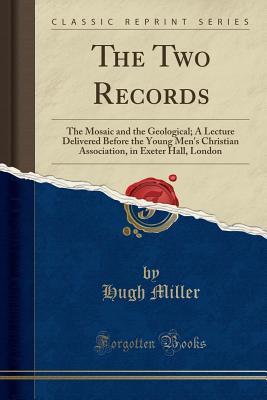
The Two Records is a work by Hugh Miller, the Scottish stonemason, geologist, and writer who lived from 1802 to 1856 and who was one of the most important popular interpreters of geology to general readers in the mid nineteenth century. Miller’s work helped establish geology as a major subject of public interest in Victorian Britain and contributed substantially to the broader popular understanding of the deep age of the earth.
The two records of the title refers to the two sources of revelation that Miller believed should both be taken seriously by educated Christians, the record of scripture and the record of nature as it was being read by the new geological and biological sciences. Miller was a serious evangelical Christian who was also a serious geological investigator, and he spent considerable intellectual energy across his career working out how the two records could be reconciled with each other. The question was a major one in mid nineteenth century British religious and scientific thought, with various positions ranging from rigid biblical literalism that rejected modern geology to liberal theological positions that simply accepted the geological findings without much effort to reconcile them with scripture.
Miller occupied a middle position. He believed the geological evidence for the great age of the earth and for the long developmental history of life was overwhelming and that no serious educated Christian could continue to defend the literal reading of the Genesis creation account as a six day operation in the relatively recent past. At the same time he believed scripture was genuinely revealed and that the apparent conflicts between scripture and geology must be capable of reasonable resolution if both records were properly read. The book sets out his position on these questions with the kind of clear careful prose that made all his geological writing accessible to general readers.
Miller’s particular approach to the reconciliation problem was characteristic of his generation. He read the Genesis days as long periods rather than literal twenty four hour days, allowing the geological time scale to fit within the structure of the biblical narrative. He read the various accounts of biblical creation and of the flood as consistent with what the geological record was actually showing about the development of life and the various major transitions in the geological history of the earth. The particular reconciliations he proposed have not stood up well to subsequent biblical scholarship and subsequent science, but his general approach to the problem influenced a substantial generation of nineteenth century Christian readers of geological literature.
The book is mostly of interest now to historians of nineteenth century relations between science and religion. It pairs naturally with The Old Red Sandstone and Footprints of the Creator.
About the Author
Download free books by Hugh Miller on BDeBooks. Read Hugh Miller’s works online or download as PDF/EPUB — part of our growing free eBook collection.
See all books by Hugh Miller →