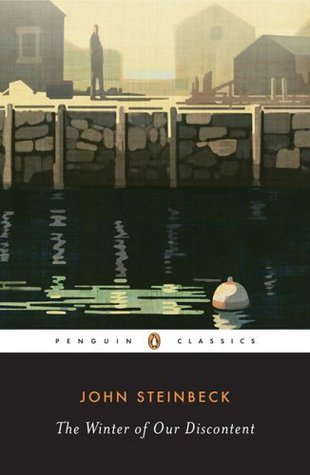
The Winter of Our Discontent
The Winter of Our Discontent is John Steinbeck’s last novel, published in 1961 just a year before he won the Nobel Prize for Literature. The book is set in the fictional Long Island town of New Baytown, in the early sixties, and it follows Ethan Allen Hawley, a man from an old whaling family who has fallen on hard times and is now working as a clerk in a grocery store he used to own. The store was lost during the war when Ethan was overseas, sold by his father to pay debts, and the new owner is a Sicilian immigrant who has hired Ethan to manage the place for him.
The novel takes place over a few months in which Ethan slowly decides that the moral standards he has lived by all his life have not paid off, and that the time has come to bend them or break them in pursuit of the success his wife and children deserve. Steinbeck handles this descent with painful precision. Ethan is not a bad man and he never quite becomes one. He is simply a tired man whose pride has been worn thin by years of being respectable and broke at the same time. His scheming around the store, around an old friend who needs his help, and around a piece of inherited family land builds slowly into a moral crisis that the title points to from the start.
Many critics consider this Steinbeck’s most direct engagement with postwar American consumerism and the spiritual emptiness he saw spreading through the country. The book is shorter than East of Eden or The Grapes of Wrath, more inward, and the prose has a strange brittle elegance that suits the material. For readers who only know Steinbeck from the high school assignments, this late novel is worth a return visit. It is a cold book in places but a deeply humane one.
About the Author
Download free books by John Steinbeck on BDeBooks. Read John Steinbeck’s works online or download as PDF/EPUB · part of our growing free eBook collection.
See all books by John Steinbeck →