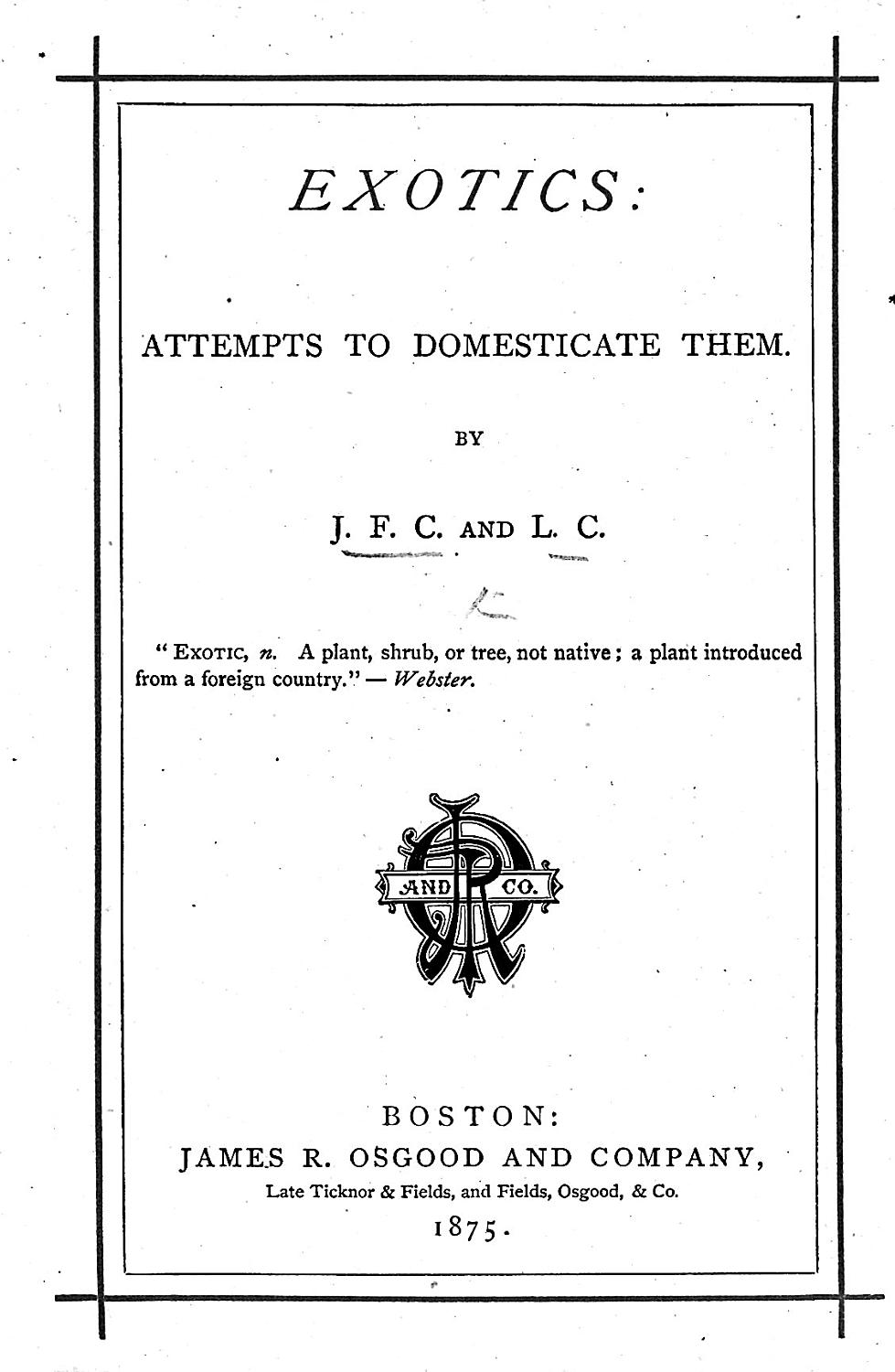
Exotics: Attempts To Domesticate Them
Exotics, Attempts to Domesticate Them is a book by James Freeman Clarke. The title refers to bringing religious and literary material from non-Western traditions into English-language American Unitarian intellectual life. Clarke was one of the leading nineteenth-century American writers on comparative religion, and his major work Ten Great Religions of 1871 was among the earliest American academic treatments of the world religious traditions.
The nineteenth-century American interest in non-Western religious and literary material had been substantial. Emerson, Thoreau, and the wider Transcendentalist circle were deeply influenced by their reading of the Bhagavad Gita, the Upanishads, Confucian texts, and various Buddhist materials that became available in English translation across the early and mid nineteenth century. Clarke participated in this engagement and produced both scholarly and popular work on the various traditions.
Exotics addresses the difficulty of moving material across cultural lines. The domestication of the title is the process by which foreign religious and literary material is rendered accessible to readers who do not share the cultural context that originally produced it. How much of the original meaning survives the transfer is a question that comparative religion scholars have continued to debate.
Clarke’s approach was typical of nineteenth-century American liberal Protestant comparative religion. He was sympathetic to the various traditions and willing to find genuine moral and spiritual value in them, while keeping a Christian framework as his own working position. The result is moderate ecumenical engagement that distinguished American Unitarian comparative religion from both the dismissive orthodox missionary tradition and the more enthusiastic Transcendentalist appropriation.
The book is mostly of interest now to historians of nineteenth-century American religious thought and of the early development of comparative religion as a field. It pairs with Clarke’s Ten Great Religions and with Emerson’s essays on Asian religious subjects.
About the Author
Download free books by James Freeman Clarke on BDeBooks. Read James Freeman Clarke’s works online or download as PDF/EPUB · part of our growing free eBook collection.
See all books by James Freeman Clarke →