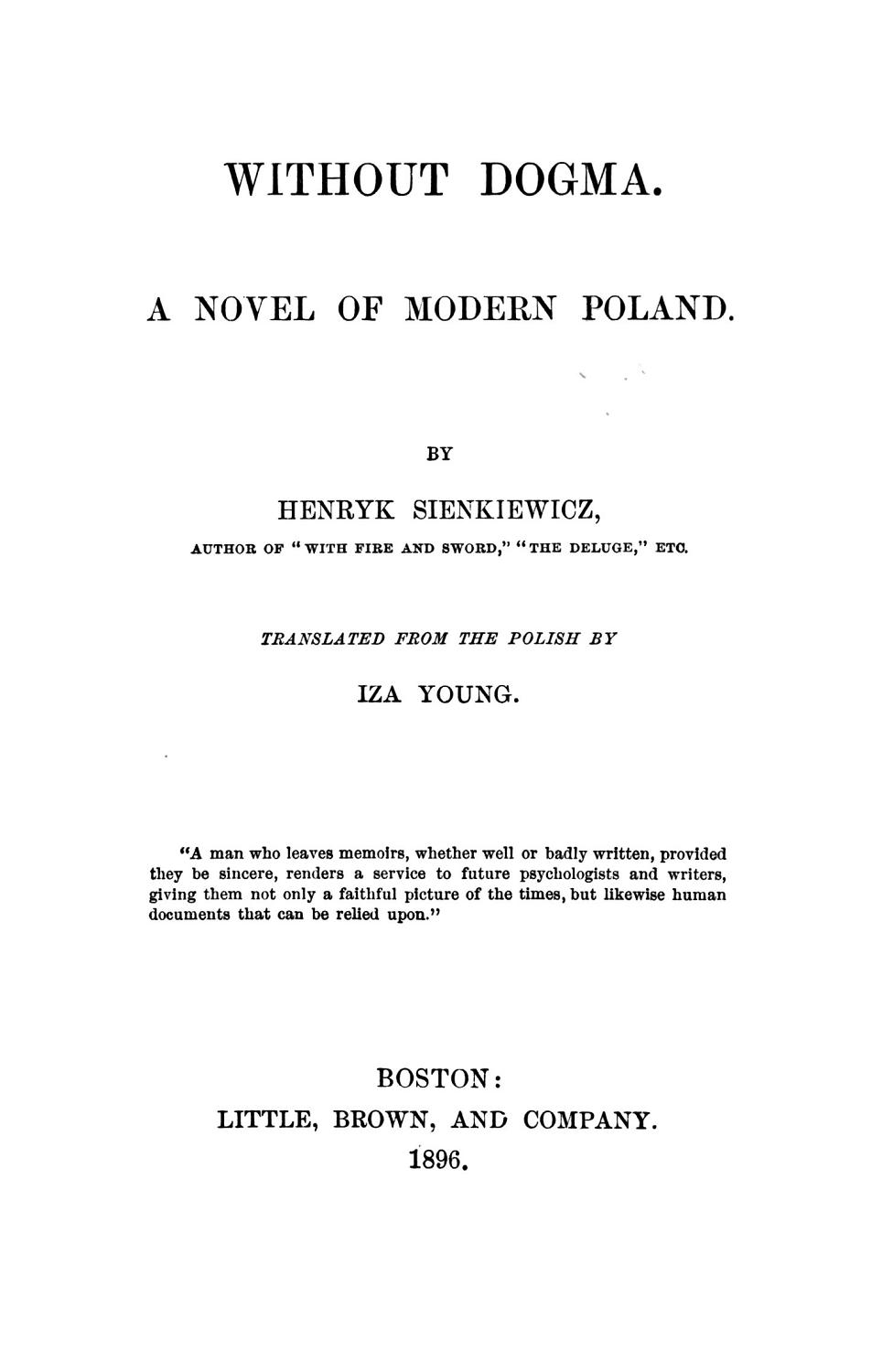
Without Dogma
Without Dogma is a novel by Henryk Sienkiewicz, first published in Polish in 1891 as Bez Dogmatu. It is one of his most ambitious works outside the historical novels and is generally considered the most psychologically serious of his contemporary fictions. The novel takes the form of a diary kept by its central character, Leon Ploszowski, a wealthy and cultivated young Polish aristocrat living mostly abroad in the cities of late nineteenth century Europe.
Leon Ploszowski is a representative figure of his class and his moment. He has been educated at the best European universities, he speaks several languages, he has independent means, and he has no clear purpose in life. He drifts between Rome, Paris, and his family estates in Poland, observing himself and the people around him with a kind of permanent intellectual detachment that prevents him from committing fully to anything. The diary records his various entanglements, his thoughts about art and religion and politics, and above all his slow developing relationship with a young woman named Aniela Kromicka, who becomes the central figure of the second half of the novel.
The title refers to the central problem the book sets out to examine. Leon is a man without dogma, without firm religious or philosophical convictions, without the kind of binding belief that earlier generations of Polish aristocrats had taken for granted. Sienkiewicz uses the diary form to show what such a condition actually feels like from the inside, with all its capacity for sophisticated observation and all its inability to act decisively when action is required. The romance with Aniela, which could have been the saving anchor of Leon’s life, is undermined by exactly the qualities of analytical detachment that make Leon such an articulate observer in the first place. The ending of the novel works out the consequences of his condition with a moral clarity that is unusual in a writer of Sienkiewicz’s generally optimistic temperament.
The book runs about five hundred pages and asks a real commitment of the reader. For readers who only know Sienkiewicz through Quo Vadis, this is the book that shows the other side of his work. It pairs naturally with the contemporary Polish novels of Bolesław Prus, particularly The Doll, and with the European diary novels of the same period from writers like Pierre Loti and Edmond de Goncourt.
About the Author
Download free books by Henryk Sienkiewicz on BDeBooks. Read Henryk Sienkiewicz’s works online or download as PDF/EPUB · part of our growing free eBook collection.
See all books by Henryk Sienkiewicz →