
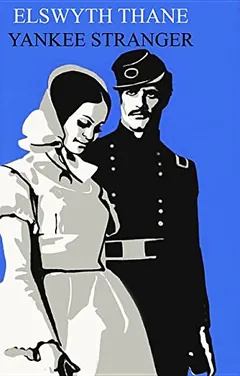
Yankee Stranger
V: September 15, 1862
V
SEPTEMBER 15, 1862
I
TO MELICENT, THE SUMMONS TO WASHINGTON, WHICH CAME in the form of a telegram from Cabot to his father, was the most exciting thing which had ever happened. The first report that he was missing had caused her an agony of suspense, only a little lessened by the news that he was a prisoner, wounded, about to be exchanged. Now when a telegram arrived and was carried into the library, she hung about in the hall outside, not daring to go in and ask, but hoping, praying, it might be from Cabot himself.
Quite suddenly the library door opened and Mr. Murray stood there, looking angry and upset, the message still in his hand. In spite of herself she took two steps backward and brought up against the banisters, waiting to be ordered upstairs to her room, but determined to ask before she went if the message was from Cabot. His eyes fell on her almost without recognition, he was so preoccupied.
“Find your mother,” he said briefly, “and come to the library, both of you.”
Melicent felt there was no time to lose. From where she stood she sent her clear, well-projected voice up the stairs.
“Mother! Come quick!”
“Don’t bellow like that!” said Mr. Murray irritably, and withdrew into the library.
Anne Murray came down the stairs, moving lightly for so big a woman.
She was large-boned, not fat, with a broad, plain, colourless face, an unsmiling mouth, cold blue eyes and mousy hair. Childless, and except for Melicent’s life-long affection, loveless, she had found her niche in caring for a foundling and two self-centred, unnoticing men. She ran the luxurious, gloomy mansion efficiently with a female staff of three, and handled the unlimited funds at her disposal economically, with household books always in order and ready for inspection which never came. The surplus which
accumulated under her careful management from each month’s housekeeping allowance she laid away for Melicent, with never an idea of using it for herself, though she bore the name of her employer and ranked as the lady of the house.
“It’s a telegram,” Melicent told her, and grabbed an unresponsive hand in two cold paws. “He wants us in the library. It must be about Cabot!”
Mr. Murray was standing on the hearthrug, reading the message for the sixth or seventh time—a tall, brooding, hawk-nosed man with a greying beard. He looked up at them fretfully over his spectacles, as though the whole thing was somehow their fault.
“Shut the door and sit down,” he snapped. “Stop goggling at me, Melicent, your eyes are popping out of your head!”
“Oh, please, sir—is it about Cabot?”
“Very well, it is about Cabot—he’s back in Washington, and apparently parted with his sanity in Libby Prison.”
“That’s a dreadful place, they say,” Anne conceded gravely.
“He was wounded, as we know, and he is still very ill—can’t look after himself, has to stay in bed and be waited on hand and foot. He wants you to come there and nurse him, Anne.”
“Why, yes, I could do that,” she said unemotionally. “Where is the wound?”
“He doesn’t say. Just like him, to leave us in the dark about that. Perhaps he’s delirious, he says to bring Melicent with you.”
“Me!” Melicent bounced on the edge of her chair. Her large brown eyes, already filled with tears for Cabot’s wounding, spilled over so that crystal drops rolled down her cheeks and hung on the long, upward sweep of her lashes. “Me go to Washington!”
“It seems a preposterous idea to me.” Mr. Murray glanced again at the telegram in his hand, as though hoping that that particular part of Cabot’s message might by now have disappeared. But there it was, as incomprehensible as ever: Please send Melicent too. It will do us both good.
Nonsense.
“Maybe he’s lonesome,” said Melicent, and the man she called Father looked at her piercingly, as though he suspected her of trying to be funny, or of being an imbecile, one or the other.
“He is probably seriously ill, and what he wants with a child under foot I can’t see!”
“I’m fourteen,” Melicent reminded him jealously. “I can read aloud to him, and—sit with him when Mother has to go out, in case he wants anything—”
“I’ve no doubt you will be very useful,” he agreed drily. “Well, Anne, I suppose you will have to go—though what will become of things here I can’t imagine.”
“Jessie can manage,” she told him unsympathetically. “She is a very capable girl.”
“Who is Jessie? That parlourmaid of yours?”
“She is the best maid we’ve ever had. And the cook knows all your favourite dishes as well as I do. You probably won’t even notice we’re away,” she added for she knew a certain satisfaction in landing a remark like that sometimes in such a way that it went unchallenged by him.
“How soon can you be ready, then?”
“Tomorrow morning.”
“I suppose I must telegraph him. Do you think you had better take the child, as he suggests?”
“I think so. If he is very ill I will need her help. If he isn’t, she can amuse him. He’s not a patient invalid, as I know very well from the time I nursed him through measles, a few years back!”
Again Mr. Murray eyed Melicent, as though trying to see how she could possibly amuse anyone.
“Very well,” he said shortly. “Whatever you think best of course. Has she the proper clothes for such an expedition?”
“If she hasn’t I can get them for her there.”
Anne rose. The interview was over. Melicent lingered on one foot when Anne left the room.
“Please, sir—”
“Well, what is it? Don’t you want to go?”
“Oh, yes, sir, I’m dying to go! M-may I have the message?”
“What’s that?”
“The telegram. May I have it—to keep?”
“Why?”
“Well, it—it’s got my name in it. I never had a telegram before.”
“You didn’t have this one. It was sent to me.”
She began to back away from him towards the door, looking ready to cry. He glanced again at the paper in his hand—the first word he had had in anxious weeks from the son who was all he cared about in a hated world.
He realized he had meant to keep it himself, to look at again, and despised himself promptly for sentimentality.
“Here you are, then,” he said roughly, and held it out to her. “Take it.”
“Thank you, sir.”
She took it, almost with a snatch, and his voice followed her like a whip as she ran out of the room,
“Close the door behind you!”
As she turned to obey, she remembered to drop her curtsy.
She slept that night with the telegram under her pillow, though she knew it by heart then, and woke at dawn to read it once more before she began to dress for the journey.
Am back at Willard’s with nasty wound and fever after month in Libby Prison. Practically bedridden and no nursing available here. Can you spare Anne to look after me. Please send Melicent too. It will do us both good. Yes I will write column on Libby. Give me couple of days.
Love to all.
CABOT
He had asked for her. She got out of bed to count over again the little pile of her own treasures she had collected to take to him: a deck of cards, to play patience with; checkers, and a board—she could play that with him, when he was bored with everything else; a copy of Pride and Prejudice, and a book of Tennyson’s poems, in case he wanted her to read aloud; and in her small, childish throat she took him her singing voice and a half dozen new songs he might like to hear, even without the piano. It wasn’t much, but it was all she had, and she was consumed with the desire that lives in all devotion to give, to bestow, and to share what she cherished most.
For she was devoted to him now, with a worshipping humility which would have horrified him if he had had any idea of its intensity. Now that she wasn’t afraid of him any more, she had centred all her starved heart in this magnificent brother who sometimes remembered to be kind. The
thought of being of some use to him, now that he was ill, had kept her awake for hours. And he must have thought she would be of some use. It will do us both good. What had he meant by that?
Half-dressed, in her plain white chemise and drawers, with no lace trimming on them, she paused to read the telegram again. There was no clue there as to his meaning. She would have to wait, and try to guess by his face what he wanted of her. You couldn’t tell much by his face, except that he liked you a little, instead of looking at you as though you were a beetle, the way Father did….
In the train she sat wondering for the hundredth time about the Virginia girl he was going to marry. It was so impossible that any girl should be good enough for him. None of the Trenton girls were, even he could see that. He hadn’t said much about his Eden, except that she had red hair and green eyes—then he corrected himself. “Titian,” he said, in correction. “She doesn’t freckle, and she can wear pink.” Imagine wearing pink, anyway….
Anne’s taste in clothes was sober, even for the young, and if it had not been, Mr. Murray would have seen to it that nobody wore pink in his house.
Melicent’s travelling dress, even in August, was a sensible brown merino, and the day got steadily hotter as they approached Washington.
The Jersey Senator who lived across the street from them in Trenton was waiting at the station with his carriage. Melicent had always thought him a nice man, square and honest and peppery, and now as they drove down Pennsylvania Avenue to Willard’s Hotel he spoke of Cabot with an almost paternal affection. The wound, he said, was in the right leg, above the knee, and the ball had missed breaking the bone by fractions of an inch. It was painful, and slow to heal, but the fever had pulled him down even worse than the wound. If it were not for a truly magnificent physique he might not have survived. It would be some time before he was himself again, even with the very best care. Most of all, he needed feeding up. They starved them at Libby Prison.
Melicent saw very little of Pennsylvania Avenue or the lounge of the hotel through which they passed on their way to Cabot’s room. She was intent on the Senator’s every word, and she was shaking with nervousness because she was going to find Cabot ill, lying in bed instead of striding about the house more than six feet tall and able to lift you right off the floor with one hand if he had chosen. What would you say, when he wasn’t
towering above you? How could you act, when he was suffering and starved? Maybe she oughtn’t to go in—
“This is the room,” said the Senator, and tapped on the door, and Cabot’s voice inside yelled, “Come in!” just the way it ought to sound, and the Senator opened the door for them.
“Well, here’s your family!” he said cheerfully. “You’ll feel better now, you old bear!”
Cabot was grinning at them from the middle of a wide bed. He was thinner and paler, but he was shaved and brushed and very much himself, and had been reading a book.
“Hullo, Anne, I’m glad to see you,” he said, just as usual, and Anne, who always knew what to do and did it however grimly, went over to the bed and kissed his forehead, and then began to take off her gloves and bonnet.
“Your room is just through this door, Mrs. Murray.” The Senator bustled across to open it. “I had him moved, so you could have connecting rooms. I thought it would be easier if he wanted something in the night. Your baggage is all in there. Perhaps I should have let you take your things off first, but I knew he’d be impatient—”
Anne thanked him, unsmiling and composed, and passed on into the other room, carrying her bonnet and gloves. Melicent started to follow.
“Hey!” said Cabot from the bed. “Come here, and let’s look at you.”
“Hullo, Cabot.” She approached him shyly, and put her hand into the hand he reached out to her. She had never seen him before with even his coat off, and now his nightshirt was unbuttoned at the throat, and the sleeve didn’t reach to his wrist.
“What’s that thing on your head?” he asked, squinting, and her other hand flew up to make sure.
“M-my hat?” she queried anxiously, feeling of the round straw headgear with the two flat black ribbons hanging over the back of the upturned brim.
“It’s not a hat, it’s a bad joke,” he said. “Take it off.”
She took it off by pulling up on the front of the brim so that the elastic slipped out from under her curls behind.
“It’s—hot, isn’t it,” she said, her hand still in his.
“Senator, I have a favour to ask of you,” Cabot said, and the Senator said, “Certainly, certainly, my boy,” and came to lay a fatherly hand on
Melicent’s shoulder.
“Or rather, of your wife. Will you ask her to take my sister out this afternoon and dress her, at my expense?”
“That is pretty heavy stuff for this climate,” the Senator agreed, pinching up a fold of the brown merino.
“It’s hideous,” said Cabot tersely.
“Oh, but I—I have a blue dress in my bag,” Melicent assured them eagerly. “It’s a sort of muslin, and much cooler, but it musses, and we thought for the train—my blue dress has a white collar, and it—”
“No, don’t tell me,” said Cabot sadly. “I can imagine what it’s like without looking.”
“My wife will be delighted,” said the Senator. “We haven’t any little girls of our own, and she is always borrowing a niece to take shopping. I’ll go and tell her. Will about four o’clock suit you, Cabot?”
“The sooner the better,” Cabot nodded, and the Senator went away.
Melicent glanced guiltily at the open door of the room where Anne was unpacking.
“Maybe she ought to go with us—to buy my dress,” she suggested.
“She can’t leave me. I’m a very sick man. I need lots of care.”
“Cabot, does it hurt much?”
“It’s not as lively as it was.”
“I’ve been so worried about you. It was awfully good of you to let me come too, and I’ll try to be a help—maybe I could read to you, or—
something.” And she added quickly, because he looked surprised: “I always try to coax Mother to read to me when I’m sick.”
“What does she read to you?” His hand drew her down on the edge of the bed.
“Won’t I hurt your leg if I sit there?”
“You’re on the good side. What have you read, tell me.”
“Maria Edgeworth, and Jane Austen, and Tennyson’s poems—” She thought he made a sort of face. “Don’t you care for them?” she asked anxiously.
“It’s been a long time—I liked Pride and Prejudice, I remember.”
Her face fell.
“I might have known you’d read it. I brought it with me.”
“Good. We’ll read it again. A man at the prison had a copy of The Cloister and the Hearth, and we all read it to shreds, but you wouldn’t like that one.”
“Was it dreadful at the prison? Were you hungry?”
“Hungry all the time, for more than a month. But that wasn’t the worst part. Eden almost came with me—well, anyway, we got as far as talking about it—and then she couldn’t. I had to leave her there in Richmond, and she’s still hungry, it doesn’t bear thinking about,” He turned his head restlessly on the pillow, and you could see that he thought of very little else.
“She came to see me at the prison—you don’t know quite what that means, in Richmond, where they hate Yankees like poison.”
His hand still held hers on the sheet. She laid her other hand on top of it, longing to comfort him.
“Couldn’t we send her something?”
“There’s a thing called the blockade.” His mouth twisted. “Their army is too much for us, so we hope to starve them out. All for their own good, mind you!”
“Isn’t the war ever going to end, Cabot?”
“If I could think of any way to cut it short by one day, I’d do it, no matter what.” He was staring past her, scowling at the wall, reading there some dark answer to his own misery. “No matter what,” he repeated, and it sounded like an oath.
“I learned all the music she sent me,” Melicent offered timidly, trying to bring him back. “Later on if you like I’ll sing it to you.”
His ringers tightened gratefully.
“I’d like it very much. You know, this was her idea—your coming to Washington while I get well. I’d never have had the brains to think of it.
She thought I ought to have a woman to look after me. And she meant you, you monkey, not Anne!”
“I’m fourteen,” she bragged, feeling confident and responsible.
“She’s only nineteen herself, poor darling.”
Anne came in, tying a white apron around her waist.
“Now, then, we’ll have you tidied up in no time,” she said briskly.
“Melicent, I think you’d better go and wash up after the journey, and put on your blue muslin, it will be cooler.”
Cabot winked at his sister as she rose reluctantly from the edge of the bed.
“You might as well,” he said. “I’ll try to bear whatever you have on, it won’t be for long.”
Melicent hesitated, looking down at him.
“Cabot, do you think— would it be too much trouble—”
“Well, what? Speak up.”
“Oh, Cabot, could I have a pink dress?”
Just in time he suppressed the impulse to indulgent laughter. Just in time lie saw what a serious thing this pink dress was. Somehow he had gleaned that it was a hard colour to wear. He rested a thoughtful gaze on her, noting for the first time that her skin was good, her teeth were white, her hair was brushed and shining, and her eyes—good Lord, she had remarkable eyes for such a youngster.
“Sure you could,” he said easily. “You tell Mrs. Trimble I said there was to be a pink dress in the outfit.”
“Thank you.” And before she had time to scare herself out of it she stooped and kissed his cheek, and ran out of the room.
II
Jackson won a victory at Cedar Mountain on the ninth of August and Lee went up to join him. Then there was news that McClellan was withdrawing his army from the James—by water, not overland, which meant that his transports came in at Aquia Creek and Alexandria. That left the whole Confederate Army free to move northward against Washington, and a fresh Federal militia draft began to stream through the city and out across the bridge into Virginia. Furloughs were revoked. Then refugees began to come in from roundabout Manassas again.
Meanwhile, as though by sheer will power, Cabot was getting well faster than anyone could have believed. Towards the end of August he was on his feet once more, though he limped still and was advised not to ride, and he still slept badly. He had discovered to his astonishment that he enjoyed Melicent’s society, and would miss her acutely if she was not there. At the same time, he no longer needed a nurse, and his father was writing
peevishly about the shortcomings of Jessie, the parlourmaid, and Anne spoke of returning to Trenton soon.
The Senator’s wife, a lonely woman with one son at the front, asked to keep Melicent a while with her in the big house on H Street. Anne said grudgingly that she thought it would be a good thing for Melicent to have an opportunity to learn how to behave in the social world. And Cabot, with the armies converging again on Manassas, wondered if he ought not to send Melicent out of Washington instead.
The day before Anne was to go back to Trenton they all went to a family dinner in H Street to talk it over. It was Cabot’s first outing, and he went with only one crutch, to everyone’s admiration. The Senator’s wife produced a couple of nieces, highly sophisticated young ladies though not out yet, with whom Melicent had already a somewhat awed acquaintance.
As they sat in the drawing room drinking coffee, Cabot saw his sister’s eyes travel covetously towards the shining piano, and when one of the nieces was invited to play for them he hoped that no one would discover that Melicent liked to sing. The little niece played very badly, but everyone applauded and Melicent gave him a look which said, I could do better than that. He shook his head at her, and heard the Senator’s wife saying kindly,
“And now, Melicent, can’t you do something to entertain us too?”
Melicent was dumb, not from shyness, but because Cabot had forbidden her. But Anne had not seen.
“She sings quite well,” said Anne, so matter-of-factly as to rob the statement of praise. “Come along, Melicent, you must do your share when your hostess asks you.”
Melicent was miserable. Everyone was looking at her.
“I—don’t think Cabot wants me to,” she gasped, and turned pink.
“Oh, nonsense, my dear, it’s all in the family, you give us a song,” the Senator insisted indulgently.
It was the one thing she was sure about—her singing. Shy as a bird about everything else, she knew that her voice was a gift from the gods and might make even Cabot proud of her if she was allowed to use it. She wanted desperately to make him proud of her, and to show these lovely people that she, too, had something to give.
“Please, Cabot, I—I’d like to sing for them.”
“Sure, you go ahead and sing,” he said unexpectedly, surprised that she was not afraid to try, reflecting that she couldn’t do worse than the niece, who had played like a music-box.
Without any embarrassment, Melicent took her place on the piano stool and smiled at him over her shoulder.
“This is one of Eden’s songs,” she said.
Pure and strong and heartbreakingly fresh and young, her voice flowed out in The Last Waltz. The Senator sat up, and his eyes sought his wife’s.
She nodded impressively. Cabot watched them under his brows, aware of their growing excitement. He had always liked Melicent’s voice himself, but he began to perceive now that the youngster must be really good.
When the song ended the Senator went to the piano and kissed Melicent’s hands.
“My dear, my dear,” he said delightedly. “I have heard Jennie Lind and she’s no better! Isn’t that so, Lydia? And to think we might never have heard you sing a note! Cabot, you chump, you must have known what a treat she is! Has she got a good teacher?”
“I don’t know. Has she?” He looked to Anne, helplessly.
“She has the only teacher in Trenton,” Anne said drily, hoping they wouldn’t turn the child’s head.
“But that voice must be handled with care! Lydia, you must take her to Boldini tomorrow. He’ll know what’s best for her.”
“Boldini by all means, my dear,” said his wife. “But she is just what we want for the concert on Saturday. Everybody plays the piano or the harp, but nobody sings, so far. Now we have found a songbird for the programme.
May we have her on Saturday, Cabot? It’s a benefit for the wounded soldiers. And may I dress her just as I like?”
“She has never sung before an audience,” he said doubtfully. “I’m not sure she wouldn’t die of stage-fright.”
‘We’ll risk that,” said the Senator’s wife. “What else do you sing, child?
Give us another one.”
Melicent looked at her brother out of the corners of her eyes. There was triumph in that look, and a happiness which was sublime, because he was smiling at her. She hadn’t disgraced him after all, and she suspected that he hadn’t been sure she wouldn’t. Now they wanted her to sing before an audience, and she had to prove to him she Wouldn’t die of stage-fright.
Well, she could do that too. And shrewdly she chose her next song. She sang them Home Sweet Home. That time when she finished the Senator blew his nose, and Cabot said, “Don’t let her do that one at the benefit, or you’ll have them all in tears!”
The nieces were openly envious of her good fortune in coming to stay with their Aunt Lydia, who always gave them a better time than they had at home.
“I suppose you’ll sleep in the lilac room,” said the one who had played so badly. “It has a four-poster bed with a canopy.”
“The green room is nicer,” said the other. “It has a bow window. Won’t you be glad to get away from that dreadful Willard place with all the spittoons?”
“Well, it seems kind of heartless to leave Cabot there all alone,”
Melicent said haltingly.
“Aha, but he isn’t going to stay there all alone!” the Senator crowed surprisingly. “He’s coming to stay here with us too. There’s a—a writing job he has to do and he’ll be better off here.”
“Both of us?” cried Melicent, radiant, and the Senator’s wife quickly covered a look of astonishment with one of hospitable pleasure, but Anne somehow surmised that this was the first she had heard of Cabot’s proposed visit.
Cabot gave his sister an affectionate grin.
“I’ll race you for the four-poster,” he suggested.
“Cabot, I’m so glad! When did you decide to leave Willard’s?”
“In the library before dinner.”
“I knew you two were up to something in there,” said the Senator’s wife, and received from her husband a glance which caused her to start talking rather fast about the concert.
When they left the house that evening it was all arranged that Melicent and Cabot should move in the next day, and she was to sing at the concert on Saturday, and perhaps later on at a hospital for the wounded soldiers.
Going back to Willard’s in the carriage Cabot was rather silent, and she asked him anxiously if he wasn’t pleased, and he assured her that he was.
Then she asked him if his leg hurt, and he said it did, damnably. “Your brother has hatched a swan,” remarked Anne from her corner in her dry way, and Melicent wasn’t sure what she meant but was too happy to care.
Anne had guessed only the half of it. The rest was what he and the Senator had been up to in the library.
That week McClellan was sent to Alexandria to direct the defence of Washington, and Pope was left to fight the coming battle on the other side of the Potomac. Cabot had no great faith in Pope, and neither, for that matter, had anyone else.
On the twenty-ninth Cabot borrowed the Senator’s carriage and drove down to McClellan’s camp. When he got back the Senator was pacing up and down in the drawing room in H Street waiting for him, and Melicent was watching out the window. There was a sound in the air over Washington like distant thunder, but a hot sun was shining.
“Well?” demanded the Senator, as Cabot came in the door, and—
“Cabot, is that guns?” asked Melicent simultaneously.
“We’re going to have another Manassas,” he told them quietly. “At least
—we’ll hope it doesn’t end the same way. If they had only held off a week longer I could have been there.” He sank stiffly into a chair, with a grimace of pain. His face was white and shining with perspiration. “Damn this leg,”
he said, and the Senator rang for brandy.
“You should never have gone,” Melicent scolded him lovingly. “We said you weren’t strong enough. Now tomorrow you’ll have to stay in bed all day or you won’t be able to come to the concert. Cabot, is that guns?”
“Yes, it is. Guns at Manassas.” He was trying to control a trembling weakness which ran all through his fever-ridden body. “If anyone had told me that I’d sit here in Washington with a battle going on just across the river—”
“Give yourself time,” said the Senator. “You had a close call. There will be plenty of work to be done when you’re fit again. Here, drink this down.”
Their eyes met over the glass.
“People are leaving Washington by the carriage load,” Cabot remarked then, with a glance at his sister. “What do you think, sir?”
“My wife says not. Not yet, anyway.”
“Leave Washington?” Melicent cried scornfully. “I’ve got to sing tomorrow night, and after that Mr. Boldini himself is going to give me lessons!”
All the next day, which was Saturday the thirtieth, Washington could hear the artillery, and towards evening many people were swearing they
could smell gunpowder on the breeze from the south-west. In the afternoon the bulletin boards announced a Federal victory and asked for volunteer nurses (male) to go to the battlefield and collect the wounded. Cabot insisted on driving round to the Provost-Marshal’s office to see the confusion there as the wagons and ambulances gathered to load supplies and volunteers. There was a shortage of transportation, and the public hacks had been commandeered for service, their unwilling coloured drivers in every stage of demoralization and fright. When he returned to the house he fainted in the hall and had to be carried to his room. At nightfall the guns were silent.
All that day while the cannon boomed at Manassas the Senator’s drawing room was being made ready for the evening’s entertainment. Rows of little gilt chairs were set facing an improvised platform at one end, the buffer arrived from Gautier’s with a towering spun sugar centrepiece representing the Ship of State, bales of flowers were suitably disposed, and the professional musicians came to run through the programme with the guest performers.
The harpist, whose new husband was at the front, collapsed in tears and had to go and lie down, and the solo pianist had suddenly left town.
Composed, earnest, melodious, Melicent added one more song to her list to fill in, and while the caterers and florists milled about her stood cheerfully on the rather unsteady wooden platform singing to the beat of the conductor’s baton.
She had never sung with a real orchestra before, and it was an experience that transcended anything she had ever dreamed of. In her enchantment at the way the muted violins embraced and adorned her own clear tone she did no t hear the cannon at all, and the conductor, a born musician too, shared her blissful concentration.
Because all the hacks and even private carriages had been sent to Manassas, the guests arrived on foot that evening, the ladies with ruined slippers and flounces, but spirits were held firmly gay because the battle was believed to have been won. Melicent felt no apprehension about singing, it was talking to people that paralysed her, and answering their well-meant questions about how she liked Washington. She liked Washington because Cabot was there. She would have liked Timbuctoo for the same reason. But you couldn’t say that to strangers.
She saw him sitting in the third row as she stood up in the new pink dress to sing. He was white and shaky, she knew, but he smiled, and she smiled back confidently because now he would be proud of her. The orchestra had stopped its incidental music, and the conductor rapped for silence and the chatter of voices died away. It was a hot night, and the long windows stood open to whatever air there was. As the room grew quiet a new sound could be heard in the streets outside—the rumble and clatter of the wagons bringing in the wounded, and even the groans of jolted, tortured men.
There was a swift and deathly silence, and into it, by some trick of the hot wind across the garden, one cry detached itself from all the confused clamour of agony— “Jesus, stop that horse and let me die!” The people on the little gilt chairs sat turned to stone, the conductor hesitated, the pianist bowed his head above the keys, a woman sobbed. Softly at first, unaccompanied, Melicent’s voice stole out into the surcharged air, rising, swelling, soaring strong and unafraid, as the stunned conductor gathered his instruments to her support—in a single intuitive second she had thrown away the carefully chosen programme they had laboured at all afternoon and was singing Schubert’s Ave Maria, while Washington wept.
III
Early the next morning the Senator appeared at the door of Cabot’s room, looking haggard and angry.
“Well, by God, they’ve licked us again!” he cried. “The wounded are still coming in, and the stragglers. The army is back at Centreville. Two years of war, and we’re right where we started from—with dear Lord how many dead!”
“They should have sent McClellan to Manassas,” said Cabot, and got up and began to dress.
Hysteria mounted in the streets of Washington as that rainy Sunday dragged on. Rumour ran wild. The wounded poured in till the hospitals overflowed into the City Hall and the churches and vacant buildings.
On Monday afternoon there were torrents of rain, and everybody suddenly realized that it wasn’t all thunder they were hearing—it was guns
again—nearer. The dripping stream of loaded ambulances never seemed to slacken.
In the lilac room Cabot lay on his bed in a dressing-gown and watched Melicent with curiosity. The Senator’s wife was still calm, but that was to be expected. Melicent was the puzzle. Melicent was behaving like a veteran. In order to keep him from limping up and down the floor and cursing and working up a fever she had ordered him to lie down—yes, pointed her finger at him and said in a loud voice, “Cabot Murray, you do as I say!”—so that he was surprised into obedience. “I’ll read to you,” she announced then. “Maybe that will keep you quiet.”
So he lay listening to her voice even more than to the words she read, soothed in spite of himself, drowsing a little, past wondering any more at the sturdy composure of this odd child of whom he had grown so fond.
“‘—and in my dream
I glanced aside and saw the palace-front
Alive with fluttering scarfs and ladies’ eyes,
And highest, among the statues, statue-like,
Between a cymbal’d Miriam and a Jael,
With Psyche’s babe, was Ida watching us,
A single band of gold about her hair,
Like a saint’s glory up in heaven; but she—’”
A newsboy’s shrill call floated up from the street. Cabot stirred, and raised his head. “Listen!’ he whispered tensely.
“Battle at Chantilly! Federal army fighting new battle at Chantilly!”
“Is that nearer?” she asked without alarm.
“A little.”
“‘—but she
No saint—inexorable—no tenderness—
Too hard, too cruel; yet she sees me fight,
Yea, let her see me fall! With that I—’”
“Melicent. What is it makes you such a good soldier?”
“Am I, Cabot?”
“People have been streaming out of Washington for days. It never seems to occur to you.”
“That’s just panic.”
“Why aren’t you afraid too?”
“Afraid of what? Why should I be? You’re here.”
“I couldn’t, even in the best of health, preserve you during a bombardment of the city.”
“Will they do that?”
“If they get close enough and it isn’t surrendered first.”
“Mr. Lincoln is still here.”
“Yes, I’d noticed that.”
“And Aunt Lydia. She said I could call her that.”
“Now that she knows the boy is safe, she’ll go any time you wish.”
“Cabot, are you scared?”
He smiled crookedly.
“I’d like to have two good legs,” he confessed. “Well, if you do get a bad fright, I’ll never forgive myself. But I like having you here, that’s the trouble. You keep me from going crazy and banging my head against the wall.”
“Then I’m really some use to you?”
“More than you know, or you wouldn’t ask such a silly question.”
“Shall I go on?”
“Yes—go on.”
She read on, against the thunder and the guns.
The Federals were whipped again at Chantilly and fell back to the Washington defences, which were fully manned. On Tuesday McClellan was in charge again—the army wanted him, if the politicians did not.
Government papers were being tied into bundles ready to be sent away in wagonloads, and the Federal gunboats were said to be assembling in the river to shell the town if it was taken by the Southern forces. The rumour also ran that if Washington had to be surrendered it would be first destroyed. A steamer was waiting in the river to remove the President and Cabinet members.
“I won’t go till he does,” said Melicent. “Not even then, if you don’t.”
Still the ambulances came, and the gunboats moved up grimly as far as Nineteenth and G Streets. Disorganized, drunken, staggering with fatigue
and defeat, the Federal army filled the streets and the bars of Washington, while the awkward incoming volunteers stared at the battle-worn veterans with incredulity. In the midst of demoralization and despair McClellan galloped down the Avenue with his cloak flying and his staff smartly at heel, intent on working the same miracle he had performed in 1861.
Lee fooled them. Instead of attacking the city he slipped past it, going north.
And so, instead of defending the capital behind cosy fortifications, McClellan had now to give chase, and try and catch up, and force a battle on a victorious invader. Except for a small garrison on the Peninsula, the soil of Virginia was now clear of the enemy, and no Federal army would march on Richmond while Lee was on the Potomac flanking Washington.
The tables were entirely turned.
Worst of all, for days no word of Lee’s exact whereabouts filtered through his cavalry screen. He was supposed to have crossed the Potomac somewhere north of Washington. And within the week McClellan swung a ragged, but spirited and hardened army through Washington towards Maryland and considerable uncertainty.
Cabot saw them go with mixed emotions. His old place was there, with McClellan, who enjoyed figuring in the newspapers and was not pleased to be without his Special Correspondent. But Cabot had found reporting the war not quite what he had expected. Apart from his healthy respect for the 57th Article of War, which provided court martial with possible sentence of death for giving military information to the enemy, either directly or indirectly—and which had already landed one journalist with six months hard labour for a slip—there was also the gentlemen’s agreement between McClellan and the eastern correspondents with regard to what they would refrain from printing. Cabot had more sense of responsibility than many of his colleagues, so that whatever the temptation to score a beat, he always dreaded to leak information in a way to jeopardize his commanding officer’s immediate plans. He was consequently more than once in hot water with his editors for holding back a story some less scrupulous rival had filed first, often with damaging effect. Before the war had been on very long, several generals, notably Sherman, were in a state of mind to shoot any correspondent at sight, and would not have one attached to their command. On the other hand, too many correspondents became mere press
agents for their generals, splashing their successes and covering up their lapses. No dependable censorship rules existed, and yet dispatches sent through Washington by wire were likely to be delayed or diverted by Government caprice or discretion—a condition of affairs which induced some correspondents to deliver their fruitier battlefront news in person by making spectacular journeys on horseback to the nearest railway, and arriving at their offices covered with the mud and blood of combat and in the last stages of exhaustion.
Furthermore, Cabot had some conscience about publicly criticizing his commanding officers and the administration, which he was forced sometimes to consider hopelessly at fault—and this hampered him in what he wanted to write, and ran him crosswise to the convictions of the armchair generals in the editorial rooms. He viewed the New York Tribune’s policy of violent attack on the President and McClellan with disgust, and went all the way home to Trenton to quarrel bitterly with his father over an editorial in the Enquirer accusing Mr. Lincoln of “languor, blindness, and want of purpose.” For an hour the dispute between the two of them raged in his father’s office, before Cabot strode out and the door closed behind him with a bang which shattered the already overstrained nerves of the Enquirer’s staff, huddled outside in the city room.
Whether Cabot resigned or was fired from the Enquirer remained a question to its other employees, but he never wrote for it again. From then on his articles appeared exclusively in a Philadelphia paper which was loyally supporting the administration and not attempting to fight a guerrilla war with Washington on the side. The War Department ruling that all news from the front must be published with a by-line helped to make the reputation of more than one correspondent, and the New York Times made him an offer just when he had begun to feel that the less said about this war the better, and the thing was to get it over. The second disaster at Manassas seemed to him to make his decision even clearer. He turned down the Times. “I’ve given up journalizing war from a staff officership,” he told McClellan briefly. “Beginning now, I’m going to concentrate on fighting it.” “Then ‘jine the cavalry,’” McClellan quoted ironically, and Cabot said,
“Later.”
He was riding every day now, exercising his wounded leg, and the fever had apparently left him for good. Melicent complained that she saw very
little of him, and he told her philosophically that it would have to be that way from now on. His room was alongside hers and she noticed by his lighted window that he did not sleep till late. One night she tapped on his door and asked if his leg was bothering. He answered vaguely through the door that he was quite all right.
Accustomed to his invalidism, she opened the door to see if there was anything she could do for him. He was sitting fully dressed at his desk, which was covered with books and papers.
“Oh, I—didn’t know you were working,” she said, preparing to back out. “You really ought to go to bed, Cabot, you rode all afternoon, and you’ll bring the fever back if you’re not careful.”
“I’ve just finished,” he said meekly. “How about getting a little sleep yourself?”
“Good night, then.” Her eyes caught a carpet-bag, standing open on a chair. “Are you—are you going away?”
He glanced round quickly, and saw the bag.
“Oh, that. No, the books came in that. It’s a special job. I have to do some studying first. Go to bed, that’s a good girl.”
The next day he rode again, and had not returned at midnight. She lay awake listening for him, fell asleep before he came, dreamed of catastrophe, and woke at daybreak feeling uneasy and nightmarish. Tiptoeing to his door, she opened it a crack to reassure herself that he was all right. His bed had not been slept in.
She closed the door and went back to her room, fighting panic. He had fallen during his ride, there must have been an accident, he might be lying somewhere beside the road, helpless—her impulse was to run to the Senator’s room, and spread a general alarm. With some instinct of caution, and by a considerable effort, she forced herself to go back to bed and wait till the first possible moment she could dress and go down to breakfast. The next thing she knew the sun was streaming into the room and the breakfast gong boomed through the house.
When she reached the dining-room Cabot was already in his chair at table, freshly shaved and guiltless-looking. He teased her about over-sleeping. Oppressed by something she could not name she said nothing of her vigil, and from the commonplace talk during the meal she deduced that no one else suspected the hours he kept.
“The paper says they’ve caught another one of Pinkerton’s men down in Virginia and hanged him,” said the Senator’s wife. “I don’t see what good it does, really, sending spies all the way to Richmond. Surely by the time their information gets back here it’s too late to be of any use.”
“Pinkerton likes them to wear the grey,” said Cabot, and shook his head.
“That’s a bit too low—putting on the other fellow’s uniform to pick his brains! Besides—if you’re caught it’s certain death.”
“They’re the bravest men we’ve got, though,” said the Senator, handing his cup for more coffee.
“Who are? Pinkerton’s?” Cabot asked aggressively.
“Not just Pinkerton’s. Any man who goes between the lines, whether he wears the enemy’s uniform or any other sort of disguise. It takes twice the guts—excuse me, Lydia—twice the courage it takes to lead a cavalry charge.”
“Yes, I suppose it does,” Cabot agreed. “In the cavalry, you’ve at least got company. And they mark your grave too, as a rule.”
“Well, of all the depressing conversations!” cried the Senator’s wife.
“You began it, my dear,” he reminded her.
Cabot slept a while during the afternoon, admitting to a headache, and spent the evening at his desk, and went to bed at a normal hour.
The following morning he remarked that he would be away two or three days, maybe longer. Melicent noticed that he took no luggage.
On the third afternoon of his absence, she began to wonder again, and drifted into the lilac room just for the companionship of his masculine belongings which lived there. It had rained all day and kept her in the house. The Senator’s wife had many engagements which did not include a fourteen-year-old guest.
The carpet-bag stood on a chair unlatched, and she yielded to a Pandora impulse—it was empty. The table by the window was piled with his books.
She went through them idly, hoping for something new to read. Most of it was heavy stuff— The Decline and Fall—a life of Napoleon, a book on cavalry tactics—and The Cloister and the Hearth. That was the book they had all read in the prison. She sat down in his easy chair and opened it to the first page.
Before long she noticed that there were words lightly underlined in a way which seemed entirely unconnected with the meaning. She read on,
puzzling at it. Cabot didn’t believe in marking books, she had heard him say so more than once. And these marks seemed at random. The story bored her, and she left it without regret, going listlessly down to dinner. It was dreadful how you missed him.
In the evening a howling thunderstorm came up, the second that day.
The Senator and his wife were at a reception, and except for the servants she was alone in the house. She went back to Cabot’s room, lighted his reading lamp, and for lack of anything better went on reading The Cloister and the Hearth. The storm banged and rattled on its way, and the wet night grew quieter. Her eyelids were drooping. The clock on the stairs struck eleven. He wouldn’t come to-night, and she might as well go to bed.
There were quick footsteps in the hall outside, and the door opened sharply under his hand. For a moment he stood on the threshold, blinking in the unexpected light, the knob still in his hand. Then without speaking he came into the room and closed the door with a snap.
She stared at him silently. He wore a long army waterproof dripping with rain, and a wide-brimmed army hat. But on the way upstairs he had unfastened the waterproof to the waist so that she saw the rough grey butternut suit he wore beneath it—the sort of suit farmers wore, and raw recruits from the hills. Her eyes travelled to his feet—sodden, broken, deplorable shoes, to go with the suit. She was numb with shock, and yet it was as though she had known for hours now what his absences meant. He had been passing between the lines. And if he was caught doing that they would hang him.
She sat frozen, unable to speak, while he took off his hat and beat it in a shower of rain drops against his knee and tossed it to the floor in a corner.
Then he shed the wet waterproof, dropping it near the hat.
At last he spoke.
“Well,” he said expressionlessly, “I’m afraid I’ll have to send you home now.”
“Oh, Cabot, I didn’t mean to sp—” The word died on her lips. She went weak with horror at what she had said. “You can trust me,” she whispered.
“Naturally. I can trust your loyalty, but not your—discretion. Pack up, you’re leaving tomorrow. We’ll say that Anne sent for you.” He came and took the book from her unresisting hand—the book whose underlined words were the key to the cypher he used.
“Oh, Cabot, please, I—m-my lessons with Mr. Boldini—”
“I’m sorry, my dear, but I have no choice. You’re too intelligent not to see that. I might have known you’d catch on, but to-night was an accident. I missed my half-way station in the storm and had to come on in like this—I borrowed the waterproof from an officer at the fort.” He went to a tabouret in the corner and poured out a stiff brandy and drank it at a gulp. His hand was shaking. He had never got his colour back since his illness and the whiteness of his drawn face terrified her.
“Please come and sit down, you’re—you’ll kill yourself if you go on this way! Let’s get those wet shoes off.” She pushed him into a chair and knelt to unfasten his soaked shoelaces.
“Don’t do that, I can manage—”
But she shook her head, picking at the knots while her eyes blurred so that it was difficult to see. She got his shoes off and brought his slippers from the cupboard, and put them on for him. He sat passive, his head against the back of the chair, his eyes closed.
“More brandy?”
“Please.”
She brought it to him.
“Cabot—does the Senator know?”
“Yes. That’s why I’m living here now. I couldn’t come and go like this at Willard’s.”
“Oh, Cabot, I’d rather you fought—”
“I am fighting.”
“In the usual way, Cabot. I’d rather you took the ordinary risks a soldier has to take—”
“Any fool can do that. What I’m doing takes brains. And nerve. There aren’t enough of us, as it is. If we’d known a day sooner that he was pulling out of Frederick—”
“Lee?”
“It’s too late now. He’s got away again. He always gets away.”
She was crying softly, wiping at her wet cheeks with her fingers because she had no handkerchief. He reached out and pulled her to him, so that she sat on the arm of his chair, leaning against his shoulder, crying into her fingers.
“Now, now—you’ll spoil your eyes. Don’t you fret, they won’t catch me. I don’t like it myself, you know, but I swore a solemn swear that if ever I got a chance to do anything to shorten the war I’d take it, no matter what it was—and if we could catch Lee now while he’s ’way off base—if we could land him with a Sunday punch while his supply line runs all the way to Culpeper—the war might be over. Think of it! The war might be over!”
There was a tap on the door and he said, “Come in.” The Senator stood there in evening dress, looking horrified.
“It’s all right,” Cabot said easily. “She caught me—nobody else. I missed Bronson on the road, though. Filthy night, isn’t it?”
The Senator came in and closed the door.
“What are we going to do about this?” he asked, looking sternly at Melicent.
“We’re going to send her home. Tomorrow. Not that she’d talk if she stayed here—but it’s the only way to prevent any possible slip.” He rose, and pulled her to her feet. “Go to bed,” he said kindly. “I’ll see you in the morning.” He kissed her, and gave her a little push towards the door.
Before she reached it they had forgotten her. As she closed it behind her she caught one word outstanding in Cabot’s lowered voice—Sharpsburg.
OceanofPDF.com