
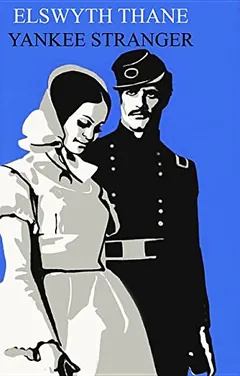
Yankee Stranger
III: July 21, 1861
III
JULY 21, 1861
I
LOUISE WAS WAITING FOR LAFE IN THEIR ROOM AT THE Spotswood Hotel in Richmond.
She stood at a window above Main Street looking down towards Capitol Square, where a band was playing. There was always a band somewhere in Richmond now, and troops marching, and trains heavy with soldiers moving along Broad Street from the south and going out northwards towards Manassas or eastwards to West Point on the York River. None of the troops stayed long in Richmond. Beauregard was at Manassas, gathering his army for an assault on Washington, unless MacDowell struck first towards Richmond. Magruder on the Peninsula was bracing for an attack from Fortress Monroe.
Richmond had become a camp, by this first week in July, 1861. It woke to a reveille of drums and retired to taps. There were almost no men in citizens’ clothes to be seen in the streets. All the women belonged to sewing circles which usually met in the churches, open every day now, where the sewing machines were kept. During the long hot afternoons they worked at heavy stuff like uniform cloth, tenting, and flannel, with swollen, bleeding fingers because there were not enough sewing machines. While they rested, they made havelocks and house-wifes, knit socks and scarves. On the porches and under the trees on the lawns, their coloured maids sat in white turbaned, brightly dressed knots and worked just as hard but with more laughter and chatter. Lately, as the first big battle drew near, there was more scraping and carding of lint to be done, and a demand for rolled bandages had to be met.
Mosquitoes, bad hotels, and a scarcity of food had driven the Confederate Government out of Montgomery to Richmond. People said the move was a strategic mistake—Richmond being too near Washington. But it had made the city gayer than ever, and very crowded. Spies were
supposed to be swarming everywhere, and one of them had been caught and condemned to hanging.
Ransom was in Richmond now, and Felicity and Eden had come with him. Lafe had written him in June to say that if Ransom would only come and fill his post with Lee, he had a chance to get into the field as a volunteer aide on Beauregard’s staff. The school was closed, and Ransom was already debating his own usefulness in Williamsburg. A few days later he arrived at the Spotswood, where with some difficulty he had secured a room for himself and Felicity, while Eden shared Sally’s.
It took Lafe only about a fortnight to acquaint his brother-in-law with his duties at Lee’s headquarters, which were now in the Mechanics’ Institute and which had been increased to include a few clerks, several aides, and a secretary. Since the arrival of the Montgomery Government and the merging of Virginia with the Confederate cause, Lee’s position had become a little vague. Jefferson Davis was supposed to be in supreme command of the Confederate Army. This left Virginia’s General Lee with an empty title and no clearly defined duties. Tacitly he assumed the responsibility of the defence of Richmond, leaving Davis to concentrate on the more active Manassas and Harper’s Ferry areas. Richmond’s earthworks and river defences were going forward briskly under Lee’s direction, but it seemed to Lafe very dull work. Lafe smelled powder up Manassas way. Ransom could take charge now, and this afternoon Lafe had an appointment with President Davis regarding a transfer to field duty with Beauregard. Sedgwick was already there, in Longstreet’s brigade.
There had been two months of war, and no major engagement so far, and only about fifty casualties, not counting the sick in the hospitals. Richmond had had a couple of false alarms, and Magruder had come off victorious in a brush with the Federals at Big Bethel, so soon over that Dabney could not even claim to have been under fire, and the Federals had occupied Alexandria on the Virginia side of the Potomac. There seemed little doubt that MacDowell was massing his Yankee troops there, and that a battle was shaping up before Manassas.
Louise leaned her forehead wearily against the windowpane, staring down into the street. A regiment of blue and orange Zouaves went by, on their way to the railway station. She waved her handkerchief at them automatically, and some of them looked up, grinning, and waved back, and
a child darted out from the curb and gave one of them a bouquet snatched from somebody’s garden. One always waved at soldiers on the way to the front. Some days it seemed as though one did it every five minutes. A little while ago Sedgwick had been among them. Now it would be Lafe. It did not occur to her to object to Lafe’s transfer from the comparative safety of Richmond to what might soon be the firing line. It never occurred to anybody that a Sprague wouldn’t be in a fight if there was one. Louise had laid her own plans accordingly.
She was still standing there at the window when she heard the clank of Lafe’s spurs at the door before he opened it and came in. She turned and smiled at him as he crossed the room to her—so that it smote him again how sweet she was, how frail and young she looked still, with a smaller waist than Sally’s and soft, near-sighted brown eyes, and chestnut hair which fell below her belt when it was down, with only a few white threads in it still—they had been married nearly twenty years, and after only the shortest absence from her his first thought was always to kiss her quick, make sure of her again in his arms—his news, whatever it might be, could always wait for that. It was so today. He held her close against him, aware of the hard clasp of her hands behind his neck, his nostrils drawing in the scent of her hair—war, impending separation, uncertainty, made it all the sweeter. Lafe savoured his homecoming jealously, with no hasty rushing into speech and commonplaces. Then, with his cheek pressing hers, he whispered their lovers’ ritual—“Who loves you best?” he demanded softly, and—“You do!” she whispered back, and offered her lips.
“Well,” he said when he had kissed her again, “it’s all fixed up, no more sitting around on my backside in an office!”
“When do we start?” she asked, still in his arms, and he looked down at her ruefully, with a little smile.
“Louise, honey—now, don’t take on, will you—but it seems you’d better stay here—just for a little while,” he added quickly, laying a finger on her parted lips. “Just till I can see where I am up there, hm?” He squeezed her suddenly till it hurt.
She lay against him, passive in the vice of his embrace, biding her time till she could breathe again, till he had had his say. Then she would have hers.
“You wouldn’t for one moment suppose that I want to leave you, would you?” he murmured. “You wouldn’t by any chance imagine that I prefer Old Bory’s company to yours? Probably in just a few days you can come up to the Springs, where lots of the other women are, and I can get leave and come and see you—like a honeymoon again, hm? Sally can stay here with Felicity, she’d rather.”
“I’m coming to Bristoe,” she said.
“Oh, not Bristoe, honey, it’s a terrible place, and hotter than Tophet!
Mrs. Cary came back from there with typhoid, didn’t she, now, and nearly died! I can’t have you frying in Bristoe just to be near me.”
“Freda Smith wants to go too, her eldest boy is with Early. We can keep each other company, and anyway Sally says she’ll go along, now that she knows young Allen is with Jackson.”
“Jackson is in the Shenandoah, nowhere near Manassas. Is Sally serious about that Allen boy?”
“I don’t know, really. He’s all right, isn’t he?”
“I suppose he is. Bit of a show-off, I thought, but Sally seems to like ’em that way! You’ve set your heart on Bristoe, haven’t you?”
“Oh, yes, Lafe, Mrs. Cary says I can drive right out to camp from there and see dress parades and you can give me tea in your tent. She said it was great fun, much more interesting than being stuck at the Springs.”
“Fun, maybe, but she got typhoid all the same.”
“Well, I promise not to get typhoid, you’ll have enough on your mind without that.”
He was tempted to have her so near. But Bristoe, he knew, was no place for her.
“Honey, if anything should happen to you—”
“Well, that’s a fine thing to say when it’s you that’s going to be doing all the fighting!” She tried to laugh at that. She had the delicate, finely-cut lips of a child, and beautiful teeth. He cupped her face in his hands, looking down at her.
“The men aren’t doing all the fighting in this war,” he said. “What a hideous thing it is to have happen to you, Louise—there shouldn’t be wars in the same world with you—”
“Reckon there will always be wars,” she said bravely. “There always have been. Reckon the Greek and Roman women felt just the same as I do.”
“And I would have loved you just the same, ’way back then,” he whispered.
“When do you have to go, Lafe?”
“Tomorrow morning.”
Her eyelids flickered.
“I’ve made you a going-away gift,” she said quietly, and went to the top drawer of the chiffonier where she had hidden it. “It isn’t very much, but—I thought it would come handy when I’m not there to do your mending.”
It was a blue flannel housewife, with needles, pins, thread, court plaster and a tiny pair of scissors all ingeniously fitted into the smallest possible space, with an extra pocket for banknotes, inside a delicately embroidered cover.
“My dear,” he said, holding it. “Where did you find the time? You’ve done it beautifully. But those are your scissors that you prize so, for embroidery silk.”
“They were the smallest, and I have others I can use. I want you to have them. You must take good care of it, honey, because needles and pins are going to be very scarce on account of the blockade.”
“I’ll take care of it,” he promised, and stowed it away tenderly in his pocket. “I’ll never let it out of my sight. Ransom is waiting for me downstairs, we’ve got to ride down to the Bluff about some new guns—be back for supper. Are you going out?”
“No. I’m going to pack.” She smiled at him, and he knew that it was useless to try to forbid her to come to Bristoe, and would only make her miserable.
A short time after he had gone, Sally and Eden came in to find her putting things into a carpet bag and looking surprisingly cheerful about it.
“Your father is off tomorrow,” she told Sally briskly, “and I’m going to follow him as far as Bristoe as soon as ever I can, no matter what he says.
Are you sure you wouldn’t rather stay here, at least till I see how it is?”
But Sally had taken to wearing brass buttons and a military cap, which was the fashion among her patriotic friends, and while she hated to leave Richmond where she had a string of beaux among the aides and secretaries, the idea of queening it near the front appealed to her, and she hurried Eden off to their room to help her start her own packing. “Now, you’re not to take
a lot of dresses!” her mother warned. “We shall have to live very simply, and it will be very hot and crowded.”
With a wistful sort of envy Eden watched Sally laying out her ruffled petticoats and lace-trimmed drawers and unpractical finery to be packed for Bristoe. Sally had a beau with Jackson in the Shenandoah, another in the same regiment with Sedgwick at Manassas. Wherever Sally went there were beaux, and it made life light and gay and perpetually interesting. Eden was not a flirt like Sally, and she had given her whole heart to Cabot Murray—and there was always Grafton Crabb, obstinately devoted, distinguishing himself now as an officer with an artillery battery near Richmond and refusing to take her engagement to a Yankee seriously, though she had felt it necessary to tell him honestly that he need not expect her to change. There were others quite ready to declare themselves, of course, at the slightest encouragement, for Eden’s red hair and greenish eyes could never pass unnoticed in a place like war-time Richmond. But Sally was free to receive advances, and Sally had no compunctions about young men’s feelings anyway, and it sometimes made Eden feel rather staid and on-the-shelf, like a maiden aunt, to watch Sally’s bright butterfly progress.
There was no way now to communicate with Cabot, for the Northern mails had stopped and you could only get a letter through to Washington by influence or the secret smuggling routes, to which she had no access. She had had no word from him since he wrote from Washington to say that he had caught the last northbound train out of Richmond by the skin of his teeth, and would remain in the Northern capital until sent into the field, which he hoped would be soon, as a Special Correspondent. Have you heard, he wrote, about the unfortunate Southern professor of medicine at Philadelphia who was nearly hanged as a spy, and escaping from there arrived somewhat hurriedly in Atlanta, and remarked thoughtlessly that he was fresh from Philadelphia, and before he could complete his sentence was again nearly hanged as a spy? And he wasn’t even a journalist!
Smiling, she had read on with a dim sense of doubt and disappointment, hardly knowing what it was she missed from the letter, until she came to the very last page, when it suddenly turned into a love letter which left nothing to be desired. It is not every young woman’s good fortune to be courted by a man who is trained to express himself on paper, for whom words march
and manœuvre like soldiers, obedient to his need. And Cabot, though he had never written a love letter before in his life, knew his way down a sheet of blank paper with a pen in his hand. She reached his signature breathless and shaken, feeling herself possessed and humble, consecrated to this brooding, passionate, somehow pathetic stranger, who had invaded her quiet life, kissed her lips, left the marks of his masterful fingers in dark bruises on her shoulders, and departed again, no one knew for how long, to serve the enemy.
It was a fantastic position Eden found herself in, in Richmond that July.
Her parents said little about it, and she had not the sustaining presence of Dabney, who somehow understood Cabot Murray and sympathized with her, or of Gran, who had been through it all too, in her day. She felt a little lost, a little sent to Coventry, and she knew that everyone—except Gran—
was secretly hoping that her attachment to the Yankee would wear off with time, or would receive, as the war went on, some logical deathblow. It was lonely to be in love and not be able to mention his name, or hear from him, or even to answer his letter. She almost wished, as she sat watching Sally pack, that she was going to Bristoe too.
II
It was a flat, treeless town, dumped down beside the glittering rails which ran north-east to the junction at Manassas, south to Richmond. The single street was ankle deep in red clay dust, the sun beat down on the bare whitewashed walls. The flies were abominable, the drinking water was muddy, and sanitation was primitive.
Louise and Sally shared with Freda Smith a small stuffy room over the grocery store, which backed on the railway track, over which the trains rumbled to and from the junction. The room was too hot to sit in by day, and much too hot for sleeping in at night, and they never had the relief of rain. There were a number of other families in Bristoe, packed into sordid, cheerless accommodations for the sake of being near husbands, brothers, and sons in the camp at Manassas. Each time a train came up from the south everyone rushed to the station platform to greet it, sure of seeing familiar faces hanging out of the windows—friends, and the sons of friends, some wearing the new grey uniform of the Confederacy, some in whatever
clothes they happened to join up in, with gay sashes and badges to lend a military air. The women would stand bareheaded in the blistering sun beside the track, waving their white handkerchiefs or the eternal knitting they never seemed to lay down, and the boys in the cars would wave back, and cheer, and call out in joyful recognition—and then they would be gone, high-hearted, often singing, to join their comrades already encamped along Bull Run.
As Mrs. Cary had promised her, Louise found that the women who owned or could obtain carriages frequently drove up to the camp to see battalion drill and dress parade, and their soldier hosts spread the best fare they could in their tents and brewed pots of tea with gallant anxiety for the comfort of their sweltering visitors, who usually had the tact to refuse the precious goodies the men had received in boxes sent from home, and to declare that they preferred the novelty of eating the raw biscuits and thumping huckleberry pies of the regular mess—and, indeed, the mess served better food than most of them got at Bristoe.
Lafe had arranged that Louise’s carriage should follow her from Richmond, driven by old black Daniel who had brought her to Richmond from Williamsburg in it. On the morning of the seventeenth of July she drove out again with Sally and Freda Smith to the vicinity of the McLean house where Beauregard’s headquarters were, near Manassas. Sedgwick and Preston Smith and Sally’s beau, Lieutenant Scott, who were all in infantry regiments encamped around Blackburn’s Ford on Bull Run, rode over on borrowed horses with a few hours’ leave. Felicity had managed to send Louise a basket of food from Richmond, and they made a picnic on the dusty grass beside the lane leading up to headquarters, served by Zekiel, who was Lafe’s body servant and Daniel’s son.
It was a strange, feverish sort of peace in the midst of war—the group of pretty women in light dresses, the white cloth spread on the grass, the cold fried chicken and melon and cakes, and the priceless piece of ice tinkling in a pitcher of grape juice—Sally was flirting with Preston Smith and her lieutenant, Sedgwick looked fit and handsome in his well-cut grey, hatless, munching a chicken leg, Louise and Lafe held hands even while they ate.
To Louise, even in her careful pretence that all this was normal and not in any way frightening or oppressive, it seemed suddenly a kind of nightmare from which she would surely wake up in the big house in England Street,
with Lafe lying beside her in their chintz-hung four-poster and the small, drowsy sounds of a well-run household beginning the day all around her.
But no dream could put Lafe and Sedgwick into those unfamiliar grey clothes, it was no dream that she sat here on a carriage cushion laid on the grass, with the unmistakable odour of an army encampment heavy on the sultry air. Lafe’s hand on hers was hot and dry, and he was flushed with the sun.
She leaned over suddenly and laid her fingers on his forehead, below the thick, straight hair. He turned quickly burrowing into her small palm.
“That feels good,” he said.
“Lafe, have you got a touch of the sun today?”
“Might have. Head aches a bit.”
“You must always remember to wear your hat.”
“Sweetheart, I have to wear my hat on duty. It’s nothing. This heat is far worse than Peninsula heat when you’re not used to it. Can’t sleep at night. It must be awful in Bristoe, and yet you come here looking as fresh and sweet as though you’d never left home. How do you do it?”
She smiled enigmatically. It was her business to look fresh and sweet for him. It was all she could do for him nowadays.
An orderly came swiftly across the grass, his feet raising a little cloud of dust at every step, and handed a folded note to Lafe, who sat up and read it at a glance.
“Good Lord!” he murmured. “You boys get back to your post, quick time! MacDowell is on the move.” He rose, pulling Louise to her feet in the same movement. “Zekiel, get these things into the carriage quick. Daniel!
Put the horses to, you must take the ladies back to Bristoe at once.”
There was a bewildered flurry of goodbyes. Preston and Sedgwick kissed their mothers, and Sally’s lieutenant kissed her hand. Lafe and Sedgwick exchanged a long, grave look over their handshake, the same flicker of excitement in the eyes of each, and the boys disappeared at a gallop in the direction of Bull Run. Lafe delayed just long enough to see the women into the carriage—to kiss Louise as though they were alone within their own four walls, an unhurried lover’s kiss, and a last lingering look at her in his arms—and then, almost before the wheels had begun to turn, was off at a run towards headquarters.
They brought the first news of MacDowell’s move to Bristoe, and were soon surrounded by a group of anxious questioners. One woman burst into tears and was led away, her face hidden in her hands. Louise left the others, her lips pressed together, and climbed the dark, smelly stairs to the stifling room above the grocery store. Sally found her there a little later, sitting in a hard wooden chair by the window, her clasped hands idle in her lap, gazing out at the fading day.
“He had a headache,” she said when Sally came in. “His hand was very hot. I’m sure he’s got a touch of the sun.”
“He’ll forget about that, I bet, if there’s a battle,” said Sally. “Does it mean there will be a battle now?”
“I’m afraid so.”
“Well, it will be a sort of relief to them, won’t it, since they know it has to come some time?”
“I suppose it will.”
“Shall we be able to hear the guns from here, do you think?”
“Very likely.”
“There goes another train!” Sally hung out of the window to wave. “I wonder if they know MacDowell is coming! I’ll bet Sedgwick is excited!
Would you be afraid, if you were a man?”
“Terrified.”
“I suppose they all are, really, only it would never do to show it. I wonder how it feels to know, for sure, that you have killed a man.”
“Oh, Sally, darling, please don’t!”
“Well, Father’s not likely to have to, being on the Staff, but Sedgwick and Preston and Lieutenant Scott may. Sedgwick looks very well, don’t you think? Camp life certainly agrees with him! I swear he’s grown!”
“The Spragues all love a fight,” said Louise patiently.
She knew it was true. She knew that even now Lafe was busy and happy and indispensable, getting ready for a fight. He wouldn’t be thinking of her again till it was all over. Unless his head got worse.
There was little sleep at Bristoe that night. Shortly after eight o’clock on the morning of the eighteenth, when the wan, heavy-eyed women in the baking town were pretending to eat breakfast, the guns began.
Scattering napkins, handkerchiefs, and knitting, they ran for the railway tracks and stood staring anxiously towards the belt of woodland beyond
which Manassas lay. The dull rumble of cannon increased, until the ground beneath their feet shook. Through the shimmering heat haze which already hung over the bright ribbon of the rails they thought they could see smoke hanging low over Manassas. Soon they were sure. The battle had begun.
In groups of twos and threes they plodded through they red dust back to the dreary railway inn, picked up their scattered belongings, hushed whimpering children, vanished into their rooms to weep or pray in the scanty privacy each could claim.
Louise neither wept nor prayed, as far as anyone knew. All that long, hot morning, while Freda Smith paced the floor of their room with tears running down her cheeks, and Sally ran back and forth with nervous energy from the railway platform to the hotel sitting-room to the room above the grocery store, Louise sat in the hard chair by the window, knitting. Her lips were pressed together, her eyes were dry, her hands were steady. Even when the windows rattled faintly with the artillery duel which began about one o’clock, she did not raise her head nor slow the steady click of her needles.
Sally begged her to eat something, but she only shook her head and began to count stitches under her breath.
Early in the afternoon Sally, who had been absent on one of her aimless excursions, rushed into the room crying, “Mother, do come down! There’s a wounded man come in from Blackburn’s Ford—he’s over at the hotel and everyone is asking him questions. And he saw Sedgwick right in the middle of the fight, quite unhurt and yelling like a banshee!”
Louise got to her feet, white as paper. The ball of wool rolled from her lap unheeded, under the bed.
“Your father—?”
“He doesn’t know Father, only Sedgwick. He’s quite a character, he says majors aren’t much in his line! Don’t you want to come and talk to him?”
“Yes,” said Freda Smith, and took Louise’s arm. “Let’s go and talk to him.”
The man from Blackburn’s Ford sat in a wooden rocker on the porch of the hotel, surrounded by tearful, ministering women. His wound was not serious, but they had taken off the dirty sling he wore and cut away his sleeve above a bloody, painful hole in his forearm, and were dressing it and bathing his face while they bombarded him with questions. He could give no very clear account of what had happened on Bull Run except that the
Yankees were beaten. He seemed dazed by his experiences, and further confused by the attention he was receiving. “The noise!” he kept muttering.
“The noise them guns made—like a dozen thunderstorms all fightin’ it out right overhead—can you hear ’em here, ma’am, or is it just my ears?”
They assured him that they could hear it too, and he seemed comforted.
They brought him food and drink, and urged him to go and lie down inside.
But he preferred to sit where he was, in the shade of the porch, staring up the track towards the battlefield; muttering about the noise.
Before long two wagons arrived with more wounded, who were laid out as comfortably as possible in the patches of shade cast by buildings, to await the train which would take them to the hospitals at Culpeper or Richmond. Glad of something to do and some outlet for their sympathies, the women of Bristoe knelt in the red dust beside the stretchers with cups of milk or water, and tore up their personal linen to supplement the hasty field dressings on ugly wounds. As the men revived a little, and discovered where they were, they remembered to produce bits of paper torn from soldiers’ note-books, smudged with powder and sweat and blood, which had been entrusted to them by their comrades before they left the firing line.
In this way Freda Smith learned that Preston was safe, at least up until noon. There was nothing from either Lafe or Sedgwick, nothing from Sally’s lieutenant.
Fresh troops came up from Richmond along the hot, shining rails, cheering as they heard the guns. At nightfall a train came back from Manassas with wounded bound for Culpeper, and those who had waited at Bristoe were loaded into it, while the women went into the cars among the stretchers by lantern light, carrying food and water. Some of the wounded were attended still by their black body servants, who crouched lamenting by their heads, or begged necessities and comforts for their masters.
Just as the brakeman came through the car ordering out all those who did not want to go to Culpeper, Freda Smith caught at Louise’s arm.
“Come quick!” she cried. “Here’s a man asking for you!”
His left leg was shot away and he suffered in a tourniquet, but he looked up at Louise with a friendly grin as she bent above him.
“In my left-hand pocket, ma’am—piece of paper for you—”
She dug with frenzied fingers and pulled out a crumpled fragment. Some one lifted her firmly under the elbows, hurried her to the steps, handed her
down into Freda’s waiting arms. The train moved out. She stood in the dark, the paper in her fingers, a trembling all through her body. Which of them?
She had had Sedgwick only eighteen years. It was Lafe’s handwriting she hoped for.
Freda brought a lantern. She unfolded the paper, peered at it in the dim yellow light— My darling, keep your heart up, we have got them on the run.
All safe here. Love L.. Tears gushed forth, and she leaned against Freda, sobbing. He had thought of her. Even in a fight, he hadn’t forgotten that she was waiting. All safe here….
III
The eighteenth was a Thursday. All day Friday and Saturday the guns were silent and news was scarce. The affair at Blackburn’s Ford had been a lively reconnaissance only. The general engagement was still to come.
MacDowell was bivouacked around Centreville, resting and provisioning his inexperienced troops, some of whom had been thoroughly demoralized by their retreat from the Ford. On Saturday the rumour ran as far as Bristoe that General Johnston had passed through Manassas Junction from the Shenandoah on the way to Beauregard’s support, and that Jackson’s brigade was following. That evening Beauregard sent a message to Bristoe that an engine and car would be spared early on Sunday morning to move the women to a place of greater safety. Those that were left looked at each other and smiled faintly. The weaker spirits, and the women whose men had been hurt at the Ford, had already departed with the wounded to Culpeper. The rest chose to stay where they were, as tension mounted.
Sunday’s dawn was bright and hot, and by six o’clock the dull boom of artillery began, followed by the sharp rattle which was Confederate musketry fire. Before noon the sky was dark with cannon smoke, and wounded stragglers from the field began to arrive, all staunchly maintaining that a Confederate victory was certain, in fact, was already won. Then came the first train full of wounded bound for Richmond, and the women, numb from strain and sleeplessness, forced themselves into action again and entered the cars to continue the anxious search for familiar faces on the stretchers, doling out their scanty stores of food and drink as they went.
“Miss Louise—oh, Miss Louise, honey, I got Marse Lafe right yere, ma’am—” It was Zekiel, beckoning her from the end of the crowded car.
She stumbled towards him, between the lines of stretchers. “’Tain’t no gunshot wound, ma’am—he got de typhoid fever—done keel right over wid his boots on, he did, an’ de Gin’ral say bring him back in de kyars an’ fin’
you to take him to Richmond—”
Louise dropped to her knees beside the stretcher where Lafe lay, on the floor of the car. His eyes were closed, his cheeks were sunken and flushed, he breathed audibly—with a little moan, she set down the pitcher of water and tin cup she carried and gathered one of his lax hands into both hers.
“Find Mrs. Smith, Zekiel—she must look after Sally for me, I can’t leave him—”
“Mother, the train is going to start— oh!” It was Sally standing above her, staring down at the stretcher. “Oh, it’s Father! Is he dying? Where is he wounded?”
“It’s typhoid. You will have to stay here with Mrs. Smith—I’m going with him.”
“But you can’t go like this, without—”
“Why can’t I?” Louise settled back on her heels, dipped her handkerchief into the pitcher of water, and began to bathe Lafe’s face and parched lips. “You can pack my things and bring them to Richmond when you come—I won’t leave him—”
Once more the brakeman’s voice rang through the car— All out that’s not for Richmond. Sally left the train without even saying goodbye to her mother—she would not have been heard if she had—and stood on the platform watching the last car disappear towards Richmond. She didn’t matter—Sedgwick didn’t matter either—nothing mattered, ever, if Lafe needed her mother.
Crouched on the filthy floor of the hospital car, Louise made the torrid, jolting journey to Richmond. Long before they reached there, her pitcher of water had emptied twice and been refilled by Zekiel when they stopped at a station. Once she had accepted a cup of tea from one of the women who came into the train with refreshment at some stop along the way, dimly aware of Zekiel’s gratitude for a sandwich bestowed by the same friendly hand. The quick southern night was falling when at last the train rumbled
through Broad Street and halted at the station. All the way Lafe had not opened his eyes nor seemed aware of her presence.
“Get an ambulance,” she said briefly to Zekiel. “We’ll take him straight to the hotel.”
Ambulances, wagons, carriages were waiting in the hot twilight. All Richmond seemed to be waiting, eager to help, urgent for news. Rich and poor alike, women in light, fragile dresses, coloured servants in bright calicoes and white turbans, stood together in the fitful lantern light, their faces lifted to watch the pitiful freight removed from car after car. And while it seemed as though a profound silence held the place in thrall, there were sounds—sharp groans, and cries of joy or grief stabbing through the endless shuffle of the stretcher-bearers’ feet—aimless, endless questioning from those who could not find what they sought—a murmur and stir of helpful strangers around a woman who had fainted across a coffin with a name tacked to its lid….
Louise stayed where she was in the car, watching Lafe’s quiet eyelids, bathing his swollen lips with the damp handkerchief, trying to find the pulse in his hot, dry wrist. The lightly wounded and the dead were to be unloaded first. Finally they came and carried Lafe out to the platform and she followed meekly at their heels and crouched beside him again where they laid him, one of a long row of stretchers, on the ground beside the rails.
Zekiel would find them there, she knew. Zekiel’s devotion was second only to hers….
“Louise! It is you! Oh, Lordy, not Lafe—!” That was Felicity, kneeling beside her.
“It’s typhoid,” she said dully. “He—doesn’t seem to know I’m here.
Zekiel is finding an ambulance—”
“My carriage is here.”
“A carriage won’t do. He has to go on the stretcher—”
Zekiel came at last, with word that there was room for one more in a wagon just starting. She watched them lift him, saw that Zekiel hoisted himself perilously on to the end-gate of the wagon before it could be drawn up, heard him say gently to the driver, “I’ll set yere, suh—dat’s my Marse Lafe you got dere.” The man turned away towards the horses without objecting.
Felicity drew Louise almost by force to where the carriage stood.
“Zekiel’s with him,” she said. “We’ll be at the Spotswood as soon as they are.”
The wagon turned into Main Street just ahead of them. They stood at the curb while Lafe was lifted out, followed him into the building and up to the bedroom which Felicity tacitly surrendered to Louise.
Louise washed her face and hands and smoothed her hair while Zekiel put him to bed and bathed his hot, inert body, and Felicity scoured Richmond in the carriage for the doctor who had attended Mrs. Cary. She found him at last, and brought him back to the hotel with her. Already exhausted with a hundred calls for the wounded, he went over Lafe with care, sent Zekiel flying to the chemist’s, turned the hotel bedroom into a hospital with a few terse directions. When he had done, Lafe was more comfortable, and showed signs of returning consciousness.
“You must save yourself all you can,” the doctor told Louise firmly.
“This will be a long fight. It always is.”
“But he—you don’t think he—?”
The doctor smiled wearily into her upturned, trustful face.
“He’s got a lot to live tor, ma’am. The chances are he knows that. We’ll try.”
And so, while Manassas was won by the Confederates and the defeated Federal troops fled headlong into the streets of Washington—while the trainloads of wounded poured into Richmond until every hospital overflowed and private homes were thrown open to suffering strangers, and every woman became a nurse, Louise’s world consisted of a room at the Spotswood where Lafe fought what seemed to be a losing battle with delirium and fever and the ghastly complications of typhoid.
She rarely left him for more than an hour at a time, and grew thin and drawn as the long cruel days dragged by. But even at the very worst, even during the endless, steaming nights when his fever mounted relentlessly, she never really took in the idea of his dying. She and Lafe belonged to each other, and one of them could not be left behind. That time years ago, when she missed the bottom step and fell heavily and lost their third child, losing also the hope of having another, even that time she had not dreamed of dying. Each time she opened her eyes and saw him sitting beside the bed she took a fresh grip on life and held on tightly, more tightly than she had
had strength to hold to his hand, where it waited on the coverlet. She and Lafe did not die, they had years yet to be together….
Sometimes for a few minutes in the mornings he knew her, and his eyes clung to her face, sane and bright and full of pain, and his parched lips tried to smile. Then as the day wore on and his fever rose, the blank, unseeing stare would return to him, and the aimless muttering of battle orders and commissary details would begin again, with now and then a sharp, unanswerable anxiety about his son. Louise knew now that Sedgwick was safe, but it was impossible to get that knowledge past the mists that had closed on Lafe’s brain. His delirium was all of war, and the riddle of a battle he had not seen the end of. But nothing that they told him lasted long, and he was perpetually unaware of victory and the fact that Sedgwick had survived without a scratch.
Near midnight of the twelfth day he seemed easier, and while the doctor watched him Felicity coaxed Louise to leave the bedside long enough to bathe and change her dress and have her hair brushed out. She was sitting at the dressing-table at the other end of the room, refreshed and soothed by the long, steady strokes of the brush in Felicity’s hand, when the doctor gave an exclamation as the pulse beneath his fingers seemed to flicker and fade.
Louise flew to kneel beside the pillow, pushing back her streaming hair impatiently to look from Lafe’s ravaged face to the doctor—who shook his head with a little gesture of helplessness.
“Oh, no— Lafe, you can’t— ! ” Her voice rose hoarsely, her face was contorted not with grief but with terror—a child’s stark, unreasoning terror at being left alone in the dark. She caught at Lafe’s shoulders with small, frantic hands, and shook him against the pillow. “Lafe, come back! ”
Felicity tried to take her in her arms, murmuring comfort. But the doctor leaned forward, holding his breath. Under his unbelieving gaze the sick man’s eyelids moved, he drew a long, tired sigh—and under the doctor’s thumb the lost pulse staggered and steadied, fast and faint but almost regular again. Louise lay sobbing against the bed, Felicity crooning above her.
“Let her cry,” said the doctor solemnly, for he had heard of such things but had never seen it before. “Let her cry. She knows she won’t lose him now.”
OceanofPDF.com