
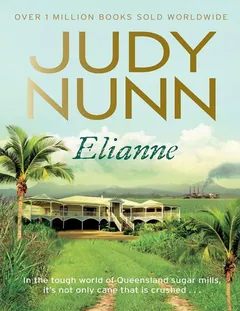
Elianne
Chapter Sixteen
Alan had opened his workshop in mid-April and by the start of the
crushing season barely two months later word had spread that this young
man knew his business. Now six months down the track the enterprise was
proving an unmitigated success, particularly as Toft Brothers had become a
regular client. Alan supplied spare parts and adaptations as required to
Tofts, specialising in steel sprockets made to order for cane harvesters.
His property in East Bundaberg appeared a bit of a shambles at first
sight. It sat just across the Kennedy Bridge, which forded a small tributary
of the Burnett River, and constituted a rather messy front yard, always
littered with machinery, beyond which was an extensive workshop with
modest living quarters above. The sign on the wire gates of the yard said in
letters big and bold, DURHAM ENGINEERING and beneath in smaller
letters Mechanical Harvesting Specialists. Alan had opted for the plural in
the belief that it sounded more impressive and in the hope that the business
would burgeon, as indeed it had. With orders pouring in it wouldn’t be long
before he’d need to employ assistant fitters and turners, although for the
moment he was enjoying working on his own.
Stan the Man detested the fact that his son had chosen to use the family
name. How dare the boy so presume! The sight aroused his anger whenever
he was in town and drove past the place, but he never confronted Alan. He
refused to speak to his son, even disappearing from the house on Sunday
afternoons when Alan visited his mother.
‘It’s so surly and childish of him,’ Hilda would complain as she and
Alan sat in the small drawing room taking afternoon tea, ‘but don’t worry, dear, he’ll get over it eventually.’
Alan would nod as if he agreed, but he did not share his mother’s
confidence.
Hilda had developed a strength of late, which had come about through
the only true confrontation she had had with her husband during their
twenty-six years of married life.
‘I have lost one son, Stanley,’ she had said defiantly when he’d tried to
forbid Alan’s visits to Elianne, ‘I am not prepared to lose another. If you
attempt to force this separation upon me I will leave you.’ Her boldness had
shocked them both, particularly Hilda, and from that day on their
relationship had undergone a subtle but distinct change. Stan had realised
that, despite the fact he’d taken his wife for granted throughout their entire
marriage, he did not dare lose her. And Hilda, in recognising her husband’s
fear, had become empowered, just a little, sometimes even enough to risk
annoying him.
‘Barbara told me at the bridge club the other day that Alan’s business is
doing remarkably well,’ she said one morning. ‘You should be proud of
him, Stanley.’
‘Don’t push me, woman,’ he growled before stomping away to his
study. Stan was sick of being told he should be proud of his son. He’d heard
the same thing again just the night before at the Burnett Club.
‘You must be proud of young Alan, Stan,’ Garnet Buss had said as
they’d shared a couple of rounds at the bar. ‘What a clever young
businessman he’s turned out to be.’
Everyone offered the same hearty congratulations, Rob Black, Stewart
Pettigrew, Carl Nielson and those others of Bundy’s elite business set who
met at the Burnett Club. ‘I’ll bet you’re proud of your boy, Stan,’ they’d
say. He knew why, of course. They’d commiserated with him over Neil for
months, every one of them, and they were now trying to give him a boost.
Well, it didn’t work. Alan’s success was no compensation for the loss of
Neil. Alan’s success and above all his use of the Durham name for his
business venture was a mockery to Neil’s memory.
Nearly one year after the death of his eldest son, Stan was still blinded
by grief, his pain as raw as ever.
Despite working long hours, often from dawn until dusk, Alan led an
active social life. He didn’t frequent the Burnett Club, respecting it as his father’s domain and wishing to avoid any possible unpleasantness, but the
Burnett Club was hardly necessary in any event. The younger male set with
whom he mingled, sons of prominent businessmen for the most part, were
members of Apex.
Apex was a club for young men aged eighteen to forty, its principal
function being to raise funds for charity and perform good works for the
community and the disadvantaged, none of which prevented its members
from having a good time. They would meet once a fortnight in the upstairs
dining room at Lewis Brothers Palais where, while discussing the club’s
latest project, they would demolish enormous steaks. As no alcohol was
permitted at an Apex meeting, they would liquor up beforehand at the
Commercial Hotel, then after the meeting and the steaks they’d adjourn to
‘The Met’ just up the road, where they’d scoff back more beers. The Apex
boys knew how to enjoy themselves.
The highlight of Alan’s social existence, however, was Saturday night,
which was always reserved exclusively for Paola. He saw her regularly
during the week, in fact nearly every day. She worked as a filing clerk in the
office of Wyper Brothers main emporium in Bourbong Street and during her
one-hour lunch break she’d bring sandwiches to his workshop. She’d make
them a pot of tea in the upstairs kitchen and sit chattering away happily
while she watched him work – he never took more than a fifteen-minute
break himself – and they would discuss what they’d do the following
Saturday. Saturday nights were precious to them both. Occasionally they’d
go out for an early dinner and then on to the pictures, but as a rule they
preferred to go dancing, sometimes as far afield as the Bargara Surf Club,
although more often than not it would be the Lewis Brothers Palais, which
was closer to home.
The Lewis Brothers Palais was above Harry Lewis’s Milk Bar in
Bourbong Street. A set of stairs led up from the milk bar, at the top of
which to the left was the dining room, famous for its steaks, where the Apex
Club met each fortnight, and to the right was the Palais, which came alive
every Saturday.
A circular bandstand sat in the centre of the dance floor, a local band
pumping out old favourites and popular songs of the day while dancers
whirled all about them, graceful or frenzied dependent upon the choice of
music. Doors led to a balcony overlooking the street where exhausted couples could take a breather now and then before returning to the fray. The
Lewis Brothers Palais was a buzzy place for Bundy’s younger set on a
Saturday night.
After the dance, Alan would drive Paola home to Elianne and they’d
share a final good-night kiss outside the Fiorellis’ cottage, Alan fighting to
control his own passion and also hers, which threatened to further enflame
him. Then he would return to town and his little flat in East Bundaberg.
At first it had seemed strange not to stay at The Big House, odd indeed
to feel like a visitor on the property that had been his childhood home. But
he’d quickly grown to enjoy his independence. He loved the poky little flat
above the workshop and the fact that the life he led was one totally of his
own choosing, unaffected by the dictates of his father. It was a strangely
double life too: only Paola knew the true contradictory nature of his
existence. His friends from the Apex Club, Anglicans to a man, had no idea
of his secret and the members of his family were most certainly unaware.
Alan had embarked upon his conversion some months previously and
was shortly to be accepted into the Catholic Church. He’d attended the
requisite series of initiation classes with the priest at the Holy Rosary
Catholic Church, he’d read his bible and catechism as instructed and had
even attended Sunday-morning Mass on a number of occasions, although
he’d been required to leave before Holy Communion as he couldn’t receive
the Eucharist until he’d been officially welcomed into the fold.
During the Mass he would sit alongside the Fiorelli clan, of which he
was already considered a member. The families would drive into town and
meet up outside the huge towering white stone edifice on the corner of
Woongarra and Barolin Streets, its grand entrance marked by six stately
Greek columns; and when they had all congregated, the brothers, their
wives and their children would march into church together, the sheer force
of their numbers a statement of their faith. Sunday Mass was of great
importance to the Fiorellis.
Alan often wondered, as they milled about outside the church in clear
view of those gathering at Christ Church just down the road, whether one or
more of his friends from Apex might spy him in the crowd. He wondered
also whether reports had got back to his family. The idea did not in the least
bother him for his family and friends were all destined to know at some
stage, but he kept awaiting comment from one quarter or another. As yet, however, there had been none. Perhaps people don’t see what they don’t
expect to see, he thought. And with his dark hair he probably looked like
one of the extended Fiorelli family anyway, a notion that he found
immensely pleasing.
The conversion exercise itself had had little effect upon Alan. He
remained a non-believer at heart, which made him feel something of a
fraud, but the importance of the Fiorelli connection could not be
underestimated. He loved Paola as deeply as it was possible to love and he
also loved her family. If being accepted into the church and following its
practises made him one of them, then so be it.
Paola knew her fiancé had not embraced the faith and from time to time
she teased him about it. ‘You’re a terrible phoney, Alan,’ she said.
‘Yes,’ he admitted, ‘I am.’
‘You don’t have to do this, you know,’ she added in all seriousness.
‘I want to,’ he said, ‘I want to do everything that pleases your family. If
they were Buddhists I’d become a monk.’
She laughed. ‘That’d make our marriage interesting,’ she said. Then she
gave a mock frown. ‘You’d better watch the blasphemy though: you’re
about to face baptism and Communion, which is a pretty daunting
prospect.’ Paola’s teasing was nothing more than a cover. She couldn’t find
the right words to express how touched she was that he should go to such
lengths for her and her family.
‘I’ll manage,’ he replied with an easy shrug. ‘And just think, by the time
we get married I’ll have been a good practising Catholic for a whole year.
That’ll impress your dad no end.’
‘Yes,’ she replied a little distractedly, ‘it will.’
Paola was shortly to turn twenty and they planned to marry the
following year after her twenty-first birthday. But Paola didn’t want to wait
another whole twelve months. In fact Paola wasn’t sure if she could.
Already she was wondering how she might go about changing the course of
events. No one was receptive to her suggestions that perhaps they could
speed up the process. Everyone including Alan himself seemed prepared to
wait until she was twenty-one. ‘I promised your father,’ Alan would say,
albeit reluctantly, and she would spend hours lying in her sleepless bed
staring into the black hole of night, pondering a course of action. She must
be bold, she knew that much.
She decided to carry out her plan on the Saturday following his baptism
and Communion, which marked his official acceptance into the Catholic
Church. The timing seemed right, although she wasn’t quite sure why.
‘Let’s go to Bargara this Saturday afternoon,’ she said lingering over the
second half of her curried egg sandwich (he’d already scoffed his down and
was back at his workbench). ‘I could make us up a picnic lunch.’
‘Sure, if that’s what you’d like – sounds good to me.’
‘Don’t come and collect me though,’ she said, ‘I’ll get the bus into
town. It’ll save time.’ Paola had Saturdays off, but Alan always worked
through until at least midday.
‘Rightio, but don’t bother packing picnic stuff, we’ll grab some fish and
chips, easier that way.’
She arrived carrying a shoulder bag stuffed with swimming togs, hat,
beach towel, after-swim robe and a miscellany of other items that from the
size of the bag appeared quite unnecessary.
‘Crikey, you’ve come prepared,’ he said. Alan had his togs on under his
shorts and a towel slung over his shoulder.
‘It’s the girl scout in me.’ She gave a disarming grin. ‘Well, no,’ she
admitted, ‘it’s probably just the girl.’
The weather was glorious, November but not yet scorching, and they
drove with the windows down as usual, the wind whipping at Paola’s hair
until with her customary deftness she tied it up in a knot.
Once at Bargara they headed directly for The Basin, where they cooled
off among the families and young children wallowing in the shallows.
‘Let’s go to the surf beach,’ she suggested as they lay side by side on the
sand soaking up the sun.
‘Why?’
‘So you can catch some waves of course – this is far too tame for you.
I’m happy to watch.’
‘Nah, can’t be bothered.’ Propping on an elbow he leant down and
kissed her. ‘Besides I don’t want to let you out of my sight.’ It was true, he
didn’t. She looked glorious in the bright red one-piece costume that set off
the silky-olive of her skin and the raven-black of her hair. ‘Anyway I’m
starving,’ he jumped to his feet, ‘come on,’ he said, offering her his hand,
‘fish and chips time.’
They bought their fish and chips wrapped up in newspaper and drove to
the surf club, where they sat on the grass and looked out at the beach. From
somewhere nearby came the sound of a transistor radio. Frank Sinatra was
building to the final crescendo of ‘My Way’.
‘This is where I fell in love with you,’ she said matter-of-factly, blowing
on a chip that, fresh from the vat was still blisteringly hot, ‘right there.’ She
waved the chip at the vast expanse of beach. ‘That very spot.’
Alan laughed at the incongruity. ‘That very spot, eh?’ he said wolfing
down a steaming mouthful of fish.
‘Absolutely, I swear it. I can still see the dent in the sand. You told me I
looked like Natalie Wood, don’t you remember?’
‘Of course I remember.’
She bit into the chip. ‘I was fifteen years old,’ she said looking down at
the engagement ring no longer kept hidden but living permanently on her
finger, ‘and I knew right then that I wanted to marry you.’
‘Me too,’ he said. ‘I felt exactly the same way.’
They kissed, tasting the salt and the oil of each other’s mouths. Nearby,
the transistor radio was no longer playing Frank Sinatra but Stevie Wonder,
who was singing, rather aptly ‘My Cherie Amour’.
After demolishing the fish and chips, they sunbaked and had another
swim, Alan catching a few waves while Paola dabbled near the shore, and
then they drove back to the flat at East Bundaberg, where she made them a
pot of tea.
‘Do you mind if I have a shower before you take me home?’ she said.
‘I’m all sandy.’
‘Of course I don’t mind.’ He fetched a fresh towel for her and sat in the
kitchen finishing his tea.
‘Oh my God,’ he said when she reappeared to stand before him fifteen
minutes later. He rose and stared at her in shock, mesmerised by the sight.
She was wearing a knee-length cream-coloured nightdress, lace-trimmed
and of the sheerest silk. With shoe-string shoulder-straps and a deep
décolletage nothing was left to the imagination and, although the fabric was
not altogether transparent, from the way it caressed her skin she was clearly
naked beneath. He remained speechless, unable to do anything but drink in
the sight of her.
‘Do you like it?’ she asked, but went on without waiting for an answer.
‘It’s a nightie, but the lady in the shop called it a chemise – it’s French. I
told her I was buying it for my trousseau and she said it was exactly the
right thing for a bride on her wedding night.’
Paola was aware she was probably talking too much, but she didn’t dare
risk a pause that might appear like uncertainty. She was not asking a
question, she was making a statement. ‘It’s time, Alan,’ she said, ‘I can’t
wait any longer,’ and she crossed to him, arms outstretched, offering
herself. He was powerless to resist.
As they made love on the little single bed with its threadbare mattress,
Alan tried to be as gentle as possible and, surprisingly enough, despite his
own mounting passion, it did not prove difficult. Looking into her eyes,
watching the wonderment unfold, feeling the response of her body after the
initial pain of penetration, he was lost in his love of her. And even more, he
was lost in her love of him. The touch and texture of her body was as
thrillingly sensual as he remembered a woman to be from his experience in
Brisbane, but this was not like the sex he’d had with the girl whose name
was long forgotten. This was not sex he and Paola were sharing at all: this
was something far greater. The willingness with which she gave herself to
him and the responsibility with which he embraced her trust was a sharing
of love, an exchange of vows.
‘We really are married now,’ she said as they lay naked, her head resting
on his chest.
‘Yes.’ Alan refused to feel guilt, at this stage anyway. He knew that
would come later, and he knew it would hit him hard, but for now he could
live only in this moment. ‘Yes, Paola, we’re married.’
He was surprised when she told him she was staying the night.
‘Of course I am,’ she said with a laugh when he queried the fact. ‘This
is my wedding night. A bride doesn’t go home on her wedding night.’
‘No I mean how have you managed it? What will your parents say?’
‘I told them I was going to a Wyper Brothers pre-Christmas staff picnic
at Bargara,’ she coolly explained. ‘Wypers always have a staff party in
November. And I told them one of my girlfriends at work suggested I stay
overnight at her flat.’
‘And they believed you?’
‘Of course. I said I’d meet them in town for Mass tomorrow morning.’
She smiled at his open incredulity. ‘My church dress and scarf and shoes are
in your wardrobe,’ she said.
‘You really did come prepared, didn’t you?’
‘Oh yes. I’ve had this planned for a fortnight.’
They ate Heinz baked beans on toast for dinner – as this was the
bachelor meal of Alan’s choice there was always a healthy supply of tins in
the kitchen cupboard. Then they made love again. This time, free of any
pain and discomfort, Paola’s response was unrestrained. She was a sensual
girl to whom sex came naturally.
They made love again in the morning, languidly, with no sense of
urgency, luxuriating in each other’s bodies. It was as if they’d been lovers
for years.
‘I like being married,’ she said.
She made them toast and a pot of tea, but as she set breakfast out on the
kitchen table before him, chattering away and glowing like a young wife
serving her husband’s first meal, guilt started to creep over Alan.
‘We’ll have to arrive at the church separately of course,’ she said,
oblivious to his concern as she poured the tea. ‘How exciting that this
morning’s your first Communion service,’ she beamed happily, ‘that’s why
I planned things the way I did. We get married and you get accepted into the
church all at the same time –’
‘But we’re not married, Paola.’ She was halted abruptly by the sternness
of his voice. ‘We’re not married and you know it. I’ve betrayed your
father’s trust. I gave him my word.’
For the first time she recognised his genuine worry. ‘Everything will be
all right,’ she assured him, keen to allay his fears, ‘Papa doesn’t need to
know. We’ll just tell him we want to marry sooner. I’ll tell him myself. I’ll
say, “Papa, I can’t wait any longer, it’s not fair you should ask me to.” He’ll
understand, I promise . . .’
Aware that he was not convinced, Paola went on to tell him a secret.
‘I’ve heard my mother and father over the years, Alan,’ she said. ‘I admit
these past few years I’ve listened. I’ve listened as hard as I could for the
noises, wanting to know what it’s like, imagining it’s you and me. They
think they make no sound, but they do, and the walls in our house are thin. I’ve heard them making love.’ She smiled knowingly. ‘Papa and Mamma
will understand, truly they will.’
‘Ah well,’ he smiled in return, not wishing to worry her, but despite her
worldly confidence he remained dubious, ‘we’ll see.’
Papa and Mamma will probably understand only too well, he thought.
Luigi will anyway, I’ll bet on it. The moment we ask permission to marry
earlier than planned, Luigi will know I’ve betrayed his trust. And what of
the other possibility, what if she’s pregnant? That hasn’t even been
mentioned. We made love three times without protection.
As he sipped his tea Alan made a mental note that first thing tomorrow
he must buy some condoms.
They arrived at the church separately to meet up with the family, kissing
each other on the cheek in greeting as they always did, and upon entering
the church they sat side by side in the pew as usual, although he was aware
that she was snuggling up to him a little closer than normal.
When he rose to take his first Holy Communion, Alfonso and the
brothers patted him on the back as he joined them in the queue, but kneeling
before the priest, Alan was barely aware of receiving the Eucharist, by now
he was so riddled with guilt.
Throughout the service he’d been unable to meet Luigi’s eyes, which he
knew were upon him and had been from the moment they’d entered the
church. He felt wretched and now that he was taking Communion doubly
so. Not only was he a liar who had broken an oath sworn to the man who’d
saved his life, he was a fraud. How dare he pose as a Catholic, what right
did he have to deceive these good people?
As young Alan Durham went through the motions, accepting the body
and blood of Christ, he didn’t know where to look or how to hide his
shame.
Luigi and Maria had recognised the signs. Maria particularly had known
in an instant and she’d nudged her husband, whispering in his ear. Alan’s
guilt had been readable from the outset, but Paola’s boldness had been the
true giveaway. Paola had met her parents’ eyes with a defiance that was
undeniable, an expression even of triumph. It was obvious to them both
who had been the true seducer.
At the conclusion of the service, when the families filed out of the
church and were heading for their respective vehicles, Paola accompanying her parents, Luigi waved Alan over.
‘You will come back to the house?’ He posed it as a question, but Alan
rightfully took it as a command.
‘Of course,’ he agreed, and he followed them to Elianne in his Holden.
When they were gathered in the Fiorellis’ kitchen, Georgio once again
discreetly absent, Luigi, Paola and Alan sat at the large wooden table while
Maria brewed the coffee.
Luigi solemnly addressed the young couple. ‘There is something you
wish to say to me?’
‘There is, Papa.’ Paola took it upon herself to answer, coming out with
her prepared response. ‘I don’t want to wait a whole year before I marry,’
she said rebelliously. ‘It’s not fair you should ask me to. Alan and I wish to
marry as soon as possible.’
‘Yes,’ Luigi’s reply was not directed to his daughter, but to his future
son-in-law, ‘I believe that you should.’ His wife nodded agreement as she
set the coffee pot on the table.
Alan couldn’t believe things had been resolved so simply. It appeared
Paola had been right: Luigi and Maria really did understand.
Stanley Durham, however, did not. How could such a situation have
come about without his knowledge, he demanded when his wife informed
him of the news. The world had gone quite mad.
‘You’ve had your head in the sand, Stanley,’ Hilda said with her
newfound confidence, ‘everyone knows Alan and Paola have been officially
engaged for some time, and with her parents’ approval.’
‘I thought that nonsense had been long forgotten.’
‘No, you just wished that it had.’ Hilda’s confidence occasionally
bordered on courage.
‘Is that right? Well how the hell are they going to get married when
she’s a bloody Mick?’ Stan growled triumphantly, ‘you tell me that!’
‘Alan has converted to Catholicism, or so he has confided to me – rather
difficult to believe, I know, but there we are.’
Stan, rendered speechless and already maddened by his wife’s
complacency, left the room.
He did not go to the wedding, which was held a month later, refusing to
set foot in the Catholic Church. But Kate did. Kate flew up from Sydney.
And she brought Frank Madigan with her.
‘Would you mind an extra house guest for a few days, Marmee?’ Her
query over the phone had been deliberately casual. ‘Frank’s a good friend
and I’ve told him so much about Elianne. I’d love him to see the place for
himself.’
‘Of course, darling,’ Hilda had replied, ‘any friend of yours is most
welcome, as you well know. And Cook will be overjoyed. With Alan now
living in town and your father at his club more often than not, she has no
one to cater to these days.’ Hilda had been most intrigued. ‘I look forward
very much to meeting your friend.’ So Kate is bringing a young man home,
she thought, surely that must mean something.
Kate had been far less circumspect when she’d telephoned Alan. ‘Mind
if I bring a friend to your wedding?’ she’d asked.
‘Someone special, I take it?’
‘Yes. Someone very, very special.’
Kate and Frank were lovers and had been for six months. They both
agreed that their affair had been a foregone conclusion ever since Planet of
the Apes and their first kiss, although in Kate’s personal opinion it had been
eminently predictable for quite some time before that.
The affair itself may indeed have been predictable, but the strength of
their love and the speed of its growth neither could possibly have
anticipated. Very early on, when Frank had voiced his concern about their
different backgrounds and the reaction their relationship would arouse in
others, Kate had been instantly dismissive. She cared nothing for public
opinion, she told him. And then she’d talked. She’d talked with a passion
that to Frank was revelatory. She’d held nothing back. And after that, nor
had he. The two had continued to share their most intimate secrets and
innermost feelings, developing a trust and understanding both knew could
weather any storm that might confront them.
Nevertheless, Frank was surprised by her suggestion he should come to
Elianne.
‘Really?’ he said as they languished in bed one Sunday morning.
Sometimes they spent the weekend at his Surry Hills terrace and sometimes
at the little house in Campbell Street; today it was Surry Hills. ‘Meet the
parents?’ He raised a deliberately comical eyebrow. ‘Already?’
‘Why not? I’d say you’re going to have to face that ordeal at some
stage, wouldn’t you?’
‘Yes.’ He kissed her lightly. ‘I would say so, most definitely.’
Marriage had not once been mentioned, nor as yet even contemplated by
either, but there was a recognition their relationship was destined to last.
‘Besides, I’d like you to see Elianne,’ she said, ‘and Alan’s wedding is
the perfect opportunity.’ She added wryly, ‘Even though Dad’s boycotting
the whole thing. Al told me he’s refused to set foot in the church. He’s
locked himself away in a world of his own and won’t even acknowledge
that the wedding’s happening. No one can get through to him. He really has
turned into the most terrible ogre.’
Frank ran his fingers lazily over her right breast. ‘If your father’s so
incensed by his son’s marriage to an Italian what on earth will he have to
say about us as a couple?’
‘Nothing,’ she replied, ‘not yet anyway. As far as my parents are
concerned you’re just a good friend. Shall I get the coffee?’ She was about
to sit up, but he stopped her.
‘Later,’ he said, ‘much later.’
She was only too willing to acquiesce. ‘There’ll be none of this at
Elianne though,’ she warned him regretfully. ‘Dad’d blow a gasket if he
found out we’d slept in the same room.’
‘Then we’d better make the most of things while we can,’ he murmured.
Frank proved an instant hit with Kate’s parents, despite, or perhaps
surprisingly because of the uncomfortable circumstances surrounding
Alan’s impending nuptials. The atmosphere that pervaded The Big House
was certainly strange. Stanley Durham refused to mention his son’s
wedding, now only two days away, and he turned sullen if anyone else did,
which meant that his wife also avoided the topic, although in fact she was
most excited by the prospect. The arrival of a stranger in their midst brought
about a whole new range of conversation that was eagerly embraced,
particularly by Hilda, who loathed any form of social awkwardness.
‘Kate tells me you have a plumbing business, Frank,’ she said as Stan
carved the roast lamb that Cook had delivered to the table and Ivy arrived
with the platter of vegetables. How splendid, Hilda thought, to feel like a
family again. ‘She says it’s in the very heart of Sydney and that it’s highly
successful.’
‘The business is in the heart of Sydney, yes,’ Frank said, ‘but I can’t
take any credit for its success I’m afraid. That I owe to my father.’
‘Who is Irish, I believe.’ Stan passed a plate of lamb to his wife.
‘That’s right.’
‘So you’re a Catholic.’
Frank registered the hint of accusation in Stanley Durham’s tone and at
the same time felt Kate’s eyes on him from across the table, but he did not
return her gaze, choosing to answer the man directly instead.
‘I must admit to being nothing in particular, Mr Durham,’ he said. ‘I
align myself to no specific religion.’
The answer went down exceedingly well with Stan who, apart from a
distinct aversion to the Roman Catholic faith, cared little for the church in
any form. ‘A man after my own heart,’ he said passing a plate of sliced
lamb to Frank, ‘too much bloodshed and strife brought about by religion –’
‘Do help yourself to vegetables, Frank,’ Hilda said before the diatribe
could begin. She pushed the platter his way and started serving herself from
the bowl of roast potatoes. ‘We don’t stand on ceremony here, dear.’
The evening progressed very smoothly after that. Upon Hilda’s enquiry
they talked about the theatre and the concerts Frank and Kate had recently
attended in Sydney, after which the two men discovered their mutual love
of rugby union football and then the conversation turned to the obsession
they shared, like most Australian males, with all forms of sport.
To Hilda, Frank Madigan presented a romantic figure with his black hair
and piercingly grey-blue eyes. Such an intriguing-looking fellow, she
thought, and impressively tall. I do hope Kate is in love with him, they
make a handsome couple.
To Stan, Frank Madigan was a man’s man. You’d never pick him for a
Southerner, Stan thought, he’s more like one of us. If this is Kate’s choice
then she’s done very well for herself. An excellent match indeed.
The following day Kate took Frank on a long walk around the estate.
Cobber plodded along behind, not attempting to match their pace, just
hoping to keep them in sight, and on the occasions when they slowed down
Ben rounded them up in his customary Cattle Dog fashion with a mock nip
to the heels, but it was habit only. At nine years of age, Ben too was less
active than he’d once been.
As they went, she gave him the full guided tour explaining the history of
Elianne, but in a way she’d never done before, so much now relating to her
personal knowledge of Ellie and Big Jim. She had told him all about the diaries and how they had so dramatically changed her life. Kate found it
extraordinarily liberating to talk so freely of her family and the past.
They finished up at the mill, standing in its eerie stillness, the toffee
smell clinging to the air, no sound from the giant machines but the metallic
clink here and there of a maintenance mechanic’s tools. Frank was in awe:
he’d never seen a sugar mill.
‘You should be here during the crushing season,’ she told him.
She introduced him to Luigi, who was working alongside the several
others.
‘You come to my daughter’s wedding tomorrow, is good,’ Luigi said,
shaking Frank’s hand enthusiastically, pleased to meet Kate’s new friend.
‘Yes, I’m very much looking forward to it: thank you for inviting me,
Mr Fiorelli –’
‘Luigi, Luigi . . .’ The Italian turned to Kate, arms outstretched in a
typically flamboyant gesture. ‘Who call me Mr Fiorelli, eh? Who call me
Mr Fiorelli?’
Frank grinned. ‘Thank you, Luigi.’
‘Yes, yes, you come, you come. After we have big party at my brother’s
home, much singing, much dancing, is big day tomorrow.’ Luigi was
excited beyond measure at the prospect of his daughter’s wedding.
The next morning, Stanley Durham stood on the front verandah,
watching the exodus. Look at them, he thought, all deserting me, the whole
bloody household, and probably every staff member and worker as well. He
had made no complaint about the fact, however, even allowing Max the use
of his Mercedes. But he’d refused to acknowledge the occasion. They might
just as well have been heading off for a picnic at Bargara. Stubborn to the
end, Stan the Man was making a statement with his silence.
Max opened the passenger door for Hilda while his wife, Maude the
cook, and young Ivy, both dressed in their Sunday best, piled into the back
seat. Frank was driving one of the mill’s Land Rovers, which he and Kate
had collected from the garage the preceding day, and he climbed into the
driver’s side, leaving Kate to linger on the verandah as he knew she wished.
‘You could still change your mind, Dad,’ she whispered in her father’s
ear.
Stan ignored her. ‘Have a pleasant time,’ he called loudly for the benefit
of all, and Kate gave up. She pecked him on the cheek. ‘See you later,’ she said and started down the steps.
Ben bounded ahead, presuming he was coming along for the ride.
‘Stay,’ she ordered, and the dog dropped, dejected but obedient. ‘Where’s
Cobber?’ The Labrador was nowhere to be seen. She looked up at her
father. ‘Where’s Cobber?’ she asked.
‘No idea,’ Stan said. ‘Go on now.’ He shooed the whole lot of them
away with an annoyed wave of his hand as if they were insects. ‘I’ll find the
dog, Kate, go on now, go on.’ And he walked off into the house.
The church was crowded not only with family and friends of the bride:
the groom’s party too was well represented, for Stanley Durham was alone
in boycotting the event. His friends did not shy from attending a Catholic
wedding. A host of Elianne employees was there alongside the Krantzes
and many business acquaintances of Stan’s who now had dealings with his
son. And the young Apex Club members were of course present in force,
led by Alan’s closest mate Charles Watford, who had accepted the role of
best man.
‘You sly bastard,’ he’d remarked when Alan had asked him, ‘you never
said a bloody word. Why didn’t you tell us?’
Alan had shrugged off the enquiry with his customary nonchalance.
‘Didn’t think it was necessary, Charlie.’
‘You were scared we’d take the mickey out of you being a Mick, I’ll bet
that was it.’
‘Yep, something like that.’
Following the wedding, the bride’s party, beribboned limousine to the
fore, led the troops to Alfonso’s home where the reception was to be held al
fresco in the rambling grounds surrounded by cane fields. The gathering
was once again eclectic, but with a flavour purely Italian.
Volare oh oh
Cantare oh oh oh oh
Cousins Lucia and Gio were the featured vocalists of the so-called
‘Fiorelli Family Band’ but whenever a favourite song was played no one
could stop the whole clan from joining in and, ‘Volare’ being a favourite,
Gio’s solo performance was rather lost in the sea of boisterous voices.
The huge backyard of Alfonso’s house was festooned with white. The
magnificent giant fig in the western corner was swathed in white streamers,
Gio having climbed to the top to fling them about with gay abandon; white satin bows hung like unripened fruit alongside the lush orange spheres of
the mango tree; the bushes and shrubs that lined the yard’s perimeter were
draped with satin ribbons, some artistically, some haphazardly, depending
upon the personality of the family member who had draped them; and in
pride of place on each of the white-clothed trestle tables set up to
accommodate a hundred guests was a massive floral decoration of
Christmas lilies. Alfonso had certainly succeeded in his determination to do
his younger brother proud.
The Fiorelli family had agreed that, given Stanley Durham’s antipathy
to the marriage, it was advisable the reception be held at Alfonso’s house
rather than Luigi’s, which was part of the Elianne estate, but the choice of
venue had proved advantageous. Popular as Luigi’s home was for family
gatherings it could never have accommodated such numbers.
The band segued on to ‘Ciao Ciao Bambina’ at Alfonso’s insistence,
Domenico Modugno being a personal favourite. Lucia sang the lyrics in
Connie Francis fashion, but she too was drowned out by the other clan
members, ‘Ciao Ciao Bambina’ being another family favourite.
The five-piece band consisting of drum kit, bass and rhythm guitars,
piano accordion and violin, was set up on the verandah. The Fiorelli cousins
were not untalented and played regularly at family functions, Alfonso often
joining in on his harmonica and his brother Enzo occasionally featuring on
the mandolin. The five younger members were in particularly fine form on
this most auspicious of occasions, having been diligently practising for
weeks.
Paola and Alan were not joining in the family sing-along. They were on
the dance floor that had been laid out on the grass beside the verandah,
swaying gently in time to the music, oblivious to anything but each other,
Paola the picture of bridal beauty in her classical lace wedding gown. Never
had she been happier and never had Alan seen her more radiant. He’d been
greatly relieved when she’d announced two weeks previously that she was
not pregnant, although she’d boldly added that she wouldn’t have cared in
the least if she were.
‘Canzone Napolitana,’ Maria called out when ‘Ciao Ciao Bambina’
came to an end. She and the other wives were mingling about with trays of
hors d’oeuvres prior to serving the main meal, while Luigi and Alfonso
stood at the drinks table refilling glasses of beer and red wine.
Alfonso’s wife Claudia took up the call. ‘Si, si,’ she cried, ‘Canzone
Napolitana.’
Young Georgio who was on the piano accordion obligingly struck up
with ‘O Sole Mio’ and the other members of the band joined in. No Italian
wedding was complete without a bracket of Neapolitan songs, certainly no
Fiorelli wedding anyway.
Several songs later, after ‘Santa Lucia’, the band took a break, the wives
and daughters disappearing into the house to fetch the food while several of
the younger men cleared the floral arrangements from the tables.
Paola automatically joined the women as they set off for the kitchen, but
her mother waved her away, telling her to mingle with her guests.
‘A bride does not serve food,’ she said.
Alan also mingled, finding himself at one stage chatting to Ivan Krantz,
who was uncharacteristically open in expressing himself.
‘Your father will come to his senses before long, Alan,’ he said. ‘Stan
can’t keep closing himself off the way he has since Neil’s death. He needs
you.’
Alan was surprised by Ivan’s show of concern, although as usual he
gave away very little himself. ‘Maybe, maybe not,’ he said, ‘I personally
doubt he needs me at all, but there’s not much I can do about it anyway.’
‘You can be there for him when he finds out he’s no longer cock of the
yard,’ Ivan said, ‘I’ve a feeling it might come as a bit of a shock.’
Alan found the remark jarring. He’d presumed the man’s concern had
been directed towards him, but he’d obviously been wrong: Ivan’s show of
sympathy had been intended for his old friend Stan Durham. His manner
and choice of expression, however, seemed unnecessarily arrogant. Ivan
Krantz has certainly changed over the past year or so, Alan thought.
‘Sure, I’ll be there for him,’ he replied with a shrug that said why should
I? If upon Ivan’s advice Stan chooses to sign the estate away to investors,
then let him, Alan thought. Elianne was Stan the Man’s to do with as he
wished. And if Stan the Man remained ignorant of the fact that he was
losing control, then that too was his choice. Any warning he’d been offered
had long gone unheeded – Stanley Durham had been living in the past for
years.
‘If my father ever decides to talk to me again, Ivan, I’ll certainly be
there for him,’ he said, ‘in the meantime . . .’ Another shrug sufficed and he wandered off to mingle elsewhere.
The women brought out the food – giant platters of meat, bowls of
steaming pastas, salads and breads, wave upon wave – the guests were
called to table and the feast began.
The speeches were as abundant as the food, and the wine also flowed
freely. Bottles and dishes were unceremoniously handed around tables,
fresh supplies fetched regularly by those members of the family elected to
keep an eye on the proceedings and the afternoon grew progressively
raucous.
Toast after toast was made from the bridal table, and following dessert
when the speeches had finally run out and the meal was drawing to an end,
the young band members leapt for the verandah to start up afresh, this time
with a tarantella.
Alan and Paola were once again first on the dance floor, others quickly
joining them and Luigi, prompted by a nudge from his wife, rose and
offered his arm to the mother of the groom.
‘You would like to dance, Mrs Durham?’ he asked.
‘Why thank you, Luigi.’
Hilda was having a splendid time. She would have preferred champagne
to red wine herself and, unaccustomed as she was to the style of food
served, she’d initially found it all a little rich. But as the day had worn on,
she’d realised that everything seemed to go very well together and that the
lack of table service at a function she’d assumed should have a formal tone
didn’t matter in the least, in fact it contributed to the freedom of the
atmosphere. Even the raucousness, of which she’d been somewhat critical
to start with, was a display of affection, she’d decided, and really quite
uplifting.
‘What a lovely reception, Luigi,’ she said as they danced. Hilda had
always loved to dance although it seemed such a long time since she’d last
stepped on to a dance floor. The Italian was light on his feet, she noted, and
led well: he was a good dancer.
‘Si si,’ Luigi happily agreed, ‘much food, much music, Italian wedding
is good.’ He glanced at the newlyweds nearby and when he looked back at
her his expression was serious. ‘I am proud that my daughter she marry
your son, Mrs Durham,’ he said. ‘Your son he is a good boy.’
‘Yes, he is.’ Hilda smiled. ‘I am proud too that my son is marrying your
daughter, Luigi. Paola is a fine young woman. And from now on as your
daughter’s mother-in-law I insist you call me Hilda.’
Luigi gave one of his irrepressible grins. ‘Very good, Hilda.’ He twirled
her under his arm and passed her along to Alan. ‘Now we swap – you dance
with your son,’ he said breaking up the couple and gathering his daughter in
his arms.
It was mid-afternoon when the newlyweds left, Paola in her pretty,
floral going-away dress waving out of the open car window as Alan drove
off, the tin cans that Charlie and the Apex boys had tied to the Holden’s rear
bumper bar rattling away noisily. Alan laughed at the racket and gave
Charlie a wave, but he would rid himself of the cans before reaching the
main road for there was a five-hour drive ahead. Not that that in the least
daunted him. Alan loved driving.
‘See you at Christmas,’ the Fiorelli cousins called after them.
Alan and Paola were off to the Gold Coast for a one-week honeymoon
at the Surfers Paradise Hotel and would return several days before
Christmas in time for the family festivities.
After the couple’s departure, many of the older guests left, including
Hilda, whom Max drove home to Elianne together with his wife Maude and
young Ivy. Ivy was most reluctant to leave. She’d danced at least a half a
dozen times with Gio Fiorelli and could have gone on all night, he was by
far the best partner she’d ever danced with, and Ivy was an excellent dancer.
He’d said he was going to the Palais on Saturday night, however, and had
suggested they meet there, a proposition which Ivy had graciously deigned
to consider, although in truth the prospect excited her no end.
Kate and Frank, who had also danced themselves into a state of near
exhaustion, made their farewells towards the end of the afternoon. The
numbers had by then halved, but the party was still in full swing, the
younger set clearly intending to go on until all hours.
They arrived home at The Big House as dusk was falling to discover
Stan the Man seated in one of the cane armchairs on the front verandah with
Ben curled up asleep at his feet. Kate was most surprised to see her father
apparently waiting for them, but she took it as a good omen.
‘Hello, Dad,’ she greeted him as she trotted up the stairs. Ben rose to
meet her at the top, tail wagging, but in a rather subdued mood. ‘We had a marvellous time –’
‘Your dog’s dead,’ he said tersely.
‘What?’ She halted before him.
‘Your dog’s dead. I shot him.’
Halfway up the stairs behind her, Frank also halted. Is this some sort of
sick joke? he wondered. Stanley Durham was a tyrant given to unreasonable
behaviour, that much was plain, but the man surely hadn’t shot his
daughter’s dog in some act of malice.
‘You shot Cobber?’
‘Yes.’
‘Why?’
‘Nothing else I could do.’ Her father’s shrug appeared careless. ‘I
looked for him as soon as you’d gone. He was down in the bushes outside
the laundry, still alive but paralysed – had to be a snake.’
‘Where is he now?’
‘On the floor in the laundry,’ Stan said. ‘I knew you’d want to examine
him.’ As she turned to go, her father reached down and grasped Ben’s collar
in order to prevent the Heeler following her.
Kate glanced at Frank as she went back down the stairs and he
accompanied her around to the rear of the house where the laundry was
situated.
She turned on the lights and they stepped inside to where Cobber lay
covered by a tarpaulin.
They both knelt and Frank watched as she lifted aside the tarpaulin and
examined the body. The dog had been neatly shot through the brain.
She inspected the snakebite wound high on the right shoulder. ‘An
Eastern Brown, I’m sure of it,’ she said. ‘Browns can be aggressive and
they hold their necks high when they strike.’ She stroked the dog tenderly.
‘Poor old Cobber,’ she murmured, ‘good old boy, I hope you didn’t suffer
too much. I’m glad Dad found you.’
Frank watched as she crooned to the animal who had been her
companion since childhood days. ‘Good old boy,’ she said continuing to
stroke him, ‘good boy Cobber.’ He could tell she was moved and waited for
the tears, intending to comfort her when they came. But they didn’t.
‘Goodbye, old friend.’ She gave the dog one final caress, replaced the
tarpaulin and rose to her feet. ‘Well, he had a fine innings,’ she said as Frank rose to stand beside her. ‘Thirteen years – you can’t complain about
that.’
‘It’s sad though,’ he said, ‘it’s very sad.’
‘Yes,’ she agreed, ‘it’s sad.’ Kate sensed he was expecting her to shed a
tear, and she could have if she’d wished, Cobber’s death was indeed
moving, but a rebellious voice inside was saying, We’re tougher than that
up here, mate, we’re Queenslanders. ‘At least I didn’t have to shoot him
myself,’ she said, ‘it’s painful when you have to kill your own dog. At least
Dad saved me that.’
‘All right, I get the message,’ Frank acceded with a smile, ‘you’re tough
and I’m a city slicker.’
She gave a light laugh acknowledging the way he’d read her mind, but
then they always seemed to know what the other was thinking. ‘Exactly,’
she said.
Kate did not know what Frank was thinking, however, when five
minutes later they joined Stan on the front verandah, where he remained
sitting in the gloom, his hand still resting on Ben’s collar.
‘Thanks, Dad.’ Kate bent down and kissed her father on the cheek.
‘Said your goodbyes?’
‘Yes.’
‘Right. I’ll have a couple of the boys bury him in the morning.’ Stan
released his hold on the dog’s collar and stood. ‘Go to bed, Ben,’ he ordered
and the Heeler obediently set off down the stairs to the kennel around the
side of the house, the kennel that would now seem so empty without his old
friend.
‘I’m going to my study,’ Stan said, ‘I’ve got work to do. Cook says
she’ll be serving up a light supper at nine.’ He patted his daughter’s arm.
‘He was a good dog, Cobber.’ Then he left the two of them alone on the
front verandah.
Throughout the exchange, Frank had observed the closeness between
father and daughter. They had not articulated their feelings to be sure, but
there’d been no need. This martinet of a man who had alienated his whole
family had waited the entire day to share his daughter’s pain over the loss of
her dog. And his daughter knew it. Surely that signifies something, Frank
thought. The strength of their bond was strong, he could sense it, far stronger than Kate had led him to believe. And perhaps, he thought,
stronger than even Kate herself knows.
After the boisterous festivities at Alfonso’s the solemn air of The Big
House was oppressive and everyone thankfully crept off for an early night
after supper, during which no mention of the wedding had been made. The
omission seemed bizarre to the entire household, both family and staff, but
all continued to tread warily in Stan’s presence.
Things were little better in the morning. Breakfast was a gloomy affair
and as if to compound the misery Ben was fretful. He’d been sniffing at the
laundry door all night and when the workers came to bury Cobber he
followed them. His pining was painful to witness.
An hour or so later, Kate borrowed her father’s Mercedes and drove
Frank to the airport. He was flying back to Sydney that day while she
stayed on at Elianne over Christmas and the New Year period as usual,
although she would far rather have been returning with him.
‘Pity about the gloom and doom,’ she said, trying to sound light-
hearted, although she found it a depressing state of affairs. ‘Not much fun
for you, I’m afraid.’
‘No need to apologise, Kate,’ he said, ‘I feel very sorry for your family.’
‘Yes, so do I.’ She dropped the light-hearted tack, which obviously
hadn’t worked. ‘Elianne used to be such a happy place, particularly for us
kids. Our childhood was so carefree. Now Dad’s bent on destroying
everything we’ve shared. It seems if he can’t be happy, then none of us
can.’
‘I believe you could change that, Kate.’ Frank decided to speak his
mind. ‘In fact I believe you’re the only person who could.’ He was aware
that he’d surprised her. ‘Your mother can’t,’ he went on, ‘and your brother
obviously can’t, but I believe that you’d be able to get through to your
father. You share a bond that might be stronger than you know.’
‘I hardly think so,’ Kate scoffed, ‘we’re at war more often than not.’
‘That’s a bond of sorts, isn’t it? Would you bother to pick an argument
with someone you didn’t respect? He respects and admires you, Kate, and
he loves you very deeply – I sensed that last night. And you did too, didn’t
you?’
Kate nodded and fell silent and Frank did not pursue the subject. There
was no further exchange until they arrived at the airport and pulled up in the car park.
‘Don’t come in to the terminal,’ he said, ‘we’ll say goodbye here.’ He
kissed her as if they were making love and she responded in kind. ‘I
wouldn’t be able to do that in there,’ he added with a smile. ‘God I’m going
to miss you.’
‘Me too,’ she said quietly.
He thought how extraordinarily vulnerable she looked, and he kissed
her again, very gently this time.
‘How do I go about it?’ she asked as they parted. ‘What do I do, Frank?
How do I get through to him?’
‘The truth mightn’t be a bad start,’ he said. He could tell she was
hanging on his every word, as if he might be able to supply the magic
answer. ‘I’m an outsider, Kate, and I’ve probably no right to offer an
opinion, but sometimes an outsider’s view can be valuable. There are so
many secrets and lies in your family. You said that your father’s locked
himself away in a world of his own. Then shock him into the real world.
Tell him the truth. Share the past with him.’
‘I don’t know if I can.’ After all this time the prospect now seemed
more daunting than ever. ‘I wouldn’t know how to begin.’
‘Take your time . . . don’t rush things. You’ll know when the moment’s
right, you’ll sense it. But tell your father the truth, Kate, tell him
everything.’ He kissed her on the cheek. ‘I’ll see you in Sydney,’ he said
and he climbed out of the car and walked off towards the terminal.
He turned to wave before disappearing through the doors. ‘Good luck,’
he called.
Kate started up the engine and drove back to Elianne.
OceanofPDF.com