
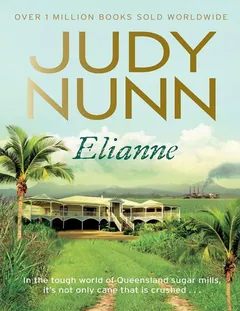
Elianne
Epilogue
1974
The early seventies ushered in many changes for Australia and its
people. After twenty-three years of Liberal–Country coalition government,
the Labor party was voted into power in 1972 under the leadership of
Edward Gough Whitlam.
Although the Vietnam War was to drag on for a further two years, the
last Australian troops were finally withdrawn and the country’s
participation in the conflict formally declared at an end with the delivery of
the Governor General’s proclamation on 11 January 1973.
The Whitlam Labor government announced an official end to the White
Australia Policy, proclaiming its intention to eradicate racial discrimination.
It appeared, without doubt, that Australia was a country on the move.
As if in a bid to keep pace with the rapid changes of the new decade, the
sugar industry continued to capitalise on the technological breakthroughs of
the sixties and production kept rising. Australia was a major sugar-
producing country and had for some time been a respected world authority
on cane-harvesting mechanisation. The central focus of this latest
technology was the heart of the Queensland southern cane-fields region
itself, Bundaberg. Bundy had become famous. And in the thick of it all was
Alan Durham.
Alan’s prescience had paid off. His company had expanded
dramatically, business was booming: he was a wealthy young man. But the
fulfilment of his private life far exceeded that of his commercial interests,
for Paola had recently given birth to their second child, a baby girl whom they’d named Sophia after Luigi’s mother. The birth of little Sophia had
brought joy to everyone, not least of all the child’s paternal grandmother.
Hilda Durham had embraced grandparenthood with a passion.
Christmas 1974 was looming and Hilda couldn’t have been happier. In
fact she felt she’d never been quite this happy. Christmas was now the true
family occasion that in her opinion it should always have been. She recalled
the Christmases of old when Elianne’s senior staff and families had been
entertained in the formal dining room of The Big House, elaborate affairs,
impressive certainly, but stilted and with far too many speeches. Then
there’d been those several years following Neil’s death, those terrible years
when Christmas had ceased to exist. She didn’t think about those years any
more: she’d put them behind her; these were happy times. She adored being
a grandmother and Christmas in the new house, so ideally suited to family
gatherings, was the highlight of her year.
The home that Hilda and Stan now shared wasn’t really new at all.
Situated not far from the site of old Elianne House, it was a gracious
Queenslander in true classic style and had been home to one of the estate’s
senior staff members in bygone days. Hilda actually preferred it to The Big
House. She’d said as much to Stan.
‘I did find The Big House just the tiniest bit ostentatious, dear, I must
admit. We really didn’t need that amount of space.’ Her intention had of
course been to ease her husband’s mind about the change in their lifestyle,
but she’d been nonetheless honest. She found her new home pleasantly
reminiscent of old Elianne House, stylish but at the same time warm and
welcoming, an elegant home and as such a constant reminder of
Grandmother Ellie herself.
Grandmother Ellie still featured a great deal in Hilda’s conversation,
although Big Jim had become notably absent. ‘Sacrifice’ rather than ‘great
love’ was Hilda’s theme these days. Indeed Grandmother Ellie’s strength
and devotion to family throughout her entire life had become the stuff of
legend. Grandmother Ellie had been a true matriarch, and Hilda’s only wish
was that she herself might one day prove worthy of such a title, which was
why Christmas was so very important.
This Christmas promised to be particularly fulfilling with a new
grandchild present. Alan and Paola would of course be bringing little
Sophia, barely a month old, along with their son, Ricky, just turned four. Luigi and Maria would be there too, and Paola’s brother, Georgio,
accompanied by his new young fiancée, who was most welcome, as Cook
always said ‘the more the merrier’.
Hilda knew that following the luncheon the Fiorellis, together with Alan
and his family, would join the rest of the clan at Alfonso’s house for their
customary raucous get-together, but she didn’t mind in the least. On the
contrary, she very much approved. Family was family after all, and it was
good for the grandchildren to experience both cultures. Why little Ricky
could already speak Italian, just imagine that. Hilda found it a tremendously
exciting sign of the times.
And Kate, too, would be home for Christmas, with Frank. Hilda did so
wish that Kate would have a baby. She’d be twenty-eight years old in only a
month or so and had been married for two whole years – surely time was
running out. But Kate had declared that career took precedence until she
was thirty. She’d even announced, and with Frank’s approval, that after
having had children she would continue to work! Hilda wasn’t sure she
understood the modern woman. According to recent press reports, Kate was
of significant importance to the country.
The youngest member ever appointed by the Australian
Government to the Advisory Committee on Livestock Breeding,
Control and Distribution, Dr Kate Durham also heads a private
consultancy firm advising the Australian Quarantine Inspection
Service, the CSIRO and the Australian Livestock Breeders
Association. Dr Durham is clearly a young woman of significant
importance to this country.
Hilda was proud of her daughter’s achievements certainly, but when it
came time in a young woman’s life to embrace motherhood, surely men
could take over those jobs of significant importance to the country.
She naturally did not express such views to her daughter, who she knew
would simply scoff and call her old-fashioned. And she had to admit, after
all, that Kate’s contacts in high places had certainly proved beneficial for
the family.
Hilda could barely contain her excitement at the thought that Kate and
Frank were bringing with them a new member of the family. The three were
due to arrive on the afternoon of Christmas Eve and she and Alan would be eagerly waiting to greet them. They’d kept the news from Stanley though.
They’d both agreed with Kate that it should come as a surprise.
When Kate had made general enquiries about bringing her brother’s
widow to Australia, she’d confronted more difficulty than she’d anticipated,
a fact which she’d found most disappointing. For all Whitlam’s declaration
of ‘no more White Australia Policy’, it appeared the government was not as
keen as it had professed to be in welcoming the Vietnamese to Australia,
even those married to Australian citizens. There still seemed to be a guard
up against Asian immigration including, at this stage anyway, those of
refugee status.
Annoyed at the bureaucratic red tape confronting her, she’d
unashamedly used her government contacts, and in doing so had discovered
that she couldn’t bring Yen to Australia anyway. Yen was dead, along with
most of her family, killed two years previously in a Viet Cong raid upon her
village. But Yen’s child had survived, a boy now five, the son Neil never
knew he had. Yen had been in the early stages of pregnancy when her
husband had died.
The boy had been brought up by Yen’s aunt, a widow who, living some
distance from the village, had escaped the massacre. The widow was poor
and illiterate, but had received assistance from a Catholic priest who was a
close friend of the family. The priest had arranged with the bank in Vûng
Tàu for her to draw funds from the monthly deposits that arrived from
Australia in order that she might adequately support her dead niece’s child.
He had also taken it upon himself to continue the boy’s education, teaching
him English, as Yen herself had been doing. It had been Yen’s greatest wish
that she and the child might one day go to Australia and meet her husband’s
family. She had wanted her son prepared for that day.
The Catholic Church in Vûng Tàu had proved of great assistance in
Kate’s application to bring the child to Australia. The priest, only too eager
to see the boy afforded a better life, had produced all the necessary
documentation, marriage and birth certificates, records of the child’s
baptism – there was every proof to hand that this was the legitimate son of
Neil Durham.
Kate had nonetheless encountered bureaucratic obstacles on the home
front. She was told she must bide her time, she was fobbed off, but she’d
refused to be daunted. Using her stellar status, she’d gone directly to federal level. A favour asked had been granted and she’d succeeded in her aim. She
had brought her nephew to Australia and the legal adoption process was
currently under way. She and Frank were about to become parents well
before they’d planned, and were now bringing the child home to meet his
new family.
They drove up from Sydney in Frank’s Land Rover, staying overnight in
Ballina, showing the boy the countryside, watching him relax more and
more with the passing of each hour. He’d been understandably guarded
when they’d first met, trying very hard Kate could tell to disguise the fact
that he was frightened. She could see so much of her brother in the child
and she’d desperately wanted to hug him, to feel Neil’s flesh and blood in
her arms. But hugs would come later, she’d told herself, and she’d offered
her hand instead.
‘Hello, I’m your Aunt Kate,’ she’d said.
‘Hello.’ He was a good-looking boy, tall for his age, and he’d shaken
hands very solemnly, doing his best to be grown up. But after a second or
so, his eyes had flickered nervously to the ground, avoiding further contact.
Now, after only several days of their acquaintanceship, he was
becoming simply an excited little boy enjoying new sights and the company
of people he liked. He particularly liked Frank. Frank’s laidback personality
and man-to-man attitude made him a winner with little boys, who wanted to
be just like him. It was happily apparent to Kate, although no surprise, that
Frank was a born father.
The trip north served to bring them closer together, all three, and as they
turned off the Bundaberg–Gin Gin Road onto the dirt road of Elianne, they
felt to Kate already like a family.
She looked out at the passing cane fields and the giant mill in the
distance, recalling how, just ten years earlier, when she’d returned after her
first year at university, everything, familiar as it was, had appeared on the
cusp of change. She’d presumed this was because she herself was changing.
She’d been wrong, she now realised. Elianne had been changing. But she
hadn’t known then to what an astonishing degree; the canecutters a dying
breed mechanical harvesters replacing them; fewer people living on the
estate, most commuting instead from Bundaberg; merchants closing up
shop and moving from Elianne’s village into town; the changes had been
endless. Yet now, as they passed by the mill and the mill dam and the sugar shed, and then on past the stables and the old hall and the once-busy village
green, everything appeared as it had in her childhood. It seemed as if
nothing at all had changed.
Frank sensed her reflective mood. ‘Good to be home, I take it?’
She smiled. ‘This is no longer home, my darling,’ she replied. ‘Home is
with you, home is wherever we are, you and I.’ She turned to look behind
her at the boy who was leaning out the open window drinking in the sights
and the smells. ‘But yes,’ she said, ‘yes, it’s good to be back.’
They pulled up outside the family home in the late afternoon glow.
Hilda, Stan and Alan were gathered in the sitting room, Cook having
just delivered a fresh batch of scones to go with the afternoon tea she’d
served. Cook and Max had remained in Stan’s employ, but the household
was without a maid these days since Ivy had left to get married.
There was only the one sitting room at Durham House, big and airy with
shuttered windows looking out over the front verandah. The main door and
the shutters were now open wide, giving access to what little breeze there
was – the day had been stifling – and Stan heard the four-wheel drive pull
up outside.
‘They’re here,’ he said, rising from the throne-like chair that even at
first glance clearly belonged to the patriarch of the house. ‘Let’s go out and
meet them.’ He always bellowed a greeting from the front verandah: it was
his habit.
‘No, no, dear,’ Hilda insisted, ‘sit down, please do, we have a little
surprise in store.’
As she crossed to the door, she cast a quick glance at her son, a mixture
of nervousness and excitement. Alan stood, returning an encouraging smile,
while Stan, intrigued, seated himself back in his armchair and waited for his
surprise.
‘Come in, my darling, come in.’ Hilda embraced her daughter warmly,
and offered Frank her cheek, which he kissed. ‘Hello, Frank dear, how
lovely to see you.’ Then she stepped back, fingers lightly to breast in
breathless anticipation. ‘Well, well, who do we have here?’ she said and she
looked down at the little boy who was clutching Kate’s hand as if it was a
lifeline.
They all looked at the boy, whose guard was instantly up, his eyes
flickering around at the strange faces and then down at the floor.
Kate gave his hand a quick squeeze. ‘Don’t worry,’ she whispered, ‘they
won’t bite.’
Stan stared long and hard at the child. He was obviously Asian, or some
sort of half-breed, but he seemed oddly familiar. There was something
about him: what the hell was it? Stan was puzzled. Why had Kate brought a
Chink home, and why did the boy remind him so strongly of someone?
There was silence while they all waited for Kate to make the
introduction. As they had expected, she did so directly to her father.
‘Dad, there’s a special person I’d like you to meet.’ Hand in hand she
and the boy crossed to Stan’s armchair, where they halted in front of him.
‘This is Neil Durham,’ she said.
Stan’s eyes left the boy and he glared up at his daughter. What sort of
sick joke was she playing at?
‘Neil was married. His wife, Yen, died in the war,’ Kate went on. ‘She
named her son after her husband. This is Neil’s boy, Dad. This is your
grandson.’
Stan’s eyes returned to the boy, and he knew that this was no joke at all.
The resemblance was uncanny. He was looking at an Asian version of his
son. For one of the few times in his life, Stanley Durham found himself
utterly dumbstruck.
‘Hello, Neil,’ he said finally.
The boy’s eyes flickered up from the floor. ‘Hello,’ he replied. Normally
his gaze would have returned to the floor, but something in the eyes of the
big man in the big chair compelled him to retain focus just that little bit
longer.
Introductions were then made all around, after which Hilda fetched
some lemonade for Neil. He sat on the edge of his chair sipping his drink
and refusing a scone with jam and cream, mainly because he was sure he’d
drop it. The others talked among themselves, trying not to place any
pressure on the child, for he was obviously nervous.
Frank noticed, after a while, that the boy’s eyes kept darting towards the
open door where Ben lay curled up on the verandah.
‘Do you want to go outside and say hello to Ben?’ he asked.
Neil looked at him, confused.
‘Ben, that’s the dog’s name, Ben. Do you want to go outside and pat
him?’
The boy nodded.
‘Why don’t we all go outside?’ The suggestion came from Stan. He
stood. ‘It’s cooler now, let’s sit on the verandah.’
They trooped outside to where a miscellany of chairs constituted the
verandah furniture and Neil knelt beside Ben, patting the old dog, who
responded with a thump of his now threadbare tail.
Stan chose to sit in one of the canvas deck chairs, which was surprising
for, like Hilda, his preference was always a hardback at the table. The
particular deck chair he chose, however, happened to be the one closest to
the dog.
‘We’re going to get Neil a dog, Dad,’ Kate said as telling looks were
exchanged. Stan’s eyes hadn’t left his grandson.
‘That’s good,’ Stan replied, ‘a boy needs a dog.’
‘He is old this dog.’ The child’s English was good, but stilted.
‘Yep,’ Stan said. ‘He’s fourteen now. That’s old for a dog.’
Neil looked up and gave a solemn nod. ‘Yes,’ he agreed, ‘it is old,’ and
he returned his attention to the dog.
Conversation dwindled away and they sat, relaxed and comfortable,
watching the child and the dog. Then after a little while, Stan stood.
‘I need some exercise,’ he said.
The child looked up once again, sensing the comment had been made to
him.
It had been. ‘Ever seen the inside of a sugar mill, son?’
Neil shook his head.
‘Do you want to?’
The boy gave a vigorous nod.
‘Come on, then.’ Stan reached out his hand and the boy stood and took
it. ‘We’ll go for a walk.’
The two set off down the stairs.
As they reached the bottom, Kate rose from her chair and called after
them. ‘You’ll have to take the car, Dad – it’s too far for him to walk.’
‘What’s wrong with a piggy-back,’ Stan called in reply and he swung
the boy up onto his shoulders.
Neil squealed excitedly. ‘Ben can come too?’
‘Sure, why not, if he can make the distance. Come on, Ben.’
The dog obediently hobbled down the stairs. He would go a hundred
metres or so before turning back for home.
Kate’s image of Stan the Man striding off towards the mill, his grandson
on his shoulders, a boy from Vietnam, would stay with her forever. How
times had indeed changed.
OceanofPDF.com
Vous avez terminé Elianne
Judy Nunn
Des livres comme celui-ci
-
 Dans l'ombre de la reine
-
 La Rose de porcelaine
-
 La Porte du non-retour
-
 La Revanche de l'Amour
-
 Sans moi
-
 Pétronille
Après le livre
Pages fournies avec cette édition, gardées ici pour référence.