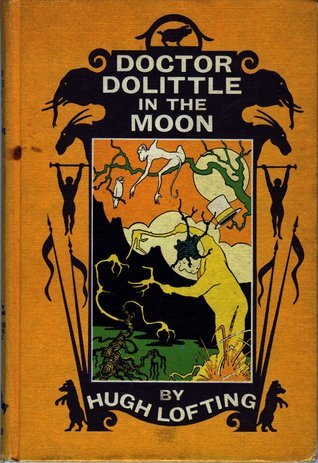
Doctor Dolittle in the Moon
Doctor Dolittle in the Moon came out in 1928 and is the most science-fictional book in the series. The doctor, Tommy Stubbins, Polynesia, Chee-Chee, and Jip the dog all set out for the Moon at the invitation of the Lunar Moth that appeared at the end of Doctor Dolittle’s Garden. They travel on the moth’s back, breathing through giant lunar lily blossoms.
On the Moon they find a complex ecology of intelligent plants, enormous insects, and a single human inhabitant called the Man in the Moon, an ancient survivor whom the lunar plants have nursed into something like immortality. The doctor does what the doctor always does: he learns the local language, in this case the language of plants, and tries to understand the social organization of the place from the inside. The book is shorter than some of the others and ends on an unusual cliffhanger that points forward to Doctor Dolittle’s Return. As a piece of 1928 children’s science fiction it is unexpectedly thoughtful, more about ecology and ethics than rocket travel.
About the Author
Hugh John Lofting was born in 1886 in Maidenhead, England, and trained as a civil engineer at MIT and the London Polytechnic. He worked on railway and mining projects in West Africa, Cuba, and Canada before settling into a quieter life in the United States,…
See all books by Hugh Lofting →

Listen to Doctor Dolittle in the Moon Audiobook Free
Listen to Doctor Dolittle in the Moon by Hugh Lofting free online. The full audiobook (4 hr 31 min, 12 chapters, read by Shelly Weingart) streams free on this page.
Doctor Dolittle in the Moon (1928) is a public domain work.
| # | Chapter | Length | |
|---|---|---|---|
| 1 | Ch 1, We Land Upon a New World, & Ch 2, The Land of Colors and Perfumes. | 19:32 | |
| 2 | Ch 3, Thirst! & Ch 4, Chee-chee the Hero | 18:59 | |
| 3 | Ch 5, On the Plateau & Ch 6, The Moon Lake | 19:14 | |
| 4 | Ch 7, Tracks of a Giant & Ch 8, The Singing Trees | 18:41 | |
| 5 | Ch 9, The Study of Plant Languages & Ch 10, The Magellan of the Moon | 16:00 | |
| 6 | Ch 11, We Prepare to Circle the Moon & Ch 12, The Vanity Lilies | 17:25 | |
| 7 | Ch 13, The Flower of Many Scents & Ch 14, Mirrors for Flowers | 19:44 | |
| 8 | Ch 15, Making New Clothes & Ch 16, Monkey Memories of the Moon | 21:50 | |
| 9 | Ch 17, We Hear of "the Council" & Ch 18, The President | 23:22 | |
| 10 | Ch 19, The Moon Man & Ch 20, The Doctor and the Giant | 25:11 | |
| 11 | Ch 21, How Otho Buldge Came to the Moon & Ch 22, How the Moon Folk Heard of Dr. Dolittle | 24:59 | |
| 12 | Ch 23, The Man Who Made Himself a King, Ch 24, Dr. Dolittle Opens His Surgery on the Moon, & Ch 25, Puddleby Once More | 46:24 |
Prefer reading? Read Doctor Dolittle in the Moon online free or download the PDF and EPUB above.