
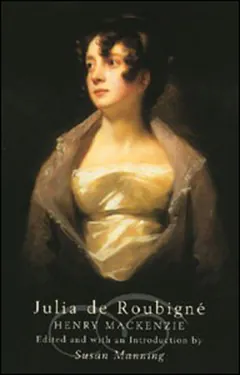
Julia de Roubigné
Pages
This chapter is long, so it is split into 6 parts.
Corredlions.
Page 22. Ime 3. for coiUy, read coli/ly.
15. for ^fiow, read J^Mrw. 15. for a^ejor, read aggreffor*
11, for fanting, read poured, 12 and Trifor^^/ir/^ rca^yOrtfr/. 11 •
for ddhoir^iunfitlythim^ read,
12. for^cw, rcad/flw/. 18. for dijpiafivii read diffuafi^ou.
7« fox iayU^ read iajlecA,
3^
57-70.
73-114.
125.
160.
167.
0/ 12 \^-9?6
^'Vfo^S-'
INTRODUCTION.
T Have formerly taken the liberty of holding fome prefatory difcourfe with my readers, on the fubjedl of thofe little hiftories, which accident had enabled me to lay before them. This is probably the laft time 1 fhall make ufe of their indulgence ; and even, if this Introdiiftioa ihould be found fupcrfluous, it may claim their pardon, as the parting addrefs of one, who has endeavoured to contribute to their entertainment..
I was favoured laft fummer with a vifit from a gentleman, a native of France, with whofe father I had been intimately acquainted when I was laft in that coun^ try. I confcfs myfelf particularly de-A 3 lighted
lighted with an intercourie, which removes the barrier of national diftinftion, and gives to the inhabitants of the world the appearance of one common family. I received, therefore, this your>g f^Fench-man into that humble flied, which »EHrovi-dence has allowed my age to reft in, with peculiar fatisfaAion, and was rewarded, for any little attention I had in my power to (hew him, by acquiring the friendfhip of one, whom I found to inherit all that paternal worth, which had fixed my cf« teem, about a dozen years ago, in Paris. In truth, fuch attention always rewards itfelf; and, I believe, my own feelings; which 1 expreffed to this amiable and ac-compliflied Frenchman on his leaving England, are fuch as every one will own,
M'hofe mind is fufceptible of feeling at all. He was profufe of thanks, to which my
good
good-offices had no titles but from die ia* clination that accompanied them.—/rt, Monfteur^ (laid 1, for he had ufed ahin*
guage more accommodated than ours to the lefler erderof fentiments, and I an-{wered him, as well as long want of prac« tice would allow me, in the fame tongue) —ia, Monfietir^ $bfcur 6f inconnuy avec
heaucoup de bienveillance^maispeude pouvoir^ *> ne goute point d^un plaifir plus fmcere^ que de penfer^ qtCil y a^ dans aucun quartier du monde^ une ame honnete^ qui fe fouvient de moi avec reconnoijfance.
But I am talking of myfelf, when I {bould be giving an account of the foU lowing papers. This gentleman,' dif-courfing with me on the fubjeft of thofc letters, the fubftancc of which I formerly pubJiihcd under the title of The Man of
the
• » •
Vlll INTRODUCTIOPT.
the Worlds obfervcd, that if the defire of fearching into the records of private life were common, the difcovery of fuch col-ledions would ceafe to be wondered at. «^ We look (faid he), for the Hlftories of Men, among thoTe of high rank; but memoirs of fentiment, and fuffering, may^ be found in every condition*
" My father, continued my young friend, made, fince you faw him, an ac-quifition of that nature, by a whimfical accident* Standing, one day at the door of a grocery (hop, making enquiry as to the lodgings of fome perfon of his acquaintance, a little boy pafled him, with a bundle of papers in his hand, which he offered for fale to the matter
of the (hop, for the ordinary ufes of his trade; but they diifcred about the price, and the boy' I was-was ready to depart^ when my father de^^ filed a fight of the papers, faying to the lad 9 with a fmilet that, perhaps, he night deal with him for his book; upon reading a fentence or two, he found a ftylc much above that of the ordinary manuscripts of a grocery-fliop, and gave the hoy his price, at a venture, for the whole. When he had got home, and examined the parcel^ he difcovered it to confift of letters put up, for the moft part, according to their dates, which he committed to me, as having, he faid, better eyes, and a keener curiolity, than his. I found them to contain a dory in detail, which, 1 believe, would intereft one of your turn of thinking a good dcal.^ If you choofe to undergo the trouble of-the perufal, I ihall take care to have them fcnt over to you by the firft opportunity I can find, A 5 and
and If you will do the Public the favour to digeft them, as you did thofe of ^i^ and his children'^—rNfy youhg Frepch^ man fpeaksthe language of compliniifnt^ but I do not choofe to cvanfiace any fur«
thcr. It is enough ^ta fey, that I receiYe4 his papers feme time. ago> and that they are thofe which I have tcanflated, and now give to the world. I had perhaps treated them as I did the letters he men*
tioned; but I found it a difiituktaik t^ red,uce them into narrative, bccaufe thejp are made up of fentiment, which narr»-tive would dcftroy. The only power I have exercifed over them, is that of omitting letters, and paflages of letters, which fecm to bear*nb relation- to tlie ftory I mean to communicate. In doing this,, however, I confefs I have been cautious: I love myfclf (and am apt therefore*
fronnii
from a common fort of weaknefs, to imagine that other people Jove) to read nature in her fmalleft charader, and am often more apprifed of theftate of the mind, from very triHing, than from very impor-tant circumftances.
As, from age and fituation, it is likely I fcall addrefs the Public no more, I cannot avoid taking this opportunity, of Aanking it for the reception it has given, to thofe tumble pages which I formerly introduced to its notice. Unknown, and unpatronized, I had little prctcnfion to its favour, and little expeftation of itj writing, or arranging the writings of others, was, to me, only a favourite amufement, for which a man eafily finds both time and apology. One advantage I drew from it, which the humane may hear with fatisfadion i I often wandered
from -
XXI . I.N T R O D U C T I O N.
fvQm my own woes in tracing the tale of another's affli£):ion» and, at this nio€iient» every feni:cnce I write^ I am but efcaping a little*farther from the preflureof ibrrowsi
• •. • r
Of thevfif^erit or faults of the'compo-fition, in the volumes of whiph I havedi-refted thif*puH|ication, a fmall Iharc only was mine^ i^r thdr tendphdy I hold my-felf entirely aicourtlable'r becaufe, had it bfeen a bad One, lyad the power of fup» prefling them •, and from their tendency, I believe, more than any other quality belonging to them, has the indulgence of their readers arifen. For that indulgence I defire to return them my gratefal ac- . knowledgments as an editor;
"I (hall ' be proud with better reifohi if thpre is nothing to be found,
\n m^ pUbRdLtipnSi that may forfeit their efteenfi B a- m»i% •
'/
JULIA DE RpUBIGNE,
TALE.
IN A SERIES OF LETTERS.
LETTER I.
Julia de Rouhigni to Maria de RonciUes.
*• f I ^ H E friendlhip of your Marian JL misfortune can never depriveyou of.*'—Thcfc were the words with which you fealed that attachment we had formed in the blifsful period of infancy. The remembrance of thofe peaceful days we paflfed together in the convent, is often recalled to my mlAd, amidft the cares of Vol. L B the a JULIA DE ROUBIGNE'.
the prefent. Yet do not think me fooli(h enough to complain of the want of thofe pleafures which affluence gave us i the fituation of my^
father's affairs is fuch as to exclude luxury, but it allows happi-nefs; and, were it not for the recoUeftion of what he once pofTeffed, which now and then intrudes itfelf upon him, he could fcarce form a wifh that were not gratified in the retreat he has found.
You were wont to call me the little phi-lofopher % if it be philofophy to feel no violent diftrefs from that change which the ill-fortune of our family has made in its circumftances, I do not claim much merit from being that way a philofopher. From my earlieft days I found myfelf unambitious of wealth or grandeur, contented with the enjoyment of fequeftered
life, and fearful of the dangers which at-f^d an exalted Nation. It b therefor6 mort properly a weakncfs, than a virtue, in tifie^ to be fatisfied with my prefent fituation.
But^ aftet- all, my friend, what is it we have loft ? We have exchanged the life of gaiety, of tumults, of pleafurc they call it, which we led in Paris, when
r
my father was a rich man; for the purS, the peaceful, the truly happy fcenes, which this place affords us, now he is isi poor one.
Dependence and poverty alone
are fufFercd tocomplain ; but they knoVr
•
not how ofteiii greatnefs is dependent, and wealth is poor. Formerly, even during the very (hort fpace of the year we wem at BelvillCy it was vain to think of that
B 2 domeftia
V
domcftic enjoyment I ufed to hope for in the country •, we were people of too much confequence to be allowed the privilege of retirement, and except thofe luxurious walks I fometimes foUnd means to take—-with you, my dear, I mean—the day was as little my own, as iii the midft of our winter-hurry in town.
The lofs of this momentous law fuit has brought us down to the level of tranquillity. Our days are not now pre-oc-cupled by nuraberlefs engagements, nor our time anxioufly divided for a rotation ,of amufements; I can walk, read, or thdnk, without the officious interru|i|foii of polite vifitors.5 and, inftcad of taUiing^ eternally of others, I find time to fettle Recounts with tnyfelf.
Could
Could we but prevail on my father to think thus ! -— Alas! his mind is not
*
formed for contrafting into that narrow fphere, which his fortune has now marked out for him. He feels adverfity a de-feat, to which the vanquiQied fubmit, with pride in their looks, but anguidi in their hearts. He is cut off from the enjoyment of his prefcnt ftate, while he puts himfelf under the cruel neceflity of diffembling his regret for the lofs of the
r
former,
I can eafily perceive how much my
deareft mother is affedled by this. I fee her conftantly on the watch for every word and look that may difcover his feelings ; and (he has, too often, occafion to obfcrve them unfavourable. Slie en-V
B 3 deavours^
$ JULIA DE ROUBIGNe'.
deavourS} and commonly fucceeds in her endeavour, to put on the appearance of cheerfulnefs 5 Ihe even tries to ptrfuade herfelf that (he has reafon to be concent'
ed; but, alas! an effort to be happy, is always but an increafe of our uneafinefs.
/.nd what is left for your Julia to do i
In truth, I fear, I am of little fervice. My heart is too much interefled in the fcene, to allow me that command over myfelf, which would make me ufeful.' My father often remarks, that 1 look grave 5 I fmile (fooliflily I fear), and deny it; it is> I believe, no more than I ufcd to do formerly; but we were then in a fituation that did not lead him to obfcrvc it. He had no confcioufnefs in himfelf, to prompt the obfervation.
How
How often do I wilh for you, Maria, to affift mc ! There is fomething in that fmile of yours (I paint it to myfclf at this inftant) which care and forrow are unable to withftand; befides the general cfFc6t produced by the intervention of a third perfon, in a fociety, the members of which are afraid to think of one anther's thoughts.—Yet you need not an-fwer this wlQi of mine •, I know how im-poflible it is for you to come hither at prefent. Write to me as often as you can 5
you will not expeft order Jn my letters, nor obferve it in your anfwers; I will fpeak to you on paper when my heart is full, and you will anfwer me from the fympathy of yours.
B4
LETTER II.
Julia to Maria.
T AM to vex my Maria with an account of trifles, and thofc too un'pleafant ones; but fhe has taught me to think, that nothing is infignificant to her, in which I am concerned, and infifts on participating, at leaft, if fhe cannot alleviate^ iiny diftrefles.
I am every day more and more un-^ tafy about the chagrin which our (itua-tion fecms to give my father. A little incident has jull now plunged him into a fit of melancholy, which all the attention of my mother, all the attempts at gaiety
which
which your poor Julia is conftrained to make, cannot diilipate or overcome*
Our old fcrvant Le Blanc is your acquaintance ; indeed he very foon becomes acquainted with every friend and vifitor of the family, his age prompting him to talk, and giving him the privilege of talking.
Le Blanc had obtained permiflion, a few days iince, to go on a vifit to his daughter, who is married to a young fellow, fcrving in the capacity of coachman at a gentleman's in the neighbourhood of Belvilie. He returned laft night, and, in his ufual familiar manner, gave us an account of his expedition this morni-ing.
B5. My
10 JULIA J>t ROVBIGHe\
My father enquired after his daughter z he gave fome fiiort anfwer as to her; but
«
I faw by his face that he was full of fome other intelligence. He was Handing behind my father, refting one band on the back of his chair; he began to rub it vio lently, as if he would have given the wood a poKlh by the friftbn, " I was at Bel-ville. Sir," faid he. My father made no reply; but L.e Blanc had got over the ijifficuky of beginning, and was too much
occupied by the idea of th« fcene^ to forbear attempting the pifturc.
•' When I ftruck off the high road, faid he, to go down by the Old Avenue^ Itfhought I had loft my way ; there was not a tree to be feen.
You may believe' me as you pleafe, Sir; but, I declare, I faw the rooks, that ufed to build there,
N
JULIA as ]IQU9IGNB^ IX
in a great flock over my head, croaking for all the world as if they had been looking for the Avenue too. Old Lafune's houfe, where you, Mi6, (turning to me) would frequently ftop in your walks, was pulk ed down, except a fingle beam at one end, which now ierves for a rubbing-poft to fome cattle that graze there; and your foan. horfe.
Sir, which the marquis had of you in a prefent, when he purchafed Belville, has been turned out to grafs among the reft, it feems; for there be was, fbanding under the fliade of the wall; and when I came up, the poor beaft knew me, as any chriftian would, and came neighing up to my fide as he was wont to do, I gave him a piece of bread I had put in my pocket in the morning, and he followed me for more, till I reach*
B 6 «d
cd the very gate of the houfe 5 I mean vrhat was the gate, when I knew it ^ for there is now a rail run acrofs^ with a fmall door, which
Le Sauvre told me the7 call Chinefe. But» after alU the marquis is feldom there to enjoy thofe fine things ; he lives in town, 1-e Sauvre fays, eleven months in the year, and only comes down to Belville, for a few weeks, to^ get mo»^ qcy to fpend in Paris.'*
Here Le Blanc paufed in his narration. I was afraid to look up to fee its effeft on my father ^ indeed the pifture which the poor fellow had, innocently, drawn, had too much afFefted myfelf. — Lafune's houfe !
— My Maria remembers it 5 but (he knows not all the ties which its rccoi-Icftion has upon me.
Iftole
I ftole however a fide-long glance at my father. He feemed affected, but dif-daio was mixed with his tendernefs; he gathered up his features, as it were, to hide the efifeft of the recital. " You faw Le SauVre then ?** faid he coolly, — •* Yes,** anfwered Le Blanc •, **
but he \» wonderfully altered fince he was in your fcrvice. Sir •, when 1 fifft difcovered hinn he was in the garden, picking feme greens for his dinneri he looked fo rueful when he lifted up his head and faw me! indeed I was little better myfelf, when I caft my eyes around. It was a fad fight to fee! for the marquis keeps no gardener, «ex-cept Le Sauvre himfclf, who has fifty things to do befides, and only hires another hand or two, for the time he refides at Belville in the fummer. The walks that ufed to be trimmed fo nicely, are covered
covered with mok-hiUs; the hedges are full of great holes, and Le Sauvre^s chickens were baflcing in the flawer-l?eds. He took me into the houfe, and his wife feemed glad to fee her old acquaintance^ and the children clambered up to kifs me, and Jeanot afked me about his godmother, meaning you, Madam, and his little fitter enquired after her handfome miftrefs, as ftie ufed to call you, Mifs. " I have got, f;^id Nanette, two new miftrefles, that are finer dreffed than (hc^
but they are nauch prouder, and not half fo pretty 5" meaning two of the marquis's daughters, who were at Belvillc for a few days, when their father was laft there, I fmiled to hear the girl,talk fo, though
heaven knows, my heart was fad. Only three of the rooms are furnifhed, in one
of which Le Sauvre and his family were
fitting i
fitting ; the reft had their, windows dark-ened with cobwebs, and they echoed (o when Le Sauvre and I walked through them, that I fliuddered, as if I had been in a mojnument/'
" It is enough, Le Blanc/* faid my mother, in a fort of whifper. My father alked fome indifferent queftion about the weather. I fat, I know not how, looking piteouQy, 1 fuppofe j for my mother tapped my cheek with the word Child! emphaticalty pronounced. I ftarted out of my reverie, and finding myfelf unable to feign a compofure which I did not feel, walked out of the room to hide my emotion. When I got to my own cham* ber, 1 felt the full force of Le Blaoc^s defcription, but to me it was not painful ; it is not on hearts that yield the
iboneft
fboneft that forrow has the moft powerful cffefts; it was but giving way to ^ihower of tears> and I could think of Belvillc vAxii pleafure, even in the pofleflion of another. — They may cut its trees, Maria, and alter its walks, but cannot fo de--face it as to leave no traces /or the memory of your Julia! — Methinks I ihould hate to have been born in a town ^ when I fay my native brook, or my native hill, I talk of friends of whom the remembrance warms my heart To me, even to me, who have loft their acquaintance, there is fomething delightful in the melancholy recoUedion of their beauties ^ and, here, I often wander out to the top of a little broom-covered knoll, merely to look towards the quarter where Belville is lituated.
It
*
f I
JULIA DE ROUBIGNB^ I7
It is otherwifc with mjr father. On Lc Blanc's recital he has brooded thcfe three days. The efFe£t it had on him is ftill vifible in his countenance, and but an hour ago, while my mother and I were talking of fomc other fubjeft, in which he was joining by monofyllables, he faid, all at once, that he had fome thoughts of fending to the marquis for his roan horfc
again, fince he did not chufe to keep him properly.
They who have never known profpe-rity, can hardly be faid to be unhappy; it is from the remembrance of joys we have loft, that the arrows of aflSiftionare pointed. Muft we then tremble, my friend, in the pofreflion of prefent plea-fures, from the fear of their embittering
futurity ? or does Heaven thus teach us
that
that fort of enjoyment, of which the remembrance is immortal ? Does it point out thofe as the happy, who can look back on their paft life, not as the chronicle of pleafure, but as the record of virtue ?
Forgive my preachings I have leifure, and caufe to preach. You know how faithfully, in every fituation,
I am yours.
LETTER III.
Julia to Maria.
^4
" T "Will fpcak to you on paper when my heart is fuU/'-^Misfortuixe thinks itfelf entitled to fpeak, and feels feme confolatioB in the privilege of complaining, even where it has nothing to hope from the utterance of complaint.
Is it a want of duty in me to mention the weaknefs of a parent ?
Heaven knows the fincerity of' the love I bear him! Were I indifferent about my father, the date of his mind would not much dif* quiet me; but my anxiety for his happi-nefs carries me perhaps a blameable lengthy
20 JULIA DE ROUBIGNE^
length, in that 'cenfure, which I cannoc
help feeling, of his incapacity to enjoy ir.
« ■ ■
My mother too ! if he knew how mucH it preys upon her geAtle foul, to fee the impatience with which he fuffers advcr-fity!—Yet, alas !
unthinking creature that I am, I judge of his mind by my own, and while I venture to blame his diftrcfs, I forget that it is entitled to my pity.
This morning he was obliged to go to the neighbouring village, to meet a pro-cureurfrom Paris onfomebufincfs, which ht told us would detain him all day. The night was cold and ftormy, and my mother and I looked often earneftly out, thinking on the difagreeable ride' he would have on his return. " My poor hufband!" faid my mother, as the wind
howled
howled in the lobby, beneath* ** But I have heard him fay, Mamma, that, in thefe little hardihips, a man thinks him-felf unfortunate, but
is never unhappy; and you may remember he would always prefer riding, to being drove in a carriage,
becaufe of the enjoyment which he told us he Ihould feel from a clean room and a cheering fire when he got* home.*' At the word Carriage, I could obferve my mother figh; I was forry it had efcaped me; but, at the end of my fpecch, we looked both of us at the hearth, whicb I had fwept but the moment before; the faggots were crackling in the fire^ and my little Fidele lay afleep before it,— He pricked up his ears and barked, and we heard the jtrampling of horfes in the court. Your father is returned, cried my
mother; and I ran to the door to receive
him*
^
tZ JTJLIA DS ROUBIOME^
him. " Julia, is it not- ?*• faid he (for the ferVant had not time to fetch us a light); but he faid it colldy. I ^ered to help him off with his furtout. " Softly, child, faid he, you pull my arm awry." It was a trifle, but I felt my heart fwell when he faid this.
He entered the room ; my mother took his hand in hers. " You are terribly cold, my love," faid (he, Snd fhe drew hk chair nearer to the fire ; he threw afide his hat and whip^ without fpeaking a Word. In the centre*.of the table, which Was covertd foi- fupper, I had placed a ijowi of milk, drcflbd in a way I know he liked, and had garnilhed it with fome af tififcial flowers, in the manner we ufed
«
to have our defcrts done at Belville. He i.ted his eyes on it, and I began to make
'5 ready
ready my anfwer to a queftion I fuppofed be would aflc, who had trimmed it fo nke* ly ? but he ftarted haftily from his chair, and fnatching tip this litde piece of orna« ment, threw it into the fire, faying, <^ we bad now no title to finery/' This was too much for me i it was foolilh, very fool* i(h, but I could not help letting fall fome tears. He looked fternly at me, and, muttering fome words which I could not hear, walked out of the room, and flap.' ped the door roughly behind him. I threw myfclf on my mother's neck, and wept outright.
Our fupper was filentundfullen; to me the more painful, from the mortifying reverie which I felt from what I had ex-pe&ed. My father did not tafte the milk; my mother aiked him to e)it of it with
S4 JULIA D£ ROUBIGNE^
with an afibfted cafe in her manner ; but I obferved her voice falter as (he afked him: As for me, I durft not look him in the face; I trembled every time the fervant left the room; there was a proteAion, even in his prefence, which I could not bear to lofe. The table was fcarcely uncovered, when my father faid he was tired and (leepy; my mother laid hold of the opportunity, and offered to accompany him to their chamber: She bid me good night; my father was filent; but I anfwered as if addreffing myfelf to both.
Maria! in my hours of vifionary indulgence, I have fometimes panted to myfelf a huiband—no matter whom— cojnforting me amidft the diftrefles which fortune had laid upon us* I have fmiied upon him through my tears; tears, not
<rf anguifli, but of tcnderncfe;—our children were playing around us, uncon* fcious of misfbrtune •, we had uught them to be humble and to be happy;—our little fhed was referved to us, and their fmiles to cheer it.4-1 have^im^ined the luxury of fuch a fcene, and alBiftion be< came a part of my dream of happinefs I
Thus far I had written laft night; I found at laft my body tired and drowzy^ though my mind was illdiipofed to obey It: I laid afide my pen, and thought of going to bed; but I continued fitting in my chair, for an hour after, in that ftate of4anguid thinking, which, though it has not ftrength enough to fatten on any fingle objeft, can wander without weari-Vol. I. C acls
26 JULIA DE ROUBIONE^
nefi over t thoufand. Th? clock ftrik^ ing one, diflblved the eqchanEtfi^nt •, I vifa$ then with my Maria, and I went to bed but
.to continue my dream of her.
ft
. Why did I wake to ans^iety and dii^ quiet ?—Selfifh! that I fhould not bear i^rithout murmuring, my proportion of both !—I met my mother in the parlour, with a fmile of meeknefs and ferenity on her countenance ^ fhe did not (vy a fingle word of laft night's incident; and I faw ftie purpofely avoided giving me any op-portunity of mentioning it 5 fuch is the delicacy of her conduft with regard to my father. What an angel this woman is! Yet I fear, my friend, fhe is a very woman in her fufierings.
She
JULIA t» ftOUBI^Nt'. gf
She was the oolyfpeEker of ourcom* pany, while my father fat with us. H% rode out foon after breakfaft, and did not return till dinner-time. I was alnfioft afraid of his return, and was happy to iee^ from my window^ fomebody riding down the lane along with hini. This was a gentleman of confiderable rank and fortune in our neighbourhood, the count Loifis de Mmtauban. I do not know how it has happened, but I cannot recoUeft having ever mentioned him to you before. He is not one of thefe very interefting jcharafters, which are long prefent with the mind ^ yet his worth is univerfally ac«
knowjedged, and his friendfliip to my fa* ther, though of late
acquifition, deferves more than ordinary acknowledgment from us«
His hiftory we heard from
others, foon after our arrival here ^ fmce
38 JULIA BE ROUBIGNB'.
our acquaintance began; we have had it, »t different times, from himfelf; for though he has not much franknefs about him.to difcover his fecrets, he poffeiles a manly firmnefs, which does not fhrink from the difcovery.
His father was only brother to the late Francis count de Montauban; his mother, the daughter of a noble family in Spain, died in childbed of him, and he was foon after deprived of his. remaining ^parent, who was killed at a fiege in Flanders, His uncle took, for fome time, the charge of his education \ but, before he attained the age of manhood,.he difco-vered, in the count's behaviour, a want of that refped which (hould have diftinguiih-ed the relatioa from the dependent; and after havit^g, in vain, endeavoured to 4, aflert ailert it, he took the refolution of leay« ing France, and travelled a-foot into Spain, where he met with a very kind reception from the relations of his mother. By their afliftance, he was afterwards enabled to acquire a refpedtable rank in the Spanifli army, and ferved, in a feries of campaigns, with diftinguifbed reputation. About a year ago, his uncle died unmarried •, by this event he fucceed-(d to the family eftate, part of which is
fuuated in this neighbourhood; and fmce that time, he has been generally here, employed in fuperintending it i for which, it feems, there was the greater neceflity;
as the late count, who commonly lived at the old hereditary feat of his anceftbrs, had, for fome of the laft years of his life, been entirely under the dominion of: rapacious domeftics, aj^d fuSered bis a& C 3 fairs
39 JULIA de' roubigne',
film in this^ quarter^ to run^ under their guidance, into the greateft.
confufion.
Though, inFranee, a man of fortune's reiidence at his countfy-feat is fo unufvial^ chat it might be fuppo&d to enhance the value ofTiKh a neighbour, yet the cir^ tutnftanoe df Montaubian's great fortune was a reafon^ I befieve, for my father ihiiDniDg aoy adtances towards his ac^ quaintance. The €^>nt at lafl contrived to introduce himfelf to us (which, for what reafon I ^now not, he feemed ex^ tremely anxious to do), in a manner that
fiattercd my father i not by offering fa^ irours, but by aflcing one. He had led a waUc through a particular part of his ground, along the courfeof a brook, which runs alfo through a narrow neck of my father's property, by the intervention of
which> "
JUJ.1A J>1& HOUBIGNE. JI
which, the counc^s territoiy was divided. This ftripe of my father's ground woold have been a purchase very convenient for Montauban
•, buc» with that peculiar delicacy which our fituation required, he never niade the propoficion of a purchafe, but only requeued that be might have leave to open a palTage through an old wi^». by which it was incloied, that he if^ight cnJQy a continuation of that ro-itmndci path, which the banks of the ri-'vulet aflForded. His defire was exprefled Ip politely, that it could not be refufed. Montauban foon after paid a vifit of thanks to my father, on the occafion; this laft was pleafed with an incident, which gave him back, the power of conferring aa obligation, and therefore, { prefume,. looked on hid new acquaintance, with a favourable eye^ he praifed his ap^.
C 4 pearance.
pearahce, to my mother and me i and fince that day, they have improved their ac* quaintance into a very cordial intimacy.
In many refpefts, indeed^ their fentt-. ments are congenial. A high fenfe of honour is equally the portion of bother Montauban, from his long fervice in the. army, and his long refidence in Spaio^
carries it to a very/omahtic height. My father, from a fenfc of his fituation, is^ now more jealous than ever of his. Mon» tauban ieems of a melancholy difpofitiont My father was far from being fo once; but misfortune has now given his mind ^ tincture of fadnefs.
Montauban thinks: Tightly of the world, from principle. My father, from ill-ufage, holds it in difguft.
This lad fimilarity of fentiment is a fa* vourite topic of their difcourfe, and their
friend*
fliip fecms to incrcafc, from every mutual obfervation which they make. Perhaps it is from fomething amifs in our nature, but I have often obferved the moft ftrift of our a'ttachments to proceed from an alliance of diflike.
m
There is fomething hard and unbend-ing in the charadter of the count, which, though my father applauds it under the title of magnanimity, X own myfelf wo-manifii enough not to like. There is an yielding weaknefs, which to me is more amiable than the inflexible right; it is an ad of my reafon to approve of the laft; but my heart gives its fuffrage to the firft, without paufing to inquire for a caufe.—I am* aukward at defining} jou know what I mean \ the laift is fterii
C 5 ib
in Monuuban, the firft is fmiling in Mafia.
Mean time, I wi(h to feel the moft per-fed gratitude for his unwearied affidyi-ties to oblige my father and his family. When I think on his uncommon fricndfhip^ I try to forget that fevcrity, which holds me ibmehow at a diftance from him.
Though I meant a defcription, I have fcrawled through moft of my paper without beginning one. I have made but fome flight (ketches of his mind; of bis
perfofi I have faid oodiii^, which, froati a woman to a woman, fliould have been mentioned the fboneft* It is fuch a^ be* comes a foldier, rather n^anly than iband-foaiCr nmh aft air of digni^ in his. nuen that
JULIA D£ ROlfBIGHK'# 35
thtc borders on haughiia^fs. In fhort^ were I to ftudy for a fenCence, I fhould
fry, that MoiiGiubaa was made to com* mand re^eft itom all, to obtain praife from moft, but to engage the siSc&ioa^ of few.
His company to-day was of in]|)ortance to us. By ourielvesy every one's look feeined the ipy on another's. We were conftious of rememberiog tirhat all afieft* ed to ^rjget.. Montauban's cokiverfadcm: reconciled us^ without oyr beii^ fenfibk of it.
My father, who (as it commonly happens to the aHcfflbr in thofe cafes) had peehaps fek moft frixm Iks own tmiftnefs, Ami either piy mother -or I, fecmed ha|>-|ff to ifiiid sm ojportHraty if b^ing re*
C 6 ' '^ ftorcd
3^5 JULIA D£ RdUBIGME^
ftored CO his former familiarity. He was gayer, and more in fpirits, than I have ieen him for a long time paft. He in-fifted on the count's (pending the evening yfith us. Montauban at firft excufed him-> ielf.
He had told us, in the courfe ol converfation, of his having appropriated the evening to bufinefs at home; but my father would liften to no apology, and the other was at 1^ overcome. He feems^
indeed, to feel an uncomiifion attachment to my father, and to enjoy more pledure in his company, than I fhould have ex*
pe&ed lum to find in the ibciety of any one.
You are now, in the account of corre^
ipondence, I do not know how deep» in my debt. I mean not to aflc regular returns i but write to me, I increat you; whca
when you can ; and write larger letters than your laft. Put down every thbg, fo it be what you feel at the time i and tell every incident that can make me prefent with you, were it but the making up of a cap that pleaies you. You fee how much paper I contrive to blot with trifles«.
LETTER IV.
Mtntaub^m to Sigarva*
VT O U faw, my friend, with what rt-ludance I left Spain, though it wa^ to return to the country of my birth, to the inheritance of my fathers. I trembled when I thought what a fcene of confuiion the ftrange mifmanagement of my uncle had left me to difentangle; but it requir-ed only a certain degree of fortitude to begin that bufinefs, and it was much iboner concluded than I looked for. I have now almoft wrought myfelf out pf work, and yet the fituation is not fo diA gufting as I imagined. I have long learned to defpife that flippancy, which charac-
. terifirs
JULIA DE ROUBIGNB^ 39
terifes my countrymen $ yet, I know not
how it is, they gain upon me in ipite of
myfelf; and while I reiblve to cenfure, I am forced .to fmile.
From Paris, however, I fled, as if it had been infefted with a peftilence. Great towns certainly contain many excellent perfons \ but vice and folly predominate (6 oiucb) that a fearch after their oppo-fites is beyond die limits of ordinary en* diirance 1 and^
befides the fuperiority of numbers, the firft are ever perked up to view, while the latter are iblicitou^ tx> avoid obfervatiom In the country I found a different ftyle
of charafter. Here are impertincntG who
ulk nonienie, and rogue^ wto cheat
wheretfaey cooj but chc^ ^K Sotamkdit
nearer
40 *JULIA DE ROUBIGNE^
nearer nature in both. L met with fome female relationsj who ftunncd me with receipts in cookery, and prefcriptions in phyfic; but they did not didtate to my tafte in letters, or my judgment in philofophy. Ignorance I can bear without emotion; but the affectation of learning gives me a fit of the Ipleen.
I make indeed but an aukward figure Among them; for I am forced, by repre* ienting my uncle, to fee a number of our family friends, whom I never heard of. Thefe good people, however, bear with me wonderfully, and I am not laughed at, as you predicted. -
But they fometimes peller me with
their civilitiest It is their principle, that a man cannot be happy alone i and they
' tire
JULIA D£ ROUBIGK£\ 4I
tire me with their company, out of pure good-nature. I have endeavoured to un« deceive them : the greater part do not underftand my hints ^ thofe who do, re-prefent. me a four ungracious being, whom Spain has taught pride and fuUen-nels. This is well, and I hope the opinion will propagate itfelf apace. One muft befomewhat hated, to be indepen-dent of folly.
There is but one of my neighbours, whofe temper I find at all congenial to my own. He has been taught by Mif-fortune to be ftrious: for that I love him; but Misfortune has not taught him to be humble: for this I love him the more. There is a pride which becomes every man ; a poor man, of all
others, (hguld poflefs it.
His
4£ '.JULIA D£ ROUBiGNE^
His name v Pierrt de Roukigni. His family of that rank, which is perhaps always neceflary to give a fixed liberality of fentiment* From the confequtnces of an unfortunate law-fuit^ his circumftances became fo involved, that he was obliged to fell his paternal eftate*
and retire to a fmall purchafe he had made in this pro* vince, which is fituated in the midftof my territories here. My fteward pointed it out to me, as a thing it was proper for me to be mafter of, and hinted, that its owner's circumftances were fuch as might induce him to part with it. Such is the language of thofe devourers of land, whp^ wifli to make a wildernefs around them,, provided they arc lords of it. For my part, I find much lefs pleaiure in being the mafter -of acres, than the friend of men.
From
From the particulars of MonC de Rou-bigness ftory, which I learned foon after I came hither, I was extremely folicitous of his acquaintance; but I found it not cafy to accomplifti my define, the diftance which .great minds prefcrvc in adverfity* keeping him
fccluded from the world. By humouring that delicacy, which ruled him in his acceptance of a new acquaint* ance» I have at laft fucceeded. He admits me as bis gueft, without the cere« inony which the little folks around us oblige me to endure from them. He docs not think himfelf under the necefi fily of eternally talking to entertain mej . and we fometimes fpend a morning together, plcafed with each other's fociety, though we do not utter a dozen fen-tences.
His
fiis youth has been enlightened by letters, and informed by travel j but what is ftill more valuable, his ;nihd has been early impreffed with the principles of manly virtue: he is liberal in fentiment, but rigid in the feelings of honour.
Were I to mark his failings, I might cbferve a degree of peeviihnefs at man* kind, which, though mankind may de-fervr, it is the trued independence not to allow them. He feels that chagrin at his fituation, which conftitutes the vic« tory of Misfortune over us—but I have not known Misfortune, and am therefore not e/ititled to obferve it.
His family confifts of a wife and daughter, his only furviving child, who are equally eftimable with himfelf. " I have not.
not^ at prefent, time to defcribe them. I have given you this (ketch of him, be-caufe I think he is fuch a man as might be the friencl of my Segar^^a. There are fo few in this trifling world, whofe mutual excellence deferves mutual efteem, that the intervention of an hundred leagues
ihould not bar their acquaintance; and we increafe the fenfe of virtue in our* felves, by the confciouihefs of virtue in others*
V
46 JULIA D£ ROUBIGNE'.
LETTER V.
i
' Montauhan to Segarva.
T Defcribed to you» in my laftt the h-' then of that family, whoie acquaintance I hav^ chiefly cultivated fince I came hither. His wife and daughter I pro-mifcd to defcribe—at leaft fuch a pro-mife was implied—perhaps I find plea-fure in defcribing them—I have time enough at leaft for the defcription—but no matter for the caufe.
Madame de Roubigne has ftill the remains of a fine woman'; and, if I may credit a pidure in her hufband's poiTef* fion, was in her youth remarkably handfome.
JULIA DB ROUBIGNS^ 47
lbme« She has now 4 fort of ftlllnefs in her look, which (ecms the efFeA of refig-nation in adverfity. Her countenance ixars the marks of a forrow, which'we cki not fo much pity as revere*, (he has yielded to calamity, while her huA>an4 has ftruggled under its preflure^ and hence; has acquired a compofure, which renders that uneafinefs I remarked in him more obfervable by the contraft. J have been informed of one particular, which, be* fides the difference of fex, may, in a great meafure, account for this; She brought Roubigne a very conGderable fortune, the greateft part of which was fpent in that, unfortunate law-fuit I mentioned, A confcioufnefs of this makes the huf* band impatient under their preient cir* cumflances, from the very principle of 6 gene*
generofity, which leads the wife to ap-^ pear contented.
In her converfation flie is guided by the fame.evennefs of temper.
She talks
of the world as of a fcene where fhe is a fpedator merely, in which there is fome-thing for virtue to praife, for charity to pardon; and fmooths the fpleen of her huA)and's obfervations by fbme palliative remark which experience has taught her.
One confolation fhe has ever at hand: Religianj the friend of Calamity, (he had cultivated in her moft proiperous days. Affliction, however, has not driven her to enfhufiafm; her feelings of devotion are mild and fecret, her expreflion gentle and charitable.- I have always obferved yaur outrageoufly-religious, amidft-their feverity
JULIA D£ ROUBIGNB^ 49
ieverity to their neighbours, manifeft a difcontent with themfebres; fpirits like Madame.de Houbigne's have that inward peace which is eafily fatisficd with others. The rapturous blaze of devotion is more allied to vanity than to happinels; like
the torches of the great, it diftrefles its owner, while it flames in the eye of the public; the other, like the rufh-light of the cottager, cheers the little family within, while it feeks not to be feen of the world.
But her daughter, her lovely daughter!—with all the gentlenefs of her mother's difpofition, (he unites the warmth of her father's heart, and the ftrength of her,father's underftanding. Her eyes^. in their filent ftate, (if I may ufe the term) give the beholder every idea of Vol. I.
D.., fcmi.
Jtk JULIA BX. ItOUBldNJLf.
htrmiott^Mti^^ wbeniendment oc&el* iog aninufits litem, how eloquent theyt ai«4 When Roubigne talks, Lhatevice^
and defpife folly; when his wife fpeaks^ 1 pity both; but the mufic of Julia's tongue gives the throb of virtue to mj heart, and lifts my fi>ul to fomewhat fu-perhuman.
1 mention not the graces of her form; yet they are fuch as would attract the admiration of thofe, by whom the beauties of her mind might not be underllood. In one as well as the other, there is a remarkable conjunction of tendernefs with dignity; but her beauty is of that fort, on which we cannot properly decide independent of the.foul, becaufe the frrft is nivcr umnf<M?med by the latter*
To
JULIA ]>£ R.OUBIG^>II^ 51
To theflVppaneys which wo mc apt tm ftfcribe to feiTKilesof her-age^ fiitf(setlii utterly a ftraoger. Her-diipofitiofi' ha^ deed appears to lean, in an^ uncommon degree, towards the feriotts. Yet Bie br«ak<-forth at times^kito filial^ attemfilir at gaie^^ to amuft that
^iiiiuiet Wl^ch^ iho obferves ia ^ her faihei'; but ^i^M thenf k looks Ukc a coQqudV over the natural' penfivenefs of her mmd. This xrtehn* choly might be held a fault in Julian but the fortune of! her family has been* fuch, that none but tbofe, who are to* tally exempted from thinking, could have looked on it with indifference.
It is only indeed, when (he wo^lc^coft-fer happinefs on others, that Ihe fteins perfcftly to enjoy it. The nifties around us talk of her affability and good'-hu«
D^ mour
aiour with the livelieft gratitude; and I baye been witneis to leveral Icenes, where ihe difpenfed mirth and gaiety to fome poor families in our neighbourhood, with a countenance as cheerful as the moft vRthinking of them all. At thpfe fea-Ipns .1 ihlave been tempted from the gra* vity.^anural to me, and borrowed .from trifles a temporary happinefs. Had you feen me yefterday dancing in the midfl: of a band of grape-gatherers, you would have blufhed for your friend; but I danced with Julia.
I am called from my defcription by the approach of her whom 1
would defcribe. Her/ather has fent his fervant to inform me,, that his
wife and daughter have agreed to accompany him in a walk, as far as to a farm of mine, where I have
^ fc , -
\
JULIA PE ROUBIGNE. 53
fet about trying fome experiments in agriculture. Roubigne is fkilful in thofe things: as for me, I know I ihaH lofe money by them ; but it will not be loft to the public : and if I can even (hew what will not fucceed, I {hall do fomething for the good of my neighbours. Methinks too, if Julia de Roubigne would pro-mife to come and look at them-—But I fee their family from my window. Farc-wcl.
D3
L E T T E R VI.
Julia^ to Maria.
"VT^ P U rally me on the fubjeft of the count de Montauban, with that vivacity which I have fo often cnvyed you
* . '
the^pofleflion of. You lay, you are fure, you (hould like him vaftly. *'
What a bleffing, in a remote province, where pne is in danger of dying of ennui^ to have this ftifF, crufty, honourableSpaniard, to tcafe and make a fool of!'* I have no thoughts of fuch amufement, and therefore 1 do not like him vaftly; but, I con-fefs, I begin to like him better than I did. He has loft much of that ftern-ncfs, (dignity, my father calls it) which
ufcd
Mfcd to-chill me when I approached him. He can talk of common ihmgs in a com-hion way; and but ycfterday he danced with me on the green, amidft a tfoop of honeft ruftics, whom I wiftied to make happy at the fmall ejj^pcncc of fharing their happinefs. All this, I allow^ at firft, icemed foreign to the man ; but he did not, as I have feen fomeof your'^ifc 'pcopfe do, tkkfe great cfedit for letting l^imfcif do^vn fo tdw. He did it wit* a tfcfigri of frankr^, though fbihe of Wi imive loftinefs rcmaiined m the execution.
«
r
We ^re much in iA% debt dn thefcoi^ of domeftic haippineft. He has become To far csne of the family us to be welc(»ne at all times, a privikge he mjdccB vttf ffei^uent ufe ef| and we find o«rfelvcb D4 f©-
S6 JULIA BE ROUBIGNe'.
fo much at cafe with him, that we never think ^even of talking more than we chufe, to entertain him. He will fit for an hour at the table where I am working, with no other amufement than that of twifting (hreds of my catgut into whim-fical figures*
I think that he alfo is not the worie for our fociety : I fuppofe him the happier for it, from the change in his fen-timents of others. He often difputes with my father, and will not allow the world to ht altogether fo bad as he u(ed to do. My father, who can now be merry at times, jokes him on his apo-ftacy. He appealed to me this morn^ Ing for the truth of his argument I told him, I was unable to judge, becaufe I knew nothing of the world. " And
yet.
JULIA DE ROUBIGNE'. S7
yeU (replied he gallantly) it is from you one fliould learn to think better of it: I never knew, till I came hither, that it^ contained any thing fo valuable as Ma« damoifelle de Roubigne." I think, he looked foolifh enough when he paid mc this compliment. I curtfied, with com* pofure enough. It is not from men like Montauban that one blufhes at a compliment.
Befides the general addition to our good-humour, his fociety is particularly ufeful to me. His difcourle frequently turns on fubjefts, from the difcufSon of which, though I am fomewhat afraid to engage in it, I always find myfelf the wifer. Amidft the toils of his military life, Montauban has contrived to find leifure for the purfuit of very cxtenfive