
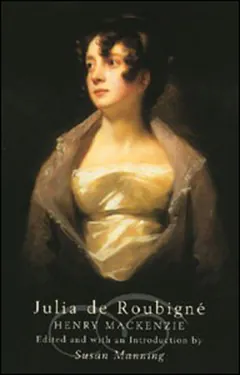
Julia de Roubigné
Pages
This chapter is long, so it is split into 6 parts.
Your lad mentions nothing of Roir* bigne, or his family, I know he diflikesr writing, and therefore am not furprifed at his filence to myfelf. You fay, in a former letter,. you find it difficult to hear of them; there is, a young lady in. Paris, for whom the lovely Julia has^
long entertained a very uncommon friend-ihip; her name is Roncilles, daughter of the prefident Roncilles.—Yet, on fecond
cond thoughts, I would not have you vifit her, on purpofe to make inquiry s^ from me J but you may^ fall on fome method of getting intelligence of then)
in this line*
Do not let flip the opportunity of thfs fhip*s return to write me fully; (he is Gonfigned to a correfpondent of ours^ and particular care will be taken of my letters. I think, if that had be^n the cafe with the laft that arrived here, I fhould have found one from you on board of her.
Think of me frequently, and write ine as often as our fituation will allow*
64 JULIA DE ROUBIGN£f.
LETTER XXX.
Savillon to Beauvaris.
T Begin to fufpcA that the fenfibility, of
which young minds are proud, from
which they look down with contempt on
the unfeeling multitude of ordinary men,
is lefs a blefling than an inconvenience.
—Why cannot I be as happy as.my uncle,
as Dorville, as all the other good people
around me ?—I eat, and drink, and fing,
nay I can be merry, like them ; but they
clofe the account, and fct down this mirth
for happlnefs 5 I retire to the family of my
own thoughts, and find them in weeds of forrow.
Herbert
Herbert left this place yeftcrday ! the only man befides thee, whom my foul can acknowledge as a friend* And him, perhaps, I fhall fee no more : And thee! my h^art droops tit this moment, and I could weep wiAout knowing why.—Tell me, as foon as poffible, that you are well and happy; there is, methinks, a languor in your laft letter—or is it but the livery of my own imagination, which the objefts around me are conftrained to wear ?
Herbert was a fort of proxy for my Beauv^ris; he fpoke from the feelings of a heart like his. To him I could un-bofom tnine, and be uhdcrftood ; for the fpeaking of a common language, is but one requifite towards the deareft inter-courfe of fociety. His forrows gave.
him
him a facfednefs in my regard, tfiar made every endeavour to fcrvc or oblige him, like the performance of a religious duty v there was a quiet fatisfadion in iff which calmed the rufflings of a fometimes troubled fpirit, and reftor^d me to peace witthmyfeUl
. He is failed for England, whither fbme bufinefsi material to a friend of his much-loved Emily, obliges him to return. He yields to this, I perceive, as a duty he thinks himfelf bound to difcharge, though the fight of his native country, fpoiled as it is of thofe bleflings. which k once poffeflcd for him, muft be no cafy trial of his fortitude* He talks of leaving it as foon as this affair will allow hint,, not to return to the Weft-Indies (for of his bufuicls there he is now independent), hut
but to travel through feme parts of Europe, which the employments of Iiis younger years prevented him from vifit-ing at an early period of fife. If he goes to Paris, he has promifed me to call on you.—Could
I be with you! What a thought is there I—nbut I (hall not be forgotten at the interview.
I have juft received yours of the third of laft month. I muft dill complain of its ihortnefs, though 1 dare not quarrel with it, a3 it afTures^ me of your welfare. But get rid, I pray you, of that very bad praftice, of fuppofing things unimportanjc at Martinique, becaufe you think them fo at Paris; Give nrte your intelligence, and allow me to be the judge of its coa*
fequence.
You
You are partial to your friend, wheir you write in fpch high terms, of bis treat/> nicnt of Yambu. We think but feldom of thofe things which habit has matte common, otherwife we (hould correct many of them \ there needed only to give one's feelings room on this theme, and they could prompt no other condu£t than mine. Your approbation, however, is not loft upon me •, the beft of our refolu-tions are bettered, by a confcio\llhe(s of the fufirage of good men in their favour^ and the reward is ftiU higher, wheti that fuffrage is from thofe we love.
My uncle has fent for me, to help him to entertain feme company who are juft arrived here. He knows not what a train of thinking he calls me from—l
have
JULIA DE ROUBIGNE'. J^^
have a little remembrancer, Beauvaris, ^ pidlure, which has hung at my bofom for fome years pad, that fpeaks fuch things !—
The fervant again!——Mademoifelle Dorville is below, and I muft come im-> mediately.—Well then—It will be difficult for me to be civil to her—^yet the girl deferves politenefs.-—But that picture !—
LETTER XXXL
Savilbn to Beauvaris.
'^ O U fay the letter, to which your
laft was an anfwer, was written in
low fpirics ( I confefs I am not always
in high ones; not even now, though I
am juft returned from a little kaft, where there was much mirth, and excellent wine. It was a dinner given by Dor-ville, on occafion of his daughter's birthday, to which my uncle and I, among other of his friends, had been long in-vitcd. The old gentleman difplaycd all his wealth, and all his wit, in entertaining us; fome of us thanked him for neither,
though
• <
though every one's complaifance obliged them to eat of his dainties, and laugh at^ his jefts.
It is after fuch a fcene, that one is often in a ftate the moft ftupid of any. The aflumption of a charader, in itfelf humiliating, diftreffes and waftes u?, while the lofs of fo much time, 1 ke the bad fortune of a gamefter, is doubly fcltj when we refleft that fools have won from. us.
Yet it muft be fo in fife, and I wifh to overcome the fplcen of repining at it.
I was again fet next Mademoifclle Dor-ville, and had the honour of accompanying fome of the fongs (he fung ^ us. A vain fellow, in my circumftanccs, might imagine that girl liked him. I believe there b nothing fo fcrious in her mind,
and
t
Jt JULIA DE ROUBIGNE'.
and I fliould be forry there were. The theft of a woman's affeflions is not fo atrocious, as that of her honour ^ but I have often feen it more terrible than that of her life; at leaft, if living wretched-nefs be worfe than death : yet is it reckoned a very venial breach of confidence^ tb endeavour to become more than agreeable, where a man feels it impoflible to rfepay what he may receive. Her father, I am apt to believe, has fomething of what is commonly called a plot upon me; but as to him my confcience is eafy, be-caufe, the cofiers of my uncle being bis quarry, it matters not much if he is dif-appointed.
Were it not from a point of delicacy, not to run the fmalleft riik of being thought particular, I could, fometimes, be
be very well entertained with the fociety of Mademoifelle Dorville.
There is a fpright-linefs about her, which amufes, though it is not winning, and I never found it fo eafy to talk nonfenfe to any other woman. I fancy this is always the cafe, where there is no chance of the heart being interefted : it is pcrfeftly fo in the prefent inftance with me.—Oh! Beau^ varis! I have laid out more foul in fir* ting five minutes with Julia de Roubignfi in filence, than I Ihould in a year's con-verlation with this little Dorville.
The converfation of women has perhaps a charm from its weaknefs; but this mud be, like all their other weak-neflcs that pleafe us, what claims an in-tereft in our afFeftions, without ofiend-ing our reafon. I know not if there is
Vol. II. . • E, really
74 JULIA Dt R0t7%IGM%V
neally a fez in the fool: coftom ind tA^ cation have eftablUhed one, in our idea; but we wilh to feel the ki:feriority of the other iex, a$ otut that does not dej^afe but endear it.
To their knowiedjge, in many thingi, we
hare fet limit>, btcesofk it feetm to en** croach on the foftneft of dicar fedings, which ivt fuppofe of that retiting kiai^ that &uni tJie keemneft o£ wgutncnt or enquiry. Knowlef^ Or learnkig has often this «Qe& among men: ttis wem, fometimes fatal to talle, if by tafte is irte«nt the tSb6t which beauties ha^ on Wttfelvts, rather thati the power of ctv-tki&tg Oft that which they ought tt> hanr oti (rtliefs*
Thfcrc
JULIA DR ROUBIGNB'.
There is a little world of fentiment made for women to move in, where they certainly excel our fex, and whem our a
fex, perhaps, ought to be excelled by them. This is irrcfiftibly engaging, vkere it is natural^, but, of all afieftations, that of fentiment is the moil: difgufting. It i^, I believe, more common in France dian any where elfe; and I am not fure» if it does not proceed from our women poffeiling the reality lefs. The daughter of Monf.
Dorville, when Ihe would be great, is always fentimental. I was forced to tell her to-day, that 1 hated fentiments, and that they fpoiled the complexion. She looked in the glafs, and began ta afk fome queftions about the Italian co* medy.
Ea My
j6 JULIA DE ROUBIGNE'.
My uncle, ivho had ftaid fome time behind me with Dorville, came in.
He was very copious on the fubjeft of Ma-demoifcllc^ I was perfcftly of his opinion in every thing, and praifed her in echo to what he faid v but he had dif-cernmcnt .enough to fee an indifference in this, which I was ferry to find he did not like. I know not how far he meant to go, if we had been long together ; but he found himfclf fomewhat indif-pofed, and was obliged to go to bed.
I fat down alone, and thought of Julia de Roubignd.
My uncle is, this morning, really ill. I owe him too much, not to be diftreffed
at
at this. He is uneafy about his own fitu* ftion, though, I believe, without reafon; but men, who, like hinij^ have enjoyed uninterrupted health, are apt to be ap« prehenfive. 1 have fcnt for a phyfician without letting him know 5 for it was; another efFe£t of his good conftitution, to hold the faculty in contempt. At pre-fent, 1 a(ir furc, he will thank me, in bis heart, for my precaution*
The doftor has been with him, and talks doubtfully; that, perhaps, is unavoidable in a fcience, from its nature. To uncertain; for this man has really too much knowledge to wifli to feem wifer.
I find I muft conclude this letter, as the (hip, by which I am to fend it, is within a quarter of an hour of failing. Would E 3 it
it had been a few days later I a few days might do much in a fate like mine.—---^ cannot expreis that fort of doubt and fear^ which the look of futurity, at this moment, gives me.
Do not, for Heaven^s fake do not fail to write n^ about the fituation of Rou** bigne and his family. I know his unwilr lingnefs to write, and decorum prevents (Is it vanity to think fo ?) his daughter; therefore I addrcjBTed my lad letter to Madame de Roubign^; but even when I ihall re? ceive her anfwer, it will not fay enough* You know what my heart requires; do not difappoiot it *•
♦ There are fto Tetterf, ?n this coTfeflion, of a later dace, from Sarilbit to Boam^ris. The perfon who at fu& arranged them, feems to intend to account for this, by the fottowingnoie on the outHde ofthe pre* ceding one* written b a hand of which I fee little jottings on
ieveral of the letters, " fieauvaris died 5th April, a few days after the receipt of this.**
LETTER XXXII.
jMlia de Montauban to Maria de Ronciltes.
t
'VT' O U muft not cxpcft to hear from mc fo oftcj;! as formerly j wc havc^ here, an even tenor of days, that admits not of much defcription. Comedies and romances, you know, always end with a marriage, becaufe, after that, riiere is nothing to be faid.
But I have reafon to be angry with you for finding fo little to fa^y at Pajpis;. though, I believe, the fault is in myfclf». or rather in your idea of me. You think 1 ami not formed to relilh thofe articles of intclUgcpce,. which are calM »ew* m,
E 4, your
'8o JULIA DE ROUBIGNE^
your great town; the truth is, I hav^c often heard them with very httle rclilh ^ but I know you have wit enough to make them pleafant if you would; and even if you had not, do but write any thing, and I ihall read it with an intereft.
You flatter me by your praifes of the naivetiy in the pidure I drew of our party of pleafure. God knows, I have no talent that way; yet the groupe was fantailic
enough, and, though I felt quite other-wife than merry next morning, when I wrote to you, yet I found a fort of pleafure in defcribing it.
There is a certain kind of trifling, in which a mind not much at eafe can fometimes indulge itfelf. One feels an efcape, as it were, from the heart, and is fain to take up with lighter company. It is like the theft of
a truant
JULIA DE ROUBIGNeV 8i
a truant boy, who goes to play for a few minutes while his mafter is afleep, and throws the chiding for his tafk upon futurity.
We have very different company at, prefcnt. Madame de Sancerre has been here thefe three days. Her hulband was an acquaintance of Monf. de Montauban in Spain,, and, you will remember, we ufed to be of her parties in town; fo Ihe is a gueft of both fides of the houfc, though I believe no great favourite of either. She is a wir, you know, and fays abundance of good things; and will fay any thing, provided it be witty. Here, indeed, we give her fo little opportunity, that her genius is almofl familhed for want of fubjeft. At Paris, I remember her furrounded with men of letters; they
E 5 praif^d
S2 JVHA DB EOUIIGNB'.
praifed her learning, and to u$ (he foem* ed wondeiful both as a khoht apd a critic V but here when I turn the di&oucfe on books, ihe chufes to talk of natbiog but the ieau monde. Her defcriptions, however, are diverting enough, and I be-lieve (he is not the worfe pleafed with me, that I can only hear them without being able to anfwer; for I think, if there is a member of our fociety fhe diflikcs, it ia that relation of the count, whom I mentioned to you in my laft, Monf. de Rou-ille, who is come to (pend fome weeks here. From the account of his vivacity which I received from his kinfman,^! thought Madame de Sancerre would have thought it a piece of high good fortune to have met him here 5 but, I fee, I miftook the thing \ and that (he would rtlilh his company better, if he were a& ftupid
JtfBIA BE KOtrMOMB'I Sj
ftupid as the reft of us. I am of a different opmion, and begin to like him much; the better, that I was prepare^ to b^ fomewhat afraid of
him; but I find.
in him nothing to be &ared; on the con-^ trary, he is my very fafefl barrier againft the fometin^ too powerful brilliancy o£ ^e lady.
RQuUle is conftitutiooally happy ; bur his vivacity, though it feems to be coiVr ftai&t, does not appear to be unfeeling. It is not the cheerfulnefs of an unthuik.^ U)g man, who is ready to laugh, on alt QccaHons, without kave of bis reafon, or, what is worie, of hia humanity y fom^ fiich people I have feen, whofe mirth wa«> like the pranks of a madman^ and, if aot of cbnfeqoence enough to excite anger or. ftar, was entitled to our compa& E 6 fion*.
84 JULIA DB ROUBIOMb\
fion» Rouille ha^ the happy talent of
hitting that point where fentiment min« gles with good humour. His wit, ex-* cept when forced into oppofition by the petulance of others, is ever of that gentle kjnd from which we have nothing to dread ^
that fports itfelf in the level of ordinary underftandings, and pleafes, be<* caufe it makes no one difpleafed with himfelf. Even the natural gravity of Montauban yields to the Winning liveli** ncfs of Rouille, and though the firft feems to feel a little aukwarknefs in the attempt, yet he often comes down from the loftinefs of his own character, to meet the pleafantry of the other's.
Do not rally me on the favour of ma-trimony in the obfcrvation, if I venture to fay, that Montauban feems to have refumed
fefumed fomewhat of bis former dignity^ Think not that I fufpedt the fmalleft diminution of his affeflion; but now, when the eafe of the hufband has reftored him to his native qharadter—I kno^y not what I would fay—Believe me, I mean nothing at all—I have the g^eateft reafom
to be fatisfied and happy.
At prefcnt, I believe, he is now an^ then out of humour with this vifitant of ours, Madame de Sancerre •, and, it may be, thrown into fomewhat of a ieverity in his manner, from the obfervation of an oppofite one in her. When fhe utters,
as (he does pretty often, any joke at which fhe laughs heartily herftlf, 1 laugh, fome«
titiies with good will, but oftener (out of complaifance) without; Rouille laughs^and
1 is
86 JULIA J&E ROUBIGNE^
is ready with his jeii ia returo % but Montaubaa look$ gravtr than ever, In^ deed» there is x^ refource lor one who eaimoc laugh at; a jeft> but to look grayer
at it.
I wi(h my Maria could have accepted of the inritatioii he communicated by me fome time ago* I think I (heuM have fliewn him, in my friend, a livelinefs that would not have difpleafed him.
Could you ftiU contrive to come, while Rouille is here, you muft be charmed with one amother. It would give me an oppoiu tunity of making up to you, for themany diult letters I have obliged you to read
;. but you taxed yourielf early with my correfpondence I it was then, perhaps^, tolerable; it has, of late» been a mere colleftioii of egotifms, the egotifms too oi(
a mind
a mind ill at cafe—-biK I have given up making apologies or acknowledgments to yoo I they are only for common obli* gations: mine is a debt beyond their quittance.
t^
88 JULIA DE ROUBIGNE'.
LETTER XXXIII.
Montauhan to Segarva.
T AM now three letters in your debt; yet the account of correfpondence ufed formerly to be in niy favour. The truth is, that of fadts I have nothing to write, and of fentiments almofl: as little. Of the firft, my fituation here in the country deprives me •, and of the laft, that quiet fort of ftate I have got into is little pro-duftive. When I was unhappy as the lover of Julia, or firft happy as her huf-band, I had theme enough, and to fpare» I can tell you, that I am happy ftill; but it is a fort of happinefs that would nor figure in narration. I believe my Julia
JOLIA DE ROUBIGNe'. Sjt
^ ■
is every thing that a good wife fhould be: I hope I am a good hufband.
I am neither-young nor old enough for a doating one*
You will fmile and look back to cer* tain letters and notes of nfiine^
written fome four or five months ago. I do not know why I Ihould be afliamed of them» Were Segarva to marry, he would write fuch letters for a while> and there never was a man who could write fuch letters long. If there were, I am not fure if I fhould wifh to be that man* When we cannot be quite fo happy as others, our pride naturally balances the account: it Ihews us that we are wifer, Rouille, who has been here for a week or two, is of a different opinion; he
hold&
holds the happieft man to be ever the wifefl. You know Rouille's difpofition^ which was always too much in the fun for us i but the goodnefs of his heart9 and the purity of his honour, are above the reft of his charaAer. With this pre* poflefflon in his favour, I hear
him laugh at me, without refcntment; and by and by he fteals upon me, till I forget my-ielf, and laugh with him. I am ibme^ times gay ^
but I feci a fort of trouble in gaiety. It is exafkly the reverfe with Rouille: he can be ierious, when Im means to be ioi but, if we mean no* thing, he is gay, and I am lerious«
My wife is neither one nor toother: therq^ is fomething about her too gentle for either^ but, I thbk» her penQvQ foftnefs deierts more xeadily to Kouille^i
fide
JULIA DE ROUJBIGNJg'. gl
dde than to mine, though one Ihould imagine hi^ manner the more diftant from hers of the twob Rouille jokes me on this: he calls her the middle ftage between us; but fay^, it is uphill to* ^ wards my fide. *^ A folitary caftle, and a^ fiill evening (faid he) would make a Julia of me; but to be Montauban, I muft have a fog and a prifon^'
Perhaps, if we confider matters im« partially^ thefe men have the advantage of us: the little cordialities of life are more frequently in ufe than its greater and more important duties. Somebody^ I think, has compared them to fmall pieces of coin, which, though of Uii value than the large, are more current amongit men; but the parallel fails in one refpedt: a thoufand of thofc livres do
do not conftitute a louts; and I have known many charaftcrs^
poflfcflcd of all that the -firft could give, whofe minds were incapable of the laft. In this number, however, I mean not to include Rouille.
We have another gueft, who ilkftrates my meaning better, the widow of San-ccrre, whom you introduced to my ac-quaintance, a long time ago, in Spain. She was then nothing; for Sancerre con* fidered all women nothing, and took care that» during his life, fire fliouM be no
exception to the rule. He died; Ihe regained her freedom v and fhe ufes it as 6ne to whom it had been long denied. She is juft fool enough to be a wit, and carries on a perpetual crufade againft fenfe and ferioufnefs. I bear with her
very
very impatiently: (he plagues me, I be-lieve, the more. My wife fmiles, Rou« ille laughs at me; J am unable to laugh, and afhamed to be angry; fo I remain filent and ftupid.
Sometimes I ceafe to think of her, and blame myfelf. Why (hould I allow this fpleen of fenfe to difqualify me for fo-ciety ?—Once or twice I alm.oft muttered things againft my prefent fituation —• Julia loves me j I know (he does: (he has that tendernefs and gratitude, which
will fecure her afFeftion to a hufband, who loves her as I do; but (he muft often fed the difference of difpofition between us. Had fuch a man as Rouille been her hulband—not Rouille neither, though ihe feems often delighted with his good humour, when I cannot be pleafed with
it.
^4 JULIA &B ROTTBlGMB^
itk^i^We ftit ttcitker of os ibch a maa at cfae writer of ft romance would hare made ft huft>ftfid for Julia.—^Ttitre is, indeed, ft
{liability in die minds of women in this article, which frequently gains over opi* nion to the fide of duty.—Duty is a cold word.—-No matter; we will caovafs it no farther. I know the purity of her bofom, and, I think, I am not unworthy of its iafie^ion.
Her fither { fee much feldomer than I ccyuld wilh; but he is gfieatly altered nf Uiot. Saiac the time of his wife"^ death, I baveobferved him droop apace; but Julia fays, th*t the diftrefe of their cir-cmoftftfices feept up in him a fort of falfe Ipirit, which, when they were difijmbar-mlbd, left Mm to fink under refleftion.
5 '
His facukicB, i csn ^fily per^eivv, ^rft oot m that Tig^ur they weitcivmt to bt) fet bh bodil/ ftittigth does n^t niQcft decline^ af>d[
he ieemi tnore contisnced
with himfelf, than he was when in fuU pofleflion of his abilities. We wi(h him to live with us; but he has conftantly refufed our requell, and it is a matter of delicacy to prefs him on that point. We go to fee him fometimes: he receives us with fatisfaftion, not ardour: violent amotions of every kind appear to be quenched in him. It creates, methinks, a feelrng of mingled complacency and fad-ncfs, to look on the evening of a life and of a character like Roubigne's.
Shall I not fee yon here fome time tliis autunm ? You gave me a fort of
pro-
promife, and I need you more than ever. I want the fociety of fome one, in whoie connpany I can be pleafed, without the tvc of {hinking that I am filly for being
JULIA DF KOOBIGI)£'. gf
• t
LETTER XXXIV.
Y Have jtift now received a piece of in* tellTgence,, which I muft beg my Ma^-rfa inltantly to fatisfy nae aboutr Le Bfanc, my father's fervant, was here a few hours ago> and among other news, informed Lifette, that a nephew of his^ who is juf£ come with his mafter fromt Paris, met Savilion there, whom he per-fedly remembered, from having feen him in his vifits to his uncle at Belville. The lad had' nxx time for eft^i#y, as his mtC-ter's carriage was juft fetting off*^ when he obferved a chaife drive up to the door of the hotel, with a gentlemsui in u, whom Vol. ir. F he
he knew to be Savillon, accompanied by a valet de chambre, ahd two black fer-vants on horfeback.
Think, Maria, what I feel at this intelligence I r-Yet why fhoiild it alarm
me ?—Alas ! you know this poor, weak, throbbing heart of mine ! I cannot, if I would, hide it from you.—Find him out, for Heaven's fake, Maria j tell me— yet what now is Savillon to your Julia ?—No matter—do any thing your pru-dence may fuggeft; only fatisfy me about the fate of this once dear—Again! I dare nottruft myfclf on the fubjcft—Monf, de Montauban!—Farewell!
Delay not a moment to anfwer this.—
Yet do not write, till you have learned fomething fatisfa£tory.
At
At any rate, write mc fpeedily.—
I have forgotten the name of the hotel, ^here the lad met him i it was fituated la the Rue St Anne.
F 2
190 juuik nt KOVBieKX^";
LETTER xxxy.
Montauian to Segarva.
V/r Y wife (that word muft often come acrofs the narration of a married man) has been a good deal indifpofed of late. You will not joke me on this intelligence, as fuch of my neighbours whom I have feen have done; it is not however what they fay, or you may think; her fpirits droop more than her body; fhe is thoughtful and melancholy when (he thinks (he is not obferved, and, what pleafes me worfe, affefts to appear otherwife, when (he u;. I like not this
ladnefs which is conlcious of itfclf. Yet, perhaps, I have feen her thus before our
marriage.
marriage, aod have rather admired thii turn of mind than dif&pproved i)£ \i\
but now I woqM not have her penfive-^ xa>r Very gay neither**-*!
would hai^e tio* thing about her, methink&^ td ftir a qiiet^ tffm in me whence it ftfdftl She Jhould be contented with th^ htk^U^ At kn&iri I btftr for htt. I do hot tnpt& htr to be romtnticalif happy, and tkt kas tio cmufe for uneafineffr^I am hot t^eafy Mitfatr^yet I wilh her to CMqutr thto melancholy.
I was laft hlght abroad at flipper: Jir-Ka wa§ a-bed hd6tt tnj return. I found her lute lying <m the table, and a mufic-book open by it, I could pefteive the marks of Mars ihed on tht paper, and the air was Ibch as naight encourage theif ^ing: fleep however had overcome htt F 3, fadnels^
102 .JULIA DE ROUBIGNE'.
fadnefs, and (he did not dwake when I opened the curtains to look on hen When I had flood fome moments, I beard her figh ftrongly through her fleep, and pre-fently fhe muttered fome words, I know not of what. import. I had fometimes heard her do (o before^
without regard* ing it muchi but there.was fomethmg that roufed my attention now* I liftened § &e fighed again, and again fpoke a few broken words; at laft, I he^rd her plainly pronounce the name SaviUon^ two or three times over, and eagh time it was accompanied with fighs fo deep, that her heart feemed burfting as it heaved them. I confefs the thing iibruck me, and, after muflng on it fome tiipe, I re-fplved to try a little experiment this daf at dinner, to difcover whether chance had made her pronounce this name, or JULIA DE ROUBIGNE. lOj
if fome previous caufe had imprefled. it on her imagination. I knew a man of that name at Paris, when I firft went thither^ who had an office under the in-tendant of the marine. I introduced fome converfation on the fubje<5l of, the fleet, aPxd faid, in an indifferent manner, that I had heard fo and fo from my old acquaintance Savillon. She fpilt fome foup (he was helping me to at the inftant; and, dealing a glance at her, I faw her cheeks flufhed into crimfon.
I have been ever fince going the round ^ of conjefture on this incident. I think I can recoiled once, and but once, her father fpcak of a perfon called Savillon re-fiding abroad, from whom he had re*
ceived a letter; but I never heard Julia mention him at all. I know not why I
F 4 fliould
104 JVLIA DE ROUBIGNE.
ihould have forbprn alking her the rea^ ion of vhcr beinjg ip afTedled at the found ^ yctj ^ thp moment I perceived it, tb? queftion ftuck in tny thrpat. I felt fome-thing like ^uilt hang over this incident altogether—it is none of itiine then—nor of Julia's neitlier, I truH:-—
and yet, Sc-garva, it has touched me nearer—much nearer ^h^n I
|hould pwn to any one but you.
■ 1 > 1.." " I 14 < J '
Nine at night. Upon locking over what I had written in the afteraeon,
! had almoft refolved to burn this Utter, and write another; but it ftrikes me as iBfinQerity to a friend like Segarva, not to truft him with the very thought ei the moment, weak as it m?y be.
I begin
r begin now to be afhamed of the ef-fc& that trifle, I mentioned above, had isipon me. Julia is bmer, fnd hal Ijttn finging to me the old Spanilh ballad,, which you ftnt us lately. I am delighted with thofe ancient national longs, becaufe dicfe is a» fimplicit^, aikd an exprtffiotk m them, wUdi 1 can vMdetSt^tiA. Adepts in mufic arc
ple^^ed with iimre inCritatt^ Gompofitions; and they talk mCfrt of tht pleafure than they feel; and others talk after them, without feeling at allr
« « ir «- #r « « # - 4r «
fs
LETTER XXXVI.
Savillonto Herbert.
T AM here in Paris, and fulfil the pro-mife, which your friendftiip required of me, to write to you immediately on my arrival.
Alas! my reception is not fuch as I looked for. He, whom alone my arrival (hould have interefted, my ever faithful Beauvaris!—he meets me not— we fhall never meet—he died, while I was imagining fond things of our meeting!
Gracious God! what have I done,
f
that I (hould be always thus an outcaft
from 8
JUl^IA DE ROUBIGNE', . IO7
from fociety ? When France was dear to me as life itfclf, my deftiny tore me from her coaft ^ now, when I anticipated th<^ pleafures of my return, is this the welcome (he affords me ?
Forlorn and friendlefs as my early days were, I complained not while Beauvaris was mine: he was wholly mine, for his heart was not made for the world; Naturally refcrved, he fhrunk early from its notice; and, when he had lived to judge of its fentiments, he wifhed not to be in the lift of its friends.
His extreme modefty, indeed, was an evil in his fate; becaufe it deprived him of that protection and affiftance, which his fituation required. Thofe who might have beea patrons of his merit, had not F 6 time
I08 • JULIA PI RDVB2GH£^
time to fearek for taknts hia hsifl^ulncft obfcured. His virtue^ even fu&red im^ puta|ioa from it» (ky, not cmly of ioti-micy^ bm (;vo« of Qf^niW 4b4 IJKitiinvii^ pcribns, whofe fituatkui kemied ta entitle them to his confidence, complained of his coldnefs and indifflrrence, and he was accufed of want of feeling, from what^ in truth, was an exceft of fenfibrlity. This jewel, undifcovered by others, was mine.
From infancy, each had accu^* temed himfdf to con Oder his fViend but a better part of himfelf; and, when the heart of either was full, talking to the 9ther was but unloading it in foliloquy.
Fwgivf me, ^y ^^ar Herl?c«, for thus dw^ing qx\ ^e fofcft?^, Tfeq oi^y fad cpnvfoft | hav^^ jjoVf l^t m?, if ip tfeioit^ of b^ viorth: it i»
^ K^vjlcgf I
would not wafte on common minds, to hear me on this theme; your's can uit-derftand it.
^hy WM I afe^fiwit ffom P^w ? Too
W^^e mt.\ Th^ys few Wn> ftrgggliij^ with povefQ; 8*.w^U 3*
fiokoftfti yft Ulie laft letter he wrote me confcffed neither 5, and fomf litije pveftnts, tbepvodvc^ of / MartfAiqu^ whiek I lime bioft, iir woutd Bor €G»ven into mon^j^^ becaafe iktf cwie from me.
I aitt now fitting ia the. looni, ift which
he died \ —On .that paltry bed Uy thjp tie^d of Be^uvaris—iOi\ this deflc, whereon
«
Iwrite,^ hie wrote!—J?4rdoj5 m?^whil<j, \ atiji uo^Wc tQ ga on.
no JULIA DE RQUBIGNE^
It is from the indulgence of forrow, that we firft know a refpite from afflidion. I have given a loofe to^y grief, and I feel the relief, which my tears have afibrded me. I am now returned to my hotel, and am able to recolleft myfelf.
I have not yet feen any acquaintance of Monf. de Roubigne; this blow, in^ ' deed, did not allow me leifure or fpirits for enquiry ; I feel as if I were in a foreign land, and am almoft afraid of the noife and buftle I hear in the (Ireets. I have fent, however, offering a viGt to a particular young lady, of whom 1 (hall be able to get intelligence of Roubigne's family; but my meflenger is not yet re**
turned.
He
;
ITLIA DE ROUBIGNe'. I if
He has found lier, and ihe has ap^* pointed me to come to her to-morrow morning. You cannot imagine what a flutter the expectation of this vifit has thrown me into; I am not apt to Hand in awe of prefages, but I could be very weak that way at this moment. My man, who poflefles a happy vivacity, brought me in, after dinner, a bottle of Burgundy, which, he faid, the landlord af-fured him was excellent.
I have drunk three-fourths of it, by way of medicine 5 it has made my head ibmewhat dizzy, but my heart is as heavy as before.
What a letter of egotifm have I written! but you have taught me to give vent to my feelings, by the acquaintance ance you have allowed me with yours. To fpeakone^s diftreflestoche unfeeling is.
terrible; even to afk the alms of pity is
liaimiiMftg; bue to pour our griefs into the bofom of a friend^ is but committing; i» htm a pledge above the truft of ordif-iiaf]r men.
Do iioc> I beii^ch y9% fergtt ymr df Gg^ of travelbog iatQ France this iirs^ ion ir^yet; why fhould I aik ibis ? I kn^ii not vthere ft>rtiuie my lead am! k can-aot» however/place im k a fimarinn^
wJjiere the IficiMUhif' of Hrrbctt £btt bs focgptteib P. S, I direft this for you at London^
a&i, I think, yw wwfk be tkare by^ ttus tioacu yow aoArer will find bMft i kbit be^ecrigii
JULIA PE RQU9ICf<s'. J13
LETTER XXXVU.
Savilhn to Her^frt,
t
"DEAR with me, Herbert, bear with me. The firft ufe I make of that correfpondence which you dt&ni^ 19 to pour out my tnifene$ b^ore you! but you C4I1 hear them*—You have known what it is to love, and to defpair as I doi
Whtn I tokl you my Beauvaris was no more, I thought I had exhaufied the fuoi of diftrefs, which this vifit to Paris was to give me.
I knew not then what fate
had prepared for me that Julia, on
whom my doating heart had rcftcd all
'114 -JULIA DE RGUSIGRR^
its hopes of happinefs i —that Julia is the wife of another!
All but this I could have born i the lofs of fortune, the decay of health, the coldnefs of friends, might have admitted of hope) here only was defpair to be found, and here I h^ve found it I Oh I Herbert 1 ihe was fo interworen with my thoughts of futurity, (hat life now fades into a blank, and is not wonh the keeping;—but I have a ufe for ici I will fee her yet at leaft—Wherefore ihould I wi(h to fee her ?—Yet, methinks, it is now the only objt(St that can prompt a wifli in me.
When I vifited that lady, that Maria dc RonciUes, whom I knew to be the deareft
of her friends, (he feemed to receive mc
^ith confudoh *, her tongue could fcarce
.articulate the words that told me of Ju-*
.lia's marriage:. She mentioned fome^
thing too of having heard of mine.-^I
i
am tortured cv^ry way with conjefture— my brain fcarce holds its recolle£tion»— Julia de Roubi^ne ii macrifid to another I I ktiow not what I faid to this friend of her's at firft 5 I remember only that, when I had recovered a little, I begged her to convey a letter from mc to Julia j fhe feemed to hefitate in her confent^ but fhe did at lad confent. Twice have I written! and twice have I burnt what I had written—I have no friend to guide,. CO diredk mc~not even to weep to !
At
mmmm
Ac Uft I h$y€ finiflicd dttt kttcr ^ k Moaini the loft rcqwft which tfas mife-rabk StviUoD hat to m4ce. JThis om imervi^w puiit, aod mf days hanre no*-ihiiig to mark them widi aiuuccy or hopci I am now more calmly wretched; the writing of that letter haa relieved, for a while, my fwelling heart. I went wixh ic n^yfelf to Mademoifelle de Roocilles's^ (he was abroad^ fo I left it without fee*
mg her. You can judge of my feelings i
I wondered at the indifference of the faces I met with in my way i they had no carea to cloud them, none at leaft like Savil-Ion's.--—
Why of all tho& thoufands an> I the moft wretched?
lam
I am returned to my hotell I hear the voices of my fervants below: they are telling, I fuppofe, the adventurer of their voyage. I can dfffinguilli tKe voice of my man^ and bis. auxitence are merry around him—Why fliould he not jcft ? ha knows nou wbaft bis.
mafter ftifitxs^
SbmetWnglike a ffupid flecpinefsop-prtffes tne :' laft night, t could not fleep. WHefe are now Aofc luxurious ffumbcrs, thofe wandering dreams of future happi-ncfs.?—Never fhall I know them ag^iii! —
Good night, my Hctbctt!—liis fome-thfng (till to fleep and tp foi;get them.
LETTER XXXVIIL
Julia to Maria.
XXT'HAT doyoutellme! Savillon in Paris! unmarried, unengaged, raving of Julia! Hide me from myfcl^ Maria, hide me from myfelf—
Am I not the wife of Montauban ?-—
Yes, and I know that charafter which. as the wife of Montauban, I have tofup-port': her hufband's honour and her own are in the bread of Julia. My heart fwells, while 1 think of the ftacion in which I am placed.«-*>Relentlefs Honour I thou
tricft me to the uttermoft i thou enjoined
me*
me to think no more of fuch a being as:
Savillon,
«
But can I think of him no more ?—• Cruel remembrances' —Thou too, my friend, betrayeft me j you dare not truft me with the whole fcene; but you tell
me enough.—I fee him, I fee him now!. He came, unconfcious of what Fortune had made of me-, he came, elate with the hopes of
{baring with his Julia that. wealth, which propitious Heaven had beilowed on him.—She is married to another 1—I fee him flart back in amazement and defpair; his eye wild and haggard, his voice loft in the throb of afto-nifhment! He thinks on the fhadows which his fond hopes had reared—the dreams of happinefs!—Say not that he wept at the thought.-»Had thofe tears
fallen
couldft not thus have ftung'me; Iftui; perhaps, gentle as his nature is, he was not weak enough to be overconne by the thdtigfitf. Coutd he But think of me with iildiffe«tfce—Tell him^ M^ria, what a Wretch I am: a wife, without a wife's af-feftion, Cd W&om Hfe has loft it^
renih^ and* virtcie Jts reward. Let him hate me, I AferVtf his {corn—
^yet, methinks, I may claim his pity.—
The dau]ght«r of Ronfergnci the wife of Wtontattban f I wiH not bear to be pitied. No; I wili ftiflc* the grief that w<M)M betJfay me;
arrf fermtftfablerwith-oot a- wttneftr. tfik heart" Ihall break, thfe prow* hcarti without fufferin'g a flgh topnclieve it, Alas!
Alas! my friend, it will not be-That pifture, Maria, that pidure!— Why did I not banifli it from my fight-? too amiable SaviUon! Look there, look there! in that eye there is no fcorn, no reproach to the unhappy Julia: mildnefs and melancholy !—Wc were, born to be miferable !-
Think'ft thou, Maria, that atthis moment—it is poflible—he is gazing thus on the refemblance of one,'whofe ill-fated rafhnefs has undone herfelf and him !—Will he thus weep over it as I do ? Will he pardon my offences, and thui prefs it?—I dare not: this bofom i$" the property of Montauban.^Tears are all I have to beftow. Is there guilt in thofe tears ? Heaven knows, I cannot help weeping.
12Z JULIA PB ROUBIGNE'.
I was interrupted by the voice of iny hufhandi giving fome orders to his fer-vant at the cioor of my apartment* He entered with a look of gaiety; biA I fear, by the change of his cquntejiaacej (l^at he ob&rved my tears. I clapped on niy hat to hide them, and told bixn, as well as I could, that I was going to waU(« He fufFered me to leave hinX) without any further queftion. I drolled I khtw not whither, till I found my&lf by the fide of a little brook, about a quarter of a mile's diftance from the houfe^ The ftillneis of noon, broken only by the gentle murmuring of the water, and the quiet hum of the bees, that hung on the wild flowers around it; thefe gave nxe back myfelf, and allowed me the languor
JULIA DE ROUBIGNE, tl^
guor of thought; iny tears fell without controul, and almpft without diftrefs. I would hare looked igain on the pidure of SavUlon, for I could then have trufted myfelf with the fight of it; but I bad left it beliind in my chamber. The thoughts of its being feen by my huiband gave wings to my return, I hope he mififed it-» for I found it lying, as I had left it, on my dreffing-tablc, inthemidft of fome letters of compliment, which had been thrown carelefsry there the day before*,
and« when I went down flairs^ I difcovered nothing in his behaviour that fliould have followed fuch a difcovery. On the contrary, I think, he feemed more pleafed than ufual, and was particularly attentive to me. I felt his kind*
fiefs a reproach, and my endeavours to return it fat aukwardly upon me* There
Q % was
^.34 JULIA DE 110UBICN£%
4
was a treichcry, methought, in my attempts to pleafe him, and, I fear, the greater eafe I meant to affume in making thofe attempts, I gave them only more the appearance of conftraint.
What a fituation is mine! to wear the appearance of, fcrenity, while my heart is wretched, and the difUmulation of guilt, though my foul is uncqnfcious of a crime!—There is fomething prediftive in my mind, that tells me I (hall not long be thus; but I am fick of conjeAure, as I am bereft of hope, and only fatisfy myfelf with concluding, that, in the moft fateful lives, there is ftill a certain point, where the^ maze of deftiny can bewilder no more I JULIA DE ROUBIGNB. 1^25
LETTER XXXIX.
Mcntauban to Segarua.
eEGARVA !—but it muft be told—f blulh even telling it to thee—have
\ lived to this ?—that thou Ihouldft hear the name of Momauban coupled with difhonour I
I came into my wife's room yeftcrday mornings fomewhat unexpeftedly. I ob-ferved fhe had been weeping, though (he put on her hat to conceal it, and fpokc in a tone of voice afFeftedly indifferent.. Prefently (he went out on pretence of walking j I (taid
behind, not without^ (lirprife at her tears, though,. I thinks without fufpicionj when turning over
G 3 (in
126 JULIA DE ROUBIGNl',
(in the carelefs way one does in muGng) feme loofe papers on her drcfling-table, I found the pidture of a young man in miniature, the glafs of which was ftill wet with the tears (he had (hed on it. I have but a confufed remembrance of my feelings at the time \ there was a bewildered paufe of thought, as if I had waked iit another wosld. My faithful Lonquillez happened to enter the room at that mo* ment; look there! faid T, holding but the pifturc without knowing what I did
\ he held it in his hand, and turhifig it, read on the back, Savillon. I ftarted at that found, and fnatched the pifture from him; I believe he fpoke fomewhaf, ex-preffing his furprife at my emotion •, I
«
know not what it was, nor what my an-fwer: he was retiring from the chamber —I called him back.~*« I think, (faid I) tho
JULIA DE ROUBIGNE. I27
thou loveft thy mafter, and would fcrvc him if thou could'ft ?"—«
With my life r anfVrercd Lonqufllez—the warmth of his manner touched me: I think 1 laid my hand on my fword. Savillon \J.
repeated the name 5 " I have heard of him/* faidLonquilIc2.—"
Heard of him!'*— ** I heard Le Blanc talk of him a few day's ago.**—
^" And what did he fay of him ?"—*• And faid he had heard of this gentleman's arrival from the Weft-Indies, from his own nephew, who had j'lift comt from Paris ; that he remembered hioi formerly, when he lived with his mafter at Bclville, the fweeteft young gentleman, and the handfomeft in the province/*—My fituation ftruck me at that inftant.—I was unable to enquire further.—After fome little time, Lonquillez left the room L 1; knew not that he was
G 4 gone.
128 JULIA DE ROUBIGNe'.
gone, till I heard him going down flairs. I called him back a fccond time; he came: I could not fpeak.—" My dear. matter I" (faid Lonquillez)—^It was the
accent of a friend, and it overcame me.
<
<* Lonquillez, (faid I) your matter is moft unhappy!—Canft thou think my wife is falfe to me ?"—" Heaven forbid !"
faid he, and ftarted back in amazement. —" It may be I wrong her j but to dream of Savillon, to keep his piflure, to weep over it."—"
What (hall I do. Sir ?" faid Lonquillez.—« You fee I am calm, I returned, and will do nothing
ralhly; try to learn from Le Blanc
every thing he knows about this Savillon* Lifecce too is filly, and talks much. I know your faith, and will truft your capacity J get me what intelligence you
can,
JtTLIA 0E ROUBIGNE^ lig
can, but bewarfc of (hewing the moft dif-tant fufpicion.—^We heard my; wife be* low ;—I threw down the pidbure where I had found it, and haftened to meet hen As I approached her, my heart throbbed fo violently that-1 durft not venture the meetmg. My dreffing-room doorftood
a-jar j 1 flunk in there, I believe, unper-ceived, and heard her pafs on to her chamber* I would have called Lonquillez to have fpoken to him again ^ but I durft not then, and have not found an opportunity, fince*.
I Taw my^^ wife foon after j: I counter-feited as well as I. could, and, I think,^ (he was the moft embarrafled of the two;. fhe attempted once or twice-to bring in fome apology for her former appearance;.
complained of having been ill in the
Ci Sj morn---
$30 JULIA »S tOVil&Ht'.
iilorningf that her head had ached, atfd her eyes been hot ahd uncafjr.
She carm herfelf to call me to dinner. We dined albrtfe, and I marked her elofe^ \j I I faWj (by Heaven ? I did) a fawn* ing folicirude to pleafe me^ an attempt at the good-humour of innocence, to cover the embarraffment of guilt. I Ihould have obferved it, I am fure 1 Ihould, even without a key; as it was, I could read her foul to the bottom.—^