
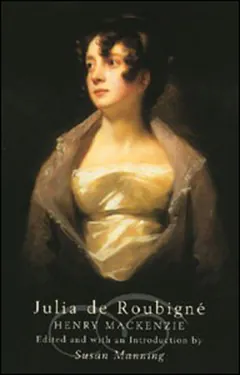
Julia de Roubigné
Pages
This chapter is long, so it is split into 6 parts.
D 5 an^
jfi JUIrIA DE ROUBIGNE^
tpd ufefisl Iqnowledge. This, tbou^ liuje folickous co difplay^ he is ailways seady .tocomniuniaitei and^ as he find» me willing to be inftruded, he teems to fiixi a pleafure in inftru&ing me.
My riiofher takes tirtff opportunity of <flcotirag?hg this fort of cbflvferfation. Yoti have often' heard her fentimcnts on the mutual advantage of (uch iritercourfe be-twcen the fexes. You well remember her frequent mention of a male friend, who died ibori after her marrij*gc, from whom, &e hzi toid us, flie derived mofl: of the little accomplifhment her mind can boaft ot *^ Men ((he ufed to fay) though they talk much of their friends, are fel-dom bleft with a friend, 'the nature of that companionlhip, 'which they miftake for friendfhip, is really deftruAive of its
exift-.
^ciftencc; beomfe the ddicacy of the kfl: ihri^s from die rude toudi of the former s ^d that^ howevef pure in thett own ftnllment^ the fo<!i^ ivhich thejr fte eadi other hold with third perfons» fe 1RM[> grofs, not to break thofe tender links, ^ich atie abfdlutely efleniial to friend-''
ifhip. Girls ((he fafd) eafily form a con* ne^i^n of a more refined fort; but as it
tomtjnonly begins with romance, it fel-dom ou'tlafts the years of childhood, exp tept when it degenerates into cabal and intrigue; but that the friendihip of one of each fex, when fo cirqumftanced as to be diftant from love, (which (he affirmed might be the cafe) has that combination orilrcngth and delicacy which is equally formed to improve and delight."'
Dg There
There may be much reafon in her arguments; but I cannot, Qotwithftanding my efteem for him, cafily think of Mon-tauban as my friend. He has not yet quite obliterated the fears I felt on our firft acquaintance. He has, however, done much to conquer them ; and, if he goes on as he has begun, I know not what in time he may arrive at.
Mean time I am contented with Maria: our friendlhip has at leaft endured beyond the period af-figncd by my mother. Shall it not always endure ? I know the anfwer which your heart will make—mine throbs whik I think of it.
JULIA PE ROUBIGNB^ ^I
LETTER VIL
Mmtauhan to Segarvd.
VT OU complain of my filence. In truth I have nothing to fay but to repeat, what is very unneceflary, my aflu* ranees of friendfliip to Scganra. My life is of a fort that produces nothing; I mean in recital.
To myfelf it is not va-cant: I can be employed in marking the growth of a Ihrub; but I cannot defcribe its progrefsy nor even tell why its progrefi pleafes me.
If the word fociety is confined to our
own fpecies, I enjoy very little of it. I
ihould except that of the famrly I gave
you an account of fome time ago« I fear I am too often with them; I frequently refoive to be h^fy ^^ I^me ^ but I have fcarce fat down to my table, when the pifture of RoubigHe's parkmr prefents itfelfy and I think that my bulinefs may wait till to-morrow.
1 blufh to tell you what a fool 1 an» grown i or is it that I am nearer the truth than formerly ? 1 fc^in to entertain doubts of my own dignity, and to think that man is not altogether formed for the fub-lime place I ufed to allot him. One caft fee very happy with much lefe trouble,, than very wife : I have difcovered this at Roubigne's. It. is but conquering the name of trifles, which our pride would give things^ and my hours at Roub^ne^
aie
ztt as importantly filkd up as any em« ployment could make them.
After all, what is our boafted f^ilo* fophy to ourfelves or others ? Its confe* quence is ofcen borrowed, more from the language it fpeaks, than the objed it pur* fues, and its attainments valued, more from their difficulty, than their ufeful-nefs. But life takes its complexion from inferior things; and proridence has wifely placed its real bleflings within the reach of moderate abilities. We look for a ftation beyond them; it is fit that we too ihould have our reward; and it is found in our vanity. It is only from this caufe, that iTometimes blufh, as if I were unwor* thily employed, when I feel myfelf happy in doing nothing at Monf. de Roubigne's
iire-Iide.
Yet
Yet do not fuppofe that we are always employed in talking of trifles: She has a mind no lefs capable of important re-fearcb, of exalted fentiment.—-
I am haftily called away;—it faves you the continuation of a very dull letter. I fend this, fuch as it is, more as a title to receive one from you, than that it Ihould ftand for any thing of itfelf.
FareweL
LETTER VIII.
yulia to Maria.
TD IT Y me, Maria, pity me! even that quiet which my letters of late defcrib-ed, which I was contented to call hap-pinefs, is denied me.
There is a fatality which evcry-wherc attends the family of the unfortunate Roubigne ; here, to the
abodes of peace, perplexity purfues it; and it is deftined to find new diftrefs, from thofe fcanty fources to which it looked for comfort.
The count de Montauban—why did he fee me ? why did he vifit here
? why did I liften to his difcourfe ? though, Hea^
vcn
€6 JULIA D^ ROUBIG**'.
ven knows, I meant not to deceive hi m ! —He has declared himfelf the lover of your JuUa !—I own his virtues, I efteem his chara£ter, I know the gratitude too we owe him; from all thofe circumftances I am doubly diftrefled at my fituation ^ but it is impoflible, it is impoflible that I (hould love him. How could he imagine thatlfhould? or how does he (till continue to imagine that 1
may be won to love him \ I foftened my refufal, becaufc I would diftrefs no man \ Montauban of all men the leaft; but furely it was determined enough, to cut off all hopes of my ever altering my refolution.
Should not his pride teach him to ceafe ibch mcirrifying foHcitations
? Ho^ has it^ rn thvs^^ii^fta^ce arione^ fbrtafken hin) \ Methi{fks«(M^hiehaaa^edarvgeM)P6^ in
letting
JULIA DE ROU^BIGNE'.
letting my mother know of his addrefles. When 1 hinted this, he fell at my feec^ and intreated me te forgive a palfion (b earneft as his, for calting in evicry poflible affiftance. Cruel I rhsx in this tendereft cemzern, that fee which is naturally fee-Ue, ihould have other weaknefies to . combat befides its own.
I know my mother's^^ntlenefs too well to have much to fear from her; but the idea of my father's difpleaiure is terrible. This morning, when I intreated my mother not to mention this matter to him, (he informed me of her having al« ready told' him. It was an affair, ihe faid, of fo much importance to his fa« mily, that (he durft not
.venture to conceal it. There was fomething in the cooU nds of her words that hurt* me ^ but I
ftifled the anfwer which I was abofut to make, and only obfcrved, that of that family I was the ncareft concerned. " You Ihall judge for yourfelf, my dear girl, (faid Ihe, refuming the natural gentlcneft of her manner) L will never pretend to controul your aSedtions. Your opinions I always hold it my duty to guide; experience, dearly bought perhaps, has given me fome title to guide them. Believe me, there are dreams of romantic affedion, which are apt to poflfefs young minds, the reality of which is not to be found in nature. I do not blame you for doubting this at prefent; but the time will come when you fhall be convinced of its truth."
Is it fo, Maria ? Shall that period ever
arrive, when my prefent feelings fhall
be
L
be forgotten ? But« IF it Qiouldy are they not now my confcience, and fhould I not be unjuft to Montauban and myfelf, were I now to a£l againft them ?
I have fcen my father. He came into my room in his ufual way, and afked me, if I choie to walk with him. His words were the fame they'
were wont to be; but I could difcover that his thoughts were
different. He looked on me with a de-' termined countenance, as if he prepared himfelf for contradiiflion. I concealed my uneafinefs^
however, and attended him with that appearance of cheerful-ncfs, which I make it a point of duty to wear in his prefcnce. He feemed to have cxpeded fomething different; for I faw be was foftened from that hoftility^ may,
I call
> t
70 JULIA DE ROUBIGNE^
I call it, ofafpedt, which he had aflumed at firily and, during our walk^ he ex-prcflbd'himfelf to me with unufual ten-dernefs. Alas! too much fo, Maria ! Why am I obliged to offend him ? When he called me the fupport and folace of his age; when he blefled Heaven for leaving hiRi, in the .worft of his misfortunes^ his Julia to comfort him-—why could I not then, amidft my filial teacs, when my heart (hould have panted itfelf out in duty dnd gratitude, why could I not then affure him of its obedience ?
Write to me, for pity's fa^e, write to mt fp^j4il yi ni* A 0j& me^
couaf^l qoe, S^4c.m6*^bjatiay nptthtf .I.fhouldliftea ta^MPAtaubMU
LETTER IX.
m
MontauboH to Segarva.
T Sit down to write to Segarva, with the idea of his prefence at the time, and the idea was wont to be a pleafant one; it is now mixed with a fort of un-eafinefsy like thet which a man feek, who has c^Fbnded, and would aft to be forgiven. The confcioufnefs of what I mean by thk letter to reveal, hangs like guilt upon my mind ; therefore it is that I have fo long delayed writings If you lhaU thiiik'it weakness.—¥ee I knew not how I can'bear, chiding on this pointi
;B\tf. wjby.flftoulfi I dPtidbilrQf yopr 4p* proving it. Our coaveiiAiipos.oii. the,
fez
78 JtfLIA DE ROUBIGNB',
fcx might be juft, but they touch not Julia dc Roubigne. Could my friend but fee, but know her, I fliould need no other advocate to excufe the change of my fentiments.
Let me tell him then of my paflloQ for
that lovelieft of women; that it has prompted me to offer her a hand, which, he has fometimes heard me declare, Ihould never give away my freedom. This founded like fomething manly, but it was, in truth, a littlenefs of foul. He who paufes in the exercife of every better aflfeAion of the heart, till he calculates the chances of danger or of ridicule, is the verieft of cowards j but the rcfolution, though frequently made, is feldotn or never adhered to ^ the voice JULIA DE ROUBIGNE. 73
of naturCf of wifdom, .and of virtue is againft it.
To acquire fuch a friend as Julia dc Roubigne—but friend is a word infigni-ficant ef the connexion-^rto have one foul, one fate with her!
to participate her happinefs, to fhare her griefs! to be that fingle Being to whom, the next to Divinity, fhe pours out the feelings of her heart, to whom fhe fpeaks the gentleft of her.wiflies, to whom Ihe fighs the moft dedicate of her tears ! to grant thofe wifiies, to footh thofe tears I to have fuch a woman (like our guardian-angel without his fuperiority) to whom we may un' bofom our own !— the creation of plea-fures is little; this is a creation of foul to enjoy them I Call not mine the language of doating love ; I am confident how much reafon it on my fide, and will now hear Segarva with patience.
He will tell me of that fafcinatiflg power which women poflefs, when they would win us, which fades at onee from the character of wife.
——But I know Julia de Roubigne well j (he has grown up under the eye of the bed of parents, unfchooled in the praftices of her fcx; ftie is ignorant of thofe arts of delufion, which are taught by the fociety of women of the world. I have had opportunities of feeing her at all feafons, and in every attitude of mind.—Her foul is too gentle for the touch of art; an effort at deceit would bring it-even to torture; He
JULIA DE ROUBIGNJB, y^
He will remind me of the difparity of age, and tell me of the danger of her zf^ feftions wandering from one, whom, oa comparifon with herfelf, Ihe will learn to think an old man.—But Julia is of an order of beings fupcrior to thoie whom external form, and the trifling language of gallantry, can attract. Had fhe the flippancy of mind which thofe fliallow qualities are able to allure, I think, Sc^ garva, (he were beneath the eledion of Montauban.
I remember our former converfations on the fubjeft of marriage, when we were both of one fide; and that, then, you obierved in me d certain wakeful jealoufy of honour, which, you faid, the fmile of a wife on another man would roufc into
E 2 difquiet.
difquiet.—Perhaps I have been fome* times too hafty that way, in the fenfe of affronts from men; but the nicety of a foldicr's. charafter, which mud ever be out of the re^ch of queflion, may cxcufe it. I think I never ihewed fufpicion of mj friends; and why to this lovely one, the delicacy of whofc virtue I would
vouch againft the world, fhould I be more unjuft than to others?—
There is BO .fiend fo malicious, as to breathe de* tradlion againft my Julia.
In (hort, I have canvaflfed all your ob-je£tions» and, I think, I have anfwered them all. Forgive me for fuppofing you to make thexn %
and forgive me, when I tell you, that, while I did fo, methought I loved you Icfs than I was wont to do.
But
But I am anticipating blefllngs, which may never arrive; for the gentlcft of her fcx is yet cruel to Montauban. But, I truft, it is only the maiden coyncfs of a mind, naturally fearful. She owned her efteem, her friend/hip; thefe arc poor to the returns I afk : but they muft be exchanged for fentiments more tender, they inuft yield to the ardour of mine. They muft, they fhall: I feel m,y heart expand with a glad foreboding, that tells it of happinefs to come. While I enjoy it, I wifli for fomething more: let me hear then that my Savcdra enjoys it too.
E3
LETTER X.
JuUa to Maria.
yj O U know not the heart of your Julia > yet impute it riot to a want of confidence in your friendfhip. Its perplexity is of a nature fo delicate, that I am fometimes afraid even to think on it myfelf; and often, when I meant to re* veal it to you, my utterancefailed in the attempt.
The character you have heard of the count de Montauban is juft; it is perhaps even lefs than he merits; for his virtues are of that unbending kind, that does not eafily ftoop to the opinion of the world \
world; tawhich the world therefore is I ^ iiot profufe of its culogium, I revere his virtues^ I elteem his good qualities; but I cannot love him.—This muft be my anfwer to others : but Maria has a right to fomcthing more ; Ihc may be told my weaknefs, for her friendihip cu^n piry and fupport it.
Learn then that I have not a heart to beftow.—I blufh even while I write this confeffion.—Yet to love merit like Sc^ villon^Sj cannot be criminal.—Why then dp I bisfii a^aiiii when I think of reveal* log-it?
Yon havefecn him at Belville^ alas! you know not \m worth ; it is not eafy to know it. Gentle, modeft, retired from notice, —it was the lot of your Julia to dilcover
E A it.
it. She prized it the more, that it was not common to all; and while (he looked on it as the child of her own obfervation, it was vanity to know, it was virtue to cherifli.—Alas! flic was inconfcious of that period, when it ceafed to be virtue and grew into paffion!
But whither am I wandering ? I meant vonly to relate;' 1)ut our feelings fpcak for themfelves, before we can tell why wc feel.
Savillon's father and mine were friends i his father was unfortunate, and mine was the friend of his misfortunes; hence afoie a fort of dependence on the one fide, which, on the other, I fear, was never entirely forgotten. I have fome-timcs obferved this weaknefs in my father ;
1
ther; but the pride that leads to virtue may be pardoned. He thinks of a man as his inferior, only that he may do him a kindneft more freely.
Savillon*s family, indeed, was not fo noble as his mind -, my father warmly acknowledged the ex* cellence of the laft; but he had been taught, from earlieft infancy, to confidcr a misfortune the want of the former.
After the death of old Savillon, my father's friendlhip and protection were transferred to his fon; the time he could fpare from ftudy, was commonly fpent at Belville. He appeared ta feel in his fi-tuation that dependence I mentioned -, in mean fouls, this produces fervility; in liberal minds, it is the nurfe pf honourable pride. There was a filent melancholy about Savillon,, which dlfdained the no*
E 5 tice
ttce of fuperficial ofaTervers, and yfzt oever fatisfied with fuperficial acqqiremcm. I^is endowments did not atcrad the eye of the world ^
but they fixed the efteena and admiration of his friends. His friends indeed were few; and he feemednotto wifh them many.
To know fuch a man; to fee his merit ^ to regret that yoke which Fortune had
4
laid upon him—I em bewildered in fen-timent again.—In truth, my ftory is the ftory of fcntiment. I would tell you how I began to love Savillon 5 but the trifles, by which I now mark the progrefs of this attachment, are too little for dc-fcription.
We were frequently together, at that
time of life when a boy and girl are not
alarmed
alarmed at being together. SavIUon's fu«
perior attainments made him a ibrt of inafter for your Julia.' He ufed to teach me ideas ; fometimes he flattered me, by faying that, in his turn» he learned from me. Our feelings were often equally dif-gufted with many of the common no* tions of mankind, and we early began to form a league againft them. We began with an alliance of argument; but the heart was always appealed to in the laft rcfort.
The time at lad came, when I began to fear fomething improper in our friend-Ihip; but the fears that ihould guard, betray ust They make pidares to our fancy, which the reafon they call to their affiftance cannot overcome. In my rambles through the woods at Belville, I
£ 6 have
/
have ofcen turned into a diflferent walk from that I (irft defigned to take, becaufc I fufpeftcd Savillon was there ^— Alas ! Maria, an ideal Savillon attended me, more dangerous than the real.
But it was only from his abfence I ac-quired a certain knowledge of myfelf. I remember, on the eve of his departure^ we were walking in the garden ; my father was with us. He had been com«* mending fome carnation feeds, which he had juft received from an eminent florid at Verfailles. Savillon was examining ibme of them, which my father had put into his hand ; and foon after, when we came to a fmall plot, which I ufed to call my garden, he fowed afew of them in a particular corner of it. I took little notice at the time j but not long after he
was
was gone, the flowers began to appear. You cannoc eafily imagine the cSk& this trifling circumftance had upon me. I ufcd to vifit the fpot by ft:ealth, for a certain confcious feeling prevented my going openly thither, and watched the growth of thofe carnations with the care of a parent for a darling child ; and when they began to droop (I blufli, Maria, to tell it) I have often watered them with my tears.
Such is the account of my owrr feel-ings ; but who fliall tell me thofe of Sa* villon? I have feen him look fuch things !—but, alas! Maria, our wifhes are traitors, and give us falfe intelligence. His foul is too noble to pour itfclf out in chofe trivial fpeeches which the other fex often addrefles to ours. Savillon knows
7 not
86 JULIA DE roubicne'.
not the language <^f con^Umeot^ yet oietfainks from SavUlon* it would pleafe.
May not a fenfe of his humbk foituae prevent him from fpeakiog vrhai he feels ?,
When we were firA acquainted, Julia de Roubigne was a name of fome confe-quence ^ fallen as (he now is, it is now her time to be haughty, and Savillon is too generous to think otherwife. In our moft exalted eftate^ my friend, we are not fo difficult to win, as we are fometimes imagined to be : it unfortunately happens, that the beft men think us the moft fa.
I know I am partial to my own caufe ^ yet I am' fenfible.of all the impropriety with wluch my conduft is attended. My conduSf^ did I call it ? It is not my con* duU I I err but in thought. Y^t, I fear, I fuffered thefe thoughts at firft without
alarm.
al«nta. They have grawn up, uttdjock-ed, in my bofom, and bow I would coo-troHl them in rain. Should I know my-fctf indiflfercnt to Savilion, would not my pride fet me free ? I figh, and dare not fay that it would.
. But thcfc i« fomething tenderer and kfe tomukuous in that feeling with which I now j-emember him, than when his pre-fence ufcd to alarm me. OWigcd to leave France, where Fortune had denied him an inheritance, he is ^one to Martinique, on the invitatbn of an uncle, who has been feveral years fettled in that ifland. When I think of the track of t>cean which feparates us, my head grows dtzry as I think!—that this little heart
ftould have ks interefts extended fo far I
that.
that, on the other fide of the Atlantic, there ihould exift a being, for whom it fwells with imaginary hope, and trembles, alas! much oftener trembles, with imaginary fear!
In fuch a fituation, wonder not at my
coldnefs to Montauban. I know not how it is; but, methinks, I efteem him kis than I did, from the prepoftcrous rcafon,^ that he loves me when I would not have him. I owe him gratitude in returriy though I cannot give him love; but I involuntarily refufe him the firft, becauie he , a(ks the latter, which I have not to beftow f Would that he had never feen your Julia ! I expeft not a life of happinefs, but had looked for one of quiet. There is
is fbtxietbing in the idea even of peaceful fadnefs, which I could bear without re-pining ; but I am not made for ftrug* glui^ ^ith perplexity.
LETTER XL
4
Julia to Maria.
¥
"T R O M your letters, Maria, I always find comfort and fatisfadion: and never did one arrive more feafonably than the laft. When the foul is torn by .contrary emotions^ it is then we wifh for a friend to reconcile us to ourfelves : fuch a friend am I bleflcd with in you.
Advice from my Maria, is the language of
wifdom without its feverity j (he can feel what is due to nature, while (he fpeaks what is required of prudence.
I have ever thought as you do, " that it is not enough for a woman not to fwervc
from
from the duty of a wife; that to love dO« other more than a hulhand, is an adul« tery af the heart ^ and not to love a huf. band with undivided affection, is a vir^ tual breach of the vow that unites us***
But I dare not own to my father the attachment from whicli thefe arguments are drawn. There is a fternnefs in his idea of honour, from which I ihrink with affright. Images of vengeance and de-ftrufCion f>aint thenmfeW^s to my miadf when f thinic of hts difcoveriiig diait weak^is wJiich I cannot bide from my* fel£ EveQ befoie my mother, ais his vife, f tremUe, and dare not difdofe it.
Bow hard is the fate rf your Julia I Unhappy from feelings which ihe chc-ri&ed as harmlefs, which ftiU ihe cannot think
think criminal, yet denied even the comfort of revealing, except to her Maria, the caufe of her diftrcfs! Amidft the wreck of our family*s fortunes, I fharcd the common calamity ^ mud: I now be robbed of the little treafure I had faved, ipoiled of my peace of mind, and forbid the native freedom of my affedtions ?
I am called to dinner. One of our fieighbours is below, a diftant relation of Montauban, with his wife and daughter. Another ftranger, Lifette fays, is alfo there, a captain of a fhip, flie thinks, whom (he remembers having fecn formerly at Belville. Muft I go then, and look unmeaning cheerfulnefs, and talk indifferent things, while my heart is torn
with
with iecret agitation ? To feel diftrefs, is pailful i Jbut to diflemble it, is torture.
I have now time to think, and power .to exprefs my thoughts-^It is midnight^ and the world is huQicd around me! After the agitation of this day, I feel fomething filently fad at my heart, that .can pour itfelf out to my friend!
Savillon! cruel Savillon!—but I com* plain, as if it were falfehood to have for* gotten her whom perhaps he never lovcd^
She too muft forget him—Maria! he
is the hufband of another! That fea-captain, --who dined with my father today,
\
94; JULIA DE ROtJBTGNE^
day, is juft rcturnccf from Martinique, ^ith a beating heart, I Reard him quc& tioned of Savillon. With a beating heart I heard him tell of the riches he is faid to have acquired by the death of that relation with whom he lived; but judge of its fenfations^ when he added, that Savitlon wa$ only prevemed by that •vent^ from nf^arrying the daughter of a rich planter, who had been deftined £<:» his wife on the very day his uncle died, and whom he was (till to marry as foon as decency would permit. " And before this time, (laid the ftranger) he muft be her hiilband.**
Before this time!—While I was chc* riihing romantic hopes! or, at leaft, while, amidft my dift^efs, I had prefcrv-cd invityhte the idea of his faith and my
own. 5
own.—But whither does this dthRotk carry me ? SwiOon ha^broken nofaithi to mc he never pledged it. Hide me, my friend, from the confcioufncfi of my folly, or let it fpeak till its expiation be made, till I have banithcd Saviflon from my mind.
Muft I then baniih him firom my mind^. Muft I forget the fcenes 0f our early days, the opinions we formed, the authors we read, the mufic we played to-
»
gether ? There was a time when I was wont to retire from the profanity of vul* gar fouls, to indulge the remembrance f
■ « HI III ■> I <^^^—^M^a^^^—M^
I heard ibmcbody tap at my door. I was iff tliat ftace of mind which every thing terrifies j I fimcy F looked terrified, for
q6 JULIA DE ROtJBlGNE'.
for my mother, when flic entered, begged me, in a low voice, not to be alarmed*
** I coaic to fee you, Julia, (faid (he,) Jjefore I go to bed; mcthought you looked ill at fupper/*—** Did 1, mam-ma ? {faidI) I am well enoughs indeed I am." She preffed my hand gently ; I tried to fmilc; it was with difficulty I fod)ore weeping.
*'Your mind, child, (continued my mother) is too tender; I fear it is, for this bad world. You muft learn to conquer Tome of its feelings, if you would bejuft to yourfclf; but I can pardon you, for I know how bewitching they
are^ but truft me, my love, they muft
»
not be indulged too far; they poifon the quiet .of our lives. Alas! we have too
little at bed! I am aware how ungra« cious the dodrine is j but it is not the fefs true. If you ewr have a child like yourfelf^ you will tell her this, in your tjum, and (he will notbelietre you."
1 was now wiping outright: it wat the Qnly aofwer I could 4nake« My mo* ther embraced mt tenderly^ aod bqged me to be calm^ and endeavour to rcBL I gave her my promife to go foon to bed t I am about to perform it ^ but to refi, Maria f—farewell!
VpL. I* B
98 JULIA DB ]tOUBIGNE\
LETTER Xn.
Julia to Maria.
\%J HI LE I write, my paper is blotted by my tears. They fall not irow for myfelf, but for rty father; you know-not how he has wrong my heart.
He had another appointment this day with that pro'cureur, who once vifited our village before. Sure there is fomething terrible in that man's bufmefs. Alas ! I
»
formerly complained of my father's ill* humour, when he returned to us from a meeting with him-, I knew not, unjuli: that I was, what reafon he then might have for his chagrin ; I am ilill ignorant JULIA pE ROUBIG.NE^ ,JP9
of their tranfaftionsy but ^ haye .too £Ood ground for .making frightful conje&ures.
On his return in the evenings he found my mother and me in feparate apartments. She has complained of a flight dilbrder, from cold I believe, thefe two or three
»
days paft, and had lain down on a couch
in her own room, till my father fliould
<
return. I ^as left, alone, aod fat down to read nay favourite Racine.
** Iphigenia! (faid my father, taking up the book) Iphigenia!" He looked on me piteoufly as he repeated the word.
■ . •■ • •
I cannot make you underftand how much that fingle name exprefled, nor how much that looki. Hi? |>i]ef^^d ime to bis. bofom, and as he kiiTed me, I; £elt a tear oh his
cheek; »
F z *« Your
%PP JVLIA BB ROUBIGilB^
V Tour mother is in her own cluun« ber, iny love.^ I oficttd to go and fetch her: he held my hand faft» as if he would not have me leave him. We
ftood for fome moments tbus^ till my mother, who had heard his voice, enter-ed the room.
We^ fiit doEwit bj dic^fircy with my fa-ditr between us. He looked on us at-ternately, with an aflbAed chcerfynefs^ and Ipoke of indiflFerent things in a tone of gaiety rather uilufual to him; but it was eafy to fee how foreign thofe ap* pearances were to the real movements of faia foul.
Tlure watt ^ l^ftf ^ pwfe t>f filenoe, wlttch gwe them^ time to overcome htm. We faw a tear, which he was unaUe to reprefs.
JULIA DX KOUBIGKB. tOI
reprefi, begm to fted from his eye. *^ Mf de^reft UfcT' £iid mjr motKcr^ Uiysi^ bold of his liand ftod kifling k: I pteffisd the other in mitte* ^* Tes^ {(aid ht) I am ftill rich in Ueffingn^ ^fhile thele ar«
kfc me. Yog$ my IoTe>. have ever (bared my fortune unrepioii^: I look up to you» as to a fuperior Beings who for all bis benefits accepts of ovr gratit^ide U the only recompence ive have to iriake. This^^lhiy k& leireat^ vrhere I looked for peadt ift hstfi^
thdiJgb it'wlsis joined to pover^,' we may ibon be forced to kave I—
Wilt thou ftill pardoB, lliU <:0nw fort the man« whc^ evil d^ftis^
has drawn thee along with it to ruin?<^^And thou toO) my child, my Julia! thou wilt not forfake thy father« grey hairs I Mif* fortune purfiies him to the laft: do thou
ft
but fmile, my cherub, and he. can bear
102 JULIA DE ROUBIGNE.
it ftill." I threw my head on his knees, and bathed them with my tears. ^' Do not unman me (he cried). I would fup-port my fituation as becomes a man; Methinksy for my own part,* I could en* dure any thing—but my wife ! my child ! can they bear want and wretchednefs
! " They can bear any thing with you, faid my mother.—I ftarted up, I know not how ; I faid fomething, Tknow not what; bur^ at that moment, I felt my heart roufed as with the found of a trum<» pet.
My mother flood on one fide, looking gently upwards, her hands, which were clafped together, leaning on my father's fhoulder. He had one hand in his fide, the other prefied on his bofom, his figure feeming to rife above itfelf, and his eye bent fteadily forward—Mcthought,
as
JULIA DE ROUBIGNE. I03
as I looked on them, I was above the fears o^ humanity!
Lc Blanc entered. " 'Tis enough,** faid my father, taking one or two ftrides through the room,v his countenance ftill preferring an air of haughtincfs. " Go
^ to my chamber, (faid he to Le Blanc) I have fome bufinefs for you."
When they left the room, I felt the weaknefi of my foul return. I looked on my mother: fhe turned from me to hide her tears, I fell on her neck, and gave a loofe to
^ mine : " Do not weep, Julia !** was all (he could utter, and ihe wept while fhe uttered it.
When Le Blanc returned, he was pale as afhes, and his hands ihook fo, that he could hardly carry in fupper. My fa-F 4 ther
104 JULIA DI ]t0UBtGNE^
ther came in a few minutes after him : he took his place at tabk in his ufual yvajy and ftrove to look as he was wont to do. During the time of fupper, I obferved Le Blanc B± his eye upon him i arvd^ when he anCwered fome ^ctk quef-tions put to him by my father, bis voice trembkd in* hi» tbnoat.
After bemg lc£t by ourfelves^ we were for ibme time filent. My mother at laft fpoke through her tears: *VDo not, my dezrtA Roubignei (faid Ae) add to out misfortunes by an unkind concealment ef them.—Has a^y new calamity befalkn us ?—When we retired hither, did wc not know the worft ?**—*•? I am afraid not, (anfwercd he calmly) but nty fears may not be ahogether jof^. Do not be alarmed, Avy love, things may turn out
better
better than th*y ippc*^, 1 W» afffefted t6o mitch before fupper, and oould not conceal it. Tftete ane weak mtMients^ when vre are not matters of ourfdve^. W^en I looked on my Jfcrlfa and you, 9/hetk I dh6dg)u oA tb^fe ttea^itsv I was a very €Oward; hm I have rfeftimed m/ foctkudfty dftd, I tbii$k$ I ran aiv^ die ckcifioii calmif. Yoo fiball kbow tHe whok^ my love ^ bat let me prevail oit yoa to be aomforted in die mean tkne r kt not our A&ttBBlti rea^h m before their time/*
He rimg fyf t,^ Bknc^ and gavtt Uro diitftions^ aboat fomit oi^diniairy mae^ csra fi(M7 ncsftt day.
*
AS' I HftAf up f&kira 16 nty ttMtt^ t kw ihac p<»or hOk>w ftaikikig aH t6e win^ 4^w in d^ ftair-eafe. ^ What do you. ktte, 0«kiI) Le BlA&ef r--^«^ Ahv Mift
F 5 Jiifia,
Julia, ((kid he) I know not well what I do " He followed me into my room^ Without nny bidding him. '^ My mafter has Ipoken fo to me.
—When he called me out before fupper, as you faw, I went with him into his clofet: he wrote fomething down, as if he were fumming up money,—• Here are fo much wages due to you, I^e filiinc (faid he, putting the paper into my hand). You (hall receive the money now; for I know not how long thefe louis may be mine to give you.'-*-I could not read the figures, I am fure I could not: I was (truck blind, as it were, while he fpoke fo* He held out the gold to me: I drew back; for I would not have touched it for the world ; l^ut he infifted on my taking it, till I fell on my knees, and intreated him not to kill me by offering^ fuch a thing* At length
length he threw ic down on his table^ and 1 faw him wipe his eyes with bis handkerchief.—* My dear mafter!' faid I, and 1 believe I took hold of his hand, for feeing him foj made me forget my-felf«—He waved his hand for me to leave the room; and, as I went down into the kitchen, if I had not burfted into tears, Ithink I fliould have fainted away."
What wiH our deftiny do with us ?
But T have learned, of late, to look on
mifery whh lefs emotion. My foul has
»
funk into a ftupid indiflerence, and fome* rimes, when ihe is roufed at all, I con-tcive a fort of pride in meeting diftrefs with fortitude, fince I cannot hope for the attainment of happinefs* But my
father, Maria !-~thus to bear at once the weaknefa of ag^ the gripe of poyeriy,.
. ' F &. the
XQ9 JVLIA D9 lOUBIGilE'.
die buftts of a irarld with which his %i* rit is already at war^—cbere niy heart bleeds again! The complaaics I have Hiade of dioie little harfltnefies I have fometimes fislt from him, rife up to aof memory in the form of remorie. HbrI Ke been more perfeAly iadttlgenr, trn^ things I frodki hafc pitied him le&»
I was alarmed, by hearing my mother's belL She had been feized with a fuddeA fit of ficknefs, and had almoft fainted. She is* now a good deal better,, and en» deavours to make light of it; but> at dvis time, I am weaiker than ufual, and every appearance of danger frightens me.
She chid me for not having been a-bedw I leave this open titt the morning, wfaei^ I can iafonft you he^w Stut dots^
^ My
JULIA DB RrOVBIGlfB^ XO9
My motkcr has got up, though againft the adv^ice of my father and me. It may be fancy, but I think I fee her eye languid and weighed down. 1 would ftifle even the thoughts of danger, but caAftot.
FareweUL
jot
no ruxiA D£ Juovm&Kt^.
LETTER xnr.
Life tie to Maria.
Madam,
T A M commanded by my dear young, lady to write to you, becaule fhe is not in a condition to write herfelf. I am fure, I am little able either^ I have a poor head for inditing at any time;; and, at prefcnt, it is fo full of the melancholy fcenes I have feen, that it goes round, as it were, at the thoughts of telling them. When I think what a lady I have loft!—To be fure, if ever there was a faint on earth, Madame de Roubigne was (he—but Heaven's will be done !
JULIA D£ ROUBIGNB^. Ill
I believe Mifs Julia wrote you a letter the day (hp was taken iU. She did not lay much, for it is not her way to be troublefon^e with her complaints ^ but we. all faw by her looks how diftrefled ihe was. That night :my mailer lay in a feparatc apartment,: and I (at up by her bed-fide ;' I Heard her. toffing and reftlefe all night long, and now and then, wheir &e got a few moments fleep, ihe would moan through it fadly, and prefently wake agaii^ with a itart, as if fomething had frightened her. In the morning a phyfician was fcnt for, who cauied her to be* blo6ded, and we thought her the better ibr it j but that was only, for a ihort time, and next night ihe wis worfe than before, and 'complained of violent pains all over her body, and particularly
her
tli JUEiEA I>E HOVBIGNE^«
iMl* ftrtfaft, knd did not <>nee (hue &er ^fM i» ikep. Tbey took a goiter^in-^ ^ of fe)6oS from hmr iio# thdn Mfirft^ and iA tfce erenftigtte^had a bltfter pot dS and the d!6£tor fat %y her, part of the Agkt. ' Afl this tiflnr Mifs Julia wait ftarcc CTer alt of bermodi^a chatabcr^ etctpt fdmc ti iaca for a qtiartct of as how, wiyok tha dadkw begged of her to ^ and ke and I were both attendiifg my lady*!
My mafter indeed^ that laft iH^t took her away, and prevailed on |^r to pu& off her clothes and gf> to bed, and I heard bkn fay to hei ia a whifp^r, ^hest ihey bad got upbii the ftaim^ «^ My Ju^ liAi have pity on ^urfelf far «ny fake si kaaaenotWIk both:''—Aad h^^wept, I faw^ as he ffoke^ wA ibe boxft into
The
The fourth day ray lady c<mtinued much in the fanoc way» but duriog the night file wandered a gpotd deal, and fpoke much of her hulband and daughter,
and frequentlj mentioned the Count de Moniaubaa. The doftor ordered feme things, I fcft^get their proper name, to be Iwd to f?ic iblcs of her ftet, which feemed 99 tfUky^ her bcstd muck/fbr Die was min diftm^ w«4ifds inarmfiigy andknevr m triien I g«re her driok, and tzUtd M by my^ n^me, which flie bad not done iiefwte, 43iut had taken ise fbr n^y young kdy; 'b«ir her roicr was fmtet than ever, and her phyfician looked more alarmed, when he vrfitcd her, than I had fccn him do aM the refk of her ill-ncfe. My m after was then in the room, and prefently they went out together ^ niy lady called me to her, and afked who
had
114 JULIA DE ROUBIGNE'.
had gone out; when I told her, (he faid^ ** I gucfs the rcafon; but heaven be praif-cd I can think of it without terror."
Her daughter entered the room juft then; fhe went up to her mother, and afked how fhe found herfelf. ** More at eafe, my child (faid fhe), but I will not deceive you into hope; I believe, this momentary relief is a fatal fymptom ^ my own feelings tell me fo, and the doftor's confirm them."— ^^ Do^not fpeak
fo, my deareft mother! for Heaven's fake, do not!"—was all fhe could anfwer.
The dodtor returned along with my mafter. He felt my lady's pulfe; Mift Julia looked up wildly in his face: my mafter turned afide his head; but my lady, fweer angel, was calm and gentle a»
JULIA DE ROUBIGNE. II5
as a lamb.. ^* Do not flatter me, (faid (he, when the dofton let go her armO I know you, think I cannot recover/*— *• I am not without hopes, madam, (he Replied) though, I confefs, my fears ar« ftronger than my hopes."^—My lady looked upwards for a moment, as I have often feen her do in health. Her daugh* ter flung herfelf on the bed; I thought ihe had fallen into a fwoon, and wanted^ to lift her up in my arms, though I was all of a tremble, and could hardly fup-port myfelf.
She ftarted up, and would have^ ipoken to her mother; but ihe wept, and fobbed, and could not. My lady begged her to be compofed; my maflier could not fpeak, but he laid hold of her hand, and with a Ibrt of gentle force, led her out of the room.
My
€l6 :JV4LIA 1>B ROUBXGNit^.
My lady eom^^A$intd of a drinfefs ao
her mouth and Itpt: die do&ot fx^t het a glafe of water, into which he poitfed n Ucde ibmewhat out of a phial ^ flie thanked him when (be had dnmk Iti, and ieedsed to fpeide eatler; he ikid^ h(i fttoukl leave htfrfopift^IHtie? MbfiC'de Rotibign€ came in. ^ Ati4hA my daogMer,** fold ilie to me ^ and I thought fhe t¥an8td «> D« atone with Aiy tfMCftei^.
i fcurtd Wife jfufia ^i» the ^aflbur, leaniffg on tire toMe, her chedc rertfng on her hand i when I /poke, fhc Ml a dyiftg ags^ Soon t^tet hdr fisther came ir^ and lokt her that hef mother wi(hed to fee her: flic fetorncd along urith rtiy matter, and they were feme time together.
Whca
Wbeo f v«i <!(dkdfc I fiiiMi 1117 laAf rttf kw,. bf feafoKt as I %ipo6, Am luMl'Wwni.liaifalf out ufpeaking to theah Tfaedoaorfaidfo^tcM^
when he murned » and in *he aicernoM, ^en I atteaded him down ftain, he faidto me, ** ThatexcclleBt la<ty ia going fift.** He promifed to fee her ag«n in two hours •, but, before that ttmc, we found (he had grown much worfe, and had loflr her fpeech
altogether: fo he was fetched immediately j and when he came, he faid nothing was to be done, but to make her as eafy as poflible, and oftred to ftay with h«r himfelf, which he did tOl about thuee next momro^ fdien the dear good hdj ei^iied.
tfer daaghoer iwQced away, and it was a tong time before the phyfician could recover her. h is wonderful how my mafter
tl8 JVIAA Dfi R0UBI6ME'.
mafter bmrs up,' in order to codifbrt her;. but one may lee how heavf his grief is on him for all that. This mornmgMils Julia deiired me to attend her tp the
chamber, where her mother's corpfe is lud. I was furprifed to hear her fpeak fo calmly as (he did; and, though I .made lb free as to difTuade her much at firft, yet ihe perfuaded me ihe could bear it well enough, and I went with her accordingly. But when we came near the door, (he (topped, and pulled me back into her room, and leaned on my arm, and fell into a violent fit of weeping; yet, when I begged her to give over thoughts of going, (he faid (he was eafy again, and would go. And thus two or
three times ihe went ar>d returned,. till, at laft, (he opened the door, in de(pe« ration, as one may fay, and I went in clo{^
i
JULIA DE. ROUBIGNE^ II9
clofe behind hen The firft fight we faw was Monf. de Roubigne at the bed-fide, bending over the corpfe, and holding one of its hands in his. ^' Support me, Liiette/* cried ihe; and leaned back on jne again.
My mailer turned about as ihe fpoke; his daughter took courage, as it were, then, and walked up to the body, and took the hand that her father had juft let drop, and kiffcd it. " My child !" faid he. " My
father!" an-fwered my dear young lady, and they clafped one another in their arms. I could not help burfi:ing into tears when I faw them; yet it was not altogether for grief neither: 1 know not how it was, but I weep when I think of it yet. May 1 Heaven bkfs them both, and preferve them to fupport one another!
I My
i$a jtrujk 2» loUBiGJii^
M^ lady's bell rung» and (he afked me if I had written to you. When I told her I had* (he enquired if I had fent off the letter, and I was fain to fay yeS) left (he (hould aik mc toread.it^ and I knew how bad it mufl: be for her» to hear all I have told y<)ur ladyihip re*
peated* I am fure it is aiad fcrtwl» and little worth your readinjg^
were it not that it concerns fo dear a frknd of yours as my lady is.; and I have told things juft as they h«|3pcned, and aa th^ came up to my mind> which is indoed but in a. confu&d way ftilL But I ever madam, with refped^
Your fiuthfid and^hcdicDt kmat^
JUsaTTik
|ULIA D£ ROUPIGNE^* 121
LETTER XIV.
Julia to Maria.
AT laft, my: Maria, I am able to write. In the fad fociety of my afflifted father, I Jiave found no rcftraint on my forrows. We have indulged them to the full: their firft turbulence is fub-fided, and the ftill quiet grief that now preflcs on my bofom, is fuch as my friend may participate.
Your lofs is common to thoufands.
• ...
5uch is* the hackneyed confolatioft of ordi* nary minds, unavailing even when it is true. But mine is not common v it is not merely to lofe a mt^thcr, the beft. Vol. L G the
122 JULIA DB ROUBIGNE^
the moft indulgent of mothers 1—Think, Maria, think of your Julia's fituation;
bow helplefs, h6w forlorn fhe b!—A father purfued by misfortune to the wane of life;—but, alas ! He looks to hef for fupport! He has outlived the laft of his friends, and thofe who ihould have been linked to him by the ties of blood, the fame fatal difputes, which ruined his fortvine, have ihaken fix>m his. fide. Beyond him,—^and he is old, and alHi&ion blails his age I—beyond him, Maria, and but for thee,—
the world were defolate around me.
My mother!—you have feen, you have known hen Her gentle, but aflured fpirit, was the tutelary power to which vfc ever looked up for comfort and protection : to the laft moment it enlighe-ened
JULIA D£ KOUBIGKK. Z25'
ened herfelf, and guided us. The night before (he died> fhe called me to her bed-fide:--" I feel, my child, (Cud Ihe) as the greateft bittemefs of pardng, the
thought of leaving you to afBi6tion and diftrefs« I have but one'
confolation to receive or to beftow: a reliance on that merciful Being, who, in this hour, as in all the paft, has not fdrfaken me ! Next to that Being, you will ihortly be the only remaining fuppoft of the unfortunate *Roubigne.-^I had, of late, looked on one meafure as the means of procuring his age an additional ftay^ but I will not prefcribe your conduft, or warp your heart; I know the purity of your ientiments, the warmth of your filial af* fedlion: to thdfe and the guidance of