
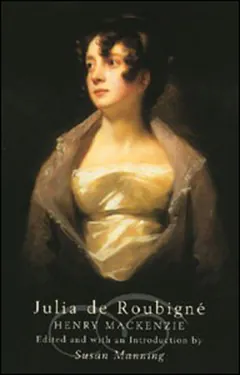
Julia de Roubigné
Pages
This chapter is long, so it is split into 6 parts.
time, with a number of bleffings. When he turned back, mc thought I envied him his return. The full piftureofthc place we had left, rofe before me; it needed all rtiy relolution, and all my fears of offending, to prevent my weeping outright. At our dinner on the road, [ was very buty, and affeftcd to be very much pleafed j La Pelliere was a lucky com-
. panion
\
192 JULIA DE ROUBIGNe'.
panion for mc; you know how full flic is of obfervation on trifles.
When we approached the houfc, (he fpoke of every thing, and praifed every thing; I had nothing to do but to aflent.
We entered between two rows of lime-trees, at the end of which is the gate
., of the houfe, wide and rudely magnificent ; its large leaves were opened to receive us by an old but frefli-looking fcr-vant, who feemed too honeft to be polite, and did not fhew mc quite fo much curtefy as fome miftreflcs would have expefted. All thefe circumftances however were in a ftile, which my friend has heard tne com-
. mend \ yet was I weaW enough, notjper-feftly to'relifli them when they happened to myfelf. There was a prefaging gloom about this manfion which filled my approach
proach with terror 5 and when Montau-ban's old domeftic opened the coach-door^ I looked upon hin) as a criminal might do on the meiTenger of death. My dreams ever fince have been full of hor-ror; and while I write thefc lines, the creaking of the pendulum of the great clock in the halU founds like the knell of your devoted Julia.
I expeft you to rally me on my ideal terrors* You may remember, when we uled to deal a midnight hour's converfa-tion together, you would laugh at my ibreboding of a fliort period to my life^ and often jeeringly tell me, I was bom to be a great-grandmother in my time. I know the fooliflinefs of this Impret fion, though I have not yet fecen able to
yoL. I. K conquer
194 JULIA D£ KOUBIGNE.
conquer it. But to me it is not the fource of difquiet:; I never feel more pofTefled &f myfelf than at thofe moments when I indulge it the mofi. Why fhould I wilh for long life i why ihould fo many wiih for it ? Did we Ht down to number
the calamities of this worlds did we think how many wretches there are of
difcafe, of poverty, of opprelfion, of vice, (alas \ I fear there are fome even of virtue) we (hould change one idea of evil, and learn to look on death as a friend.
This might a philofopher accomplilh ^ but a Chriftiany Maria, can do more* Religion has taught me to look beyond diflfolution* Religion has removed the darkneis that covered the fepukhres of our fathers, and filled that gloomy void-vhich was only the retreat of hopelefs af-fliftion, with profpcAs, in contemplatioa of which, even the felicity of the world dwindles into nothing I IMD OF THE riRST VOLUME.
JULIA DE ROUBIGNE,
A TALE.
IN A SERIES OP tETTERS.
PUBLISHED BY
The AUTHOR of THE MAN QF FEELING, and THE MAN OF THE
WORLD.
VOLUME THE SECQND.
LONDON:
PRINTED FOR W. STRAHAN; AND T. CADELL, IN THE STRAND.
M DCC LXX VII.
ADVERTISEMENT*
JUi Y readers will cafily perceive fome-thing particular,Tia the place where
V
the following letters oiSavtllon arc Foun^ as they are manifeftly of a date confi* derably prior to many of the preceding. They came to my hands, aflbrted in the manner 1 have now publifhed them, probably from a view in my young friend, who had the charge of their arrangement, of keeping the correfpondencc of Julia, Vol* II. A 3
which
^ <k.
[ vi J
which communicated the great train of her feelings on the fubjefts contained in them, as much undivided as poffibk. While I conjedured this reafon for their prefent order, I was aware of fome advantage, which thefe papers, as relating a ftory, might derive from an alteration in that particular St but, after balancing thofe difTetent confiderations, without coming to any decifion, my indolence, perhaps (aftronger motive with moft mcntbaa they are difpofed to allow), at length prevailed, and I refolved t6 give them to the Public in the order they were tranfmitted to me from France, Many of the particulars.
. C vii ]
ticulars they recount are anticipated by a perufal of the foregoing letters; but it is not fo much on ftory, as fentiment, that -their intereft with the reader muft dc-pend.
JULIA
JULIA DE ROUBIGNE,
TALE.
IN A SERIES OF LETTERS.
LETTER XXVL
Savillon to Beauvaris.
AF T E R a very unfavourable paflagc,' we are at laft arrived at our deftined port. A (hip is lying along-fide of us, ready to fail for France, and every one on board, who can write, is now writing to fome relation or friend, the hard-(hips of his voyage, and the period of his Vol. II. B arrival.
arrival. How few has Savillon to greet with tidings! to Roubigne I have already written; to Beauvaris I am now writing; and, when I have excepted thefe, there is not in France a fingle man, to whom I am entitled to write. Yet I mean not to clafs them together : to Rou-biane I owe the tribute of efteem, the debt of gratitude 5 for you 1 feel fome-thing tenderer than either. Roubigne has been the guide, the father, of my youth, and him I reverence as a parent: you have been the friend, the brother, of my foul, and with yours it mingles as with a part of itfelf.
You remember the circumftanccs of our parting. You would not bid me adieu till the Ihip was getting under way : I believe you judged aright, if^you meant
to
to ijpare us both; the buftle of the fcene, the rattling of the fails, the noife of the failors, had a mechanical efFedt on the mind, and ftifled thofe tender feelings, which we indulge in folitude and filence. When I went to bed, I had time to indulge them. I found it vain to attempt fleeping, and fcarcely wiflied to fucceed in attempting it. About miJnight I arofe, and went upon deck. The wind had been fair all day, and we were then, I fuppofe, more than thirty leagues from the fhore. 1 looked on the arch of heaven, where the moon purfued her
courfe unclouded ; and my ear caught no found, except the ftilly noife of the fea around me. I thought of my diflance from France as of fome illufivc dream, and could not believe, without an effort, that it was not four and twenty hours fince
B 2 wc
we parted. I recoUeftcd a thoufand things which I (hould have faid to you, and Ipoke them involuntarily in the car of night.
There was, my friend, there was one thing, which I meant to have told you at parting* Had you (laid a few moments longer in the room after the feaman called us, I Ihould have fpoken it then; but you (bunned being alone with me, and I could not command even words enough to tell you, that I wilhcd to fpeak with you in private. Hear it now, and pity your Savillon.
Julia de Roubigne!—Did you feel that name, as I do1—Even traced with n^ own pen, what throbbing remembrances has it raifcd !—You are acquainted with
-f" my
my obligations to her father: you have heard me fometimcs talk of her; but you know not, for I trembled to* tell you^ the power Ihe has acquired over the heart of your friend.
The fate of my father, as well as mutual inclination, made Roubigne his friend 5 for this laft is of a temper formed rather to delight in the pride of ^flirting unfortunate 'v^orth, than in the joy of knowing it in a better fituation. After the death of my father, t became the wdrd of his friend's generofity: a ftate I Ihould have brooked but ill, had not Ju« lia been his daughter. From thofe early days, when firft I knew her, I remem* ber her friendlhip as making part of my exiftence: without her, pleafure was vapid, and forrow, in her fociety, was 6 ^ change^
changed into enjoyment. At that time of life, the mind has little referve. We meant but friendfhip, and called it fo without alarm. The love, to which at length I difcovered my heart to be fub* jeft, had conquered without tumult, and become delpotic under thcufcmblance of freedom.
The misfortunes of her family firft Ihewcd me how I loved.—When her father told them the ruined ftate of his fortune, when he prepared them for leaving the now alienated feat of his ancef-tors, I was a fpedlator of the fcene. When I faw the old man^ with indignant pride, ftifling the anguifli of hifr heart, and pointing to the chaife that was to carry them from BelviHe, hi» wife, with one hand clafping her hufband's^
band's, the other laid on her borom, turning up to Heaven a look of refignation 5 his daughter, ftriving to check her tears,: kneeling before him, and vowing her duty to his misfortunes ; then did I firft curfe my poverty, which prevented me from throwing myfelf at her feet, and bidding her parents be happy with their Julia! —The luxury of the idea ftill rufhcs on my mind!—to heal the fortunes of my father's friend; to juftify the ways of Heaven to his faint-like wife ; to
'Wipe the tears from the eyes of his angel daughter!—Beauvaris, our philo-fophy is falfc: power and wealth arc the choiceft gifts of Heaven: to poflefs them indeed, is nothing, but thus to ufe them, is rapture!
B 4 I had
I had them not thus to ufe j but what I could, I did. I attended his family to that ancient manfion, which was now the folc property of the once opulent Rou-bigne. With unwearied attention I footh-cd his forrows, and humbled myfelf be-* fore his misfortunes, as much as I had formerly refifted dependence on his pro-fperity.
He felt the affiduity of my fricndlhip, and I faw him grateful for its exertion i yet would the idea of beingobliged,often rankle in his mind
; and I have feen him
4
frequently look at me with an appearance of anger, when he thought I was confci-ous of obliging him.
Far diflfcrent was the gentle nature of his daughter. She thanked me with unfeigned
feigned gratitude for my fervices to her father, and fcemed folicitous to com-penfate with her fmiles, for that want of acknowledgment fhc obfcrved in him*
Had my heart been free before, it w? ? impoffible to prefcrve its freedom now,' A fpedator of all thofe excellencies which, though (he ever pofTeflcd, her prcfcnt fituation alone could give full room to exert; all that fublimity'of mind, which, bore advcrfity unmoved ; all that gentle* . nefs, which contrived to lighten it to her father, and fmooth the rankling of his haughty foul! I applauded the eleftion I had made, and looked on my lave as a virtue*
Yet there were moments of anxiety, in which I feared the confequences of
B 5 in*
10 JULIA DE ROUBIGNE,
indulging this attachment. My own fitu^ ation^ the fituation of Julia, the pride of her father, the pride which it was proper for herfelf to feel: all thefc were prcfcnt to my view, and fliewcd me how little I could build on hope •, yet it cheats ed me, I know not how, and I dreamed, /rom day to day, of blefTings, which every da/a. refledioD
told me were not to be looked for*
There was, indeed, foihething in the fcene around us, formed to create thofc romantic illufions. The retreat of Roi>* bigne is a venerable pile, the remains of ancient Gothic magnificence, and the grounds adjoining to it are in that ftyle of melancholy grandeur, which marks the dwellings of our forefathers. One part of that fmall cftate, which is ftill
the
the appendage of this oncc-rcfpcaable manfion, is a wild and rocky dell, where taftelefs wealth has never warred on nature, nor even elegance refined or em-belliihed her beauties." The walks are only worn by the tread of tlic Ihepherds, and the banks only fmoothed by the feeding of their flocks. There, too dangerous fociety! have I pafled whole days
with Julia : there, more dangerous ftill! have I palTcd whole days in thinking of her.
A circun)(lance, trifling in itfclf, added not a little to the fafcinatlon of the reft. The fame goo^ woman who nurfed me, was alfo'the nurfe of Julia. She was too fond of her fofter-daughter, and too well treated by her, ever to • leave the fortunes of her family^ To this rcfidence B6 ihe
~I2* JULIA Dfi ROUBIGNe',
Ibe attended them when they left Belville^ * and here too, as at that place, had a (mall hqp^ and garden allotted her. It was fituated at the extreme verge of that dell I have defcribed, and was often the etid 'of thofe walks we took through it together. The good Lafune, for that is pur nurfe's nana^ confidered us her children, and treated us, in thofe vilits to her little dwelling, with that fimplicity of af-fedlion, which has the moft powerful ef-fe6l: on hearts of fenfibility. Oh! Beau-varis!
methinks I fee the figure of La-fune, at this moment, pointing out to your.friend, with rapture in her coun^ tcnapce, the beauties of her lovelj; daugh-^ter ! She places our feats together; fhc produces her
fhining platters, with fruit and milk,, /or our rcpaft i fhe prcflfes the fmiling Julia, and will not be denied by «' Sa-Savillon!—Am I then a thoufand leagues diftant ?
Does Julia remember Savillon ?—Should I hope that fhc does ?—My friend, 1 will confeli my wcaknefs ; perhaps, it is worfe than weaknefs; I have wiftied—I have hoped, that I am not indifferent to her, ^ Often have I been on the point of unload-* ing my throbbing heart, of telling her how paflioilately I loved, of aflcing her forgivenefs for my prefumption. I have thought, perhaps, it was vanity, that at fomc fcafons fhe might have anfwered and bleffed me; hut I faw the confe* quences which would follow to both^ and bad fortitude enough to refift the im-pulfe.—A time may come, when better fortune fliall entitle me to fpeak; when the
the pride of Roubigne may not blufli to look on Savillon as his fon.
But this is the language of viliohary hope ! In the mean time, I am torn from her, from France, from every connection my heart had formed; cad, like a fhipwrecked thing, on the other fide of the Atlantic, amidfl: a defert, of all others, the moft dreadful, the defert of ibciety, with which no focial tie unites
me !—Where now are Roubignc's little copfes, where his winding walks, his namelefs rivulets ? Where the ivy'd gate of his venerable dwelling, the Gothic windows of his echoing hall?—That morning, on which I fct out for Paris, is ftill frefli on my memory. I could not bear the formality of parting, and Hole
from
from his houfe by day-break. As I pafled that hall, the door was open/, I
entered to take one laft look, and bid it adieu ! I had fat in it with Julia the night before; the chairs we had occupied were ftill in their places4 you know not, my friend, what I felt at the fight: there was
fomething in the filent attitude of thofe very chairs, that wrung my heart beyond the power of language; and, I believe, the fervant had told me that my horfes waited, five or fix times over, before I could liften to what he faid.
A gentleman has fent to afk, if my name is Savillon: if it is, he defires Vis compliments, and will do himfelf
the
1^ JULIA DE ROUBIGNE'.
the pleafure of waiting of me. I ftarted to hear my name thus alked for in Mar* tinique.
This gentleman is a fea«captain, a particular acquaintance, of my uncle:
he is more, Beauvaris, he is an acquaintance of Roubigne, has been often at Bel* ville, has fometimes feen my Julia.— We are intin^atc already, and he has offered to condu6t me to my uncle's houfe : his horfes, he fays, arc in waiting.
Adieu, my deareft friend ! think of me often; write to me often; though you fliouH feldom have an opportunity of conveying letters, yet write as if you had; make a journal of intelligence^
and
*
and let it come when it may, Telt me
every thing, though I fhould afk nothing. Your letters muft give me back my country, and nothing is a trifle that belongs to her.
LETTER XXVIL
Savillon to Beauvaris.
T T is now a week fincc I reached my uncle's, during all which time I have been fo much occupied in anfwering quef-tions to the curiofity of others, or afking queftions for the fatisfaftion of my own, that I have fcarce had a moment left for any other cmJ)loyment.
I have now feized the opportunity of the reft of the family being ftill a-bed, to write to you an account of this uncle, of him under whofe protedion I am to rife into life, under whofe guidance I am to thrid the mazes of the world, 1 fear I
am
am unfit for the tafk: I muft unleari> feelings in which I have long been ac-cuftomed to delight: I muft accommodate fcntiment to conveniency, pride to intereft, and fometimes even virtue itfelJf to fafhion.
r
But is all this abfolutely neceflary ?— I hate to believe it. I have been frequent* ly told fo indeed, but my authorities are drawn either from men who have never entered the fcene at all, or entered it, re^ folved to be overcome, without the trouble of refiftance. To think too meanly of mankind is dangerous, to our reverence of virtue.
It is fuppofed, that in thefe wealth];^ iflands, profit is the only medium of opi^ nion, and that morality has nothing to do
aO JULIA DE ROUBIGNe'.
do in the fyftem ; but I cannot eafily imagine that, in any latitude, the bofomis (hut to thofe plcafurcs which rcfult from the cxcrcife of goodncfs, or that honefty fhould be always fo unfuccefsful as to have the fneer of the million againft it. Men will not be depraved beyond the perfuafion of fomc motive, and felf-intereft will oftca^ be the parent of focial obligation.
My uncle is better fitted for judging of this qucftioni he is cool enough to judge of it from experience^ without being milled by feeling.—He believes there are many more honeft dealings than honeft men, but that there are more honeft men than knaves every where 5 that? common fenfe will keep them fo, even ex-clufive of principle 5 but that all may be vanquilhed by adequate temptation.
\Sitk
With a competent ftiare of plain ufeful parts, and a certain fteady application- of mind, he entered into commerce at an early period of life. Not apt to be feduccd by
the glare of great apparent advantage, nor cafily intimidated from his purpofes by accidentaldifappointmentj he has held ■on, with Ibme viciffitude of fortune, but with uniform equality of temper, till, in virtue of his abilities, his diligence, and his obfervation, he has acquired very confiderable wealth. He ftill, however, continues the labour of the race, though Jie has already reached the goal; not becaufe he is covetous of greater riches, but ^becaufe the induftry, by.
whicli greater riches are acquired, is grown nc-■ceffary to his enjoyment of life. " I have
been long, faid he yefterday, a very hap* py man ^ having had a little lefs time,
and
I
and a little more money, than I know what to make of/*
The opinion of the world he truft* but little, in his judgment of others; of men's actions he fpeaks with. caution, either in praife or blame, and is commonly moft fceptical, when thofe around him are moft convinced: for ic is a maxim with him, in queftions of charafter, to doubt of ftrong evidence, from the very circumftance of its ftrength.
With regard to himfelf, however, he accepts of the common opinion, as a fort of coin, which pafles current, though it is not always real, and often feems to yield up the conviction of his own mind in compliance to the general voice. Ever averfc to fplcndid projeft in aftion,
or
J-fLIA DE ROUBIGNE^ SJ
or fplendid conjeAure in argument, he contents himfelf with walking in the beaten track of things, and does not even venture to leave it, though he may, now ^and then, obferve it making fmall deviations from reafon and juftice. He has fometimes, fince our acquaintance began, tapped me on the fhoulder, in the midft of fome fentiment I was uttering, and told me, with a fmile, that thefe ^ere fine words, and did very well in the mouth of a young,man. Yet he feems not difpleafed with my feeling what himfelf does not feel *, and looks on me with the more favourable eye, that I have fome* ithing about me for experience and obfer-vatioa to prune.
His plan of domeflic economy is regular, but nobody is difturbed" by its re-8 gula-
gularity; for he is pcrfefHy free from that rigid attention to method, which one frequently fees in the houfes of old bat-chelors. He has fenfe, or fang-froid enough, not to be troubled with little difarrangements, and bears, With wonderful complacency, and confequently with great eafe to guefts, thofe accidents which difturb the peace of other entertainments. Since my arrival, we have had tvtry day fomething like a fcaft, probably from a fort .C|f compliment which his friends meant to pay to him and to me; but at his table, in its moft elevated ftyle, thfc government is nearly republican; he affumes very little, either of the trouble, or the dignity of a landlord, fatisfied with giving a general afTurance of welcome and good*humour in his afpeA.
Ac
At one of thofe dinners was a neighbour and intimate acquaintance of my uncle, a Mr. Dorville, with his wife and daughter. The young lady was fcated next me, and my uncle feemed to incline that I fhould be particularly pleafed with her. He addrefled fuch difcQurfe to her as might draw her forth to the grcateft advantage; and, as he had heard me pro* fefs myfclf a lover of mufic, he mad« her fing, after dinner, till, I believe, fome^of the company began to be tired of their entertainment. After they were gone, he aflced my opinion of Made-*
moifclle Dorville, in that particular ftylc by which a man gives you to underftand, that his own is a very favourable one. To fay truth, the lady's appearance is in her favour; but there is a jealous fort of Vol. ir. C fciling.
feeling, which arifes in my mind, when I hear the praifes of any woman but one4 and, from that t:aufe perhaps, I anfwered my uncle rather coldly. I faw he thought fo, from the reply he made; I offered fomc aukward apology; he fmiled, and faid, I was a philofbpher. Alas!
*he knows not how little claim I have to phi-lofophy in that way; if, indeed, we are fd often to profane fhat word^ by affixing to it the idea of infenfibility.
To-day I begin bufinefe. Vlj unde and I are to view his different plantations, and be is to (hew me, in general, the province he means to dlot me. I wi(h for an opportunity to be affniuous in his fervice : till I can do fomething on my part, bis favours are debts upon me.
It
JUXIA DE ROUBIGNE' fif
5t is only to. a friend, like my Beauvaris, that one feels a pleafure in being ob-liged«
y
LETTER XXVIIL
SaviUon to BcauvariSm
A Thoufand thanks for your laft letter. When you know how much I enjoyed the unwieldy appearance of the packet, with my friend's hand on the back of it, you will not grudge the time it coft you. It is juft fuch as I wifhed : your fcene-painting is delightful. No man is more fufcepcible of local attachments than I; and, with the Atlantic between, there is not a ftone in France, which I can remember with indifference.
Yet I am happier here than I could venture to expe6t» Had I been left to
my
my own choice, I fliould probably have iat down in folitude, to think of the paft«; and enjoy my reflexions; but I have been forced to do better. There is an aftive duty, which rewards every man in the performance; and my uncle has fo contrived matters, that! have had very little time unemployed. He has been liberal of inftruftion, and, I hope, has found
me willing to be inftrufted^ Our bufi-nefs, indeed, is not very intricate •, but, in the fimpleft occupations, there are a thoufand little circumftances, which experience alone can teach us. In certain departments, however, I have tried pro-jefts of my own: fome of them have failed in the end, but all gave me plea-fure in the purfuit.
In one I have been fuccefsful beyond expedation; and in that one I was the moft deeply interefted,
C 3, becaufe
becauie it couched die caufe of huma!f>
Ta a man not callous from habit, the. treatment of the negroes, in the plantations here, is (hocking. I felt it ftronglf,,
and could not forbear ezprefling my fen« timents to my uncle. He allowed them. to be natural, but pleaded necefllty, in, juftification of.
thofe feverities, which his. averleers fometimes ufed towards his flaves. I ventured to doubt this propo-fition,. and« begged he would fufFenme to« try a different mode of government in one plantation, the produce of which he had already allotted to my management. He confented, though with the- belief that I fhould fucceed very, ill in the experiment.
I begaa
I began by endeavouring to ingratiata myfelf with fuch of the (laves as could beft fpeak the language of my: country v but I found this was a. manner they did not underftand, and that, from a white,, the appearance of indulgence carried the fiifpicion of treaclieryv Moft of them^ to whom rigour had become habitual^ took the advantage of its remitting, ta negleft their work altogether; but this only fervcd to convince me, that my
plan was a good one, and that I fhould
undoubtedly profit, if I could eftablifbr
fome other motive, whofe impulfc wai
more fleady than tho fe of punifbmene and terror^
By continuing the mildncfs of my con-du^i I at lafl: obtained a degree of wil-Ibgnefs in the fervicc-of feme; and I was C 4 ftUl
ftill induced to believe, that the moft favage and fullcn among them had prin-ciples of gratitude, which a good matter might improve to his advantage.
One flave, in particular, had for fome time attrafted my notice, from that gloomy fortitude, with which he bore the hardfhips of his fituation. Upon inquiring of the overfeer, he told me, that this flave, whom he called Yanibu, though, from his youth and appearance of
ttrength, he ha[d been accounted va-^ luable, yet, from the untraftable ftub-bornnefs of his difpofition, was worth lefs money than almoft any other in my uncle*s pofleffion. This was a language natural to the overfeer. I anfwered him, ibn his own ftyle, that 1
hoped to improve his price fome hundreds of livrcs. On being
being further informed, that feveral of his fellow-flaves had come from the fame part of the Guinea coaft with him, I fent for one of them who could fpeak tolc* rable French, and queftioned him about Yambu. He told me, that, in their own country, Yambu was mafter of them all; that they had been taken prifoners when fighting in his caufe, by another prince, who, in one battle, was more fortunate than theirs ; that he had fold them: tofome white men, who came, in a great Ihip, to their coaft ; that they were after-wards brought hither, where other white men purchafed them from the firft, and fet them to work where I faw them; but that, when they died, and went beyond the Great Mountains, Yambu (hould be
their mafter again.
C5 Ldif.
I difmiffcd the negro, and called thf* Yambu before me.
When he came, he feemcd. to regard me with:an» eye of. perfcfl: indifference. One who had.inquired. no further, would have concluded hi<n. poffleffed of that ftupid infcnfibility,, whiqh Europeans ofr ten mention as an apology for their crur cities. I took his. hand; he confidercd this a prologue to chaftifement, and turned his back to receive the la(hes he fup* pofed me ready to inflift. " I wifh to be the friend of Yambti,*' faid I. Hq made me no anfwer: I let go his hand, and he fufFered it to drop to its former pofi ture. ** Can this man have been'a prince ;jn Africa ?** faid I to.myfelfj»-I reflefted for a moment.—" Yet what fhould he now do, if he has ?—
Juft what I fee him
do*
tm
do. I have feen a depofed favcreign at
Paris J but in Europe, kings are artificial
beings, like their fubjeds,—Silence is the
only throne which adverfity has left to princes."
" I fear, (feid I to him) you have been; fbmetithes treated harfhly by the over-feer j but you fliall be treated fo no more: I wifli all my people to be happy.** He looked on me now for the firft timc-^—
^•'Can you fpeak* my language, or fhall
I call for fome of your friends who cart explain what you would lay to me-?'*— ** I fpeak no fay to you," he replied irt his broken French.
—"And you will hat be my friend ?"—« No."—« Even if I fliould deferve it."—" Ydu a white man.'^ -^I felt the rebuke as I ought.*—"
But all white men are not overfeers. What
C6^v' ihall^
36 JULIA DE liOUSlGNE^
fliall I do to make you think me a good man ?"-^" Ufe men goodly."—" I mean to do fo, and you among the firft, Yam-^
bu."—"Be good for Yambu's peoplej do your pleafe with Yambu."
»•'
Juft then the bell rung as a fummons
for the negroes to go to work: he made a fewdeps towards the door. "
Would you now go to work (faid I), if you were at liberty to avoid ic?'*— " You make go for whip, and no man love go."—• ** I will go along with you, though I am not obliged \ for Ichufe to work fome-times, rather than be idle."-—" Chufc work, no work at all," faid Yambu.— 'Twas the very principle en which my
fyAem was founded.
JULIA DE ROVBJGNe'. j^
I took him with me into the houfe-^hen bur taik was over. •* I wrought chufe-work (faid I), Yambu, yet I did kfs than you ?»--«
Yambu do chufe-work then too ?»—« You fhall do fo al-ways, anfwered I; from this moment you-are mine no more!»—« You fdi 0,^ other white men then ?"_.. No, j.ou are free, and may do whatever you pleafe!"
« Yambu's pleafe no here, no this coun. try?" he replied, waving his hand, and looking wiftfully towards tht fea.-~«» I cannot give you back your country, Yambu; but I can make this one better for you.
You can make it better for me
too, ^d for your people !*» « Speak
Vambu that <faid he eagerly), and be good man !»-" You would not (faid I) make your people work by the whip, as you fee the overfeers do ?"—«« oh I no.
no
^9' JULIA; DE ROITBIGNe'.
•IK) whip !'*—" Yet thcymuft workj die-we fhall have no fugars to buy them meat and clothing with."—(He put his hand to his brow, as if I had ftarted a diffir culty he was unable ta overcome;)-—
** Then ydu (ball have the command of
*■ •.
them, and they (hall work chufe-work for Yan>buu"-^He looked aikance, as
if he. doubted the truth of what I faid; Lcallcd the negro with whom I had the firft converfation about him, and, points ing to Yambu, **
Your matter ((aid. I) is now free,, and may leave you when he pleafes-!"~^* Yambu.no leave you," faid : he to the negro warmly.—"
But he may
accompany Yambu if he chufesJ*
Yambu (hook his head.—" Matter, (faid his former fubje^), where we go ? leave good white, man, • and go to bad ; for much, bad white men in this country."
—-"Theiit
—" Then if you think it better, yout Ihall t,both ftayi Yambu ftiall be my friend, and help me to raife fugars for^ the. good of us all: you flull have no. overfeer but Yambu, and (hall work no more than he bids you.?"—The. negro fell at my icet, and kiffed them : Yambu flood filcnjt, and I faw a te^r on hia cheek.—*' This man has been a prince
\xi * Africa!" faid I to myfelf.
I did not mean to deceive them. Next mormng I called thofe negroes who had formerly been in his fcrvice together, and told them that, while they continued in the plantation, Yambu was to fuperin-tend their work; that, if they chofeto leave him and me, they were at liberty to go -, and that, if found idle or unworthy,, they Ihould not be allowed to ftay.
+ He
^ JULIA DE ROUBIGNeV
He has, accordingly, ever fincc had the command of his former fubjefts, and fupcrintcnded their work in a particular quarter of the plantation; and, having been declared free, accordingto the mode prefcribcd by the laws of the ifland, has a certain portion of ground allotted him,, the produce of which is his property. T have had the fatisfadtion of obfervino*
o
thofe men, under the feeling of good treatment, and the idea of liberty, do-more than almoft double their number fubjeft to the whip of an overfeer. I am under no apprehenfion of defertion or mutiny; they work with the willingnefe-of freedom, yet are mine with more than
the obligation of (lavery*
I have been often tempted to doubt whether there is not an error in the whole
pUo
plan of negro fervitude, and /Whether whites, or Creoles born in the Weft-Indies, or perhaps cattle, after the manner of European hufbandry, would not do the blirinefs better and cheaper than the flaves do. The money which the latter coft at firft, the ficknefs (often owing to defpondency of mind) to which they are liable after their arrival, and the proportion that die in confequence of it, make the machine, if it may be fo called, of a plantation extremely expenfivc: rn its operations. In the lift of flaves belonging to a wealthy planter, it would aftonifli you to fee the number unfit for fervice, pining Under difcafe, a burden
#
on their mafter.—I am talking only as a merchant:—but as a man—
good Heavens ! when I think of the many thou-fands of my fellow-creatures groaning
under
under fcrvitude and mifcry !——Great? God ! haft thou peopled thofe regions oS thy world for* the purpofe of calling ou& their inhabitants to chains and torture ?; —No; thou gavcft them a land teeming ^ith good things, and lighted'ft up th]» fun to bring forth fpontaneous plenty j,, but the refinements of man, ever at war w'.th thy works, have changed this fcene of profufion and luxuriance, into a thea«r tre of rapine, of flavcry, and.of murder I
Forgive the warmth of this apoftrophci here it would not be underftood j even my uacle, whofe heart is far from a hard one,, would fmile at my romance,. and tell me that thing? muft be fo.
Habits the tyrant of nature and of reafon, is. d^af to the voice of either 5 here flic flifle&.humanitj^,.and dehafes the fpecies..
—for*
—for the mafter of flavcs has feldom the foul of a man.
This. is. not difficult to,be accounted for; from his infancy he is made callous to thofe feelings, which fofjen at once and ennoble our nature. Children mud of ncceffity firft exert thofe towards do*
medics^ becaufe the fociety of domeftics is the firft they enjoy 5 here they arc taught to command for the fake of com* mandihg, to beat and'torture for pure amufement •^—their realbn and good*na-? ture improve as may be expefted.
Among the legends of a European^ nurfery, are ftories of captives delivered,, of flavcs releafcd, who had pined for -)Kcajrs in the durance of unmerciful ene*
mie3»
mies. Could we fuppofe its infant audience tranfported to the fea-
(hore, where a (hip laden with (laves is ju(t landing v the qucftion would be univerfal, ** Who fliall fct the(e poor people free ^—The young Weft-Indian aflcs his father to buy a Ijoy for him, that he may have Ibmc-thing to vent his fpite on when Jie is pecvifli.
Methinks too, thefe people lofe a fort of connexion which is of more importance in life than moft of the relationfhipa. we enjoy. The ancient, the tried domeftic of a family, is one of its mo{t ufeful members, one of its moft zffurtd fupports.. My friend,, the ill-fated Rou-bigne, has not one relation who has flood by him in the (hipwreck of his fortunes; but the ftorm could not kvtr from their
m after
JULIA P« ROUBIGNS'. . 45
mailer his faithful Le Blanc, or the vene* rableLafune.
Oh Beauvaris ! I Sometimes fit down alone, and tranfporting myfelf into the little circle at Roubigne's, grow fick of the world, and hate the part which I am obliged to perfor/n in it.
^B JULIA DB irotJBrGNE^
LETTER XXIX.*
Savillon to Seauvaris.
•O IN C E the date of my laft is a longer period than you allow between my letters} but my time has been more than commonly occupied of late. Among other employments was that of acquiring a friend. Be not, however, jealous : my iieart cannot own a fecond in the fame
* It is proper to apologize to the reader ibr intro-dacing a letter fo purely epifodical. I might tell hias that it is nof altogether unneceflarj, as it ilitrodacet to his acquaintance a perfon, whofe correfpoodent Savillon becomes at a future period; but I muft once more rcfort to an egotifm for the true reafon : the pifture it exhibited pleafed myfelf, and I could not >*efift the defire of communicating it, degree^
*flegree with Bcauvaris; yet is this one above the level of ordinary men. He enjoys alfo that privilege which misfortune beftows on the virtuous.
Among thofe, with whom my uncle's cxtenfive dealings have conncded him, he had nientioned, with particular commendation, one Herbert, an Englifhman,
a merchant iir one of the Britilh Weft-India iflands. Chance brought him latelf to Martinique, and I was folicitous to fhew every poffible civility to olfc, who, to the claim of a ftratiger, added ^e chara^r of a worthy and amiable man. PrepofTeiTed as I was in his favour, my cxpeftations fell Ihort of the reality* I difcovered in him a delicacy and finenefs of fentiment, which fomething beyond she education of a trader muft have in*
fpiredj
fpired; and I looked on him perhaps with the greater reverence, from the circum-ftance of having found him in a ftation where I did not expe6t he would be found. On a clofer inveftigation, I perceived a tindlure of melancholy enthufiafm in his mind, which, I was perfuaded, was not altogether owing to the national character, but muft have arifen from fome particular caufe. This increafed my regard for him ; and I could not help exprefling it in the very ftyle which was fuited to its obje£l:, a quiet and ilill attention, fym-pathetic but not intrufive. He feemed to take notice of my behaviour, and looked as if he had found a perfpn, who guefled him to be unhappy, and to whom he could talk of his unhappinefs. I en«
couraged the idea with that diffidence, which, 1 believe, is of all manners the
mod:
,moft intimate with a mind of the fort I
hav^ defcribed 5 and, foon after, he took an opportunity of telling me the ftory of his misfortunes.
It was fimple, bgt not the lefs pathe# tic. Inheriting a confiderable fortune from his father, he fet out in trader with every advantage.
Soon after he was &t« ftled in bufineb, he married a beautiful and excellent woman, for whom, from
his infancy, he had conceived the ten-dereft attachment; and^ about a year after tli^ir marriage, ihe ble0ed him with a foQ* But love and fortune did not long continue to fmile upon him. Loifes in trade, to
which, though benevolence like-his be more expofed, the mod prudent and unfeeling are liable, reduced him, from his former affluence, to very embar-^ Vol. 1I« D tafled raflcd circumftances;. and his diftrefs was aggravated from the confideration, that he did not fuflfer alone, but communicated misfortune to a woman he pafllonatel^ loved. Some very confiderable debts remained due to him in the Weft-IndieSy and he found it abfolutely neceflary for-their recovery, to repair thither himfelf, however terrible might be a reparation from his wife, now in a fituation of all others the moft fufceptible. They parted, and ftie was, foon after, delivered of a girl, whofe promifing appearance, as well as that of her brother, was fome confolation for the abfencc of their father.
His abfence, though duel, was necef-iary, and he found his affairs in fuch a fituation, that it promifi^d not to be long. Pay after day, however, elapfed, without
their
their final fetUeoienc. The impatience, both of his wife and him was increafed, by the appearance of a conclufion, which fo repeatedly difappointed them; till, at laft, he ventured to fuggeft, and flxe warmly approved, the expedient of coming out to a hufband, whofe circumftances presented him from meeting her at home. She fct fail with her children % but Wift nor children ever reached the unfortunate Herbert! they periflied in a ftorm f©oa after their departure from England.
You can judge of the feelings of a man,' who upbraided himfelf as their murderer. An interval of madnefs, he informed me,, fucceeded the account he received o^ their death. When, his reafon returned, it fettled ijito a melancholy, which time has foothcd, not extinguifhed, which
D 2 indeed
indeed feems to have become the habitual tone of his mind. Yet is it gentle, though deep, in its eSe£);s; it difturbs not the circle of focicty around him, and few, except fuch as are formed to difcover and to pity it, obferve any thing peculiar in his behaviour. But he holds it not the lefs facred to himfelf; and often retires from the company of thofe, whom he has entertained with the good-humour of a welt-bred nian, to arrange the memorials of his much-loved Emily, and call up the fad remembrance of his former joys,
, Having acquired a fort of privilege with his diftrefs, from my acquaintance with its caufe, I entred his room yefter-day, when he had thus fliut out the world, and found him with fome letters on the table before him, on which he
looked.
looked, with a tear, not of anguifh, but of tendernefs. I flopped Ihort on perceiving him thus employed j he feemed unable to fpeak, but making a movement, as if he defired that I (hould come forward, put two of thofc lettisrs fycceffively into my hand. They were written by his wife : the firft, foon after their ^^narriage, when fome bufinefs had called him away from her into the country 5 and the fecbnd, addreffed to him in the Weft-Indies, where, by that time, their ili-fortune had driven him. They pleafed me fo much, that I afked his leave to keep them for a day or two. He would not abfolutely refufe me v but faid they had never been out of his poffeflion. I
preffcd him no further: I could only read them over repeatedly, and fomc parts, that ftruck moft forcibly on my
D 3 me-
memory, which you know is pretty tenacious, I can recoiled almofl: verbatim. To another, it might feem odd to write fuch things as thefe
\ but my Beauvaris is never inattentive to the language of nature, or the voice of misfortune.
In the firft letter were the following expreflions.
** Tou know not what feelings are bert^ at tbusy for the firfi tiniij writing to my Henry under the name of a huJhand.-^A mixture of tendernefs^ of love^ of efteem^ and confidence. A fomethingy never experienced before^ is fo warm in my hearty that fure it is^ at this momenty mere worthy o^ his love than ever. — Shall not this laji, my Harry^ . notwitbftanding what 1 have heard from the fcoffers among you men ? I think it fbalL
It
JULIA HE ROUBIGRe', SS
// is not a tumultuous tranfport^ that mujl fuddenly difappear ; but the foft^ ftiU plea-fnre of a happy mind^ that can feel itt happihefsy and delight in its caufe\
** 1 have had Utile company Jince you left me^ and I wifh not for much. The idea of Hny Henry is my heft companion. I have figured out your journey^ your company^ and your bujinefsy and filled up my hours mtb the pi3ure of what ihey are to you.^\
*♦ John has jufi taken away nrf chicken >^ ymt, know be takes liherlies., — ^^ Dear hearty a leg and tving onhf,--^Betty fays^
Madam^ the cheefecakes are excellent.**-^!
fniikd at John's manner of preffing^ and
helped myfelf to a cbeefecake^ The poor fellow looked fo happy —
^^Mjf mafter wili
D 4 foon
fioH uturn^^ faid be^ by way of accounth^ for fny pmy dinner. He fet the wine upon 4he fable: J filled out hd^ a glafs^ and began to ibink of you 5 but^ in carrying ii to my lips J I reproached myfelf that it was not a bumper: that was remedied as it Jhould be. John J J
believej gu^ed at ibe torre^Hon* —" God Mefs bim /** / heard biff^
fayy muttering as be put up the things i^ hisbajkef. —/ fent bim
down with thertji of the bottle^ and tbey are now drinking your health in the kitchen.^*
" Mjf coujin Harriet has erne in to fee me J and is going on with the cap I was mak* ing upi while I write this by heif. She is a better milliner than /, and wotdd bavi altered it fomewbat ; but J ftuck to my own wayy for I beard you fay you liked it, in
in tbat Jhape.^--^^ It is not half fo. fajhion^
able J indeed^ my dear^^ faid Harriet ; but Jhe does not know the luxury of making up a cap to pleafe the hujhand one loves.—^his is all very fooUJh : is it not? but I love to tell you thofe trifles: it is like having you here. If you can^ write me juft fucb a letter about you.**
Gf the oth(jr letter, I recoUeft fome paiTages, fuch as thefe.
" Captain Lewfon has juft now been with me^ but has brought no letter \ and gives for reafon^ your having written by a fhip that left the ifland but a few days before him^ meaning the "Triton^ by which I got your lafi\ but I beg to hear from you by
*
every opportunity^ efpecially by fo friendly
*■
D 5 a hand
58 JtJI.iA O" koObigne'.
«„ ,« «, (to *' f^""**' " /'^ *""
we "J^ere not mbaff3 . ^^« -^
/.r .«. .«.r^^. '»«^/'"' ^'"' '^'^ ^*"^' '""*
7 fear, my love. ;"»« '^^iT^' "^ '"' ^^ nobly, than I hope I deferved:.
J ^as not ta U Jbocked hy any retrenchmenP from our for-s Vn»^<t ' T could have bom even mer ivay of hvtng . i f'Omi* f^^^
the'
JULIA DE RO'UBIGNE^ ^f
the bardjhips^ of pQverty^, bad it left n^e ffny Hariri^
ce
Tour fweetmeats arrived nsfiry fafe un* der the care of CapVain hevafm: the children have profited by tbem^ particularly Billy J who has ftill fome remains- rf the bo/)pingrCOUgb^ He afkedme^ if they did not come from papa ;. and wben^^ faid be^ will papa come-bimfelf? *^ Papa^^ cried my
little Emmy^ who has juft learned to lifp the word. " She never fAW
papa^ (replied her brother) did Jhe^ mamma .?"—/ could not ft and this prattle 5 my boy wept with me for company's fakeV^
« 4F » « «- 4^ « » « €►
" Emmy^ they tell mc^ will Se a beauty^^ She hasy t<i fay truthj lovely darbblue eyes^
D 6 and
6o JULIA DE ROUBIGNe'.
0nd a tharming complexion. I think therr is fomething of melancholy in her look y but^ this may be only my fancy. Bilfy is quia different^
a bold fpirited child j yet he is remarkably attentive to every thing I endeavour to teach him^ and can read a little ah ready^ with no other tutor than'inyfelf I chofe this tajki to amufe my lonely houfs v for I make it a point of duty^ to keep up my fpirits as well as I can.
Sometimes^ indeed^ I droop infpite ofme^ efpecially when yott feem to waver about the time of your return^, "^hinky my love^ ■
what rijks your health runs for the fake of thofe richesy which are e(f no ufe without it -, and^ after ally it is chiefly in opinion^ that their power of be* flowing happinefs conjtfts. I am fure^ the little parlour^ in which I now write^ is - more fnug and comfortable^
than the large room we ufed to receive company in formerly %
and
and the plain mealy to which I Jit down with my children^ has more relijb than the formal dinners we were obliged to invite them to.
Return then^ my deareft Harry^ from tbofe fatigues and dangers^ to whichj by youw own accounty you are obliged to be expofed^ Return to your Emily's love^ and the fmiles of thofe little cherubs that wait your ar^ rivalJ^
Such was the wife whom Herbert loft; you wiil not wonder at his grief; yet fometimes, when the whole fcene is before me, I know not how, I almoft envy him his tears.
It is fomething to endeavour to com» fort him, 'Tis perhaps a felfifh movement in our nature, to conceive an attachment 62 jrLIA DE roubigne''.
Blent to fuch a charafler; one that throws itfclf on our pity by feeling its diftrefleSy, is ever more beloved than chat which rifcs above them.
—I know, however, without farther inquiry, that I feel myfelf pleafed with being the friend oS Herbert; would wc were in France, that I might make him- the friend of Beauvaris I