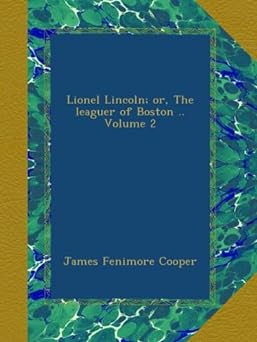
Lionel Lincoln; or, The leaguer of Boston .. Volume 2
Lionel Lincoln Volume 2 continues James Fenimore Cooper’s 1825 historical novel about the early months of the American Revolutionary War in Boston. Volume 1 had established the situation in the city, the central character Lionel Lincoln as a young British officer of American ancestry, and the various plot threads involving the family inheritance, the romantic subplot, and the wider political situation. Volume 2 carries the story through the major events that followed the opening of armed conflict, including the Battle of Bunker Hill in June 1775 and the wider American siege of Boston that would eventually force the British evacuation of the city in March 1776.
The second volume develops the wider historical and personal plot threads that the first volume established. Lionel’s complicated position as a British officer with American family connections becomes increasingly difficult to maintain as the political situation polarizes and as the personal complications of his family inheritance and his developing relationship with Cecil Dynevor force him to make choices that his initial position did not anticipate. Cooper handles the wider historical material with the kind of detailed attention that his serious historical fiction reliably delivered, with the major events of the early war unfolding alongside the personal and family drama that drives the wider novel.
Cooper had researched the Revolutionary period extensively in preparation for the novel, drawing on the available documentary sources for the early months of the war. The Battle of Bunker Hill in particular receives substantial attention, with Cooper rendering the chaos, the heavy casualties, and the moral weight of one of the most consequential early engagements of the war with the kind of seriousness the material deserved. The wider American siege of Boston that followed the battle and that eventually forced the British evacuation provides the structural framework for much of the second volume.
The family secrets and inheritance plot that Cooper had set up in the first volume comes to its various reveals in the second, with the wider Lincoln family history that has been gradually surfacing across the novel reaching the kind of resolution that the historical romance tradition required. The romantic subplot involving Lionel and Cecil also reaches its resolution, with the political and personal complications that the wider novel has been developing finding their conclusion in the closing chapters.
Cooper’s prose is in the formal style of his time, which can take some getting used to. The combination of historical material and personal drama gives the novel its particular character within Cooper’s wider catalogue. For Cooper completists, for students of early American historical fiction, or for readers interested in how American writers of the early nineteenth century thought about the Revolutionary moment, Lionel Lincoln is essential. The two volume structure rewards being read in order from Volume 1.
About the Author
James Fenimore Cooper was an early American novelist best known for The Last of the Mohicans and the Leatherstocking Tales, frontier adventures that helped shape the myth of the American wilderness.
See all books by James Fenimore Cooper →