
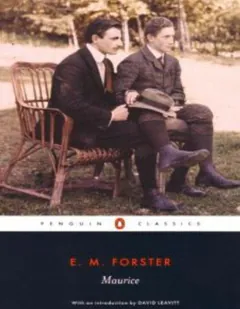
Maurice
Part
This chapter is long, so it is split into 2 parts.
Their passion for each other was the strongest force in either family, and drew everything
after it as a hidden current draws a boat. Mrs Hall and Mrs Durham came together because their sons were friends; "and now," said Mrs Hall, "we are friends too."
Maurice was present the day their "friendship" began. The matrons met in Pippa's London house. Pippa had married a Mr London, a coincidence that made a great impression on Kitty, who hoped she would not think of it and laugh during tea. Ada, as too silly for a first visit, had been left at home by Maurice's advice. Nothing happened. Then Pippa and her mother motored out to return the civility. He was in town but again nothing seemed to have happened, except that Pippa had praised Kitty's
brains to Ada and Ada's beauty to Kitty, thus offending both girls, and Mrs Hall had warned Mrs Durham against installing hot air at Penge. Then they met again, and as far as he could see it was always like this; nothing, nothing, and still nothing.
Mrs Durham had of course her motives. She was looking out wives for Clive, and put down the Hall girls on her list. She had a theory one ought to cross breeds a bit, and Ada, though suburban, was healthy. No doubt the girl was a fool, but Mrs Durham did not propose to retire to the dower house in practice, whatever she might do in theory, and believed she could best manage Clive through his wife. Kitty had fewer qualifications. She was less foolish, less beautiful, and less rich. Ada would inherit the whole of her grandfather's fortune, which was considerable, and had always inherited his good humour. Mrs Durham met old Mr Grace once, and rather liked him.
Had she supposed the Halls were also planning she would have drawn back. Like Maurice they held her by their indifference. Mrs Hall was too idle to scheme, the girls too innocent.
Mrs Durham regarded Ada as a favourable line and invited her to Penge. Only Pippa, into whose mind a breath of modernity had blown, began to think her brother's coldness odd.
"Clive, are you going to marry?" she asked suddenly. But his reply, "No, do tell mother,"
dispelled her suspicions: it is the sort of reply a man who is going to marry would make.
No one worried Maurice. He had established his power at home, and his mother began to speak of him in the tones she had reserved for her husband. He was not only the son of the house, but more of a personage than had been expected. He kept the servants in order, understood the car, subscribed to this and not to that, tabooed certain of the girls'
acquaintances. By twenty-three he was a promising suburban tyrant, whose rule was the stronger because it was fairly just and mild. Kitty
protested, but she had no backing and no experience. In the end she had to say she was sorry and to receive a kiss. She was no match for this good-humoured and slightly hostile young man, and she failed to establish the advantage that his escapade at Cambridge had given her.
Maurice's habits became regular. He ate a large breakfast and caught the 8.36 to town. In the train he read the Daily Telegraph. He worked till 1.0, lunched lightly, and worked again through the afternoon. Returning home, he had some exercise and a large dinner, and in the evening he read the evening paper, or laid down the law, or played billiards or bridge.
But every Wednesday he slept at Clive's little flat in town. Weekends were also inviolable.
They said at home, "You must never interfere with Maurice's Wednesdays or with his weekends. He would be most annoyed."
20 Clive got through his bar exams successfully, but just before he was called he had a slight touch of influenza with fever. Maurice came to see him as he was recovering, caught it, and went to bed himself. Thus they saw little of one another for several weeks, and when they did meet Clive was still white and nervy. He came down to the Halls', preferring their house to Pippa's, and hoping that the good food and quiet would set him up. He ate little, and when he spoke his theme was the futility of all things.
"I'm a barrister because I may enter public life," he said in reply to a question of Ada's. "But why should I enter public life? Who wants me?"
"Your mother says the county does."
"If the county wants anyone it wants a Radical. But I've talked to more people than my mother, and they're weary of us leisured classes coasting round in motor-cars and asking for something to do. All this solemn to and fro between great houses —it's a game without gaiety. You don't find it played outside England. (Maurice, I'm going to Greece.) No one wants us, or anything except a comfortable home."
"But to give a comfortable home's what public life is," shrilled Kitty.
"Is, or ought to be?"
"Well, it's all the same."
"Is and ought to be are not the same," said her mother, proud of grasping the distinction.
"You ought to be not interrupting Mr Durham, whereas you—"
"—is," supplied Ada, and the family laugh made Clive jump.
"We are and we ought to be," concluded Mrs Hall. "Very different."
"Not always," contradicted Clive.
"Not always, remember that, Kitty," she echoed, vaguely admonitory: on other occasions he had not minded her. Kitty cried back to her first assertion. Ada was saying anything, Maurice nothing. He was eating away placidly, too used to such table talk to see that it worried his friend. Between the courses he told an anecdote. All were silent to listen to him. He spoke slowly, stupidly, without attending to his words or taking the trouble to be interesting.
Suddenly Clive cut in with "I say— I'm going to faint," and fell off his chair.
"Get a pillow, Kitty: Ada, eau de cologne," said their brother. He loosened Clive's collar.
"Mother, fan him; no; fan him . . ."
"Silly it is," murmured Clive.
As he spoke, Maurice kissed him.
"I'm all right now."
The girls and a servant came running in.
"I can walk," he said, the colour returning to his face.
"Certainly not," cried Mrs Hall. "Maurice'U carry you—Mr Durham, put your arms round Maurice."
"Come along, old man. The doctor: somebody telephone." He picked up his friend, who was so weak that he began to cry.
"Maurice—I'm a fool."
"Be a fool," said Maurice, and carried him upstairs, undressed him, and put him to bed. Mrs Hall knocked, and going out to her he said quickly, "Mother, you needn't tell the others I
kissed Durham."
"Oh, certainly not."
"He wouldn't like it. I was rather upset and did it without thinking. As you know, we are great friends, relations almost."
It sufficed. She liked to have little secrets with her son; it reminded her of the time when she had been so much to him. Ada joined them with a hot water bottle, which he took in to the patient.
"The doctor'll see me like this," Clive sobbed.
"I hope he will."
"Why?"
Maurice lit a cigarette, and sat on the edge of the bed. "We want him to see you at your worst. Why did Pippa let you travel?"
"I was supposed to be well."
"Hell take you."
"Can we come in?" called Ada through the door.
"No. Send the doctor alone."
"He's here," cried Kitty in the distance. A man, little older than themselves, was announced.
"Hullo, Jowitt," said Maurice, rising. "Just cure me this chap. He's had influenza, and is supposed to be well. Result he's fainted, and can't stop crying."
"We know all about that," remarked Mr Jowitt, and stuck a thermometer into Clive's mouth.
"Been working hard?"
"Yes, and now wants to go to Greece."
"So he shall. You clear out now. I'll see you downstairs."
Maurice obeyed, convinced that Clive was seriously ill. Jowitt followed in about ten minutes, and told Mrs Hall it was nothing much—a bad relapse. He wrote prescriptions, and said he would send in a nurse. Maurice followed him into the garden, and, laying a hand on his arm, said, "Now tell me how ill he is. This isn't a relapse. It's something more. Please tell me the truth."
"He's all right," said the other; somewhat annoyed, for he piqued himself on telling the truth. "I thought you realized that. He's stopped the hysteria and is getting off to sleep. It's just an ordinary relapse. He will have to be more careful this time than the other, that's all."
"And how long will these ordinary relapses, as you call them, go on?
At any moment may he have this appalling pain?"
"He's only a bit uncomfortable—caught a chill in the car, he thinks."
"Jowitt, you don't tell me. A grown man doesn't cry, unless he's gone pretty far."
"That is only the weakness."
"Oh, give it your own name," said Maurice, removing his hand.
"Besides, I'm keeping you."
"Not a bit, my young friend, I'm here to answer any difficulties."
"Well, if it's so slight, why are you sending in a nurse?"
"To amuse him. I understand he's well off."
"And can't we amuse him?"
"No, because of the infection. You were there when I told your mother none of you ought to go into the room."
"I thought you meant my sisters."
"You equally—more, for you've already caught it from him once."
"I won't have a nurse."
"Mrs Hall has telephoned to the Institute."
"Why is everything done in such a damned hurry?" said Maurice, raising his voice. "I shall nurse him myself."
"Have you wheeling the baby next."
"I beg your pardon?"
Jowitt went off laughing.
In tones that admitted no argument Maurice told his mother he should sleep in the patient's room. He would not have a bed taken in, lest Clive woke up, but lay down on the floor with his head on a footstool, and read by the rays of a candle lamp. Before long Clive stirred and said feebly, "Oh damnation, oh damnation."
"Want anything?" Maurice called.
"My inside's all wrong."
Maurice lifted him out of bed and put him on the night stool. When relief had come he lifted him back.
"I can walk: you mustn't do this sort of thing."
"You'd do it for me."
He carried the stool down the passage and cleaned it. Now that Clive was undignified and weak, he loved him as never before.
"You mustn't," repeated Clive, when he came back. "It's too filthy."
"Doesn't worry me," said Maurice, lying down. "Get off to sleep again."
"The doctor told me he'd send a nurse."
"What do you want with a nurse? It's only a touch of diarrhoea. You can keep on all night as far as I'm concerned. Honestly it doesn't worry me—I don't say this to please you. It just doesn't."
"I can't possibly—your office—"
"Look here, Clive, would you rather have a trained nurse or me? One's coming tonight, but I left word she was to be sent away again, because I'd rather chuck the office and look after you myself, and thought you'd rather."
Clive was silent so long that Maurice thought him asleep. At last he sighed, "I suppose I'd better have the nurse."
"Right: she will make you more comfortable than I can. Perhaps you're right."
Clive made no reply.
Ada had volunteered to sit up in the room below, and, according to arrangement, Maurice tapped three times, and while waiting for her studied Clive's blurred and sweaty face. It was useless the doctor talking: his friend was in agony. He longed to embrace him, but remembered this had brought on the hysteria, and besides, Clive was restrained, fastidious almost. As Ada did not come he went downstairs, and found that she had fallen asleep. She lay, the picture of health, in a big leather chair, with her hands dropped on either side and her feet stretched out. Her bosom rose and fell, her heavy black hair served as a cushion to her face, and between her lips he saw teeth and a scarlet tongue. "Wake up," he cried irritably.
Ada woke.
"How do you expect to hear the front door when the nurse comes?"
"How is poor Mr Durham?"
"Very ill; dangerously ill."
"Oh Maurice! Maurice!"
"The nurse is to stop. I called you, but you never came. Go off to bed now, as you can't even help that much."
"Mother said I must sit up, because the nurse mustn't be let in by a man—it wouldn't look well."
"I can't think how you have time to think of such rubbish," said Maurice.
"We must keep the house a good name."
He was silent, then laughed in the way the girls disliked. At the bottom of their hearts they disliked him entirely, but were too confused mentally to know this. His laugh was the only grievance they avowed.
"Nurses are not nice. No nice girl would be a nurse. If they are you may be sure they do not come from nice homes, or they would stop at home."
"Ada, how long were you at school?" asked her brother, as he helped himself to a drink.
"I call going to school stopping at home."
He set down his glass with a clank, and left her. Clive's eyes were open, but he did not speak or seem to know that Maurice had returned, nor did the coming of the nurse arouse him.
21 It was plain in a few days that nothing serious was amiss with the visitor. The attack, despite its dramatic start, was less serious than its predecessor, and soon allowed his removal to Penge. His appearance and spirits remained poor, but that must be expected after influenza, and no one except Maurice felt the least uneasiness.
Maurice thought seldom about disease and death, but when he did it was with strong disapproval. They could not be allowed to spoil his life or his friend's, and he brought all his youth and health to bear on Clive. He was with him constantly, going down uninvited to Penge for weekends or for a few days' holiday, and trying by example rather than precept to
cheer him up. Clive did not respond. He could rouse himself in company, and even affect interest in a right of way question that had arisen between the Durhams and the British Public, but when they were alone he relapsed into gloom, would not speak, or spoke in a half serious, half joking way that tells of mental exhaustion. He determined to go to Greece.
That was the only point on which he held firm. He would go, though the month would be September, and he alone. "It must be done," he said. "It is a vow. Every barbarian must give the Acropolis its chance once."
Maurice had no use for Greece. His interest in the classics had been slight and obscene, and had vanished when he loved
Clive. The stories of Harmodius and Aristogeiton, of Phaedrus. of the Theban Band were well enough for those whose hearts were empty, but no substitute for life. That Clive should occasionally prefer them puzzled him. In Italy, which he liked well enough in spite of the food and the frescoes, he had refused to cross to the yet holier land beyond the Adriatic. "It sounds out of repair" was his argument. "A heap of old stones without any paint on. At all events this"1—he indicated the library of Siena Cathedral—"you may say what you like, but it is in working order." Clive, in his amusement, jumped up and down upon the Piccolomini tiles, and the custodian laughed too instead of scolding them. Italy had been very jolly—as much as one wants in the way of sight-seeing surely—but in these latter days Greece had cropped up again. Maurice hated the very word, and by a curious inversion connected it with morbidity and death. Whenever he wanted to plan, to play tennis, to talk nonsense, Greece intervened. Clive saw his antipathy, and took to teasing him about it, not very kindly.
For Clive wasn't kind: it was to Maurice the most serious of all the symptoms. He would make slightly malicious remarks, and use his intimate knowledge to wound. He failed: i.e., his knowledge was incomplete, or he would have known the impossibility of vexing athletic love. If Maurice sometimes parried outwardly it was because he felt it human to respond: he always had been put off Christ turning the other cheek. Inwardly nothing vexed him. The desire for union was too strong to admit resentment. And sometimes, quite
cheerfully, he would conduct a parallel conversation, hitting out at Clive at times in acknowledgement of his presence, but going his own way towards light, in hope that the beloved would follow.
Their last conversation took place on these lines. It was the evening before Clive's departure, and he had the whole of the
Hall family to dine with him at the Savoy, as a return for their kindness to him, and had sandwiched them out between some other friends. "We shall know what it is if you fall this time," cried Ada, nodding at the champagne. "Your health!" he replied. "And the health of all ladies. Come, Maurice!" It pleased him to be slightly old-fashioned. Healths were drunk, and only Maurice detected the underlying bitterness.
After the banquet he said to Maurice, "Are you sleeping at home?"
"No."
"I thought you might want to see your people home."
"Not he, Mr Durham," said his mother. "Nothing I can do or say can make him miss a Wednesday. Maurice is a regular old bachelor."
"My flat's upside down with packing," remarked Clive. "I leave by the morning train, and go straight through to Marseilles."
Maurice took no notice, and came. They stood yawning at each other, while the lift descended for them, then sped upwards, climbed another stage on their feet, and went down a passage that recalled the approach to Risley's rooms at Trinity. The flat, small, dark, and silent, lay at the end. It was, as Clive said, littered with rubbish, but his housekeeper, who slept out, had made up Maurice's bed as usual, and had arranged drinks.
"Yet again," remarked Clive.
Maurice liked alcohol, and had a good head.
"I'm going to bed. I see you've found what you wanted."
"Take care of yourself. Don't overdo the ruins. By the way—" He took a phial out of his pocket. "I knew you'd forget this. Chlorodyne."
"Chlorodyne! Your contribution!"
He nodded,
"Chlorodyne for Greece. . . . Ada has been telling me that you thought I was going to die. Why on earth do you worry about my health? There's no fear. I shan't ever have so clean and clear an experience as death."
"I know I shall die some time and I don't want to, nor you to. If either of us goes, nothing's left for both. I don't know if you call that clean and clear?"
"Yes, I do."
"Then I'd rather be dirty," said Maurice, after a pause. Clive shivered.
"Don't you agree?"
"Oh, you're getting like everyone else. You will have a theory. We can't go quietly ahead, we must always be formulating, though every formula breaks down. 'Dirt at all costs' is to be yours. I say there are cases when one gets too dirty. Then Lethe, if there is such a river, will wash it away. But there may not be such a river. The Greeks assumed little enough, yet too much perhaps. There may be no forgetfulness beyond the grave. This wretched equipment may continue. In other words, beyond the grave there may be Hell."
"Oh, balls."
Clive generally enjoyed his metaphysics. But this time he went on. "To forget everything—
even happiness. Happiness! A casual tickling of someone or something against oneself—
that's all. Would that we had never been lovers! For then, Maurice, you and I should have lain still and been quiet. We should have slept, then had we been at rest with kings and counsellors of the earth, which built desolate places for themselves—"
"What on earth are you talking about?"
"—or as an hidden untimely birth, we had not been: as infants which never saw light. But as it is—Well, don't look so serious."
"Don't try to be funny then," said Maurice. "I never did think anything of your speeches."
"Words conceal thought. That theory?"
"They make a silly noise. I don't care about your thoughts either."
"Then what do you care about in me?"
Maurice smiled: as soon as this question was asked, he felt happy, and refused to answer it.
"My beauty?" said Clive cynically. "These somewhat faded charms. My hair is falling out.
Are you aware?"
"Bald as an egg by thirty."
"As an addled egg. Perhaps you like me for my mind. During and after my illness I must have been a delightful companion."
Maurice looked at him with tenderness. He was studying him, as in the earliest days of their acquaintance. Only then it was to find out what he was like, now what had gone wrong with him. Something was wrong. The diseases still simmered, vexing the brain, and causing it to be gloomy and perverse, and Maurice did not resent this: he hoped to succeed where the doctor had failed. He knew his own strength. Presently he would put it forth as love, and heal his friend, but for the moment he investigated.
"I expect you do like me for my mind—for its feebleness. You always knew I was inferior.
You're wonderfully considerate— give me plenty of rope and never snub me as you did your family at dinner."
It was as if he wanted to pick a quarrel.
"Now and then you call me to heel—" He pinched him, pretending to be playful. Maurice started. "What is wrong now? Tired?"
"I'm off to bed."
"I.e., you're tired. Why can't you answer a question? I didn't say 'tired of me', though I might have."
"Have you ordered your taxi for the nine o'clock?"
"No, nor got my ticket. I shan't go to Greece at all. Perhaps it'll be as intolerable as England."
"Well, good night, old man." He went, deeply concerned, to his room.
Why. would everyone declare Clive was fit to travel? Clive even knew he wasn't himself. So methodical as a rule, he had put off taking his ticket till the last moment. He might still not go, but to express the hope was to defeat it. Maurice undressed, and catching sight of himself in the glass, thought, "A mercy I'm fit." He saw a well-trained serviceable body and a face that contradicted it no longer.
Virility had harmonized them and shaded either with dark hair.
Slipping on his pyjamas, he sprang into bed, concerned, yet profoundly happy, because he was strong enough to live for two.
Clive had helped him. Clive would help him again when the pendulum swung, meanwhile he must help Clive, and all through life they would alternate thus: as he dozed off he had a further vision of love, that was not far from the ultimate.
There was a knock at the wall that divided their rooms.
"What is it?" he called; then, "Come in!" for Clive was now at the door.
"Can I come into your bed?"
"Come along," said Maurice, making room.
"I'm cold and miserable generally. I can't sleep. I don't know why."
Maurice did not misunderstand him. He knew and shared his opinions on this point. They lay side by side without touching.
Presently Clive said, "It's no better here. I shall go." Maurice was not sorry, for he could not get to sleep either, though for a different reason, and he was afraid Clive might hear the drumming of his heart, and guess what it was.
22 Clive sat in the theatre of Dionysus. The stage was empty, as it had been for many centuries, the auditorium empty; the sun had set
though the Acropolis behind still radiated heat. He saw barren plains running down to the sea, Salamis, Aegina, mountains, all blended in a violet evening. Here dwelt his gods—Pallas Athene in the first place: he might if he chose imagine her shrine untouched, and her statue catching the last of the glow. She understood all men, though motherless and a virgin. He had been coming to thank her for years because she had lifted him out of the mire.
But he saw only dying light and a dead land. He uttered no prayer, believed in no deity, and knew that the past was devoid of meaning like the present, and a refuge for cowards.
Well, he had written to Maurice at last. His letter was journeying down to the sea. Where one sterility touched another, it would embark and voyage past Sunium and Cythera, would land and embark, would land again. Maurice would get it as he was starting for his work. "Against my will I have become normal. I cannot help it."
The words had been written.
He descended the theatre wearily. Who could help anything? Not only in sex, but in all things men have moved blindly, have evolved out of slime to dissolve into it when this accident of consequences is over.
sighed the actors
in this very place two thousand years before. Even that remark, though further from vanity than most, was vain.
23 Dear Clive,
Please come back on receiving this. I have looked out your connections, and you can reach England on Tuesday week if you start at once. I am very anxious about you on account of your letter, as it shows how ill you are. I have waited to hear from you for a fortnight and now come two sentences, which I suppose mean that
you cannot love anyone of your own sex any longer. We will see whether this is so as soon as you arrive!
I called upon Pippa yesterday. She was full of the lawsuit, and thinks your mother made a mistake in closing the path. Your mother has told the village she is not closing it against them. I called to get news of you, but Pippa had not heard either. You will be amused to hear that I have been learning some classical music lately—also golf. I get on as well as can be expected at Hill and Hall's. My mother has gone to Birmingham after changing backwards and forwards for a week.
Now you have all the news. Wire on getting this, and again on reaching Dover.
Maurice.
Clive received this letter and shook his head. He was going with some hotel acquaintances up Pentelicus, and tore it to pieces on the top of the mountain. He had stopped loving Maurice and should have to say so plainly.
24 He stopped a week more at Athens, lest by any possibility he was wrong. The change had been so shocking that sometimes he thought Maurice was right, and that it was the finish of his illness. It humiliated him, for he had understood his soul, or, as he said, himself, ever since he was fifteen. But the body is deeper than the soul and its secrets inscrutable.
There had been no warning—just a blind alteration of the life spirit, just an announcement,
"You who loved men, will henceforward love women. Understand or not, it's the same to me." Whereupon he collapsed. He tried to clothe the change with reason, and understand it, in order that he might feel less humiliated: but it was of the nature of death or birth, and he failed. It came during illness—possibly through illness. During the first attack, when he was severed from ordinary life and feverish, it seized an opportunity that it would have taken some time or other. He noticed how charming his nurse was and enjoyed obeying her.
When he went a drive his eye rested on women. Little details, a hat, the way a skirt is held, scent, laughter, the delicate walk across mud—blended into a charming whole, and it pleased him to find that the women often answered his eye with equal pleasure. Men had never responded—they did not assume he admired them, and were either unconscious or puzzled. But women took admiration for granted. They might be offended or coy, but they understood, and welcomed him into a
world of delicious interchange. All through the drive Clive was radiant. How happy normal people made their lives! On how little had he existed for twenty-four years! He chatted to his nurse, and felt her his for ever. He noticed the statues, the advertisements, the daily papers.
Passing a cinema palace, he went in. The film was unbearable artistically, but the man who made it, the men and the women who looked on—they knew, and he was one of the them.
In no case could the exaltation have lasted. He was like one whose ears have been syringed; for the first few hours he hears super-normal sounds, which vanish when he adjusts himself to the human tradition. He had not gained a sense, but rearranged one, and life would not have appeared as a holiday for long. It saddened at once, for on his return Maurice was waiting for him, and a seizure resulted: like a fit, it struck at him from behind the brain. He murmured that he was too tired to talk, and escaped, and Maurice's illness gave him a further reprieve, during which he persuaded himself that their relations had not altered, and that he might without disloyalty contemplate women. He wrote affectionately and accepted the invitation to recruit, without misgivings.
He said he caught cold in the car; but in his heart he believed that the cause of his relapse was spiritual: to be with Maurice or anyone connected with him was suddenly revolting. The heat at dinner! The voices of the Halls! Their laughter! Maurice's anecdote! It mixed with the food—was the food. Unable to distinguish matter from spirit, he fainted.
But when he opened his eyes it was to the knowledge that love had died, so that he wept when his friend kissed him. Each kindness increased his suffering, until he asked the nurse to forbid Mr Hall to enter the room. Then he recovered and could fly to Penge, where he loved him as much as ever until he turned up.
He noticed the devotion, the heroism even, but his friend bored him. He longed for him to go back to town, and actually said so, so near the surface had the rock risen. Maurice shook his head and stopped.
Clive did not give in to the life spirit without a struggle. He believed in the intellect and tried to think himself back into the old state. He averted his eyes from women, and when that failed adopted childish and violent expedients. The one was this visit to Greece, the other—
he could not recall it without disgust. Not until all emotion had ebbed would it have been possible. He regretted it deeply, for Maurice now inspired him with a physical dislike that made the future more difficult, and he wished to keep friends with his old lover, and to help him through the approaching catastrophe. It was all so complicated. When love flies it is remembered not as love but as something else. Blessed are the uneducated, who forget it
entirely, and are never conscious of folly or pruriency in the past, of long aimless conversations.
25 Clive did not wire, nor start at once. Though desir-ous to be kind and training himself to think reasonably of Maurice, he refused to obey orders as of old. He returned to England at his leisure. He did wire from Folkestone to Maurice's office, and expected to be met at Charing Cross, and when he was not he took a train on to the suburbs, in order to explain as quickly as possible. His attitude was sympathetic and calm.
It was an October evening; the falling leaves, the mist, the hoot of an owl, filled him with pleasing melancholy. Greece had been clear but dead. He liked the atmosphere of the North, whose gospel is not truth, but compromise. He and his friend would arrange something that should include women. Sadder and older, but without a crisis, they would slip into a relation, as evening into night. He liked the night also. It had graciousness and repose. It was not absolutely dark. Just as he was about to lose his way up from the station, he saw another street lamp, and then past that another. There were chains in every direction, one of which he followed to his goal.
Kitty heard his voice, and came from the drawing-room to welcome him. He had always cared for Kitty least of the family —she was not a true woman, as he called it now—and she brought the news that Maurice was away for the night on business. "Mother and Ada are in church," she added. "They have had to walk because Maurice would take the car."
"Where has he gone?"
"Don't ask me. He leaves his address with the servants. We know even less about Maurice than when you were last here, if you think that possible. He has become a most mysterious person." She gave him tea, humming a tune.
Her lack of sense and of charm produced a not unwelcome reaction in her brother's favour.
She continued to complain of him in the cowed fashion that she had inherited from Mrs Hall.
"It's only five minutes to church," remarked Clive.
"Yes, they would have been in to receive you if he had let us know. He keeps everything so secret, and then laughs at girls."
"It was I who did not let him know."
"What's Greece like?"
He told her. She was as bored as her brother would have been, and had not his gift of listening beneath words. Clive remembered how often he had held forth to Maurice and felt at the end an access of intimacy. There was a good deal to be saved out of the wreck of that passion. Maurice was big, and so sensible when once he understood.
Kitty proceeded, sketching her own affairs in a slightly clever way. She had asked to go to an Institute to acquire Domestic Economy, and her mother would have allowed her, but Maurice had put his foot down when he heard that the fees were three guineas a week.
Kitty's grievances were mainly financial: she wanted an allowance. Ada had one. Ada, as heiress-apparent, had to "learn the value of money. But I am not to learn anything." Clive decided that he would tell his friend to treat the girl better; once before he had interfered, and Maurice, charming to the core, had made him feel he could say anything.
A deep voice interrupted them; the churchgoers were back. Ada came in, dressed in a jersey, tam o'shanter, and gray skirt; the autumn mist had left a delicate bloom upon her hair. Her
cheeks were rosy, her eyes bright; she greeted him with obvious pleasure, and though her exclamations were the same as Kitty's they produced a different effect. "Why didn't you let us know?" she cried.
"There will be nothing but the pie. We would have given you a real English dinner."
He said he must return to town in a few minutes but Mrs Hall insisted he should sleep. He was glad to do this. The house now filled with tender memories, especially when Ada spoke. He had forgotten she was so different from Kitty.
"I thought you were Maurice," he said to her. "Your voices are wonderfully alike."
"It's because I have a cold," she said, laughing.
"No, they are alike," said Mrs Hall. "Ada has Maurice's voice, his nose, by which of course I mean the mouth too, and his good spirits and good health. Three things, I often think of it. Kitty on the other hand has his brain."
All laughed. The three women were evidently fond of one another.
Clive saw relations that he had not guessed, for they were expanding in the absence of their man. Plants live by the sun, yet a few of them flower at night-fall, and the Halls reminded him of the evening primroses that starred a deserted alley at Penge. When talking to her mother and sister, even Kitty had beauty, and he determined to rebuke Maurice about her; not unkindly, for Maurice was beautiful too, and bulked largely in this new vision.
The girls had been incited by Dr Barry to join an ambulance class, and after dinner Clive submitted his body to be bound. Ada tied up his scalp, Kitty his ankle, while Mrs Hall, happy and careless, repeated "Well, Mr Durham, this is a better illness than the last anyhow."
"Mrs Hall, I wish you would call me by my Christian name."
"Indeed I will. But Ada and Kitty—not you."
"I wish Ada and Kitty would too."
"Clive, then!" said Kitty.
"Kitty, then!"
"Clive."
"Ada—that's better." But he was blushing. "I hate formalities."
"So do I," came the chorus. "I care nothing for anyone's opinion—never did," and fixed him with candid eyes.
"Maurice on the other hand," from Mrs Hall, "is very particular."
"Maurice is a rip really—Waow, you're hurting my head."
"Waow, waow," Ada imitated.
There was a ring at the telephone.
"He has had your wire from the office," announced Kitty. "He wants to know whether you're here."
"Say I am."
"He's coming back tonight, then. Now he wants to talk to you."
Clive took the receiver, but only a burr arrived. They had been disconnected. They could not ring Maurice up as they did not know where he was, and Clive felt relieved, for the approach of reality alarmed him. He was so happy being bandaged: his friend would arrive soon enough. Now Ada bent over him. He saw features that he knew, with a light behind that glorified them. He turned from the dark hair and eyes to the unshadowed mouth or to the curves of the body, and found in her the exact need of his transition. He had seen more seductive women, but none that promised such peace. She was the compromise between memory and desire, she was the quiet evening that Greece had never known. No argument touched her, because she was tenderness, who reconciles present with past. He had not supposed there was such a creature except in Heaven, and he did not believe in Heaven.
Now much had become possible suddenly. He lay looking into her eyes, where some of his hope lay reflected. He knew that he might make her love him, and the knowledge lit him with temperate fire. It was charming—he desired no more yet, and his only anxiety was lest Maurice should arrive, for a memory should remain a memory. Whenever the others ran out of the room to see whether that noise was the car, he kept her with him, and soon she understood that he wished this, and stopped without his command.
"If you knew what it is to be in England!" he said suddenly.
"Is Greece not nice?"
"Horrible."
She was distressed and Clive also sighed. Their eyes met.
"I'm so sorry, Clive."
"Oh, it's all over."
"What exactly was it—"
"Ada, it was this. While in Greece I had to reconstruct my life from the bottom. Not an easy task, but I think I've done it."
"We often talked of you. Maurice said you would like Greece."
"Maurice doesn't know—no one knows as much as you! I've told you more than anyone. Can you keep a secret?"
"Of course."
Clive was nonplussed. The conversation had become impossible.
But Ada never expected continuity. To be alone with Clive, whom she innocently admired, was enough. She told him how thankful she was he had returned. He agreed, with vehemence. "Especially to return here."
"The car!" Kitty shrieked.
"Don't go!" he repeated, catching her hand.
"I must—Maurice—"
"Bother Maurice." He held her. There was a tumult in the hall.
"Where's he gone?" his friend was roaring. "Where've you put him?"
"Ada, take me a walk tomorrow. See more of me. . . . That's settled."
Her brother burst in. Seeing the bandages, he thought there
i
had been an accident, then laughed at his mistake. "Come out of that, Clive. Why did you let them? I say, he looks well. You look well. Good man. Come and have a drink. I'll unpick you. No, girls, not you." Clive followed him, but, turning, had an imperceptible nod from Ada.
Maurice looked like an immense animal in his fur coat. He slipped it off as soon as they were alone, and came up smiling. "So you don't love me?" he challenged.
"All that must be tomorrow," said Clive, averting his eyes.
"Quite so. Have a drink."
"Maurice, I don't want a row."
"I do."
He waved the glass aside. The storm must burst. "But you mustn't talk to me like this," he continued. "It increases my difficulties."
"I want a row and I'll have it." He came in his oldest manner and thrust a hand into Clive's hair. "Sit down. Now why did you write me that letter?"
Clive did not reply. He was looking with growing dismay into the face he had once loved.
The horror of masculinity had returned, and he wondered what would happen if Maurice tried to embrace him.
"Why? Eh? Now you're fit again, tell me."
"Go off my chair, and I will." Then he began one of the speeches he had prepared. It was scientific and impersonal, as this would wound Maurice least. "I have become normal—like other men, I don't know how, any more than I know how I was born. It is outside reason, it is against my wish. Ask any questions you like. I have come down here to answer them, for I couldn't go into details in my letter. But I wrote the letter because it was true."
"True, you say?"
"Was and is the truth."
"You say that you care for women only, not men?"
"I care for men, in the real sense, Maurice, and always shall."
"All that presently."
He too was impersonal, but he had not got off the chair. His fingers remained on Clive's head, touching the bandages, his mood had changed from gaiety to quiet concern. He was neither angry nor afraid, he only wanted to heal, and Clive, in the midst of repulsion, realized what a triumph of love was ruining, and how feeble or how ironical must be the power that governs Man.
"Who made you change?"
He disliked the form of the question. "No one. It was a change in me merely physical." He began to relate his experiences.
"Evidently the nurse," said Maurice thoughtfully. "I wish you had told me before.... I knew something had gone wrong and thought of several things, but not this. One oughtn't to keep secrets, or they get worse. One ought to talk, talk, talk—provided one has someone to talk to, as you and I have. If you'd have told me, you would have been right by now."
"Why?"
"Because I should have made you right."
"How?"
"You'll see," he said smiling.
"It's not the least good—I've changed."
"Can the leopard change his spots? Clive, you're in a muddle. It's part of your general health. I'm not anxious now, because you're well otherwise, you even look happy, and the rest must follow. I see you were afraid to tell me, lest it gave me pain, but we've got past
sparing each other. You ought to have told me. What else am I here for? You can't trust anyone else. You and I are outlaws. All this"—he pointed to the middle-class comfort of the room—"would be taken from us if people knew."
He groaned. "But I've changed, I've changed."
We can only interpret by our experiences. Maurice could understand muddle, not change.
"You only think you've changed," he said, smiling. "I used to think I had when Miss OI-cott was here, but it all went when I returned to you."
"I know my own mind," said Clive, getting warm and freeing himself from the chair. "I was never like you."
"You are now. Do you remember how I pretended—``
"Of course I remember. Don't be childish."
"We love each other, and know it. Then what else—"
"Oh, for God's sake, Maurice, hold your tongue. If I love anyone it's Ada." He added, "I take her at random as an example."
But an example was the one thing Maurice could realize. "Ada?" he said, with a change of tone.
"Only to prove to you the sort of thing."
"You scarcely know Ada."
"Nor did I know my nurse or the other women I've mentioned. As I said before, it's no special person, only a tendency."
"Who was in when you arrived?"
"Kitty."
"But it's Ada, not Kitty."
"Yes, but I don't mean—Oh, don't be stupid!"
"What do you mean?"
"Anyhow, you understand, now," said Clive, trying to keep impersonal, and turning to the comforting words with which his discourse should have concluded. "I've changed. Now I want you to understand too that the change won't spoil anything in our friendship that is real. I like you enormously—more than any man I've ever met" (he did not feel this as he said it) "I most enormously respect and admire you. It's character, not passion, that is the real bond."
"Did you say something to Ada just before I came in? Didn't you hear my car come up? Why did Kitty and my mother come
out and not you? You must have heard my noise. You knew I flung up my work for you. You never talked to me down the telephone. You didn't write or come back from Greece. How much did you see of her when you were here before?"
"Look here, old man, I can't be cross-questioned."
"You said you could."
"Not about your sister."
"Why not?"
"You must shut up, I say. Come back to what I was saying about character—the real tie between human beings. You can't build a house on the sand, and passion's sand. We want bed rock . . ."
"Ada!" he called, suddenly deliberate.
Clive shouted in horror. "What for?"
"Ada! Ada!"
He rushed at the door and locked it. "Maurice, it mustn't end like this—not a row," he implored. But as Maurice approached he pulled out the key and clenched it, for chivalry had awoken at last. "You can't drag in a woman," he breathed; "I won't have it."
"Give that up."
"I mustn't. Don't make it worse. No—no."
Maurice bore down on him. He escaped: they dodged round the big chair, arguing for the key in whispers.
They touched with hostility, then parted for ever, the key falling between them.
"Clive, did I hurt you?"
"No."
"My darling, I didn't mean to."
"I'm all right."
They looked at one another for a moment before beginning new lives. "What an ending," he sobbed, "what an ending."
"I do rather love her," said Clive, very pale.
"What's going to happen?" said Maurice, sitting down and wiping his mouth. "Arrange . . .
I'm done for."
Since Ada was in the passage Clive went out to her: to Woman was his first duty. Having appeased her with vague words, he returned to the smoking-room, but the door was now locked between them. He heard Maurice turn out the electric light and sit down with a thud.
"Don't be an ass anyway," he called nervously. There was no reply. Clive scarcely knew what to do. At any rate he could not stop in the house. Asserting a man's prerogative, he announced that he must sleep in town after all, in which the women acquiesced. He left the darkness within for that without: the leaves fell as he went to the station, the owls hooted, the mist enveloped him. It was so late that the lamps had been extinguished in the suburban roads, and total night without compromise weighed on him, as on his friend. He too suffered and exclaimed, "What an ending!" but he was promised a dawn. The love of women would rise as certainly as the sun, scorching up immaturity and ushering the full human day, and even in his pain he knew this. He would not marry Ada—she had been transitional—but some goddess of the new universe that had opened to him in London, someone utterly unlike Maurice Hall.