
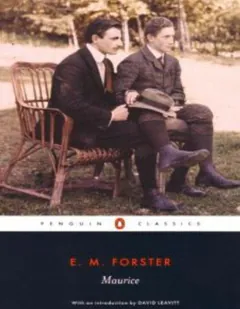
Maurice
Part
This chapter is long, so it is split into 2 parts.
38 "Had I best be going now, sir?" Abominably shy, Maurice pretended not to hear.
"We mustn't fall asleep though, awkward if anyone came in," he continued, with a pleasant blurred laugh that made Maurice feel friendly but at the same time diffident and sad. He managed to reply,
"You mustn't call me sir," and the laugh sounded again, as if brushing aside such problems. There seemed to be charm and insight, yet his discomfort increased.
"May I ask your name?" he said awkwardly.
"I'm Scudder."
"I know you're Scudder—I meant your other name."
"Only Alec just."
"Jolly name to have."
"It's only my name."
"I'm called Maurice."
"I saw you when you first drove up, Mr Hall, wasn't it Tuesday, I did think you looked at me angry and gentle both together."
"Who were those people with you?" said Maurice, after a pause.
"Oh that wor only Mill, that wor Milly's cousin. Then do you remember the piano got wet the same evening, and you had great trouble to suit yourself over a book, didn't read it, did you either."
"How ever did you know I didn't read my book?"
"Saw you leaning out of the window instead. I saw you the next night too. I was out on the lawn."
"Do you mean you were out in all that infernal rain?"
"Yes .. . watching ... oh, that's nothing, you've got to watch, haven't you . . . see, I've not much longer in this country, that's how I kep putting it."
"How beastly I was to you this morning!"
"Oh that's nothing—Excuse the question but is that door locked?"
"I'll lock it." As he did so, the feeling of awkwardness returned.
Whither was he tending, from Clive into what companionship?
Presently they fell asleep.
They slept separate at first, as if proximity harassed them, but towards morning a movement began, and they woke deep in each other's arms. "Had I best be going now?" he repeated, but Maurice, through whose earlier night had threaded the dream "Something is a little wrong and had better be," was resting utterly at last, and murmured "No, no."
"Sir, the church has gone four, you'll have to release me."
"Maurice, I'm Maurice."
"But the church has—"
"Damn the church."
He said, "I've the cricket pitch to help roll for the match," but did not move, and seemed in the faint gray light to be smiling proudly. "I have the young birds too—the boat's done—Mr London and Mr Fetherstonhaugh dived splack into the water lilies—they told me all young gentlemen can dive—I never learned to. It seems more natural like not to let the head get under the water. I call that drowning before your day."
"I was taught I'd be ill if I didn't wet my hair."
"Well, you was taught what wasn't the case."
"I expect so—it's a piece with all else I was taught. A master I used to trust as a kid taught me it. I can still remember walking on the beach with him ... oh dear! And the tide came up, all beastly gray . . ." He shook himself fully awake, as he felt his companion slip from him.
"Don't, why did you?"
"There's the cricket—"
"No, there's not the cricket—You're going abroad."
"Well, well find another opportunity before I do."
"If you'll stop, I'll tell you my dream. I dreamt of an old grandfather of mine. He was a queer card. I wonder what you'd have made of him. He used to think dead people went to the sun, but he treated his own employees badly."
"I dreamt the Reverend Borenius was trying to drown me, and now really I must go, I can't talk about dreams, don't you see, or I'll catch it from Mr Ayres."
"Did you ever dream you'd a friend, Alec? Nothing else but just 'my friend', he trying to help you and you him. A friend," he repeated, sentimental suddenly. "Someone to last your whole life and you his. I suppose such a thing can't really happen outside sleep."
But the moment for speech had passed. Class was calling, the crack in the floor must reopen at sunrise. When he reached the window Maurice called, "Scudder," and he turned like a well-trained dog.
"Alec, you're a dear fellow and we've been very happy."
"You get some sleep, there's no hurry in your case," he said kindly, and took up the gun that had guarded them through the night. The tips of the ladder quivered against the dawn as he descended, then were motionless. There was a tiny crackle from the gravel, a tiny clink from the fence that divided garden and park: then all was as if nothing had been, and silence absolute filled the Russet Room, broken after a time by the sounds of a new day.
39 Having unlocked the door, Maurice dashed back into bed.
"Curtains drawn, sir, nice air, nice day for the match," said Simcox entering in some excitement with the tea. He looked at the head of black hair that was all the visitor showed. No answer came, and, disappointed of the morning chat Mr Hall had hitherto accorded, he gathered up the dinner-jacket and its appurtenances, and took them away to brush.
Simcox and Scudder; two servants. Maurice sat up and drank a cup of tea. He would have to give Scudder some handsome present now, indeed he would like to, but what should it be? What could one give a man in that position? Not a motor-bike. Then he remembered that he was emigrating, which made the problem easier. But the anxious look remained on his face, for he was wondering whether Simcox had been surprised at finding the door locked. Also had he meant anything by "Curtains drawn, sir"? Voices sounded under his window. He tried to drowse again, but the acts of other men had impinged.
"Now what will you wear, sir, I wonder?" inquired Simcox, returning.
"You'll put on your cricketing flannels straight away perhaps; that rather than the tweed."
"All right."
"College blazer with them, sir?"
"No—never mind."
"Very good, sir." He straightened out a pair of socks and continued meditatively: "Oh, they've moved that ladder at last, I see. About
time." Maurice then saw that the tips against the sky had disappeared. "I could have sworn it was here when I brought in your tea, sir. Still, one can never be certain."
"No, one can't," agreed Maurice, speaking with difficulty and with the sense that he had lost his bearings. He felt relief when Simcox had left, but it was overshadowed by the thought of Mrs Durham and the breakfast table, and by the problem of a suitable present for his late companion. It couldn't be a cheque, lest suspicions were aroused when it was cashed. As he dressed, the trickle of discomfort gathered force. Though not a dandy, he had the suburban gentleman's usual show of toilet appliances, and they all seemed alien. Then the gong boomed, and just as he was going down to breakfast he saw a flake of mud close to the window sill. Scudder had been careful, but not careful enough. He was headachy and faint when, clothed all in white, he at last descended to take his place in society.
Letters—a pile of them, and all subtly annoying. Ada, most civil. Kitty, saying his mother looked done up. Aunt Ida—a postcard—wanting to know whether the chauffeur was supposed to obey orders, or had one misunderstood?, business fatuities, circulars about the College Mission, the Territorial training, the Golf Club, and the Property Defence Association. He bowed humorously over them to his hostess. When she scarcely responded, he went hot round his mouth. It was only that Mrs Durham's own letters worried her. But he did not know this, and was carried out further by the current. Each human being seemed new, and terrified him: he spoke to a race whose nature and numbers were unknown, and whose very food tasted poisonous.
After breakfast Simcox returned to the charge. "Sir, in Mr Durham's absence the servants feel—we should be so honoured if you would captain us against the Village in the forthcoming 'Park versus Village' match."
"I'm not a cricketer, Simcox. Who's your best bat?"
"We have no one better than the under gamekeeper."
"Then make the under gamekeeper captain."
Simcox lingered to say, "Things always go better under a gentleman."
"Tell them to put me to field deep—and I won't bat first: about eighth if he likes—not first. You might tell him, as I shan't come down till it's time." He closed his eyes, feeling sick-ish. He had created something whose nature he ignored. Had he been theologically minded, he would have named it remorse, but he kept a free soul, despite confusion.
Maurice hated cricket. It demanded a snickety neatness he could not supply; and, though he had often done it for Clive's sake, he disliked playing with his social inferiors. Footer was different—he could give and take there—but in cricket he might be bowled or punished by some lout, and he felt it unsuitable. Hearing his side had won the toss, he did not go down for half an hour. Mrs Durham and one or two friends already sat in the shed. They were all very quiet. Maurice squatted at their feet, and watched the game. It was exactly like other years. The rest of his side were servants and had gathered a dozen yards away round old Mr Ayres, who was scoring: old Mr Ayres always scored.
"The captain has put himself in first," said a lady. "A gentleman would never have done that. Little points interest me."
Maurice said, "The captain's our best man, apparently."
She yawned and presently criticized: she'd an instinct that man was conceited. Her voice fell idly into the summer air. He was emigrating, said Mrs Durham—the more energetic did—
which turned them to politics and Clive. His chin on his knees, Maurice brooded. A storm of distaste was working up inside him, and he did not know against what to direct it. Whether the ladies spoke,
whether Alec blocked Mr Borenius's lobs, whether the villagers clapped or didn't clap, he felt unspeakably oppressed: he had swallowed an unknown drug: he had disturbed his life to its foundations, and couldn't tell what would crumble. When he went out to bat, it was a new over, so that Alec received first ball. His style changed. Abandoning caution, he swiped the ball into the fern.
Lifting his eyes, he met Maurice's and smiled. Lost ball. Next time he hit a boundary. He was untrained, but had the cricketing build, and the game took on some semblance of reality. Maurice played up too.
His mind had cleared, and he felt that they were against the whole world, that not only Mr Borenius and the field but the audience in the shed and all England were closing round the wickets. They played for the sake of each other and their fragile relationship —if one fell the other would follow. They intended no harm to the world, but so long as it attacked they must punish, they must stand wary, then hit with full strength, they must show that when two are gathered together majorities shall not triumph. And as the game proceeded it connected with the night, and interpreted it. Clive ended it easily enough. When he came to the ground they were no longer the leading force; people turned their heads, the game languished, and ceased. Alec resigned. It was only fit and proper that the squire should bat at once. Without looking at Maurice, he receded. He too was in white flannels, and their looseness made him look like a gentleman or anyone else. He stood in front of the shed with dignity, and when Clive had done talking offered his bat, which Clive took as a matter of course: then flung himself down by old Ayres.
Maurice met his friend, overwhelmed with spurious tenderness.
"Clive. ... Oh my dear, are you back? Aren't you fagged frightfully?"
"Meetings till midnight—another this afternoon—must bat a minute to please these people."
"What! Leaving me again? How frightfully rotten."
"You may well say so, but I really do come back this evening, then your visit really does begin. I've a hundred things to ask you,
Maurice."
"Now, gentlemen," said a voice; it was the socialist schoolmaster, out at long stop.
"We stand rebuked," said Clive, but didn't hurry himself. "Anne's cried off the afternoon meeting, so you'll have her for company. Oh look, they've actually mended her dear little hole in the roof of the drawing-room. Maurice! No, I can't remember what I was going to say. Let us join the Olympic Games."
Maurice went out first ball. "Wait for me," called Clive, but he went straight for the house, for he felt sure that the breakdown was coming. As he passed the servants, the majority of them rose to their feet, and applauded him frantically, and the fact that Scudder didn't alarmed him. Was it meant for impertinence? The wrinkled forehead
—the mouth—possibly a cruel mouth; head a trifle too small—why was the shirt open at the throat like that? And in the hall of Penge he met Anne.
"Mr Hall, the meeting didn't go." Then she saw his face, which was green-white, and cried, "Oh, but you're not well."
"I know," he said, trembling.
Men hate to be fussed, so she only replied, "I'm frightfully sorry, I'll send some ice to your room."
"You've been so kind to me always—"
"Look here, what about a doctor?"
"Never another doctor," he cried frantically.
"We want to be kind to you—naturally. When one's happy oneself one wants the same happiness for others."
"Nothing's the same."
"Mr Hall—!"
"Nothing's the same for anyone. That's why life's this Hell, if you do a thing you're damned, and if you don't you're damned—" he paused, and continued. "Sun too hot—should like a little ice."
She ran for it, and released he flew up to the Russet Room. It brought home to him the precise facts of the situation, and he was violently sick.
40 He felt better at once, but realized that he must leave Penge. He changed into the serge, packed, and was soon downstairs again with a neat little story. "The sun caught me," he told Anne, "but I'd radier a worrying letter too, and I think I'd better be in town."
"Much, much better," she cried, all sympathy.
"Yes, much better," echoed Clive, who was up from the match. "We'd hoped you'd put it right yesterday, Maurice, but we quite understand, and if you must go you must go."
And old Mrs Durham had also accrued. There was to be a laughing open secret about this girl in town, who had almost accepted his offer of marriage but not quite. It didn't matter how ill he looked or how queerly he behaved, he was officially a lover, and they interpreted everything to their satisfaction and found him delightful.
Clive motored him to the station, since their ways lay together that far. The drive skirted the cricket field before entering the woods.
Scudder was fielding now, looking reckless and graceful. He was close to them, and stamped one foot, as though summoning something. That was the final vision, and whether of a devil or a comrade Maurice had no idea. Oh, the situation was disgusting—of that he was certain, and indeed never wavered till the end of his life.
But to be certain of a situation is not to be certain of a human being.
Once away from
Penge he would see clearly perhaps; at all events there was Mr Lasker Jones.
"What sort of man is that keeper of yours who captained us?" he asked Clive, having tried the sentence over to himself first, to be sure it didn't sound odd.
"He's leaving this month," said Clive under the impression that he was giving a reply.
Fortunately they were passing the kennels at that moment, and he added, "We shall miss him as regards the dogs, anyhow."
"But not in other ways?"
"I expect we shall do worse. One always does. Hard-working anyhow, and decidedly intelligent, whereas the man I've coming in his place—"; and, glad that Maurice should be interested he sketched the economy of Penge.
"Straight?" He trembled as he asked this supreme question.
"Scudder? A little too smart to be straight. However, Anne would say I'm being unfair. You can't expect our standard of honesty in servants, any more than you can expect loyalty or gratitude."
"I could never run a job like Penge," resumed Maurice after a pause. "I should never know what type of servant to select. Take Scudder for instance. What class of home does he come from? I haven't the slightest idea."
"Wasn't his father the butcher at Osmington? Yes. I think so."
Maurice flung his hat on the floor of the car with all his force. "This is about the limit," he thought, and buried both hands in his hair.
"Head rotten again?"
"Putrid."
Clive kept sympathetic silence, which neither broke until they parted; all the way Maurice sat crouched with the palms of his hands against his eyes. His whole life he had known things but not known them—it was the great defect in his character.
He had known it was unsafe to return to Penge, lest some folly leapt out of the woods at him, yet he had returned. He had throbbed when Anne said, "Has she bright brown eyes?" He had known in a way it
was wiser not to lean out of his bedroom window again and again into the night and call "Come!" His interior spirit was as sensitive to promptings as most men's, but he could not interpret them. Not till the crisis had come was he clear. And this tangle, so different from Cambridge, resembled it so far that too late he could trace the entanglement. Risley's room had its counterpart in the wild rose and the evening primroses of yesterday, the side-car dash through the fens foreshadowed his innings at cricket.
But Cambridge had left him a hero, Penge a traitor. He had abused his host's confidence and defiled his house in his absence, he had insulted Mrs Durham and Anne. And when he reached home there came a worse blow; he had also sinned against his family. Hitherto they had never counted. Fools to be kind to. They were fools still, but he dare not approach them. Between those commonplace women and himself stretched a gulf that hallowed them. Their chatter, their squabble about precedence, their complaints of the chauffeur, seemed word of a greater wrong. When his mother said, "Morrie, now for a nice talk," his heart stopped. They strolled round the garden, as they had done ten years ago, and she murmured the names of vegetables. Then he had looked up to her, now down; now he knew very well what he wanted with the garden boy. And now Kitty, always a message-bearer, rushed out of the house, and in her hand she held a telegram.
Maurice trembled with anger and fear. "Come back, waiting tonight at boathouse, Penge, Alec": a nice message to be handed in through the local post-office! Presumably one of the house-servants had supplied his address, for the telegram was fully directed. A nice situation! It contained every promise of blackmail, at the best it was incredible insolence. Of course he shouldn't answer, nor could there be any question now of giving Scudder a present. He had gone outside his class, and it served him right.
But all that night his body yearned for Alec's, despite him. He called it lustful, a word easily uttered, and opposed to it his work, his family, his friends, his position in society. In that coalition must surely be
included his will. For if the will can overleap class, civilization as we have made it will go to pieces. But his body would not be convinced.
Chance had mated it too perfectly. Neither argument nor threat could silence it, so in the morning, feeling exhausted and ashamed, he telephoned to Mr Lasker Jones and made a second appointment.
Before he was due to go to it a letter came. It arrived at breakfast and he read it under his mother's eyes. It was phrased as follows.
Mr Maurice. Dear Sir. I waited both nights in the boathouse. I said the boathouse as the ladder as taken away and the woods is to damp to lie down. So please come to "the boathouse" tomorrow night or next, pretend to the other gentlemen you want a stroll, easily managed, then come down to the boathouse. Dear Sir, let me share with you once before leaving Old England if it is not asking to much. I have key, will let you in. I leave per Ss Normannia Aug 29. I since cricket match do long to talk with one of my arms round you, then place both arms round you and share with you, the above now seems sweeter to me than words can say. I am perfectly aware I am only a servant that never presume on your loving kindness to take liberties or in any other way.
Yours respectfully,
A. Scudder.
(gamekeeper to C. Durham Esq.)
Maurice, was you taken ill that you left, as the indoors servants say?
I hope you feel all as usual by this time. Mind and write if you can't come, for I get no sleep waiting night after night, so come without fail to "Boathouse Penge" tomorrow night, or failing the after.
Well, what did this mean? The sentence Maurice pounced on to the neglect of all others was "I have the key." Yes, he had, and there was a duplicate, kept up at the house, with which an accomplice, probably Simcox—In this light he interpreted the whole letter. His mother and aunt, the coffee he was drinking, the college cups on the
sideboard, all said in their different ways, "If you go you are ruined, if you reply your letter will be used to put pressure upon you. You are in a nasty position but you have this advantage: he hasn't a scrap of your handwriting, and he's leaving England in ten days' time. Lie low, and hope for the best." He made a wry face. Butchers' sons and the rest of them may pretend to be innocent and affectionate, but they read the Police Court News, they know. ... If he heard again, he must consult a reliable solicitor, just as he was going to Las-ker Jones for the emotional fiasco. He had been very foolish, but if he played his cards carefully for the next ten days he ought to get through.
41 "Mornin', doctor. Think you can polish me off this time?" he began, very flippant in his manner; then
flung himself down in the chair, half closed his eyes and said, "Well, go ahead." He was in a fury to be cured. The knowledge of this interview had helped him to bear up against the vampire. Once normal, he could settle him. He longed for the trance, wherein his personality would melt and be subtly reformed. At the least he gained five minutes' oblivion, while the will of the doctor strove to penetrate his own.
"I will go ahead in one moment, Mr Hall. First tell me how you have been?"
"Oh, as usual. Fresh air and exercise, as you told me. All serene."
"Have you frequented female society with any pleasure?"
"Some ladies were at Penge. I only stayed one night there. The day after you saw me, Friday, I returned to London— that's to say home."
"You had intended to stop longer with your friends, I think."
"I think I did."
Lasker Jones then sat down on the side of his chair. "Let yourself go now," he said quietly.
"Rather."
He repeated the passes. Maurice looked at the fire irons as before.
"Mr Hall, are you going into a trance?"
There was a long silence, broken by Maurice saying gravely, "I'm not quite sure."
They tried again.
"Is the room at all dark, Mr Hall?"
Maurice said, "A bit," in the hope that it would become so. And it did darken a little.
"What do you see?"
"Well, if it's dark I can't be expected to see."
"What did you see last time?"
"A picture."
"Quite so, and what else?"
"What else?"
"What else? A cr— a cr—"
"Crack in the floor."
"And then?"
Maurice changed his position and said, "I stepped over it."
"And then?"
He was silent.
"And then?" the persuasive voice repeated.
"I hear you all right," said Maurice. "The bother is I've not gone off. I went just a little muzzy at the start, but now I'm as wide awake as you are. You might have another shot."
They tried again, with no success.
"What in Hell can have happened? You could bowl me out last week first ball. What's your explanation?"
"You should not resist me."
"Damn it all, I don't."
"You are less suggestible than you were."
"I don't know what that may mean, not being an expert in the jargon, but I swear from the bottom of my heart I want to be healed. I want to be like other men, not this outcast whom nobody wants—"
They tried again.
"Then am I one of your twenty-five per cent failures?"
"I could do a little with you last week, but we do have these sudden disappointments."
"Sudden disappointment, am I? Well, don't be beat, don't give up,"
he guffawed, affectedly bluff.
"I do not propose to give up, Mr Hall."
Again they failed.
"And what's to happen to me?" said Maurice, with a sudden drop in his voice. He spoke in despair, but Mr Lasker Jones had an answer to every question. "I'm afraid I can only advise you to live in some country that has adopted the Code Napoleon," he said.
"I don't understand."
"France or Italy, for instance. There homosexuality is no longer criminal."
"You mean that a Frenchman could share with a friend and yet not go to prison?"
"Share? Do you mean unite? If both are of age and avoid public indecency, certainly."
"Will the law ever be that in England?"
"I doubt it. England has always been disinclined to accept human nature."
Maurice understood. He was an Englishman himself, and only his troubles had kept him awake. He smiled sadly. "It comes to this then: there always have been people like me and always will be, and generally they have been persecuted."
"That is so, Mr Hall; or, as psychiatry prefers to put it, there has been, is, and always will be every conceivable type of person. And you must remember that your type was once put to death in England."
"Was it really? On the other hand, they could get away. England wasn't all built over and policed. Men of my sort could take to the greenwood."
"Is that so? I was not aware."
"Oh, it's only my own notion," said Maurice, laying the fee down. "It strikes me there may have been more about the Greeks—Theban Band—and the rest of it. Well, this wasn't unlike. I don't see how they could have kept together otherwise— especially when they came from such different classes."
"An interesting theory."
Words flying out of him again, he said, "I've not been straight with you."
"Indeed, Mr Hall."
What a comfort the man was! Science is better than sympathy, if only it is science.
"Since I was last here I went wrong with a—he's nothing but a gamekeeper. I don't know what to do."
"I can scarcely advise you on such a point."
"I know you can't. But you might tell me whether he's pulling me away from sleep. I half wondered."
"No one can be pulled against his will, Mr Hall."
"I'd a notion he'd stopped me going into the trance, and I wished—that seems silly—that I hadn't happened to have a letter from him in my pocket—read it as I've told you so much. I feel simply walking on a volcano. He's an uneducated man; he's got me in his power. In court would he have a case?"
"I am no lawyer," came the unvarying voice, "but I do not think this letter can be construed as containing a menace. It's a matter on which you should consult your solicitor, not me."
"I'm sorry, but it's been a relief. I wonder if you'd be awfully kind—hypnotize me once more. I feel I might go off now I've told you. I'd hoped to get cured without giving myself away. Are there such things as men getting anyone in their power through dreams?"
"I will try on condition your confession is this time exhaustive. Otherwise you waste both my time and your own."
It was exhaustive. He spared neither his lover nor himself. When all was detailed, the perfection of the night appeared as a transient grossness, such as his father had indulged in thirty years before.
"Sit down once again."
Maurice heard a slight noise and swerved.
"It is my children playing overhead."
"I get half to believe in spooks."
"It is merely the children."
Silence returned. The afternoon sunshine fell yellow through the window upon the roll-top desk. This time Maurice fixed his attention on that. Before recommencing, the doctor took Alec's letter, and solemnly burnt it to ashes before his eyes.
Nothing happened.
41 By pleasuring the body Maurice had confirmed— that very word was used in the final verdict—he had confirmed his spirit in its perversion, and cut himself off from the congregation of normal man.
In his irritation he stammered; "What I want to know is—what I can't tell you nor you me— how did a country lad like that know so much about me? Why did he thunder up that special night when I was weakest? I'd never let him touch me with my friend in the house, because, damn it all, I'm more or less a gentleman—public school, varsity, and so on—I can't even now believe that it was with him."
Regretting he had not possessed Clive in the hour of their passion, he left, left his last shelter, while the doctor said perfunctorily. "Fresh air and exercise may do wonders yet." The doctor wanted to get on to his next patient, and he did not care for Maurice's type. He was not shocked like Dr Barry, but he was bored, and never thought of the young invert again.
On the doorstep something rejoined Maurice—his old self perhaps, for as he walked along a voice spoke out of his mortification, and its accents recalled Cambridge; a reckless youthful voice that girded at him for being a fool. "You've done for yourself this time," it seemed to say, and when he stopped outside the park, because the King and Queen were passing, he despised them at the moment he bared his head. It was as if the barrier that kept him from his fellows had taken another aspect. He was not afraid or ashamed anymore. After all, the forests and the night were on his side, not theirs; they, not he, were inside a ring fence. He had acted wrongly, and was still being
punished—but wrongly because he had tried to get the best of both worlds. "But I must belong to my class, that's fixed," he persisted.
"Very well," said his old self. "Now go home, and tomorrow morning mind you catch the 8.36 up to the office, for your holiday is over, remember, and mind you never turn your head, as I may, towards Sherwood."
"I'm not a poet, I'm not that kind of an ass—"
The King and Queen vanished into their palace, the sun fell behind the park trees, which melted into one huge creature that had fingers and fists of green.
"The life of the earth, Maurice? Don't you belong to that?"
"Well, what do you call the 'life of the earth'—it ought to be the same as my daily life—the same as society. One ought to be built on the other, as Clive once said."
"Quite so. Most unfortunate, that facts pay no attention to Clive."
"Anyhow, I must stick to my class."
"Night is coming—be quick then—take a taxi—be quick like your father, before doors close."
Hailing one, he caught the 6.20. Another letter from Scudder awaited him on the leather tray in the hall. He knew the writing at once, the
"Mr M. Hall" instead of "Esq.", the stamps plastered crooked. He was frightened and annoyed, yet not so much as he would have been in the morning, for though science despaired of him he despaired less of himself. After all, is not a real Hell better than a manufactured Heaven? He was not sorry that he had eluded the manipulations of Mr Lasker Jones. He put the letter into the pocket of his dinner-jacket, where it tugged unread, while he played cards, and heard how the chauffeur had given notice; one didn't know what servants
were coming to: to his suggestion that servants might be flesh and blood like ourselves
his aunt opposed a loud "They aren't". At bedtime he kissed his mother and Kitty without the fear of defiling them; their shortlived sanctity was over, and all that they did and said had resumed insignificance. It was with no feeling of treason that he locked his door, and gazed for five minutes into the suburban night. He heard owls, the ring of a distant tram and his heart sounding louder than either. The letter was beastly long. The blood began pounding over his body as he unfolded it, but his head kept cool, and he managed to read it as a whole, not merely sentence by sentence.
Mr Hall, Mr Borenius has just spoke to me. Sir, you do not treat me fairly. I am sailing next week, per s.s. Normannia. I wrote you I am going, it is not fair you never write to me. I come of a respectable family, I don't think it fair to treat me like a dog. My father is a respectable tradesman. I am going to be on my own in the Argentine. You say, "Alec, you are a dear fellow"; but you do not write. I know about you and Mr Durham. Why do you say "call me Maurice", and then treat me so unfairly? Mr Hall, I am coming to London Tuesday. If you do not want me at your home say where in London, you had better see me—I would make you sorry for it. Sir, nothing of note has occurred since you left Penge. Cricket seems over, some of the great trees as lost some of their leaves, which is very early. Has Mr Borenius spoken to you about certain girls? I can't help being rather rough, it is some men's nature, but you should not treat me like a dog. It was before you came. It is natural to want a girl, you cannot go against human nature. Mr Borenius found out about the girls through the new communion class. He has just spoken to me. I have never come like that to a gentleman before.
Were you annoyed at being disturbed so early? Sir, it was your fault, your head was on me. I had my work, I was Mr Durham's servant, not yours. I am not your servant, I will not be treated as your servant, and I don't care if the world knows it. I will show respect where it's due only, that is to say to gentleman who are gentleman. Simcox says, "Mr Hall says to put him in about eighth." I put you in fifth, but I
was captain, and you have no right to treat me unfairly on that account.
Yours respectfully, A. Scudder.
P.S. I know something.
This last was the outstanding point, yet Maurice could brood over the letter as a whole. There was evidently some unsavoury gossip in the under-world about himself and Clive, but what did it matter now?
What did it matter if they had been spied on in the Blue Room, or among the ferns, and been misinterpreted? He was concerned with the present. Why should Scudder have mentioned such gossip?
What was he up to? Why had he flung out these words, some foul, many stupid, some gracious? While actually reading the letter, Maurice might feel it carrion he must toss on to his solicitor, but when he laid it down and took up his pipe, it seemed the sort of letter he might have written himself. Muddle-headed? How about muddle-headed? If so, it was in his own line! He didn't want such a letter, he didn't know what it wanted—half a dozen things possibly—but he couldn't well be cold and hard over it as Clive had been to him over the original Symposium business, and argue, "Here's a certain statement, I shall keep you to it." He replied, "A.S. Yes. Meet me Tuesday 5.0 p.m. entrance of British Museum. B.M. a large building.
Anyone will tell you which. M.C.H." That struck him as best. Both were outcasts, and if it came to a scrap must have it without benefit of society. As for the rendezvous, he chose it because they were unlikely to be disturbed there by anyone whom he knew. Poor B.M., solemn and chaste! The young man smiled, and his face became mischievous and happy. He smiled also at the thought that Clive hadn't quite kept out of the mud after all, and though the face now hardened into lines less pleasing, it proved him an athlete, who had emerged from a year of suffering uninjured.
His new vigour persisted next morning, when he returned to work.
Before his failure with Lasker Jones he had looked forward to work as a privilege of which he was almost unworthy. It was to have
rehabilitated him, so that he could hold up his head at home. But now it too crumbled, and again he wanted
to laugh, and wondered why he had been taken in so long. The clientele of Messrs Hill and Hall was drawn from the middle-middle classes, whose highest desire seemed shelter—continuous shelter—
not a lair in the darkness to be reached against fear, but shelter everywhere and always, until the existence of earth and sky is forgotten, shelter from poverty and disease and violence and impoliteness; and consequently from joy; God slipped this retribution in. He saw from their faces, as from the faces of his clerks and his partners, that they had never known real joy. Society had catered for them too completely. They had never struggled, and only a struggle twists sentimentality and lust together into love. Maurice would have been a good lover. He could have given and taken serious pleasure.
But in these men the strands were untwisted; they were either fatuous or obscene, and in his present mood he despised the latter least. They would come to him and ask for a safe six per cent security. He would reply, "You can't combine high interest with safety
—it isn't to be done"; and in the end they would say, "How would it be if I invested most of my money at four per cent, and play about with an odd hundred?" Even so did they speculate in a little vice—
not in too much, lest it disorganized domesticity, but in enough to show that their virtue was sham. And until yesterday he had cringed to them.
Why should he serve such men? He began discussing the ethics of his profession, like a clever undergraduate, but the railway carriage did not take him seriously. "Young Hall's all right," remained the verdict. "Hell never lose a single client, not he." And they diagnosed a cynicism not unseemly in a business man. "All the time he's investing steadily, you bet. Remember that slum talk of his in the spring?"
43 The rain was coming down in its old fashion, tapping on a million roofs and occasionally effecting an entry. It beat down the smoke, and caused the fumes of petrol and the smell of wet clothes to linger
mixed on the streets of London. In the great forecourt of the Museum it could fall uninterruptedly, plumb onto the draggled doves and the helmets of the police. So dark was the afternoon that some of the lights had been turned on inside, and the great building suggested a tomb, miraculously illuminated by spirits of the dead.
Alec arrived first, dressed no longer in corduroys but in a new blue suit and bowler hat—part of his outfit for the Argentine. He sprang, as he had boasted, of a respectable family—publicans, small tradesmen—and it was only by accident that he had appeared as an untamed son of the woods. Indeed, he liked the woods and the fresh air and water, he liked them better than anything and he liked to protect or destroy life, but woods contain no "openings", and young men who want to get on must leave them. He was determined in a blind way to get on now. Fate had placed a snare in his hands, and he meant to set it. He tramped over the courtyard, then took the steps in a series of springs; having won the shelter of the portico he stood motionless, except for the flicker of his eyes. These sudden changes of pace were typical of the man, who always advanced as a skirmisher, was always "on the spot" as Clive had phrased it in the written testimonial; "during the five months A. Scudder was in my service I found him prompt and assiduous": qualities that he proposed to display now. When the victim drove up he became half cruel, half frightened. Gentlemen he knew, mates he knew; what class of creature was Mr Hall who said, "Call me Maurice"? Narrowing his eyes to slits, he stood as though waiting for orders outside the front porch at Penge.
Maurice approached the most dangerous day of his life without any plan at all, yet something kept rippling in his mind like muscles beneath a healthy skin. He was not supported by pride but he did feel fit, anxious to play the game, and, as an Englishman should, hoped that his opponent felt fit too. He wanted to be decent, he wasn't afraid. When he saw Alec's face glowing through the dirty air his own tingled slightly, and he determined not to strike until he was struck.
"Here you are," he said, raising a pair of gloves to his hat. "This rain's the limit. Let's have a talk inside."
"Where you wish."
Maurice looked at him with some friendliness, and they entered the building. As they did so, Alec raised his head and sneezed like a lion.
"Got a chill? It's the weather."
"What's all this place?" he asked.
"Old things belonging to the nation." They paused in the corridor of Roman emperors. "Yes, it's bad weather. There've only been two fine days. And one fine night," he added mischievously, surprising himself.
But Alec didn't catch on. It wasn't the opening he wanted. He was waiting for signs of fear, that the menial in him might strike. He pretended not to understand the allusion, and sneezed again. The roar echoed down vestibules, and his face, convulsed and distorted, took a sudden appearance of hunger.
"I'm glad you wrote to me the second time. I liked both your letters.
I'm not offended—you've never done anything wrong. It's all your mistake about cricket and the rest. I'll tell you straight out I enjoyed being with you, if that's the trouble. Is it? I want you to tell me. I just don't know."
"What's here? That's no mistake." He touched his breast pocket, meaningly. "Your writing. And you and the squire— that's no mistake
—some may wish as it was one."
"Don't drag in that," said Maurice, but without indignation, and it struck him as odd that he had none, and that even the Clive of Cambridge had lost sanctity.
"Mr Hall—you reckernize it wouldn't very well suit you if certain things came out, I suppose."
Maurice found himself trying to get underneath the words.
He continued, feeling his way to a grip. "What's more, I've always been a respectable young fellow until you called me into your room to amuse yourself. It don't hardly seem fair that a gentleman should
drag you down. At least that's how my brother sees it." He faltered as he spoke these last words. "My brother's waiting outside now as a matter of fact. He wanted to come and speak to you hisself, he's been scolding me shocking, but I said, 'No Fred no, Mr Hall's a gentleman and can be trusted to behave like one, so you leave 'im to me,' I said, 'and Mr Durham, he's a gentleman too, always was and always will be.'"
"With regard to Mr Durham," said Maurice, feeling inclined to speak on this point: "It's quite correct that I cared for him and he for me once, but he changed, and now he doesn't care any more for me nor I for him. It's the end."
"End o' what?"
"Of our friendship."
"Mr Hall, have you heard what I was saying?"
"I hear everything you say," said Maurice thoughtfully, and continued in exactly the same tone: "Scudder, why do you think it's 'natural' to care both for women and men? You wrote so in your letter. It isn't natural for me. I have really got to think that 'natural' only means oneself."
The man seemed interested. "Couldn't you get a kid of your own, then?" he asked, roughening.
"I've been to two doctors about it. Neither were any good."
"So you can't?"
"No, I can't."
"Want one?" he asked, as if hostile.
"It's not much use wanting."
"I could marry tomorrow if I like," he bragged. While speaking, he caught sight of a winged Assyrian bull, and his expression altered into naive wonder. "He's big enough, isn't he," he remarked. "They must have owned wonderful machinery to make a thing like that."
"I expect so," said Maurice, also impressed by the bull. "I couldn't tell you. Here seems to be another one."
"A pair, so to speak. Would these have been ornaments?"
"This one has five legs."
"So's mine. A curious idea." Standing each by his monster, they looked at each other, and smiled. Then his face hardened again and he said, "Won't do, Mr Hall. I see your game, but you don't fool me twice, and you'll do better to have a friendly talk with me rather than wait for Fred, I can tell you. You've had your fun and you've got to pay up." He looked handsome as he threatened—including the pupils of his eyes, which were evil. Maurice gazed into them gently but keenly. And nothing resulted from the outburst at all. It fell away like a flake of mud. Murmuring something about "leaving you to think this over", he sat down on a bench. Maurice joined him there shortly.
And
it was thus for nearly twenty minutes: they kept wandering from room to room as if in search of something. They would peer at a goddess or vase, then move at a single impulse, and their unison was the stranger because on the surface they were at war. Alec recommenced his hints—horrible, reptilian—but somehow they did not pollute the intervening silences, and Maurice failed to get afraid or angry, and only regretted that any human being should have got into such a mess. When he chose to reply their eyes met, and his smile was sometimes reflected on the lips of his foe. The belief grew that the actual situation was a blind—a practical joke almost—and concealed something real, that either desired. Serious and good-tempered, he continued to hold his own, and if he made no offensive it was because his blood wasn't warm. To set it moving, a shock from without was required, and chance administered this.
He was bending over a model of the Acropolis with his forehead a little wrinkled and his lips murmuring, "I see, I see, I see." A gentleman near overheard him, started, peered through strong spectacles, and said "Surely! I may forget faces but never a voice.
Surely! You are one of our old boys." It was Mr Ducie.
Maurice did not reply. Alec sidled up closer to participate.
"Surely you were at Mr Abrahams's school. Now wait! Wait! Don't tell me your name. I want to remember it. I will remember it. You're not Sanday, you're not Gibbs. I know. I know. It's Wimbleby."
How like Mr Ducie to get the facts just wrong! To his own name Maurice would have responded, but he now had the inclination to lie; he was tired of their endless inaccuracy, he had suffered too much from it. He replied, "No, my name's Scudder." The correction flew out as the first that occurred to him. It lay ripe to be used, and as he uttered it he knew why. But at the instant of enlightenment Alec himself spoke. "It isn't," he said
to Mr Ducie, "and I've a serious charge to bring against this gentleman."
"Yes, awfully serious," remarked Maurice, and rested his hand on Alec's shoulder, so that the fingers touched the back of the neck, doing this merely because he wished to do it, not for another reason.
Mr Ducie did not take notice. An unsuspicious man, he assumed some uncouth joke. The dark gentlemanly fellow couldn't be Wimbleby if he said he wasn't. He said, "I'm extremely sorry, sir, it's so seldom I make a mistake," and then, determined to show he was not an old fool, he addressed the silent pair on the subject of the British Museum—not merely a collection of relics but a place round which one could take—er—the less fortunate, quite so—a stimulating place—it raised questions even in the minds of boys—
which one answered—no doubt inadequately; until a patient voice said, "Ben, we are waiting," and Mr Ducie rejoined his wife. As he did
so Alec jerked away and muttered, 'That's all right. . .. I won't trouble you now."
"Where are you going with your serious charge?" said Maurice, suddenly formidable.
"Couldn't say." He looked back, his colouring stood out against the heroes, perfect but bloodless, who had never known bewilderment or infamy. "Don't you worry—I'll never harm you now, you've too much pluck."
"Pluck be damned," said Maurice, with a plunge into anger.
"It'll all go no further—" He struck his own mouth. "I don't know what came over me, Mr Hall; I don't want to harm you, I never did."
"You blackmailed me."
"No, sir, no..."
"You did."
"Maurice, listen, I only ..."
"Maurice am I?"
"You called me Alec... . I'm as good as you."
"I don't find you are!" There was a pause; before the storm; then he burst out: "By God, if you'd split on me to Mr Ducie, I'd have broken you. It might have cost me hundreds, but I've got them, and the police always back my sort against yours. You don't know. We'd have got you into quod, for blackmail, after which—I'd have blown out my brains."
"Killed yourself? Death?"
"I should have known by that time that I loved you. Too late ...
everything's always too late." The rows of old statues tottered, and
he heard himself add, "I don't mean anything, but come outside, we can't talk here." They left the enormous and overheated building, they passed the library, supposed catholic, seeking darkness and rain. On the portico Maurice stopped and said bitterly, "I forgot. Your brother?"
"He's down at father's—doesn't know a word—I was but threatening
—"
"—for blackmail."
"Could you but understand..." He pulled out Maurice's note. "Take it if you like.... I don't want it.. . never did .... I suppose this is the end."
Assuredly it wasn't that. Unable to part yet ignorant of what could next come, they strode raging through the last glimmering of the sordid day; night, ever one in her quality, came finally, and Maurice recovered his self-control and could look at the new material that passion had gained for him. In a deserted square, against railings that encircled some trees, they came to a halt, and he began to discuss their crisis.
But as he grew calm the other grew fierce. It was as if Mr Ducie had established some infuriating inequality between them, so that one struck as soon as his fellow tired of striking. Alec said savagely, "It rained harder than this in the boathouse, it was yet colder. Why did you not come?"