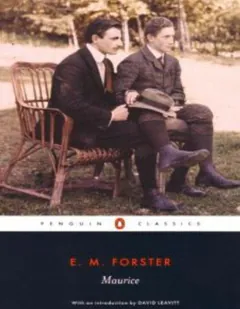
Maurice
Part
This chapter is long, so it is split into 2 parts.
"Muddle."
"I beg your pardon?"
"You've to learn I'm always in a muddle. I didn't come or write because I wanted to get away from you without wanting. You won't understand. You kept dragging me back and I got awfully frightened.
I felt you when I tried to get some sleep at the doctor's. You came hard at me. I knew something was evil but couldn't tell what, so kept pretending it was you."
"What was it?"
"The—situation."
"I don't follow this. Why did you not come to the boathouse?"
"My fear—and your trouble has been fear too. Ever since the cricket match you've let yourself get afraid of me. That's why we've been trying to down one another so and are still."
"I wouldn't take a penny from you, I wouldn't hurt your little finger," he growled, and rattled the bars that kept him from the trees.
"But you're still trying hard to hurt me in my mind."
"Why do you go and say you love me?"
"Why do you call me Maurice?"
"Oh let's give over talking. Here—" and he held out his hand.
Maurice took it, and they knew at that moment the greatest triumph ordinary man can win. Physical love means reaction, being panic in essence, and Maurice saw now how natural it was that their primitive abandonment at Penge should have led to peril. They knew too little about each other—and too much. Hence fear. Hence cruelty. And he rejoiced because he had understood Alec's infamy through his own
—glimpsing, not for the first time, the genius who hides in man's tormented soul. Not as a hero, but as a comrade, had he stood up to the bluster, and found childishness behind it, and behind that something else.
Presently the other spoke. Spasms of remorse and apology broke him; he was as one who throws off a poison. Then, gathering health, he began to tell his friend everything, no longer ashamed. He spoke of his relations. . . . He too was embedded in class. No one knew he was in London—Penge thought he was at his father's, his father at Penge—it had been difficult, very. Now he ought to go home—see his brother with whom he returned to the Argentine: his brother
connected with trade, and his brother's wife; and he mingled some brag, as those whose education is not literary must. He came of a respectable family, he repeated, he bowed down to no man, not he, he was as good as any gentleman. But while be bragged his arm was gaining Maurice's. They deserved such a caress—the feeling was strange. Words died away, abruptly to recommence. It was Alec who ventured them.
"Stop with me."
Maurice swerved and their muscles clipped. By now they were in love with one another consciously.
"Sleep the night with me. I know a place."
"I can't, I've an engagement," said Maurice, his heart beating violently. A formal dinner party awaited him of the sort that brought work to his firm and that he couldn't possibly cut. He had almost forgotten its existence. "I have to leave you now and get changed.
But look here: Alec, be reasonable. Meet me another evening instead—any day."
"Can't come to London again—father or Mr Ayres will be passing remarks."
"What does it matter if they do?"
"What's your engagement matter?"
They were silent again. Then Maurice said in affectionate yet
"dejected tones, "All right. To Hell with it," and they passed on together in the rain.
44 "Alec, wake up."
An arm twitched.
"Time we talked plans."
He snuggled closer, more awake than he pretended, warm, sinewy, happy. Happiness overwhelmed Maurice too. He moved, felt the answering grip, and forgot what he wanted to say. Light drifted in upon them from the outside world where it was still raining. A strange hotel, a casual refuge protected them from their enemies a little longer.
"Time to get up, boy. It's morning."
"Git up then."
"How can I the way you hold me!"
"Aren't yer a fidget, I'll learn you to fidget." He wasn't deferential any more. The British Museum had cured that. This was 'oliday, London with Maurice, all troubles over, and he wanted to drowse and waste time, and tease and make love.
Maurice wanted the same, what's pleasanter, but the oncoming future distracted him, the gathering light made cosiness unreal.
Something had to be said and settled. O for the night that was ending, for the sleep and the wakefulness, the toughness and tenderness mixed, the sweet temper, the safety in darkness. Would such a night ever return?
"You all right, Maurice?"—for he had sighed. "You comfortable? Rest your head on me more, the way you like more . . . that's it more, and Don't You Worry. You're With Me. Don't Worry."
Yes, he was in luck, no doubt of it. Scudder had proved honest and kind. He was lovely to be with, a treasure, a charmer, a find in a thousand, the longed-for dream. But was he brave?
"Nice you and me like this ..." the lips so close now that it was scarcely speech. "Who'd have thought.... First time I ever seed you I thought, "Wish I and that one...' just like that...
'wouldn't I and him ...' and it is so."
"Yes, and that's why we've got to fight."
"Who wants to fight?" He sounded annoyed. "There's bin enough fighting."
"All the world's against us. We've got to pull ourselves together and make plans, while we can."
"What d'you want to go and say a thing like that for, and spoil it all?"
"Because it has to be said. We can't allow things to go wrong and hurt us again the way they did down at Penge."
Alec suddenly scrubbed at him with the sun-roughened back of a hand and said, "That hurt, didn't it, or oughter. That's how I fight." It did hurt a little, and stealing into the foolery was a sort of resentment. "Don't talk to me about Penge," he went on. "Oo! Mah! Penge where I was always a servant and Scudder do this and Scudder do that and the old lady, what do you think she once said? She said, 'Oh would you most kindly of your goodness post this letter for me, what's your name?' What's yer name! Every day for six months I come up to Clive's bloody front porch door for orders, and his mother don't know my name. She's a bitch. I said to 'er, "What's yer name? Fuck yer name.' I nearly did too. Wish I 'ad too.
Maurice, you wouldn't believe how servants get spoken to. It's too shocking for words. That Archie London you're so set on is just as bad, and so are you, so are you. 'Haw my man'
and all that. You've no idea how you nearly missed getting me. Near as nothing I never climbed that ladder when
you called, he don't want me really, and I went flaming mad when you didn't turn up at the boathouse as I ordered. Too grand! We'll see. Boathouse was a place I always fancied. I'd go down for a smoke before I'd ever heard of you, unlock it easy, got the key on me still as a matter of fact... boathouse, looking over the pond from the boathouse, very quiet, now and then a fish jump and cushions the way I arrange them."
He was silent, having chattered himself out. He had begun rough and gay and somehow factitious, then his voice had died away into sadness as though truth had risen to the surface of the water and was unbearable.
"We'll meet in your boathouse yet," Maurice said.
"No, we won't." He pushed him away, then heaved, pulled him close, put forth violence, and embraced as if the world was ending. "You'll remember that anyway." He got out and looked down out of the grayness, his arms hanging empty. It was as if he wished to be remembered thus. "I could easy have killed you."
"Or I you."
"Where's my clothes and that gone?" He seemed dazed. "It's so late.
I h'aint got a razor even, I didn't reckon staying the night. ... I ought—
I got to catch a train at once or Fred'll be thinking things."
"Let him."
"My goodness if Fred seed you and me just now."
"Well, he didn't."
"Well, he might have—what I mean is, tomorrow's Thursday isn't it, Friday's the packing, Saturday the Normannia sails from Southampton, so it's goodbye to Old England."
"You mean that you and I shan't meet again after now."
"That's right. You've got it quite correct."
And if it wasn't still raining! Wet morning after yesterday's downpour, wet on the roofs and the Museum, at home and on
the greenwood. Controlling himself and choosing his words very carefully, Maurice said, "This is just what I want to talk about. Why don't we arrange so as we do meet again?"
"How do you mean?"
"Why don't you stay on in England?"
Alec whizzed round, terrified. Half naked, he seemed also half human. "Stay?" he snarled. "Miss my boat, are you daft? Of all the
bloody rubbish I ever heard. Ordering me about again, eh, you would."
"It's a chance in a thousand we've met, we'll never have the chance again and you know it. Stay with me. We love each other."
'1 dessay, but that's no excuse to act silly. Stay with you and how and where? What'd your Ma say if she saw me all rough and ugly the way I am?"
"She never will see you. I shan't live at my home."
"Where will you live?"
"With you."
"Oh, will you? No thank you. My people wouldn't take to you one bit and I don't blame them. And how'd you run your job, I'd like to know?"
"I shall chuck it."
"Your job in the city what gives you your money and position? You can't chuck a job."
"You can when you mean to," said Maurice gently. "You can do anything once you know what it is." He gazed at the grayish light that was becoming yellowish. Nothing surprised him in this talk. What he could not conjecture was its outcome. "I shall get work with you," he brought out: the moment to announce this had now come.
"What work?"
"We'll find out."
"Find out and starve out."
"No. There'll be enough money to keep us while we have a look round. I'm not a fool, nor are you. We won't be starving. I've thought
out that much, while I was awake in the night and you weren't."
There was a pause. Alec went on more politely: "Wouldn't work, Maurice. Ruin of us both, can't you see, you same as myself."
"I don't know. Might be. Mightn't. 'Class.' I don't know. I know what we do today. We clear out of here and get a decent breakfast and we go down to Penge or whatever you want and see that Fred of yours.
You tell him you've changed your mind about emigrating and are taking a job with Mr Hall instead. I'll come with you. I don't care. I'll see anyone, face anything. If they want to guess, let them. I'm fed up. Tell Fred to cancel your ticket, I'll repay for it and that's our start of getting free. Then we'll do the next thing. It's a risk, so's everything else, and we'll only live once."
Alec laughed cynically and continued to dress. His manner resembled yesterday's, though he didn't blackmail. "Yours is the talk of someone who's never had to earn his living," he said. "You sort of trap me with I love you or whatever it is and then offer to spoil my career. Do you realize I've got a definite job awaiting me in the Argentine? Same as you've got here. Pity the Normannids leaving Saturday, still facts is facts isn't it, all my kit bought as well as my ticket and Fred and wife expecting me."
Maurice saw through the brassiness to the misery behind it, but this time what was the use of insight? No amount of insight would prevent the Normannia from sailing. He had lost. Suffering was certain for him, though it might soon end for Alec; when he got out to his new life he would forget his escapade with a
gentleman and in time he would marry. Shrewd working-class youngster who knew where his interests lay, he had already crammed his graceful body into his hideous blue suit. His face stuck out of it red, his hands brown. He plastered his hair flat. "Well, I'm off," he said, and as if that wasn't enough said, "Pity we ever met really if you come to think of it."
"That's all right too," said Maurice, looking away from him as he unbolted the door.
"You paid for this room in advance, didn't you, so they won't stop me downstairs? I don't want no unpleasantness to finish with."
"That's all right too." He heard the door shut and he was alone. He waited for the beloved to return. Inevitable that wait. Then his eyes began to smart, and he knew from experience what was coming.
Presently he could control himself. He got up and went out, did some telephoning and explanations, placated his mother, apologized to his host, got himself shaved and trimmed up, and attended the office as usual. Masses of work awaited him. Nothing had changed in his life.
Nothing remained in it. He was back with his loneliness as it had been before Clive, as it was after Clive, and would now be for ever.
He had failed, and that wasn't the saddest: he had seen Alec fail. In a way they were one person. Love had failed. Love was an emotion through which you occasionally enjoyed yourself. It could not do things.
45 When the Saturday came he went down to Southampton to see the Normannia off.
It was a fantastic decision, useless, undignified, risky, and he had not the least intention of going when he left home. But when he reached London the hunger that tormented him nightly came into the open and demanded its prey, he forgot everything except Alec's face and body, and took the only means of seeing them. He did not want to speak to his lover or to hear his voice or to touch him—all that part was over—only to recapture his image before it vanished for ever.
Poor wretched Alec! Who could blame him, how could he have acted differently? But oh, the wretchedness it was causing them both.
He got down to the boat in a dream, and awoke there to a new sort of discomfort: Alec was nowhere in sight, the stewards were busy, and it was some time before they brought him to Mr Scudder, an unattractive middle-aged man, a tradesman, a cad —brother Fred: with him was a bearded elder—presumably the butcher from
Osmington. Alec's main charm was the fresh colouring that surged against the cliff of his hair: Fred, facially the same, was sandy and foxlike, and greasiness had replaced the sun's caress. Fred thought highly of himself, as did Alec, but his was the conceit that comes with commercial success and despises manual labour. He did not like having a brother who had chanced to grow up rough, and he thought that Mr Hall, of
whom he had never heard, was out to patronize. This made him insolent. "Licky's not aboard yet, but his kit is," he said. "Interested to see his kit?" The father said, "Plenty of time yet," and looked at his watch. The mother said with compressed lips, "He won't be late.
When Licky says a thing Licky means it." Fred said, "He can be late if he likes. If I lose his company I can bear it, but he needn't expect me to help him again. What he's cost me..."
"This is where Alec belongs," Maurice reflected. "These people will make him happier than I could have." He filled a pipe with the tobacco that he had smoked for the last six years, and watched Romance wither. Alec was not a hero or god, but a man embedded in society like himself, for whom sea and woodland and the freshening breeze and the sun were preparing no apotheosis. They ought not to have spent that night together in the hotel. It had now raised hopes that were too high. They should have parted with that handshake in the rain.
A morbid fascination kept him among the Scudders, listening to their vulgarity, and tracing the gestures of his friend in theirs. He tried to be pleasant and ingratiate himself, and failed, for his self-confidence had gone. As he brooded a quiet voice said, "Good afternoon, Mr Hall." He could not reply. The surprise was too complete. It was Mr Borenius. And both of them remembered that initial silence of his, and his frightened gaze, and the quick movement with which he removed his pipe from his lips, as if smoking were forbidden by the clergy.
Mr Borenius introduced himself gently to the company; he had come to see his young parishioner off, since the distance was not great
from Penge. They discussed which route Alec would arrive by—
there seemed some uncertainty—and Maurice tried to slip off, for the situation had become equivocal. But Mr Borenius checked him.
"Going on deck?" he inquired; "I too. I
too." They returned to the air and sunlight; the shallows of Southampton Water stretched golden around them, edged by the New Forest. To Maurice the beauty of the evening seemed ominous of disaster.
"Now this is very kind of you," said the clergyman, beginning at once.
He spoke as one social worker to another, but Maurice thought there was a veil over his voice. He tried to reply—two or three normal sentences would save him—but no words would come, and his underlip trembled like an unhappy boy's. "And the more kind because if I remember rightly you disapprove of young Scudder. You told me when we dined at Penge that he was 'a bit of a swine'—an expression that, as applied to a fellow creature, struck me. I could hardly believe my eyes when I saw you among his friends down here. Believe me, Mr Hall, he will value the attention though he may not appear to. Men like that are more impressionable than the outsider supposes. For good and for evil."
Maurice tried to stop him by saying, "Well . . . what about you?"
"I? Why have I come? You will only laugh. I have come to bring him a letter of introduction to an Anglican priest at Buenos Aires in the hope that he will get confirmed after landing. Absurd, is it not? But being neither a helleriist nor an atheist I hold that conduct is dependent on faith, and that if a man is à`bit of a swine' the cause is to be found in some misapprehension of God. Where there is heresy, immorality will sooner or later ensue. But you—how came you to know so precisely when his boat sailed?"
"It... it was advertised." The trembling spread all over his body, and his clothes stuck to him. He seemed to be back at school, defenceless. He was certain that the rector had guessed, or rather
that a wave of recognition had passed. A man of the world would have suspected nothing—Mr Ducie hadn't—but
this man had a special sense, being spiritual, and could scent out invisible emotions.
Asceticism and piety have their practical side. They can generate insight, as Maurice realized too late. He had assumed at Penge that a white-faced parson in a cassock could never have conceived of masculine love, but he knew now that there is no secret of humanity which, from a wrong angle, orthodoxy has not viewed, that religion is far more acute than science, and if it only added judgement to insight would be the greatest thing in the world. Destitute of the religious sense himself, he never yet encountered it in another, and the shock was terrific. He feared and hated Mr Borenius, he wanted to kill him.
And Alec—when he arrived, he would be flung into the trap too; they were small people, who could take no risk—far smaller, for instance, than Clive and Anne—and Mr Borenius knew this, and would punish them by the only means in his power.
The voice continued; it had paused for a moment in case the victim chose to reply.
"Yes. To speak frankly, I am far from easy about young Scudder. When he left Penge last Tuesday to go to his parents as he told me, though he never reached them till Wednesday
— I had a most unsatisfactory interview with him. He was hard. He resisted me. When I spoke of Confirmation he sneered. The fact being— I could not mention this to you if it weren't for your charitable interest in him—the fact being that he has been guilty of sensuality." There was a pause. "With women. In time, Mr Hall, one gets to recognize that sneer, that hardness, for fornication extends far beyond the actual deed. Were it a deed only, I for one would not hold it anathema. But when the nations went a whoring they invariably ended by denying God, I think, and until all sexual irregularities and not some of them are penal the Church will never reconquer England. I have reason to believe that he spent that missing night in London. But surely—that must be his train."
He went below, and Maurice, utterly to pieces, followed him. He heard voices, but did not understand them; one of them might have been Alec's for all it mattered to him. "This too has gone wrong"
began flitting through his brain, like a bat that returns at twilight. He was back in the smoking-room at home with Clive, who said, "I don't love you any more; I'm sorry," and he felt that his life would revolve in cycles of a year, always to the same eclipse. "Like the sun... it takes a year..." He thought his grandfather was speaking to him;
then the haze cleared, and it was Alec's mother. "It's not like Licky,"
she gibbered, and vanished.
Like whom? Bells were ringing, a whistle blew. Maurice ran up on deck; his faculties had returned, and he could see with extraordinary distinctness the masses of men sorting themselves, those to stop in England, those to go, and he knew that Alec was stopping. The afternoon had broken into glory. White clouds sailed over the golden waters and woods. In the midst of the pageant Fred Scudder was raving because his unreliable brother had missed the last train, and the women were protesting while they were hustled up the gangways, and Mr Borenius and old Scudder were lamenting to the officials. How negligible they had all become, beside the beautiful weather and fresh air.
Maurice went ashore, drunk with excitement and happiness. He watched the steamer move, and suddenly she reminded him of the Viking's funeral that had thrilled him as a boy. The parallel was false, yet she was heroic, she was carrying away death. She warped out from the quay, Fred yapping, she swung into the channel to the sound of cheers, she was off at last, a sacrifice, a splendour, leaving smoke that thinned into the sunset, and ripples that died against the wooded shores. For a long time he gazed after her, then turned to England. His journey was nearly over. He was bound for his new home. He had brought out the
man in Alec, and now it was Alec's turn to bring out the hero in him.
He knew what the call was, and what his answer must be. They must live outside class, without relations or money; they must work and stick to each other till death. But England belonged to them. That, besides companionship, was their reward. Her air and sky were theirs, not the timorous millions' who own stuffy little boxes, but never their own souls.
He faced Mr Borenius, who had lost all grasp of events. Alec had completely routed him. Mr Borenius assumed that love between two men must be ignoble, and so could not interpret what had happened.
He became an ordinary person at once, his irony vanished. In a
straightforward and rather silly way he discussed what could have befallen young Scudder and then repaired to visit friends in Southampton. Maurice called after him, "Mr. Borenius do look at the sky—it's gone all on fire," but the rector had no use for the sky when on fire, and disappeared.
In his excitement he felt that Alec was close to him. He wasn't, couldn't be, he was elsewhere in the splendour and had to be found, and without a moment's hesitation he set out for Boathouse, Penge.
Those words had got into his blood, they were part of Alec's yearnings and blackmailings, and of his own promise in that last desperate embrace. They were all he had to go by. He left Southampton as he had come to it—instinctively—and he felt that not merely things wouldn't go wrong this time but that they daren't, and that the universe had been put in its place. A little local train did its duty, a gorgeous horizon still glowed, and inflamed cloudlets which flared when the main glory faded, and there was even enough light for him to walk up from the station at Penge through quiet fields.
He entered the estate at its lower end, through a gap in the hedge, and it struck him once more how derelict it was, how unfit to set standards or control the future. Night was approaching,
a bird called, animals scuttled, he hurried on until he saw the pond glimmering, and black against it the trysting place, and heard the water sipping.
He was here, or almost here. Still confident, he lifted up his voice and called Alec.
There was no answer.
He called again.
Silence and the advancing night. He had miscalculated.
"Likely enough," he thought, and instantly took himself in hand.
Whatever happened he must not collapse. He had done that enough
over Clive, and to no effect, and to collapse in this graying wilderness might mean going mad. To be strong, to keep calm, and to trust—they were still the one hope.. But the sudden disappointment revealed to him how exhausted he was physically.
He had been on the run ever since early morning, ravaged by every sort of emotion, and he was ready to drop. In a little while he would decide what next should be done, but now his head was splitting, every bit of him ached or was useless and he must rest.
The boathouse offered itself conveniently for that purpose. He went in and found his lover asleep. Alec lay upon piled up cushions, just visible in the last dying of the day. When he woke he did not seem excited or disturbed and fondled Maurice's arm between his hands before he spoke. "So you got the wire," he said.
"What wire?"
"The wire I sent off this morning to your house, telling you ..." He yawned, "Excuse me, I'm a bit tired, one thing and another . . . telling you to come here without fail." And since Maurice did not speak, indeed could not, he added, "And now we shan't be parted no more, and that's finished."
46 Dissatisfied with his printed appeal to the electors— it struck him as too patronizing for these times— Clive was trying to alter the proofs when Simcox announced, "Mr Hall." The hour was extremely late, and the night dark; all traces of a magnificent sunset had disappeared from the sky. He could see nothing from the porch though he heard abundant noises; his friend, who had refused to come in, was kicking up the gravel, and throwing pebbles against the shrubs and walls.
"Hullo Maurice, come in. Why this thusness?" He asked, a little annoyed, and not troubling to smile since his face was in shadow.
"Good to see you back, hope you're better. Unluckily I'm a bit occupied, but the Russet Room's not. Come in and sleep here as before. So glad to see you."
"I've only a few minutes, Clive."
"Look here man, that's fantastic." He advanced into the darkness hospitably, still holding his proof sheets. "Anne'll be furious with me if you don't stay. It's awfully nice you turning up like this. Excuse me if I work at unimportancies for a bit now." Then he detected a core of blackness in the surrounding gloom, and, suddenly uneasy, exclaimed, "I hope nothing's wrong."
"Pretty well everything . . . what you'd call."
Now Clive put politics aside, for he knew that it must be the love affair, and he prepared to sympathize, though he wished the appeal had come when he was less busy. His sense of pro—
i
portion supported him. He led the way to the deserted alley behind the laurels, where evening primroses gleamed, and embossed with faint yellow the walls of night. Here they would be most solitary. Feeling for a bench, he reclined full length on it, put his hands behind his head, and said, "I'm at your service, but my advice is sleep the night here, and consult Anne in the morning."
'1 don't want your advice."
"Well, as you like of course there, but you've been so friendly in telling us about your hopes, and where a woman is in question I would always consult another woman, particularly where she has Anne's almost uncanny insight."
The blossoms opposite disappeared and reappeared, and again Clive felt that his friend, swaying to and fro in front of them, was essential night. A voice said, "It's miles worse for you than that; I'm in love with your gamekeeper"—a remark so unexpected and meaningless to him that he said, "Mrs Ayres?" and sat up stupidly.
"No. Scudder."
"Look out," cried Clive, with a glance at darkness. Reassured, he said stiffly, "What a grotesque announcement."
"Most grotesque," the voice echoed, "but I felt after all I owe you I ought to come and tell you about Alec."
Clive had only grasped the minimum. He supposed "Scudder" was a jagon de parler, as one might say "Ganymede", for intimacy with any social inferior was unthinkable to him. As it was, he felt depressed, and offended, for he had assumed Maurice was normal during the last fortnight, and so encouraged Anne's intimacy. "We did anything we could," he said,
"and if you want to repay what you 'owe' us, as you call it, you won't dally with morbid thoughts. I'm so disappointed to hear you talk of yourself like that. You gave me to understand that the land
through the looking-glass was behind you at last, when we thrashed out the subject that night in the Russet Room."
"When you brought yourself to kiss my hand," added Maurice, with deliberate bitterness.
"Don't allude to that," he flashed, not for the first and last time, and for a moment causing the outlaw to love him. Then he relapsed into intellectualism. "Maurice—oh, I'm more sorry for you than I can possibly say, and I do, do beg you to resist the return of this obsession. It'll leave you for good if you do. Occupation, fresh air, your friends. ..."
"As I said before, I'm not here to get advice, nor to talk about thoughts and ideas either. I'm flesh and blood, if you'll condescend to such low things—"
"Yes, quite right; I'm a frightful theorist, I know."
"—and'll mention Alec by his name."
It recalled to both of them the situation of a year back, but it was Clive who winced at the example now. "If Alec is Scudder, he is in point of fact no longer in my service or even in England. He sailed for Buenos Aires this very day. Go on though. I'm reconciled to reopening the subject if I can be of the least help."
Maurice blew out his cheeks, and began picking the flowerets off a tall stalk. They vanished one after another, like candles that the night has extinguished. "I have shared with Alec," he said after deep thought.
"Shared what?"
"All I have. Which includes my body."
Clive sprang up with a whimper of disgust. He wanted to smite the monster, and flee, but he was civilized, and wanted it feebly. After all, they were Cambridge men ... pillars of society both; he must not show violence. And he did not; he remained quiet and helpful to the very end. But his thin, sour disapproval,
his dogmatism, the stupidity of his heart, revolted Maurice, who could only have respected hatred.
"I put it offensively," he went on, "but I must make sure you understand. Alec slept with me in the Russet Room that night when you and Anne were away."
"Maurice—oh, good God!"
"Also in town. Also—" here he stopped.
Even in his nausea Clive turned to a generalization—it was part of the mental vagueness induced by his marriage. "But surely—the sole excuse for any relationship between men is that it remain purely platonic."
"I don't know. I've come to tell you what I did." Yes, that was the reason of his visit. It was the closing of a book that would never be read again, and better close such a book than leave it l^ing about to get dirtied. The volume of their past must be restored to its shelf, and here, here was the place, amid darkness and perishing flowers. He owed it to Alec also. He could suffer no mixing of the old in the new. All compromise was perilous, because furtive, and, having finished his confession, he must disappear from the world that had brought him up. "I must tell you too what he did," he went on, trying to keep down his joy. "He's sacrificed his career for my sake . . . without a guarantee I'll give up anything for him . . . and I shouldn't have earlier. . . . I'm always slow at seeing. I don't know whether that's platonic of him or not, but it's what he did."
"How sacrifice?"
"I've just been to see him off—he wasn't there—"
"Scudder missed his boat?" cried the squire with indignation. "These people are impossible." Then he stopped, faced by the future. "Maurice, Maurice," he said with some tenderness. "Maurice, quo vadis? You're going mad. You've lost all sense of—May I ask whether you intend—"
"No, you may not ask," interrupted the other. "You belong to the past.
I'll tell you everything up to this moment—not a word beyond."
"Maurice, Maurice, I care a little bit for you, you know, or I wouldn't stand what you have told me."
Maurice opened his hand. Luminous petals appeared in it. "You care for me a little bit, I do think," he admitted, "but I can't hang all my life on a little bit. You don't. You hang yours on Anne. You don't worry whether your relation with her is platonic or not, you only know it's big enough to hang a life on. I can't hang mine on to the five minutes you spare me from her and politics. You'll do anything for me except see me. That's been it for this whole year of Hell. You'll make me free of the house, and take endless bother to marry me off, because that puts me off your hands. You do care a little for me, I know"— for Clive had protested—"but nothing to speak of, and you don't love me. I was yours once till death if you'd cared to keep me, but I'm someone else's now—I can't hang about whining for ever—and he's mine in a way that shocks you, but why don't you stop being shocked, and attend to your own happiness?"
"Who taught you to talk like this?" Clive gasped.
"You, if anyone."
"I? It's appalling you should attribute such thoughts to me," pursued Clive. Had he corrupted an inferior's intellect? He could not realize that he and Maurice were alike descended from the Clive of two years ago, the one by respectability, the other by rebellion, nor that they must differentiate further. It was a cesspool, and one breath from it at the election would ruin him. But he must not shrink from his duty. He must rescue his old friend. A feeling of heroism stole over him; and he began to wonder how Scudder could be silenced and whether he would prove extortionate. It was too late to discuss ways and means
now, so he invited Maurice to dine with him the following week in his club up in town.
A laugh answered. He had always liked his friend's laugh, and at such a moment the soft rumble of it reassured him; it suggested happiness and security. "That's right," he said, and went so far as to stretch his hand into a bush of laurels. "That's better than making me a
long set speech, which convinces neither yourself nor me." His last words were "Next Wednesday, say at 7.45. Dinner-jacket's enough, as you know."
They were his last words, because Maurice had disappeared thereabouts, leaving no trace of his presence except a little pile of the petals of the evening primrose, which mourned from the ground like an expiring fire. To the end of his life Clive was not sure of the exact moment of departure, and with the approach of old age he grew uncertain whether the moment had yet occurred. The Blue Room would glimmer, ferns undulate. Out of some external Cambridge his friend began beckoning to him, clothed in the sun, and shaking out the scents and sounds of the May term.
But at the time he was merely offended at a discourtesy, and compared it with similar lapses in the past. He did not realize that this was the end, without twilight or compromise, that he should never cross Maurice's track again, nor speak to those who had seen him. He waited for a little in the alley, then returned to the house, to correct his proofs and to devise some method of concealing the truth from Anne.
TERMINAL NOTE
i
In its original form, which it still almost retains, Maurice dates from 1913. It was the direct result of a visit to Edward Carpenter at Milthorpe. Carpenter had a prestige which cannot be understood today. He was a rebel appropriate to his age. He was sentimental and a little sacramental, for he had begun life as a clergyman. He was a socialist who ignored industrialism and a simple-lifer with an independent income and a Whitmannic poet whose nobility exceeded his strength and, finally, he was a believer in the Love of Comrades, whom he sometimes called Uranians. It was this last aspect of him that attracted me in my loneliness. For a short time he seemed to hold the key to every trouble. I approached him through Lowes Dickinson, and as one approaches a saviour.
It must have been on my second or third visit to the shrine that the spark was kindled and he and his comrade George Merrill combined to make a profound impression on me and to touch a creative spring. George Merrill also touched my backside— gently and just above the buttocks. I believe he touched most people's. The sensation was unusual and I still remember it, as I remember the position of a long vanished tooth. It was as much psychological as physical. It seemed to go straight through the small of my back into my ideas, without involving my thoughts. If it really did this, it would have acted in strict accordance with Carpenter's yogified mysticism, and would prove that at that precise moment I had conceived.
I then returned to Harrogate, where my mother was taking a cure, and immediately began to write Maurice. No other of my books has started off in this way. The general plan, the three characters, the happy ending for two of them, all rushed into my pen. And the whole thing went through without a hitch. It was finished in 1914. The friends, men and women, to whom I showed it liked it. But they were carefully picked. It has not so far had to face the critics or the public, and I have myself been too much involved in it, and for too long, to judge.
A happy ending was imperative. I shouldn't have bothered to write otherwise! I was determined that in fiction anyway two men should fall in love and remain in it for the ever and ever that fiction allows, and in this sense Maurice and Alec still roam the greenwood. I dedicated it "To a Happier Year" and not altogether vainly. Happiness is its keynote—which by the way has had an unexpected result: it has made the book more difficult to publish.
Unless the Wolfenden Report becomes law, it will probably have to remain in manuscript. If it ended unhappily, with a lad dangling from a noose or with a suicide pact, all would be
well, for there is no pornography or seduction of minors. But the lovers get away unpunished and consequently recommend crime. Mr Borenius is too incompetent to catch them, and the only penalty society exacts is an exile they gladly embrace.
Notes on the three men
In Maurice I tried to create a character who was completely unlike myself or what I supposed myself to be: someone handsome, healthy, bodily attractive, mentally torpid, not a bad business man and rather a snob. Into this mixture I dropped an ingredient that puzzles him, wakes him up, torments him and
finally saves him. His surroundings exasperate him by their very normality: mother, two sisters, a comfortable home, a respectable job gradually turn out to be Hell; he must either smash them or be smashed, there is no third course. The working out of such a character, the setting of traps for him which he sometimes eluded, sometimes fell into, and finally did smash, proved a welcome task.
If Maurice is Suburbia, Clive is Cambridge. Knowing the university, or one corner of it, pretty well, I produced him without difficulty and got some initial hints for him from a slight academic acquaintance.
The calm, the superiority of outlook, the clarity and the intelligence, the assured moral standards, the blondness and delicacy that did not mean frailty, the blend of lawyer and squire, all lay in the direction of that acquaintance, though it was I who gave Clive his "hellenic"
temperament and flung him into Maurice's affectionate arms. Once there, he took charge, he laid down the lines on which the unusual relationship should proceed. He believed in platonic restraint and induced Maurice to acquiesce, which does not seem to me at all unlikely. Maurice at this stage is humble and inexperienced and adoring, he is the soul released from prison, and if asked by his deliverer to remain chaste he obeys. Consequently the relationship lasts for three years—precarious, idealistic and peculiarly English: what Italian boy would have put up with it?—still it lasts until Clive ends it by turning to women and sending Maurice back to prison.
Henceforward Clive deteriorates, and so perhaps does my treatment of him. He has annoyed me. I may nag at him over much, stress his aridity and political pretensions and the thinning of his hair, nothing
he or his wife or his mother does is ever right. This works well enough for Maurice, for it accelerates his descent into Hell and toughens him there for the final reckless climb. But it may be unfair on Clive who intends no evil and
who feels the last flick of my whip in the final chapter, when he discovers that his old Cambridge friend has relapsed inside Penge itself, and with a gamekeeper.
Alec starts as an emanation from Milthorpe, he is the touch on the backside. But he has no further connection with the methodical George Merrill and in many ways he is a premonition. As I worked at him, I got to know him better, partly through personal experiences, and some of them were useful. He became less of a comrade and more of a person, he became livelier and heavier and demanded more room, and the additions to the novel (there were scarcely any cancellations in it) are all due to him. Not much can be premised about him. He is senior in date to the prickly gamekeepers of D. H.
Lawrence, and had not the advantage of their disquisitions, nor, though he might have met my own Stephen Wonham, would they have had more in common than a mug of beer. What was his life before Maurice arrived? Clive's earlier life is easily recalled, but Alec's, when I tried to evoke it, turned into a survey and had to be scrapped. He certainly objected to nothing—one knows that much.
No more, once they met, did Maurice, and Lytton Strachey, an early reader, thought this would prove their undoing. He wrote me a delightful and disquieting letter and said that the relationship of the two rested upon curiosity and lust and would only last six weeks.
Shades of Edward Carpenter!—whose name Lytton always greeted with a series of little squeaks. Carpenter believed that Uranians remained loyal to each other for ever. And in my experience though loyalty cannot be counted on it can always be hoped for and be worked towards and may flourish in the most unlikely soil. Both the suburban youth and the countrified one are capable of loyalty. Risley, the clever Trinity undergraduate, wasn't, and Risley, as Lytton gleefully detected, was based upon Lytton.
The later additions to the novel necessitated by Alec are two, or rather they fall into two groups.
In the first place he has to be led up to. He must loom upon the reader gradually. He has to be developed from the masculine blur past which Maurice drives into Penge, through the croucher beside the piano and the rejecter of a tip and the haunter of shrubberies and the stealer of apricots into the sharer who gives and takes love^He must loom out of nothing until he is everything. This requires careful handling. If the reader knows too much of what's coming he may be bored. If he knows too little he may be puzzled. Take the half-dozen sentences the two exchange in the dark garden when Mr Borenius has left them, and avowal begins to hover. These sentences can reveal less or more, according to the way they are drafted. Have I drafted them appropriately? Or take Alec, when he hears the wild lone cry on his rounds: should he respond at once or—as I have finally decided—should he hesitate until it is repeated? The art called for in these problems is not of a high order, not as high as Henry James thinks, still it has to be employed if the final embrace is to be felt.
In the second place Alec has to be led down from. He has taken a risk and they have loved. What guarantee is there that such love will last? None. So their characters, their attitudes towards each other, the tests through which they are put must suggest that it may last, and the final section of the book had to be much longer than originally planned. The British Museum chapter had to be extended and a whole new chapter inserted after it—the chapter of their passionate and distracted second night, where Maurice comes further into the open and Alec daren't. In the original draft I had only implied all this. Similarly, after Southampton, when Alec too had risked all, I hadn't brought them to their final reunion. All this had to be written
out, so that they might be ascribed the fullest possible knowledge of each other. Not until some dangers and some threats had been surmounted could the curtain prepare to fall.
The chapter after their reunion, where Maurice ticks off Clive, is the only possible end to the book. I did not always think so, nor did others, and I was encouraged to write an epilogue. It took the form of Kitty encountering two woodcutters some years later and gave universal dissatisfaction. Epilogues are for Tolstoy. Mine partly failed because the novel's action-date is about 1912, and "some years later" would plunge it into the transformed England of the First World War.
The book certainly dates and a friend has recently remarked that for readers today it can only have a period interest. I wouldn't go as far as that, but it certainly dates—not only because of its endless anachronisms—its half-sovereign tips, pianola-records, norfolk jackets, Police Court News, Hague Conferences, Libs and Rads and Terriers, uninformed doctors and undergraduates walking arm in arm, but for a more vital reason: it belongs to an England where it was still possible to get lost. It belongs to the last moment of the greenwood. The Longest Journey belongs there too, and has similarities of atmosphere. Our greenwood ended catastrophically and inevitably. Two great wars demanded and bequeathed regimentation which the public services adopted and extended, science lent her aid, and the wildness of our island, never extensive, was stamped upon and built over and patrolled in no time. There is no forest or fell to escape to today, no cave in which to curl up, no deserted valley for those who wish neither to reform nor corrupt society but to be left alone. People do still escape, one can see them any night at it in the films. But they are gangsters not outlaws, they can dodge civilization because they are part of it.
TERMINAL NOTE
Homosexuality
Note in conclusion on a word hitherto unmentioned. Since Maurice was written there has been a change in the public attitude here: the change from ignorance and terror to familiarity and contempt. It is not the change towards which Edward Carpenter had worked. He had hoped for the generous recognition of an emotion and for the
reintegration of something primitive into the common stock. And I, though less optimistic, had supposed that knowledge would bring understanding. We had not realized that what the public really loathes in homosexuality is not the thing itself but having to think about it. If it could be slipped into our midst unnoticed, or legalized overnight by a decree in small print, there would be few protests.
Unfortunately it can only be legalized by Parliament, and Members of Parliament are obliged to think or to appear to think. Consequently the Wolfenden recommendations will be indefinitely rejected, police prosecutions will continue and Clive on the bench will continue to sentence Alec in the dock. Maurice may get off.
September 1960
( 255 )
A NOTE ON THE TEXT
With a small number of exceptions, the 1960 typescript has been faithfully followed, even where it reads a trifle oddly—as when Alec Scudder, batting in a cricket match, is made to "resign" (i.e., retire), or "Whitmannic" is used in place of "Whitmanesque", or some sentences in the Terminal Note need revising in the light of the Sexual Offences Act of 1967. The exceptions are as follows.
1. The surname of one of the characters has, on the author's written instructions, been altered throughout, and one or two contingent changes made.
2. Spelling, punctuation and capitalization have, where no nuance is involved, been regularized in accordance with normal practice today.
3. A number of obvious typing errors (or in some cases possibly slips of the pen) have been corrected.
4. Rather more diffidently, the following readings have been adopted with the aim of correcting what appear to be either typing errors or slips on Forster's part:
PAGK LINE BEADING ADOPTED TYPESCRIPT
37
8
but he held . . . Durham
but held ... he
39
20
watching for Durham
watching
Durham
42
25
was
is
61
21
kicking
kissing
103
16
coasting (hooting?)
hoosting
or
boosting
169
5-6
evidently he had
had evidently
183
11-
that he should telephone
for next week
12
next week
5. Finally, on page 116, a famous phrase from Sophocles ("Not to be born is best"— Oedipus Coloneus, 1224—5) has been inserted where the 1960 typescript has a blank space, and an earlier typescript supplies a slightly inaccurate version of the quotation.
You finished Maurice
E. M. Forster